No products in the cart.

Research-grade peptides commonly run $20 to $80 per vial, and the estimated synthesis cost is about $2 to $4 per amino acid. In a 2026 market snapshot, premium vendors were charging about 1.9× the budget price per mg for a typical peptide, which is why the actual answer to how expensive are peptides depends on more than the number on the catalog page.
The first thing to know about how expensive are peptides is that the answer changes by market tier, not just by molecule. A 2026 index covering 59 peptides found that the premium price per mg was about 1.8× the budget price for a typical peptide, and more than 5× for the most dispersed compounds, while a separate 2026 market report found a similar spread of about 1.9× for the typical peptide and up to 4.0× for the most dispersed peptide PeptideBase price index.
That spread is why two catalog pages can look comparable and still represent very different value. One vendor may be quoting a basic research lot, another may be bundling in stricter documentation, better batch consistency, or a higher purity target. Buyers who only compare sticker price often miss the actual procurement story.
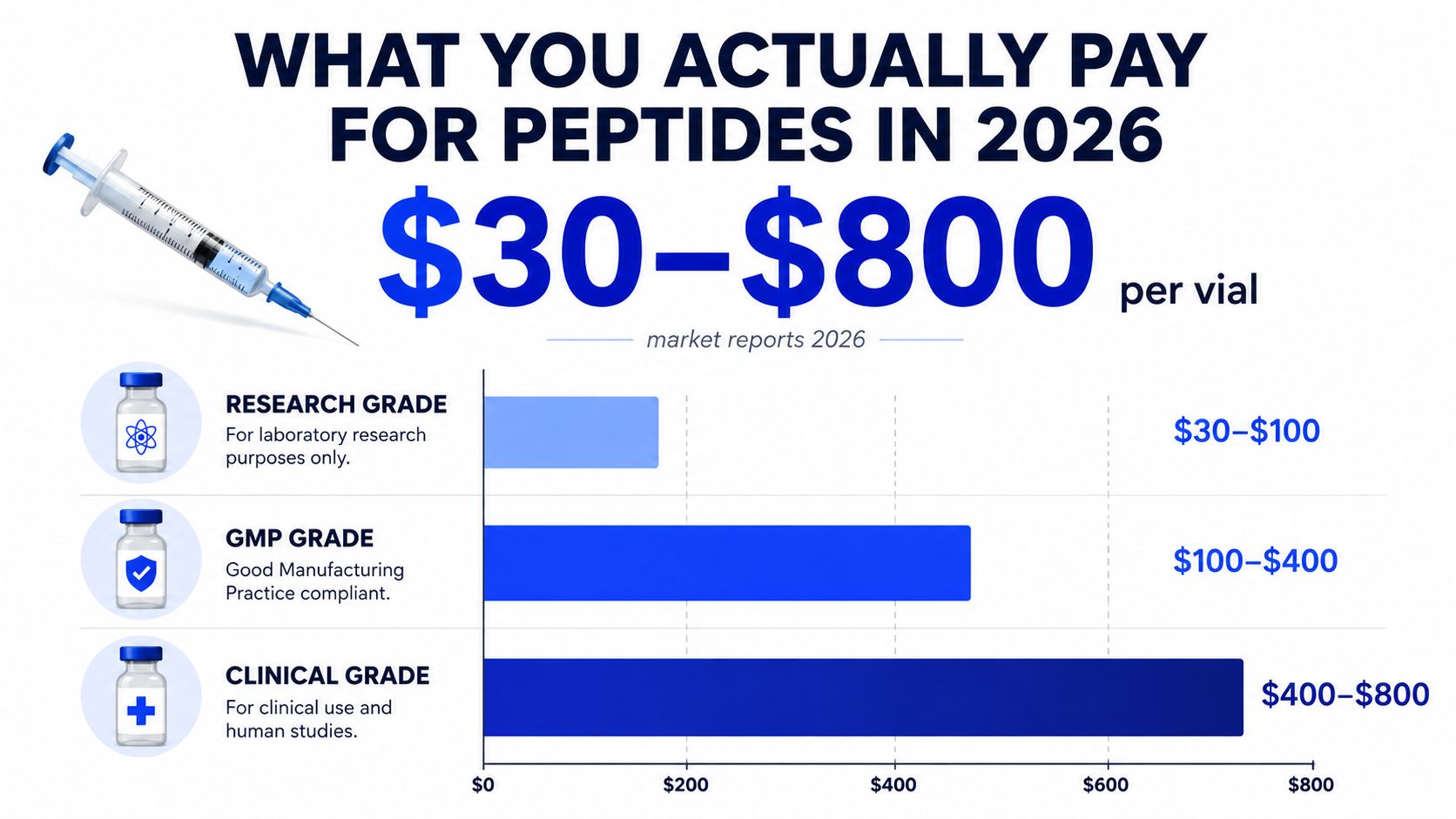
| Price Lens | Typical Range | What Drives the Range |
|---|---|---|
| Research grade | $30 to $100 per vial | Purity target, sequence length, and batch documentation |
| GMP grade | $100 to $400 per vial | Higher QA burden, tighter lot control, and added testing |
| Clinical grade | $400 to $800 per vial | Compliance layers, validation, and deeper release testing |
A useful way to think about it is like comparing printer ink. The bottle size matters, but so does the cartridge type, the brand standard, and whether you need a full warranty trail. Peptides work the same way, except the documentation burden is much heavier and the chemistry is more sensitive.
Practical rule: Never ask only, “What does the vial cost?” Ask, “What does one mg cost, what does one lot cost, and what does one usable protocol cost?”
The rest of the budget picture becomes clearer when you look at four lenses together, per mg, per vial, per cycle, and per tested lot. That framework keeps you from overpaying for a tiny vial that looks cheap on paper but gets expensive once you add QC, shipping, and the actual amount your protocol consumes.
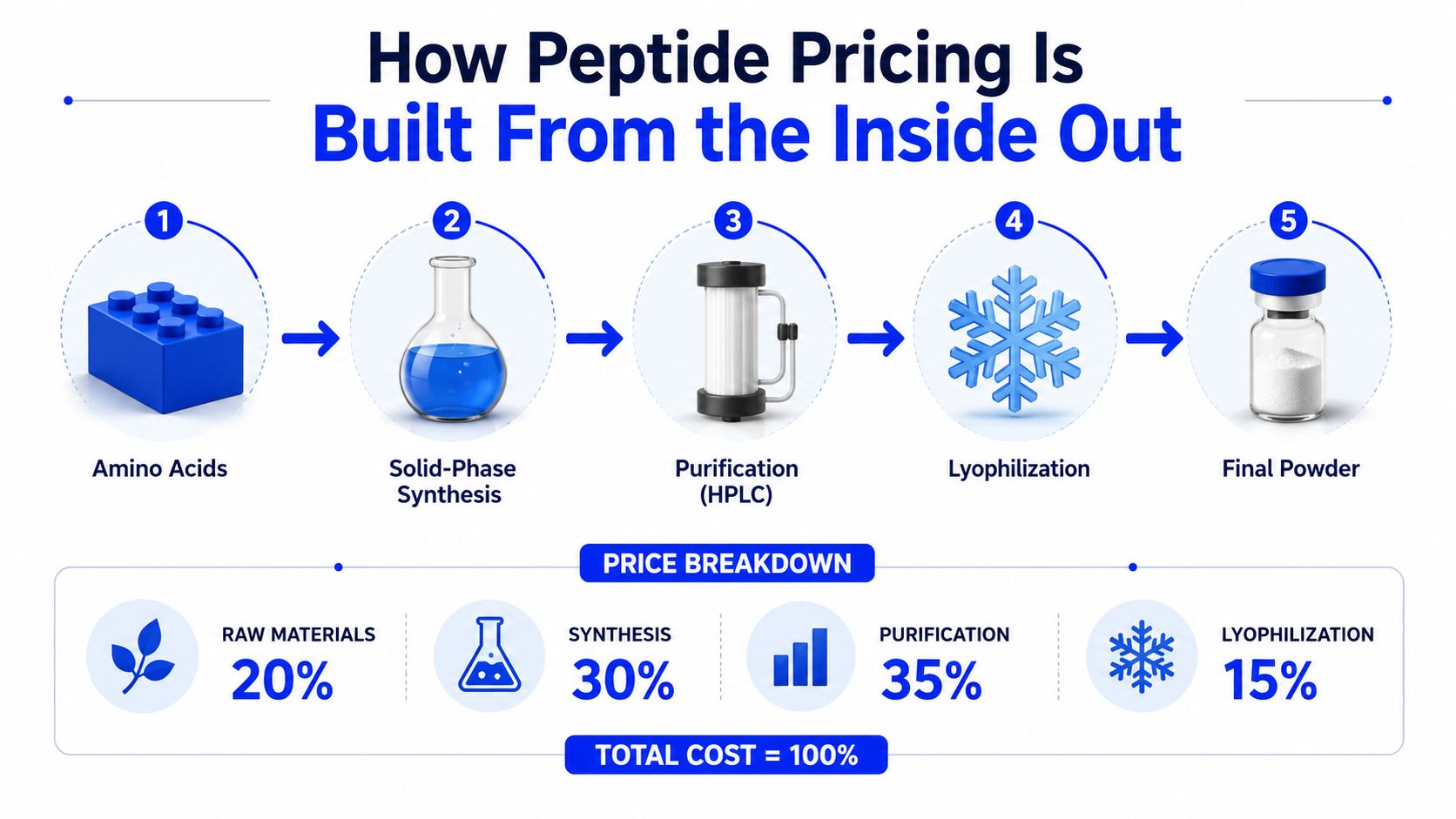
Think of a peptide as a chain of Lego blocks, except every block has to be added in a controlled chemical environment and then cleaned up after the assembly. The longer and more complex the chain, the more steps the lab needs, and every step adds cost. That's why the quote isn't just about the raw ingredients.
A 2026 market report estimates synthesis cost at $2 to $4 per amino acid Roots Analysis. The same source also shows example finished-product prices ranging from $40 to $80 per peptide for crude 1 to 4 mg material to $300 to $450 per peptide for material above 98% purity, which is the kind of jump that surprises first-time buyers.
The manufacturing chain usually moves from amino-acid inputs to solid-phase synthesis, then purification, then lyophilization, then final powder in a vial. Each stage protects quality, but each stage also adds labor, time, and equipment use. The money doesn't disappear, it gets converted into cleaner material and more reliable handling.
A cheap peptide that still needs major cleanup is not really cheap. It's just unfinished.
Historical cost data helps explain why the retail end looks so different from raw chemistry. An American Chemical Society report noted that peptides are typically more expensive to produce than conventional drugs, and cited consultant estimates of about $300 to $500 per gram at 300 to 500 gram quantities, $100 to $200 per gram at 1 to 2 kg scale, $25 to $50 per gram at 50 to 100 kg scale, and less than $10 per gram at very high volumes ACS report.
That gap between gram-level economics and vial pricing is why the same compound can show up as a low-cost research item in one setting and a premium product in another. By the time a peptide is packaged into a lyophilized vial, the price already reflects chemistry, cleanup, presentation, and the size of the batch that was made.
The biggest price mover is purity. Crude research material sits near the low end of the market, while higher-purity material can cost much more because the lab has to spend more time removing closely related impurities. That means two vials with the same peptide name can still land in very different budget ranges if one needs far less cleanup.
Sequence complexity matters just as much. Longer peptides need more synthesis cycles, and unusual residues or modifications can make cleanup harder. A peptide with a straightforward sequence is usually easier to make than one with extra chemical features, so the quote often rises as the chemistry becomes less forgiving.
Length also changes the work behind the scenes. Each additional step gives the chemist another chance to lose yield, and each unusual building block can add another point of friction in synthesis or purification. The result is simple enough to remember, the more custom the chemistry, the more the price tends to move.
Order size creates its own savings curve. The source set shows that larger formats can reduce per-mg cost by about 40%, which is why a 30 mg tirzepatide vial can be a much better unit-cost buy than a 10 mg vial. Buyers who only compare vial totals often miss that the bigger format may be cheaper per mg even if the sticker looks higher.
That same logic is why procurement teams usually compare unit cost, not just invoice total. A vendor may appear more expensive at checkout and still be cheaper once the material is spread across the doses a protocol uses. Pricing systems built around context, including models discussed in boost revenue with ML pricing, follow the same basic pattern: the price shifts with the size of the order and the setting around it.
The hidden budget line is often testing. Independent lab pricing for peptide QC commonly runs $150 to $300 for HPLC purity, $200 to $400 for LC-MS identity confirmation, and $800 to $2,000 for a full panel that adds endotoxin, heavy metals, residual solvents, and moisture ACS Lab Test. A low-cost vial can stop looking cheap once batch-release testing is added.
For a first-time buyer, that can feel like paying for a second product. In practice, the test is part of the overall cost of knowing what is in the vial, just as a weigh scale is part of the cost of getting an accurate measurement. A low sticker price without verification is like a number written on a label without calibration behind it.
A vendor that provides lot-level COAs, clear analytical methods, and traceable sourcing is usually selling more than powder. They're selling confidence that the vial matches the label. In procurement terms, that confidence has real value, especially when a team needs repeatability or has to defend its sourcing record later.
The source set points in the same direction. It shows that price is not just a reflection of the molecule, but of the testing, traceability, and handling that sit around it. Once those layers are included, the quote starts to look less like a simple per-mg number and more like a bundled research expense.
A mg price tells you very little about the actual cost of a protocol. A vial that looks affordable can still turn into a costly purchase once dose frequency, cycle length, and waste are part of the calculation. Procurement-minded buyers get a clearer answer by looking at total cost of ownership, not just the shelf price.
The source set shows a 5 mg BPC-157 vial at about $25 to $80, a 10 mg tirzepatide vial at $58 to $99, and a 30 mg tirzepatide vial at $90 to $149. It also shows that a basic BPC-157 healing cycle can total $75 to $250 over 8 weeks, depending on usage.
| Example item | Vial price range | Budget lesson |
|---|---|---|
| BPC-157, 5 mg | $25 to $80 | Low sticker price can still become a meaningful cycle cost |
| Tirzepatide, 10 mg | $58 to $99 | Mid-sized vials are not always the cheapest per mg |
| Tirzepatide, 30 mg | $90 to $149 | Bigger formats can lower unit cost materially |
For a first-time buyer, the useful question is not, “Can I afford one vial?” The better question is, “How many doses does this support, and what does the full protocol cost once I use it the way the study or lab plan requires?”
Budget rule: Compare peptides by cost per effective dose, then multiply by the number of doses in the cycle.
A dose that looks cheap on paper can behave like an undersized reagent bottle in the lab. The label price only matters if the vial size matches the amount you need. If the protocol calls for repeated dosing, a smaller vial can force more frequent reorders, which raises the practical cost even when the per-mg figure looks attractive.
That logic matters across research interests, whether you're looking at healing compounds, weight-loss compounds, anti-aging work, or stack design. A small vial can fit a quick screen, but a longer protocol usually rewards a larger format or a more efficient supply plan. When the same peptide appears in different vial sizes, the cheapest box on the page is not always the smartest purchase.
A vendor comparison should start with paperwork, not product photos. If two listings look similar, the key question is whether both suppliers are proving the same thing in the same way. The strongest quotes usually come with the clearest documentation.
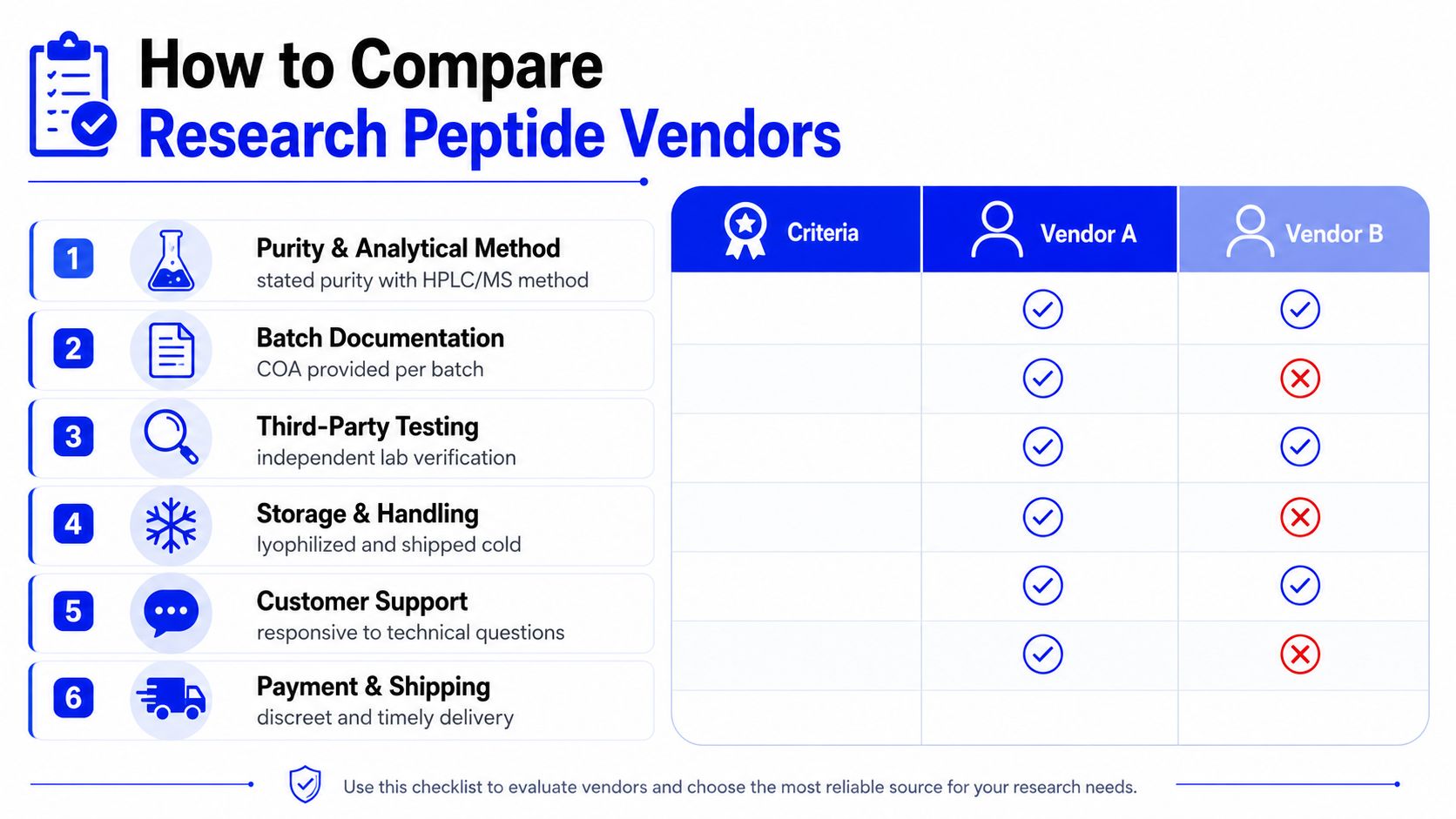
If a price sits far below the published range, that's not automatically a bargain. It may mean thinner testing, a weaker documentation trail, or a quality tier that won't fit your use case. A suspiciously cheap vial is often expensive later, especially if you have to replace it or pay for testing yourself.
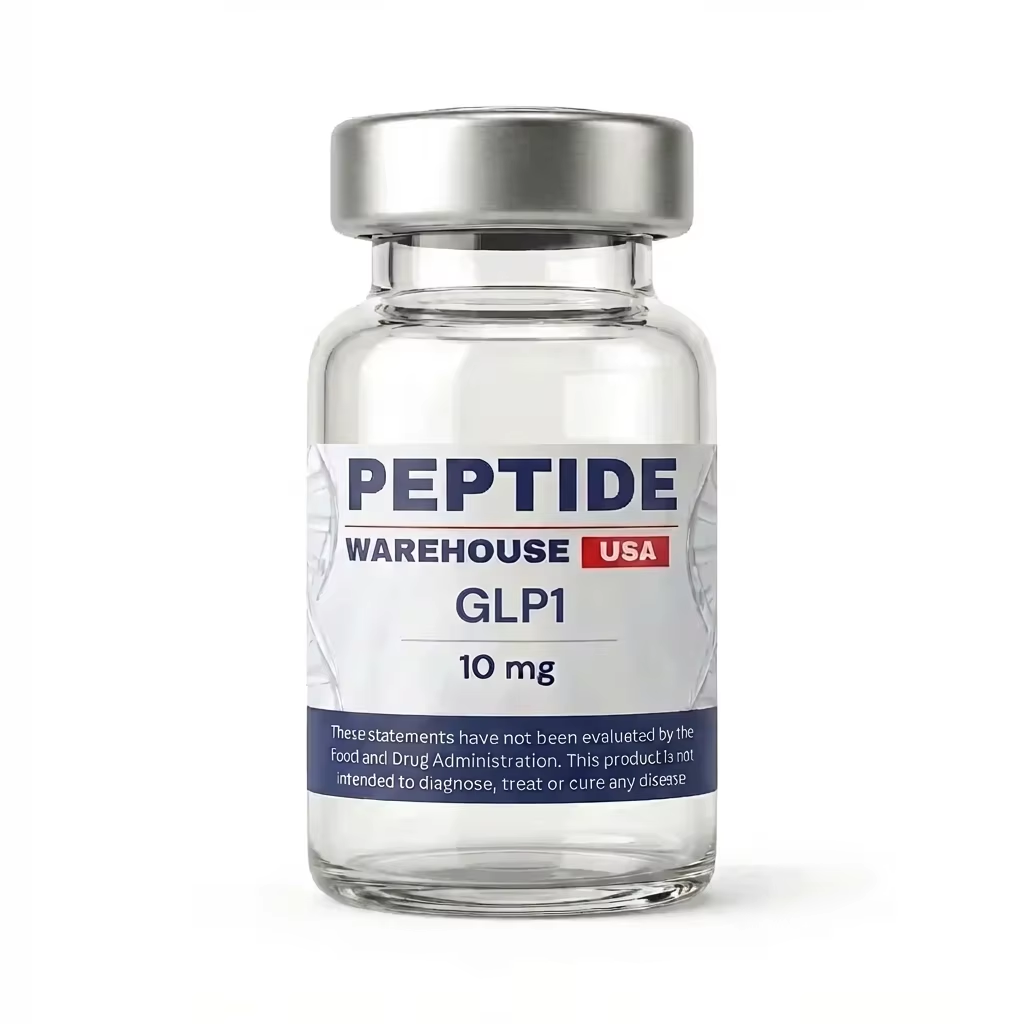
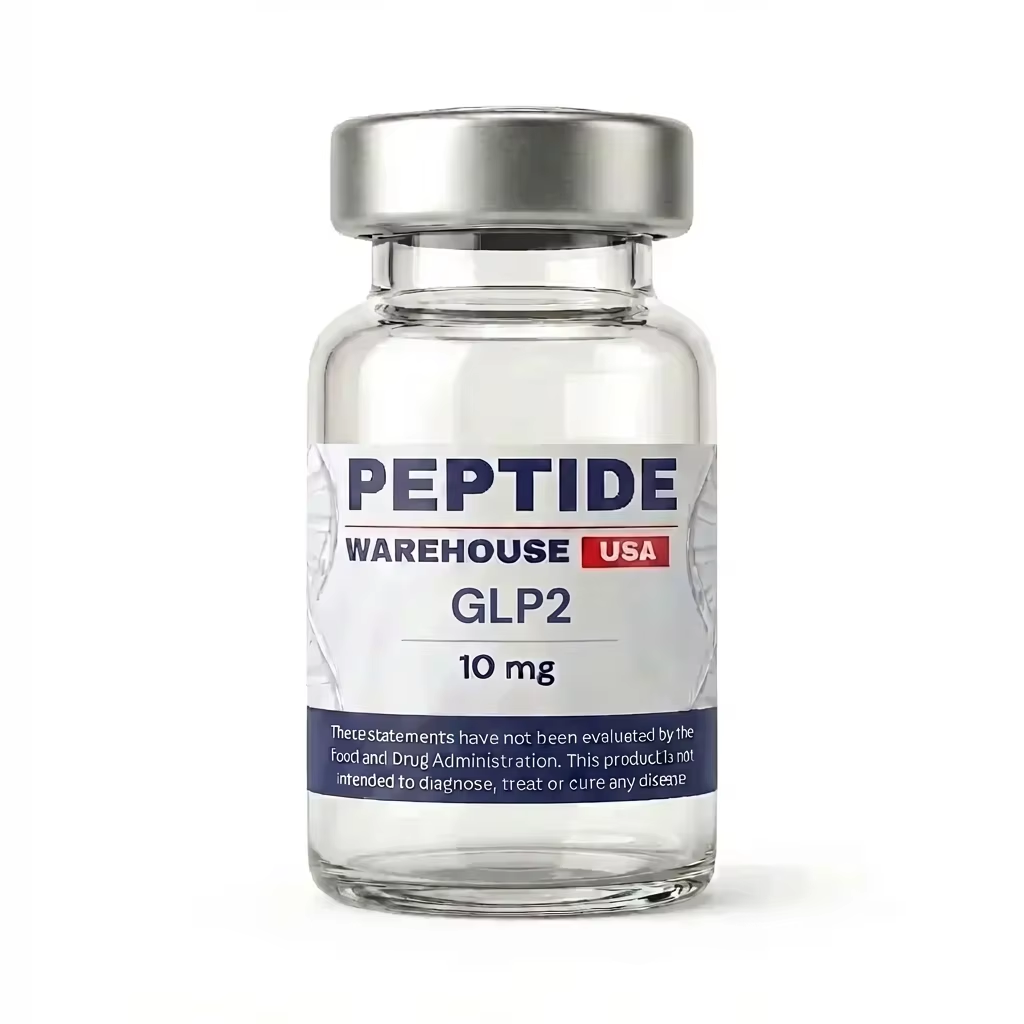
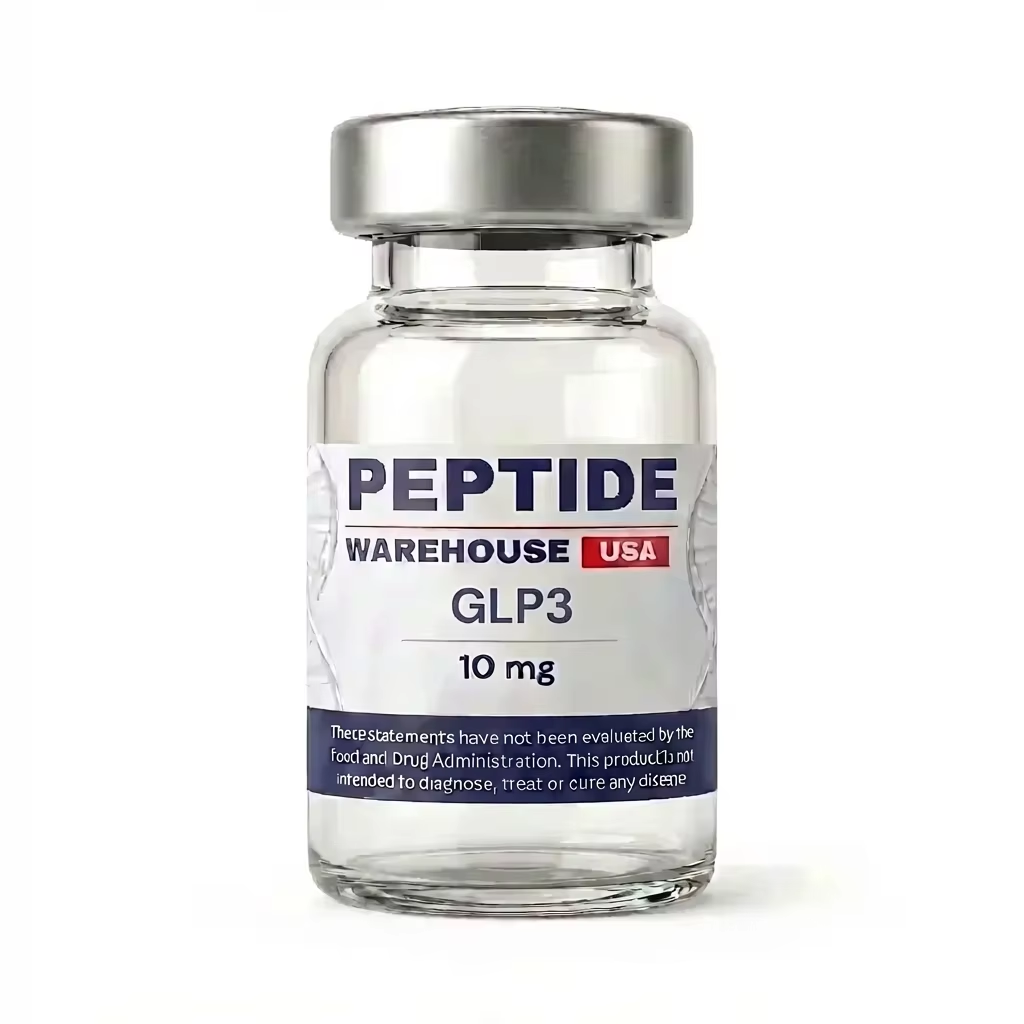
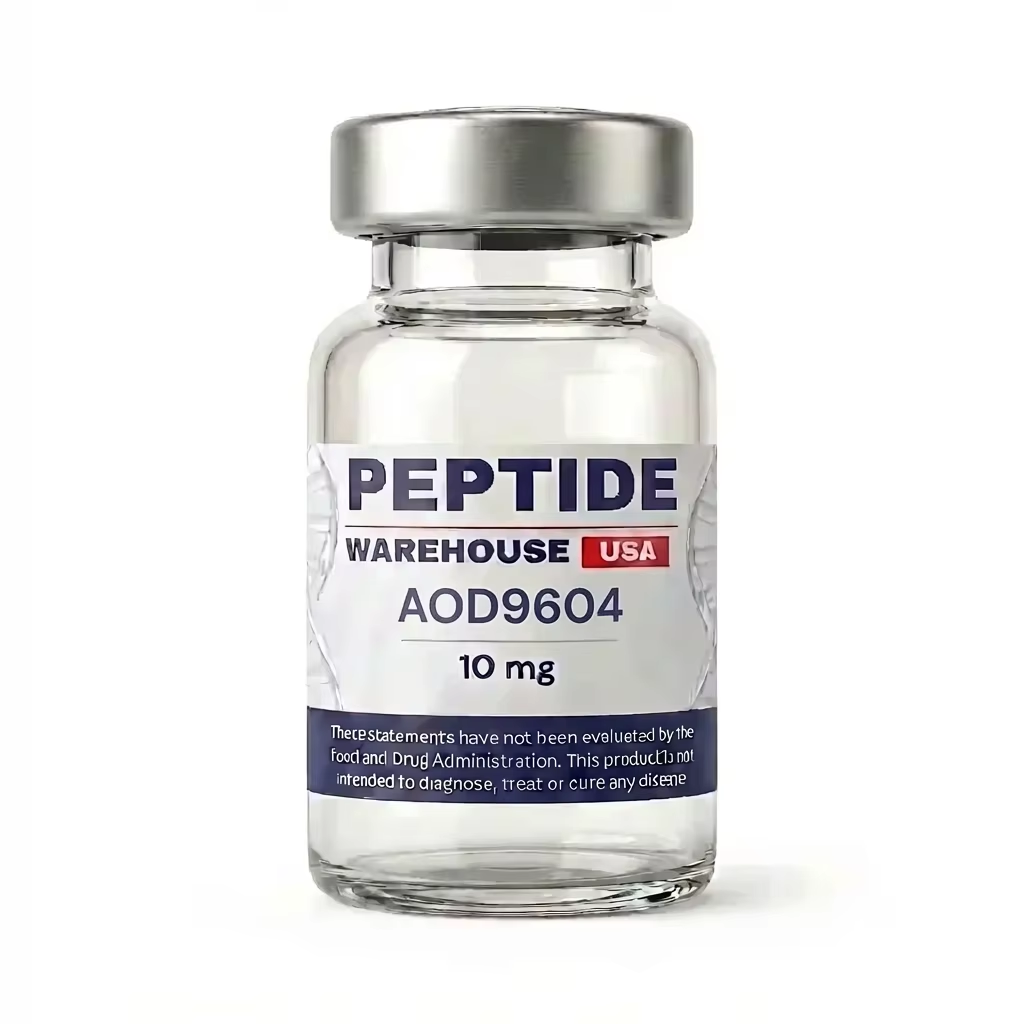
One practical example is Peptide Warehouse USA, which operates as a research chemical supplier with USA-manufactured lots, COAs, microbial and endotoxin reports, and stated purity levels up to 99.5%. In a buyer's comparison sheet, that kind of documentation belongs in the same column as the price, because the paperwork changes the value proposition.
The easiest way to waste money is to buy the wrong vial size for the amount you'll use. If your protocol is small and short, bulk pricing won't help much. If your protocol is ongoing, small vials can become annoying and costly because each reorder adds friction.
A well-run lab purchase treats documentation as part of the product. That includes traceability, lot consistency, and a clear paper trail. If a supplier offers all of that, the quote may look higher, but the total package can still be the better value.
The smartest budget move is usually not cutting corners, it's aligning the purchase to the protocol. If the peptide is for a screening run, keep the order small and focused. If the peptide will support repeated dosing or a longer study window, buy with the cycle in mind so the per-dose cost stays under control.
Peptide pricing makes a lot more sense once you separate the vial price from the underlying drivers. Synthesis scale, purity, testing, and supply-chain transparency all show up in the final number, and the cheapest option is rarely the clearest one.
For research use only, the most reliable buying habit is simple. Check the COA, confirm the analytical method, and compare vendors on documentation as much as on price. If you want to explore a COA-verified, USA-manufactured catalog and see how product pricing lines up with those standards, it's worth taking a close look at the current options.
If you're comparing peptide pricing for a study, a protocol, or a new purchasing plan, Peptide Warehouse USA gives you a place to review USA-made research peptides with COAs, batch testing, and clear lot documentation. Visit Peptide Warehouse USA to explore current pricing, compare vial sizes, and evaluate options against the cost-per-dose math that matters most.