No products in the cart.



A researcher types Vilon peptide benefits into a search bar and gets two very different answers. One says the peptide is a promising thymus bioregulator for immune aging studies, the other makes it sound like a near-finished solution for recovery, longevity, and repair. The question is simpler and more useful: what is supported by evidence, and what still belongs in the hypothesis column?
That gap matters because Vilon is unusually small, unusually old in the literature, and unusually easy to overstate. Its biology sits at the intersection of chromatin, immune modulation, and gerontology, which makes it fascinating for lab-focused readers, but also easy to oversell if the evidence gets blurred. This guide separates the preclinical signals, the limited human data, and the safety tradeoffs so you can judge Vilon as a research compound, not a marketing claim.
Why does Vilon peptide benefits keep drawing attention in research discussions? The main reason is simple, the molecule is tiny, but the biology around it is not. Vilon is identified as a dipeptide bioregulator, Lys-Glu, and independent summaries place it in the immune-aging and chromatin-modulation category rather than the receptor-binding class people usually expect from peptides PubMed-indexed mechanistic summary, immune and gene-expression overview. That difference matters because it changes how researchers choose endpoints, controls, and the way results should be read.
A practical way to assess the vilon peptide benefits question is to separate three kinds of evidence. The first is preclinical gerontology data from animals and cell systems. The second is a limited human-era dataset that offers an early signal, not a settled conclusion. The third is the safety question that many benefit pages gloss over, whether immune or chromatin-related effects could create tradeoffs in people with cancer risk, autoimmune disease, or inflammatory pathology evidence review, safety and risk discussion.
That framing keeps Vilon in the right category. It is best treated as hypothesis-generating, which means a mechanistic story can point toward useful experiments without proving a human outcome. In lab settings, that shifts the focus toward study design, clean readouts, and careful interpretation, instead of assuming the molecule already performs the way a promotional summary might suggest.
Researchers usually want a simple rule for how to start. If a Vilon claim jumps straight from mechanism to human benefit, the evidence has likely been compressed too far.
The more useful approach is to ask which biological layer appears most relevant first, immune-cell differentiation, inflammatory signaling, or age-related chromatin accessibility. Then the endpoint can match the biology rather than the marketing. That keeps the research question aligned with what the literature can support.
Why does such a small peptide still attract research attention? Vilon is a two-amino-acid peptide, Lys-Glu, and one summary describes it as the shortest bioactive peptide with documented activity structural summary. Its size matters because it places Vilon in the category of a minimal bioregulator, a molecule that may have a narrow but meaningful effect rather than broad, many-step signaling behavior.
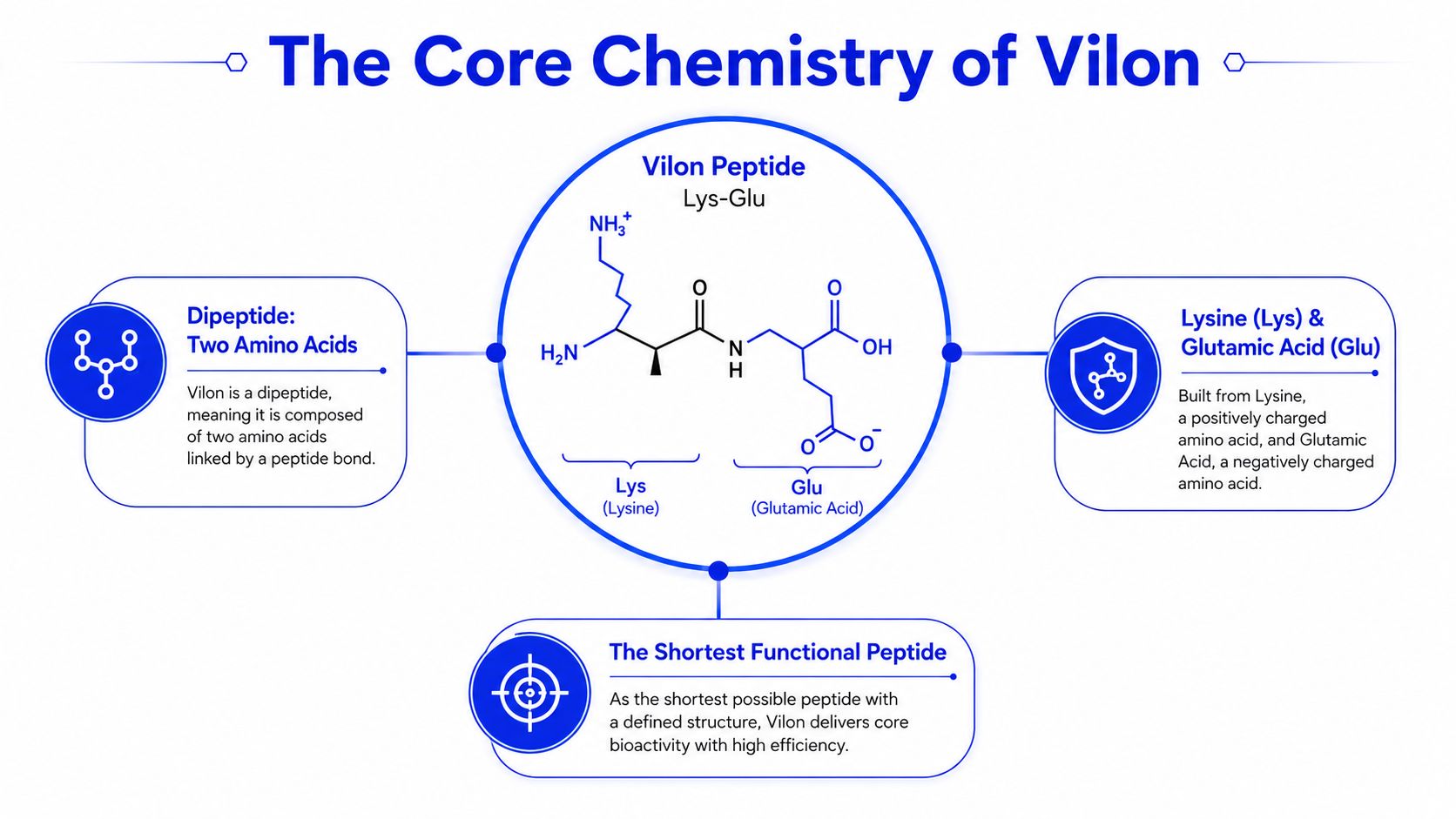
Chromatin can be treated like a library, where some sections are easy to access and others stay tightly closed. Vilon's published mechanistic description says it shifts heterochromatin toward a more open state, supports ribosomal-gene synthetic processes, and affects genes held in facultative heterochromatin PubMed-indexed study. A practical way to measure that kind of change in the lab is to look at chromatin accessibility or transcriptional readouts after exposure, then compare them with untreated controls.
That is more specific than saying the peptide “activates genes.” The same study notes that it does not open pericentromeric structural heterochromatin PubMed-indexed study. The pattern points to a selective chromatin effect, not a global loosening of every DNA region, which matters because selective effects are usually more informative for mechanistic research than broad, vague activation claims.
Vilon should be read as a focused chromatin-related probe, not as a general receptor ligand with an obvious on-off switch. Its small size does not imply a weak signal. It suggests the opposite possibility, that a very compact molecule may influence a fundamental control layer such as chromatin state and then produce downstream shifts that are easy to miss if the assay is poorly chosen.
For lab-focused work, the useful question is straightforward. Which gene-expression changes track with Vilon exposure, and which ones disappear once culture conditions, donor age, or baseline inflammatory state are controlled? That is a better research frame than assuming the peptide already performs a finished biological role in humans.
A concise way to read the literature is this. Vilon's chemistry supports a plausible mechanism, but the evidence still sits at the level of biological inquiry, not settled clinical translation.
That is why Vilon remains interesting to studies of immune aging, regenerative biology, and peptide bioregulation. The structure is minimal. The downstream questions are not.
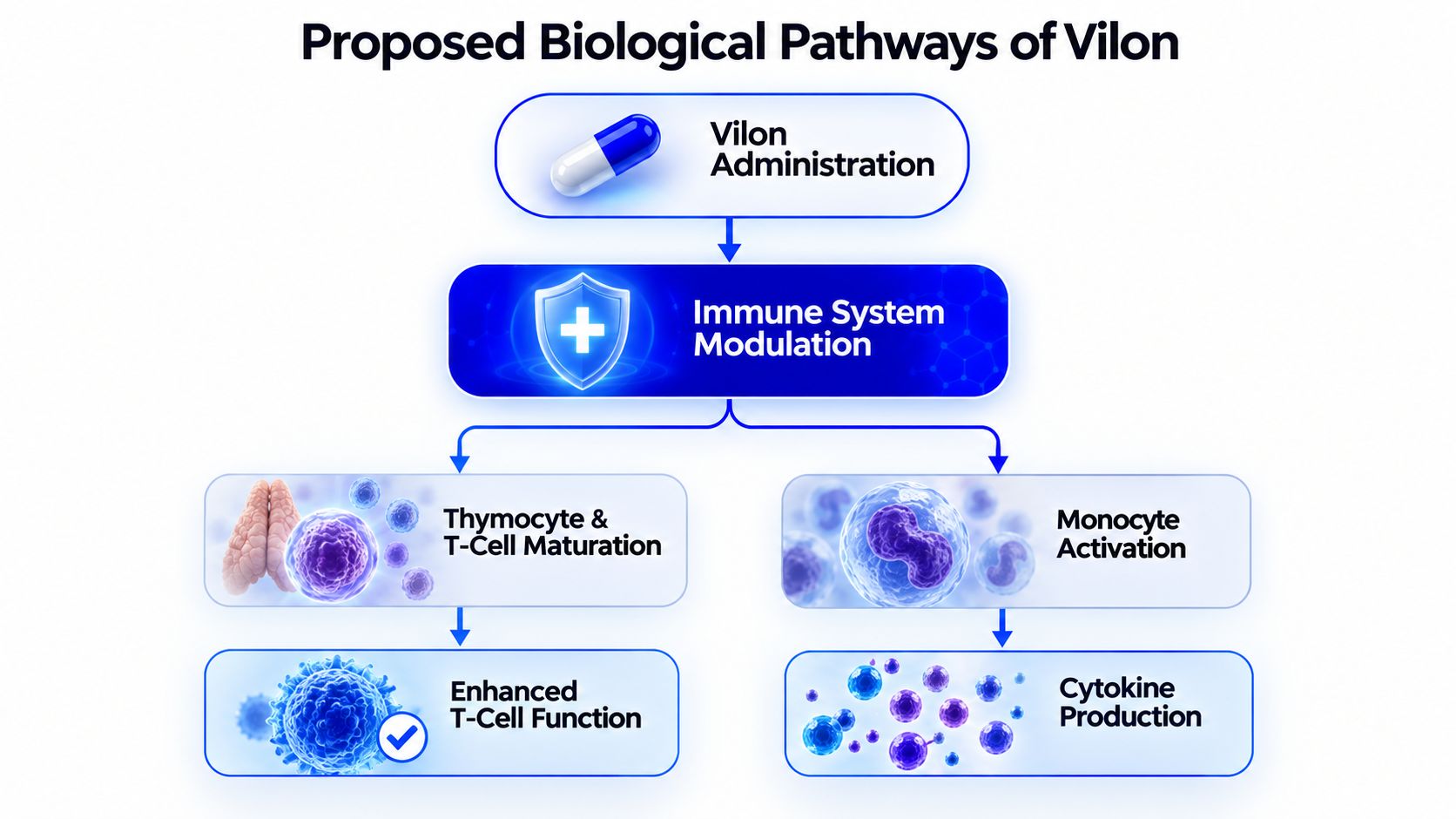
How can a very small peptide be discussed in the same conversation as immune aging, gene expression, and cellular differentiation? The answer is that some peptide summaries describe Vilon as a compound studied for immune modulation and chromatin or gene-expression effects, including T-cell differentiation and IL-2 gene expression immune pathway summary. That pairing matters because it links nuclear-level control with immune-cell behavior, which is exactly the kind of mechanism researchers want to sort out in aging-focused models.
If chromatin is more open in some contexts, cells can reach genes that are otherwise harder to express. In Vilon's case, the literature summary points to effects on thymocyte and T-cell maturation, plus reported influence on monocyte and macrophage inflammatory responses immune pathway summary. For immune-aging research, that makes the peptide interesting because it gives a plausible route from gene access to cell behavior.
The practical value is not a claim that Vilon “boosts immunity.” It gives a testable pathway. A lab can examine whether exposure changes maturation markers, shifts inflammatory readouts, or alters gene-expression patterns in ways that fit the chromatin hypothesis. That is a much clearer research frame than treating the peptide as a finished biological answer.
IL-2 often appears in immune research because it is tied to T-cell activation and function, so its appearance in Vilon summaries gives researchers a concrete marker to follow. The peptide-deck summary specifically cites reported effects on IL-2 gene expression and immune-cell function immune pathway summary. For mechanism mapping, that is more useful than broad language about general support.
The strongest use of this pathway is in immune-aging studies, where the question is not whether a peptide cures anything, but whether it changes the trajectory of age-related immune decline in cells or models. That is a hypothesis-generating role, not a settled therapeutic one, and the evidence quality should be read in that light. Preclinical signals can justify a research program, while limited human data, where present, should be treated as far less informative than controlled laboratory work.
The best Vilon hypotheses are narrow, testable, and tied to immune-cell readouts, not broad wellness claims.
What does Vilon show once the evidence is separated by type? The clearest signal still comes from preclinical gerontology. Reports from the Khavinson and Anisimov line describe chronic administration studies in female CBA mice with 20-40% lifespan extension relative to controls, plus reduced spontaneous tumor incidence and improved physical activity and endurance preclinical gerontology summary. That is the kind of result that kept Vilon in research circulation for so long.
The mouse findings matter because they place Vilon on the map as a geroprotective bioregulator before most readers ever encountered it in a human context. A peptide with that profile invites questions about aging biology, especially if it appears to influence how cells maintain function under stress.
The same body of work still has a narrow origin, and independent reviews describe the interventional literature as largely preclinical and rooted mainly in one research lineage evidence review. That does not cancel the signal. It tells researchers to treat the findings as hypothesis-generating, not as settled proof.
The human signal is much smaller and much less secure. One summarized clinical evaluation included 520 adults aged 43-76, recovering from acute respiratory and viral illness, and reported that 86% had normalized immune parameters after 20 days of oral Vilon, one capsule daily human-era summary. For a peptide with such a thin human record, that is one of the few quantified observations available.
The limit is straightforward. That dataset is described as non-replicated, and there is no large randomized placebo-controlled trial establishing the effect as definitive human-era summary. So the best reading is early human relevance, not clinical confirmation.
A simple research hierarchy helps keep the signal in proportion.
| Evidence layer | What it suggests | How to read it |
|---|---|---|
| Animal studies | Immune, lifespan, and tumor-related signals | Strong for hypothesis generation |
| Cell studies | Chromatin and gene-expression effects | Useful for mechanism mapping |
| Human observation | Early immune normalization signal | Preliminary, not confirmed |
That table captures the core tension around Vilon. The preclinical findings are interesting enough to justify continued study, while the human evidence remains too limited to turn benefit language into certainty. For lab-focused readers, the right conclusion is not that the peptide is proven or dismissed, but that it deserves careful immune-aging research with clearly defined endpoints and cautious interpretation.
Why do so many Vilon summaries sound more certain than the evidence allows? Because the strongest signals still come from older animal and cell work, while modern controlled human trials remain limited. Independent reviews describe Vilon as a preclinical bioregulator, and they also note that the interventional literature is still shaped by a single research lineage, so any human benefit claim should stay unconfirmed.
The same preclinical literature that makes Vilon interesting also raises a safety question. If a peptide appears to influence immune-cell differentiation and chromatin remodeling, the effect that looks useful in one setting could be undesirable in another, especially where cancer risk, autoimmune disease, or chronic inflammation are already part of the picture safety and risk discussion. Benefit-only pages often leave that part out.
A promotional read may treat immune stimulation as automatically positive. A research read has to examine whether the same signaling could produce unintended effects in a system already under stress. The literature does not settle that question cleanly, and that uncertainty is exactly why compliance-minded language matters.
Practical rule: If a peptide page sounds certain about human outcomes but skips safety nuance, the page is doing marketing, not research interpretation.
Vilon is not FDA-approved, and the available evidence does not support presenting it as a validated human intervention evidence review. That changes how it should be described in lab settings, protocols, and product copy. The right framing is investigational, hypothesis-generating, and preclinical-first.
For researchers, the safety discussion should stay close to the evidence base. That means acknowledging the favorable signals reported in earlier studies, while also recognizing that modern long-term human safety data is thin. It is a compound worth studying, but not one to overstate.
Why does a short peptide demand so much attention at the bench? With Vilon, the answer is that simplicity cuts both ways. A dipeptide can be easier to make, but that same simplicity can let contamination, incomplete coupling, or uneven batch quality slip past weak suppliers more easily than with a larger molecule. For research use, the first question is not what the peptide might do, but whether the vial contains the molecule you expect.
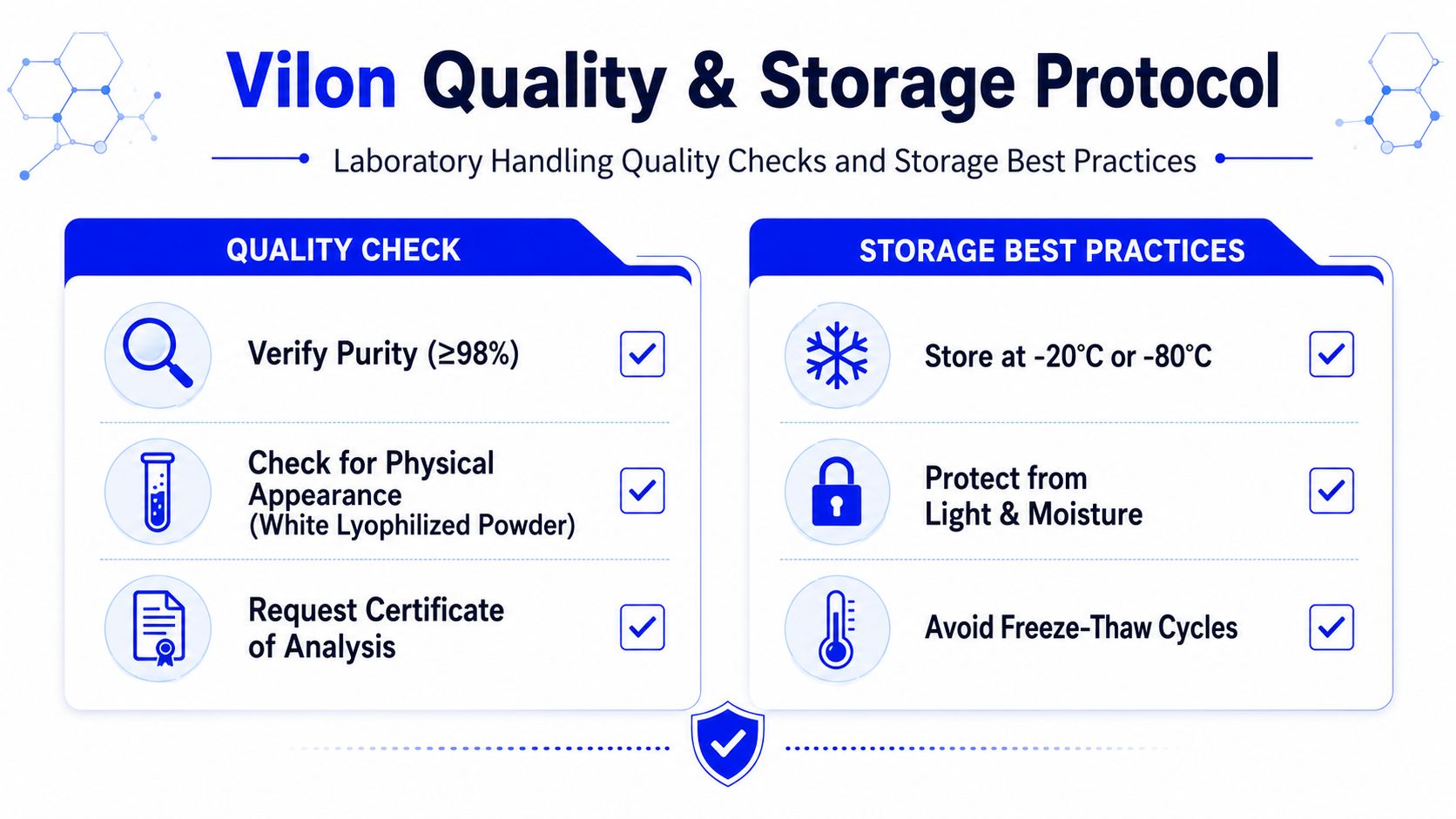
A credible batch should arrive with a Certificate of Analysis, identity confirmation, and purity documentation. For Vilon, that matters because the peptide is so short that even a small impurity can shift assay behavior or blur downstream interpretation. A vendor that cannot show batch traceability and testing documents has not met the standard for serious laboratory work.
One practical way to think about this is to treat the vial like an instrument calibration file. If the paperwork is thin, the readout may still look clean, but you have less confidence in what generated it.
A practical checklist looks like this:
For Vilon, some labs also ask vendors to specify the reconstitution solvent used on the Certificate of Analysis, along with the working concentration chosen for the example preparation. That extra detail helps you compare one lot with another and makes it easier to spot whether a difference in results came from the sample itself or from handling. A clear stability note, even if it only describes the short window observed in the vendor's example conditions, is more useful than vague storage language.
Lyophilized peptide should stay in a cool, dry, dark environment, protected from light and moisture. Reconstitution should be handled gently, because unnecessary agitation can increase the chance of foaming or avoidable degradation. Once a sample has been prepared, reduce handling and avoid repeated freeze-thaw cycles whenever the workflow allows.
The reconstitution step deserves the same care as the storage step. If a lab is preparing working aliquots, it helps to keep the solvent choice, concentration, and container material consistent from run to run, because those details can influence how the sample behaves on the bench. That is especially true for short peptides, where small handling differences can look larger than they really are.
Clean storage does not make a poor sample better, but bad storage can damage a good one.
That is why handling discipline matters so much with small peptides. If assay results shift, you want to know the biology changed, not the sample quality. Good storage and documentation make that distinction possible.
Vilon fits best in a research program that treats it as a hypothesis-generating compound for immune-aging studies. The animal evidence suggests a signal worth testing, and the limited human observation is preliminary rather than settled. That makes Vilon useful for careful study design, not for confident conclusions.
A useful way to frame the evidence is to separate what comes from preclinical work from what comes from early human reporting. The preclinical literature points toward chromatin and immune-cell pathways, while the human-era summary remains small and exploratory. That split matters because it tells researchers where the compound is strongest, and where interpretation should stay cautious.
Researchers who want useful data should keep the endpoints tight. A practical design might pair Vilon with immune-cell maturation markers, inflammatory readouts, or gene-expression assays that reflect the published mechanism, then compare those results against proper controls and batch-matched material. Broad wellness outcomes are too loose to explain what changed, or why.
A concrete example helps. A study could track baseline immune-cell status, introduce the peptide under controlled conditions, then recheck the same markers on a fixed assay timeline while keeping a vehicle control in parallel. If the work is aiming at immune aging, the readout should stay anchored to maturation state, stress response, or transcriptional changes that fit the hypothesis. That kind of design works like a clean lens, it narrows the field so small signals are easier to see.
| Decision point | Better choice |
|---|---|
| Primary question | Mechanism or immune-aging marker |
| Control design | Vehicle and batch-matched comparator |
| Readout choice | Immune-cell maturation markers, inflammatory assays, or gene-expression panels |
| Interpretation | Preliminary, not therapeutic |
| Documentation | Lot traceability and COA retention |
That kind of setup keeps the work tied to the actual evidence base. It also reduces the risk of reading too much into a peptide that is still being mapped rather than clinically settled.
If the goal is reproducible lab work, sourcing has to be part of the experimental design. Transparent documentation, batch consistency, and clear research-use labeling matter more with a compound like Vilon because the literature is still developing. The clearer the sourcing, the easier it is to interpret whatever signal appears in the assay.
Quality checks should be simple and consistent. Confirm the certificate of analysis, keep lot records with the experimental file, and match storage and reconstitution practices across runs so handling does not become a hidden variable. For short peptides, small differences in the sample can look bigger than they are, which is why documentation matters as much as the assay itself.
For readers comparing options and building a study plan, restraint is the right mindset. Vilon is interesting because it may help answer questions about immune aging, not because it already answers them. That is the right starting point if the goal is honest data instead of inflated expectations.
If you are building a Vilon study or comparing research peptides for immune-aging work, choose a supplier that treats documentation seriously and keeps batch transparency front and center. Explore the current research catalog at Peptide Warehouse USA to review high-purity options, compare specifications, and source materials with the traceability lab work depends on.