No products in the cart.



You're interested in peptides for recovery, anti-aging, weight-management, or cognitive research, but you'd rather avoid the friction of injections. That interest has made non injectable peptides a popular search topic, yet the phrase can hide an important distinction: a peptide molecule and the way it reaches its target are separate scientific problems.
This guide explains the main non-injectable routes, why peptides struggle to survive the gut or cross the skin, what the evidence can and can't establish, and how to evaluate a research supplier. It's an educational, research-use-only overview, not medical advice. The practical question isn't merely whether a peptide sounds promising. It's whether the route, formulation, documentation, and intended research application make sense together.
Interest in non-injectable delivery starts with a practical problem. Researchers and informed buyers may want to study a peptide without working with an injectable format, while consumers often associate non-injectable options with greater convenience. Nasal sprays, oral capsules, topical products, patches, and sublingual formats appear easier to handle than a vial and syringe, but convenience doesn't automatically mean equivalent delivery.
The route changes the experiment. A nasal formulation may avoid the digestive tract, while an oral formulation must protect the peptide from acid, enzymes, and intestinal barriers. A topical cream may be appropriate for a skin-focused model, but it usually isn't designed to produce meaningful systemic exposure. Treating all of these products as interchangeable can produce misleading conclusions.
Practical rule: Start with the research question, then evaluate the route. Don't choose a route first and force the peptide into it.
The field exists because peptide therapeutics have historically been constrained by delivery. Non-injectable approaches attempt to solve that limitation with permeation enhancers, protective coatings, encapsulation, structural modification, or alternative mucosal routes. Each strategy addresses part of the problem, and each introduces its own formulation demands.
A useful evaluation sequence is:
The central lesson is simple. Non-injectable doesn't describe a special class of peptide. It describes a delivery choice, and that choice determines how much of the molecule may remain intact and available for the intended experiment.
A peptide is a short chain of amino acids. The route is the delivery system that carries it. Think of the peptide as a typed letter and the formulation as the envelope, courier, and mailbox. The same letter can be perfectly written, but its chance of arriving intact depends on how it's packaged and transported.
The term non injectable peptides covers research peptides delivered without a needle, including:
These routes shouldn't be treated as interchangeable versions of the same product. A nasal spray and an oral tablet containing a related peptide may have different excipients, stability requirements, absorption behavior, and research use cases. Even the same molecule can exist in pharmaceutical and research settings with very different formulation controls.
Semaglutide illustrates the distinction. A pharmaceutical product containing semaglutide is developed under a defined regulatory framework and formulation standard. A research product referencing the same molecule may be labeled for laboratory or analytical use only, with a different purpose and set of documentation expectations. The shared molecular name doesn't make the products equivalent.
Buyers often search for a peptide by name and assume the route is a secondary detail. In delivery science, the opposite is often true. The route determines which barriers the formulation must overcome.
An oral peptide must contend with the gastrointestinal environment. A nasal peptide must remain in contact with the nasal mucosa long enough to be absorbed. A topical peptide may be useful for local skin research even when systemic delivery isn't the objective.
A research-grade peptide is supplied for laboratory, analytical, or preclinical work. It isn't automatically a medicine, supplement, or approved treatment. Product labeling should make that boundary clear, especially when online marketing discusses recovery, fat loss, anti-aging, or other human outcomes.
A responsible buyer therefore evaluates two separate questions: Is the molecule identified and characterized properly? And is the formulation appropriate for the research application? A strong answer to the first question can't compensate for a poor answer to the second.
Each non injectable route addresses a different delivery barrier. The route also determines what a buyer should verify in the formulation record and COA, such as the intended dosage form, stability data, storage conditions, and testing for identity and purity. Reported ranges describe specific studies or products, not a guarantee for every formulation.
An intranasal spray avoids the stomach and intestinal tract, which makes it useful for peptide research. The nasal cavity still clears material through mucus and mucociliary movement. Enzymatic activity, contact time, and molecular size can limit how much crosses the mucosa.
Many marketed intranasal peptide products have reported human bioavailability below 5%, while hydrophilic peptides are often below 1%, according to a review of intranasal peptide delivery. For molecules above 1 kDa, reported nasal bioavailability ranges from 0.5% to 5%, and molecular weight can help predict performance, as described in this review of nasal delivery for large-molecule peptides.
A COA cannot prove nasal absorption by itself. It can show whether the named peptide was identified and tested, while the formulation record should explain the vehicle, concentration, preservatives, container, and stability approach.
Oral delivery is familiar to buyers but difficult for many peptides. The dosage form must protect the molecule through the gastrointestinal tract and support movement across the intestinal lining.
Permeation enhancers, protective coatings, and encapsulation can improve delivery, yet results remain highly formulation-sensitive. For research use, examine whether the supplier provides evidence for intact-peptide stability rather than treating a capsule label as proof of systemic exposure.
Topical products fit studies focused on local skin behavior. GHK-Cu is frequently discussed in cosmetic-peptide research involving skin appearance, collagen-related models, and hair-follicle research.
The main boundary is systemic reach. A cream may suit a surface or skin model without being designed to produce meaningful peptide levels throughout the body. The COA should still identify the peptide and batch, while the formulation documentation should clarify whether the product is intended for local research.
Transdermal patches offer sustained contact in principle, but peptide movement through skin depends on molecular size, barrier condition, adhesive design, and formulation chemistry. Sublingual troches examine absorption through the oral mucosa, although this route is less established than conventional pharmaceutical delivery.
Inhaled aerosols also bypass the gastrointestinal tract. They require control of particle behavior, deposition, stability, and respiratory exposure, so they function as specialized research platforms rather than simple substitutes for tablets or sprays.
| Route | Common research use | Reported bioavailability |
|---|---|---|
| Intranasal | Mucosal and systemic delivery research | Many marketed products below 5%, hydrophilic peptides often below 1% |
| Oral | Oral-stability and systemic-delivery research | Often below 1% to 2%, with some compounds below 0.1% (oral peptide review) |
| Topical | Local skin and cosmetic-peptide research | Route-dependent, with systemic exposure generally not the primary objective |
| Transdermal | Permeability and sustained-contact research | Highly formulation-sensitive |
| Sublingual | Mucosal absorption research | Not established as a universal range |
| Inhaled | Respiratory and aerosol delivery research | Product- and device-specific |
Four physical and chemical barriers make non-injectable peptide delivery substantially harder than needle-based routes. The gut is a demanding environment: acid can destabilize a peptide, enzymes can cut its bonds, the intestinal lining limits passage, and the liver can remove part of the absorbed material before it reaches systemic circulation.
These barriers create a persistent bioavailability gap. Oral peptide bioavailability has often been reported below 1% to 2%, with some compounds below 0.1%, according to the review of oral peptide delivery and systemic exposure. A review of oral peptide development also described oral octreotide capsules at about 0.7% bioavailability in Phase I studies. Even an advanced formulation may therefore deliver only a small fraction of its labeled peptide to systemic circulation.
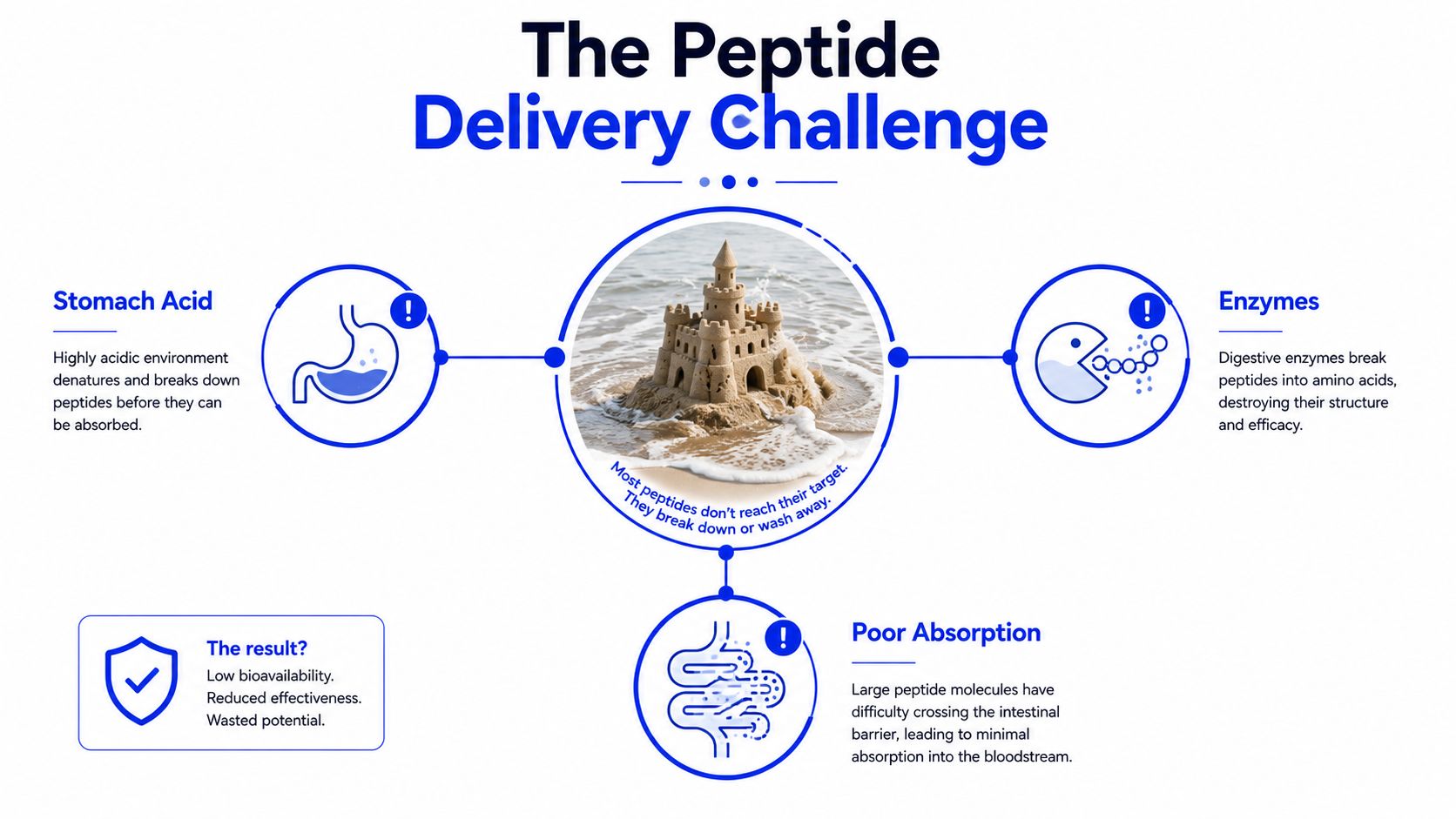
A non-injectable formulation may contain far more peptide than an injectable version because much of the material can degrade or fail to cross the relevant barrier. One review noted that achieving about 0.7% oral bioavailability for a peptide therapy could require a dose more than 200 times higher than a subcutaneous injection, as summarized in this review of oral peptide delivery challenges.
That relationship does not apply to every product. It shows why buyers should examine the formulation rather than compare labeled milligrams alone. A COA can help verify identity, purity, and handling results, but it does not by itself prove intestinal stability, absorption, or systemic exposure. Those questions require route-specific performance data.
Nasal delivery avoids the gut but faces different barriers. Mucociliary clearance can remove the formulation, nasal enzymes can degrade it, and larger molecules cross the mucosa less readily. Research therefore examines permeation enhancers, protective carriers, encapsulation, and structural modifications.
The bottleneck is often delivery physics, not a lack of biological interest in the peptide. A credible supplier should connect the COA, formulation design, storage instructions, and route-specific evidence instead of treating peptide content as proof of performance.
A buyer comparing a nasal spray, topical serum, and oral capsule is not comparing equivalent products. Each route places the peptide against a different biological barrier, so the useful question is how the formulation supports the intended research endpoint.
PT-141 often appears in nasal-spray research discussions. The route avoids stomach acid and much of the gastrointestinal enzyme exposure, yet the peptide still has to remain on the nasal mucosa long enough to support absorption. Spray deposition, mucosal contact, molecule size, formulation ingredients, and clearance can all change the result.
The broader intranasal literature reports low and variable bioavailability for many peptide products, with hydrophilic peptides often showing especially limited absorption, as described in this intranasal peptide delivery review. A nasal format therefore provides a route-specific research question. It does not establish that the same peptide will produce comparable exposure by another route.
For a COA, verify identity, purity, lot number, and storage-related testing. Then look for formulation records that explain concentration, excipients, container compatibility, and any nasal stability or deposition work. A clean COA confirms what was tested in the batch. It cannot prove mucosal absorption.
GHK-Cu is a copper-binding tripeptide frequently discussed in skin-focused research. Creams, serums, and sprays place the material at the surface being studied, which suits local skin appearance, collagen-related models, or hair-follicle work.
That route does not automatically imply meaningful systemic exposure. Buyers should match the product format to the endpoint and ask whether testing addresses local stability, skin penetration, or only peptide identity and purity.
BPC-157 oral formulations, oral semaglutide-class molecules, and oral octreotide illustrate how dependent oral delivery is on formulation design. Some oral peptide products use permeation enhancers or protective systems to help preserve and transport the molecule.
The practical question is whether enough intact peptide reaches the intended analytical endpoint. Product pages that provide a peptide name but omit stability data, excipient details, and lot-specific testing leave that question open.
Selank and Semax are commonly associated with intranasal research formats, especially in cognitive and mood-related discussions. Their inclusion should prompt the same checks as PT-141: nasal stability, concentration accuracy, spray performance, and route-specific evidence.
A useful screening rule is simple:
Popularity identifies a research interest. It does not validate a delivery system or a supplier.
“Non-injectable” describes the route, not a safety profile or proof of equivalence. Removing a needle may simplify handling, while leaving degradation, uneven absorption, labeling accuracy, and limited human evidence unresolved.
A 2026 systematic review reported that oral and topical peptides may improve hydration, brightness, and some wrinkle-related outcomes with favorable tolerability. Results for elasticity and density were inconsistent, and larger standardized trials remained necessary, according to the 2026 review of oral and topical peptide evidence. The practical interpretation is route-specific. A promising result in one formulation does not validate every powder, capsule, cream, or spray carrying the same peptide name.
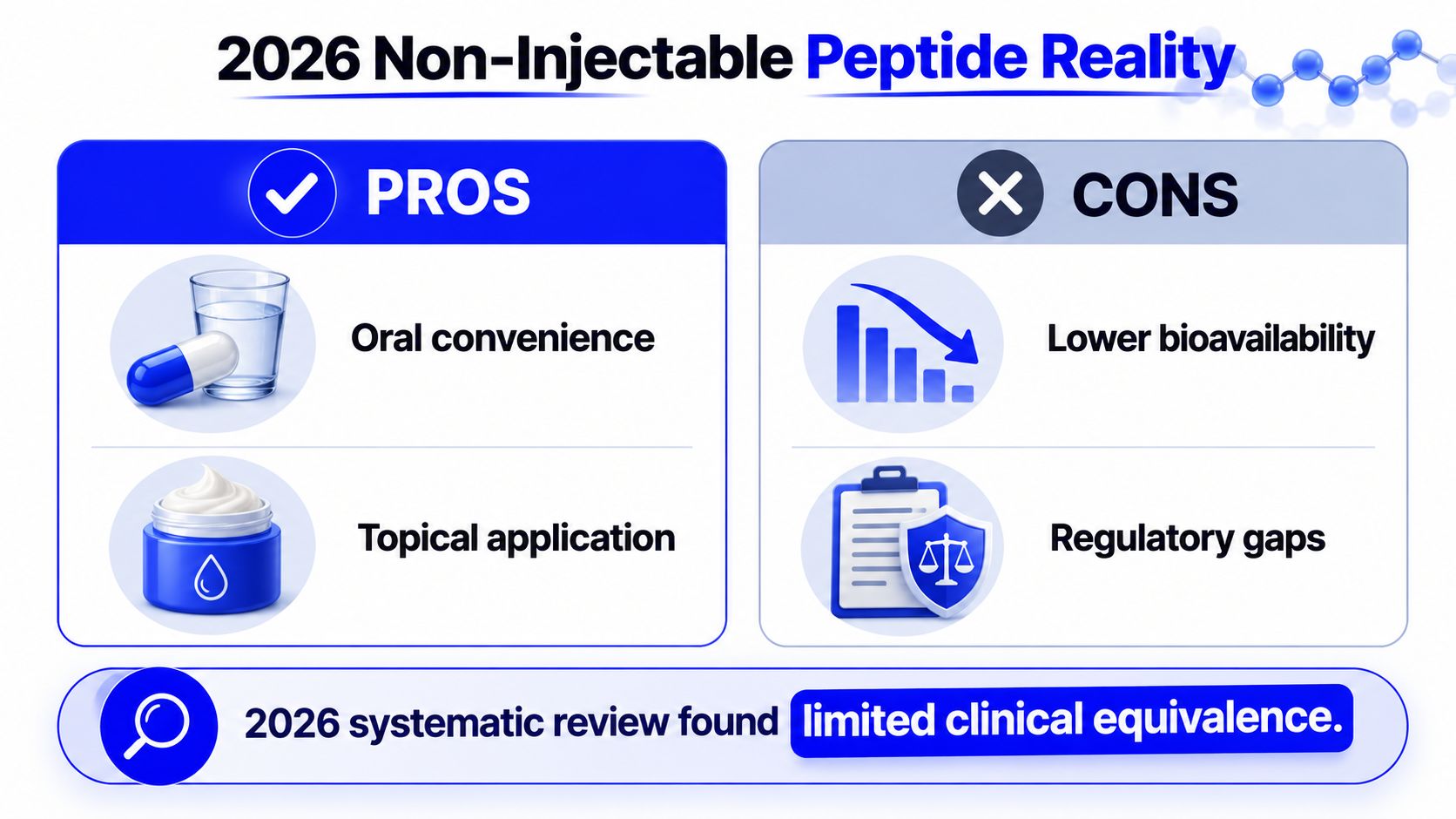
Products promoted for anti-aging, recovery, or fat loss may occupy a regulatory gray zone when sellers make medicinal claims without matching human evidence and product oversight. A research-chemical supplier is not the same as a pharmaceutical manufacturer, compounding pharmacy, or outsourcing facility.
In the United States, FDA-registered outsourcing facilities must follow current good manufacturing practice requirements, undergo FDA inspections on a risk-based schedule, report adverse events, and provide required product information, according to the FDA's information on outsourcing facilities. A supplier outside that category should describe its materials accurately and avoid presenting laboratory products as approved treatments.
Buyers comparing suppliers can also review compliance insights from Atlanta Hyperbaric Center for broader context on compliance concepts surrounding regulated products.
The useful question is not whether a route sounds safer. Ask which route, formulation, dose, and indication support the specific claim being made.
That question should shape the paperwork review. For oral products, look for evidence that the formulation protects the peptide and supports absorption. For topical products, ask whether testing addresses skin stability and penetration rather than identity alone. A lot-specific COA should then connect the material to its stated identity, purity, concentration, and storage requirements.
Consumer interest has advanced faster than the evidence for many products. Oral and topical formats can offer practical research-handling advantages, but convenience does not establish clinical equivalence. A careful buyer checks route-specific data, regulatory language, formulation details, and quality documentation before treating a product as a meaningful solution.
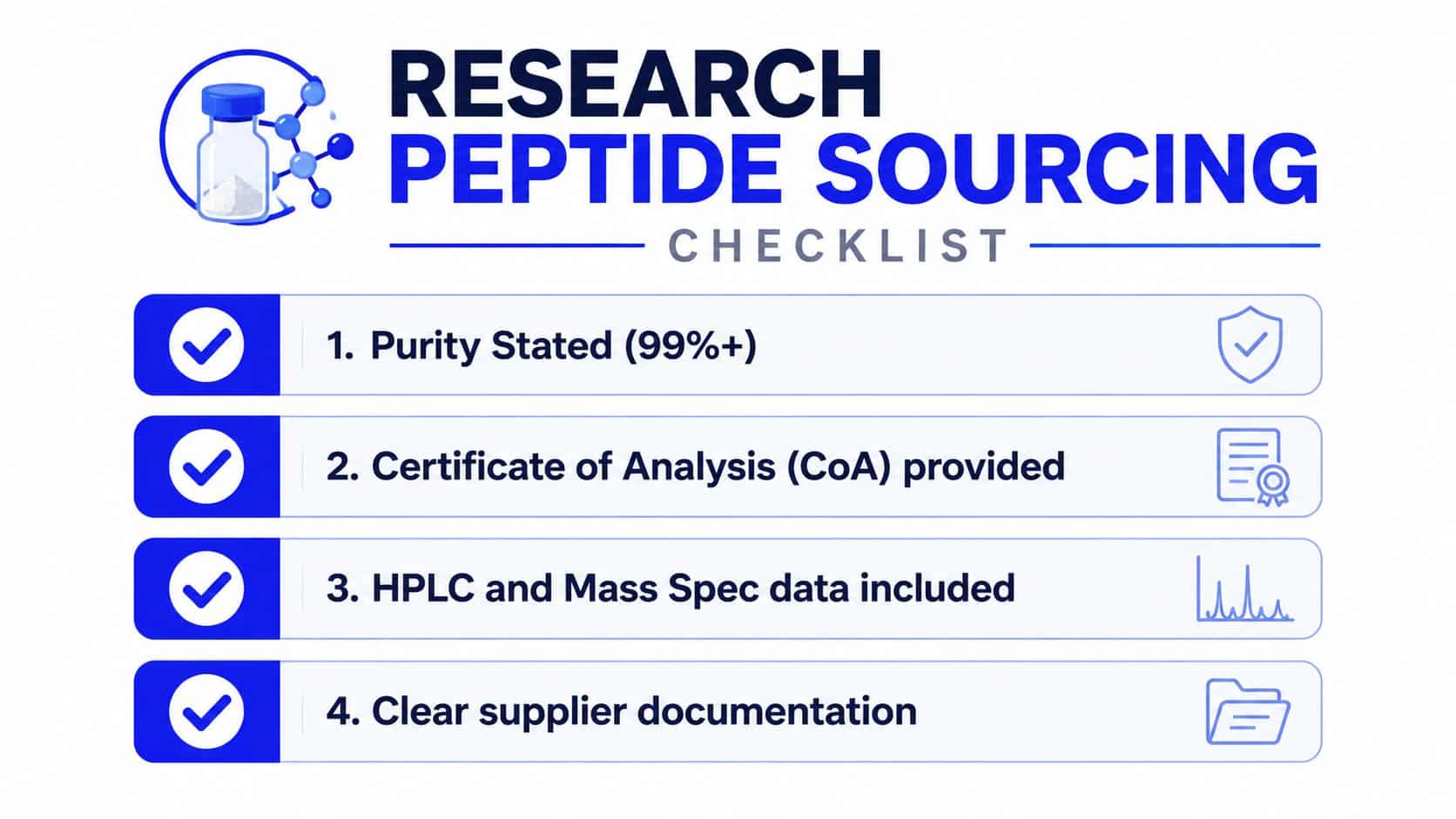
A serious sourcing review begins with the paperwork, not the product name. The same peptide can produce very different research results when identity, purity, concentration, storage, or contamination controls vary.
Look for these signals:
The point of a COA isn't decoration. It gives procurement teams a way to connect a container to a tested lot, review the reported identity and purity, and document what entered the lab. If the supplier can't provide clear records, reproducibility becomes harder to defend.
For buyers comparing formats, Peptide Warehouse USA lists research-use-only products in spray formats, including PT-141, GHK-Cu, TB-500, and BPC-157, with product documentation and supplier disclaimers presented for laboratory and analytical purchasing. Explore options only after matching the formulation to your protocol and reviewing the relevant lot documentation.
Use that checklist whenever you evaluate a product page, label, or supplier. If you're ready to compare research formats and review available documentation, learn more before placing an order.
Peptide Warehouse USA offers USA-made research peptides and related compounds for laboratory, analytical, and preclinical applications, with batch documentation that can include COAs, microbial reports, endotoxin reports, and stated purity levels. Visit Peptide Warehouse USA to explore available non-injectable research options and review the information provided for your intended protocol.