No products in the cart.


Most advice on a TB-500 peptide buy starts with price, shipping speed, or a list of supposed benefits. That's the wrong starting point. The first question is whether the vial, label, sequence, and supporting records match the compound being discussed.
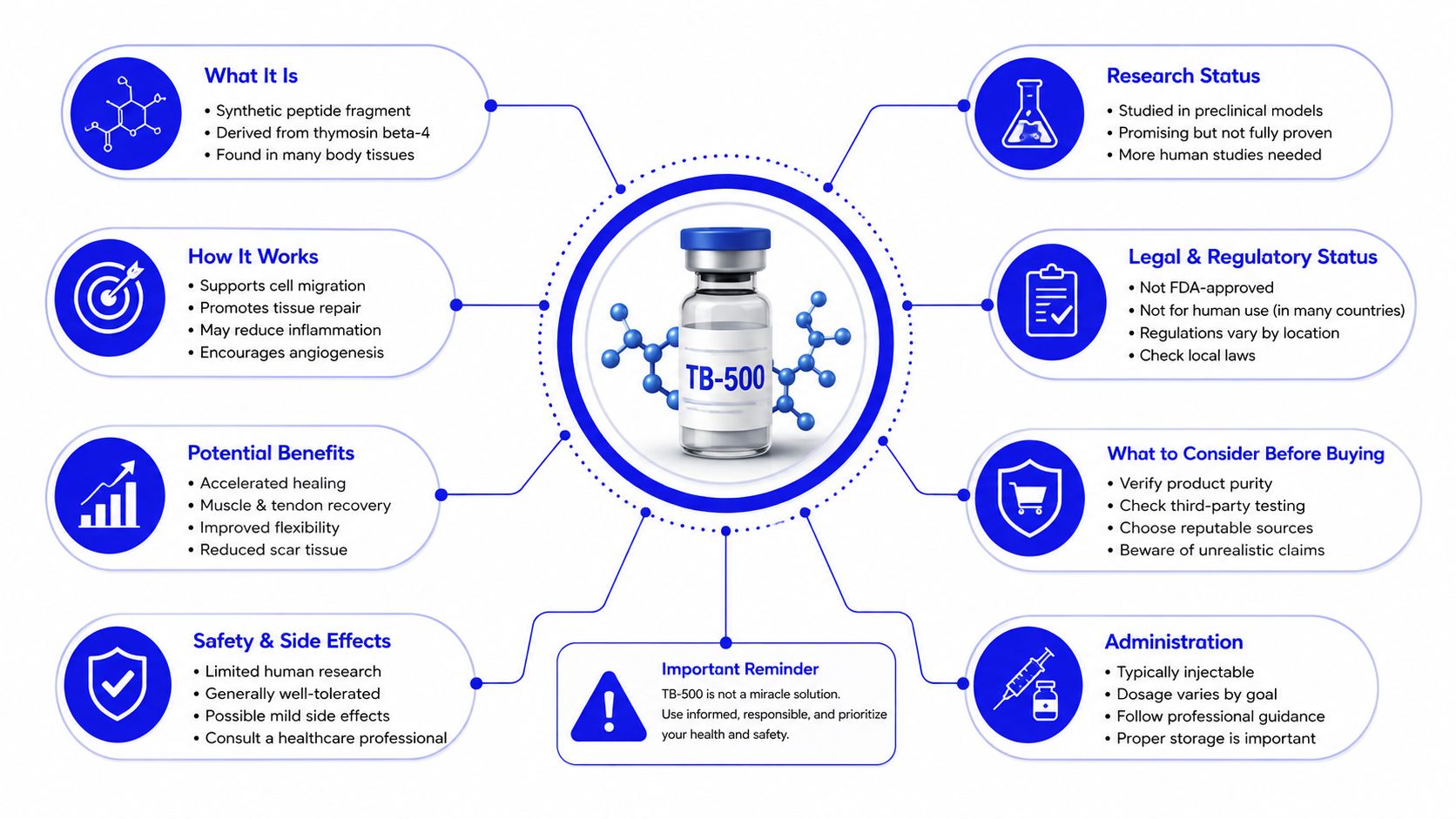
TB-500 is commonly used as a research-market name for a synthetic fragment associated with thymosin beta-4. Much of the human literature cited in online marketing concerns the full-length parent protein, not the shorter fragment sold under TB-500 labeling. A responsible purchase therefore begins with identity, traceability, intended use, and regulatory context, not therapeutic promises.
TB-500 isn't another name for full-length thymosin beta-4. The parent molecule is a 43-amino-acid protein first isolated from calf thymus in 1981, while TB-500 is commonly described in research-market materials as a shorter synthetic fragment that retains the LKKTET actin-binding motif. The FDA recorded an orphan-drug designation for the parent molecule on December 31, 2013, for neurotrophic keratopathy, but the record states that the indication was not FDA approved for orphan use (FDA orphan-drug record).
That distinction matters because the biological mechanism and the commercial product aren't interchangeable. Research discussions connect thymosin beta-4 biology with actin sequestration, cell migration, and angiogenic signaling, yet evidence for the exact synthetic TB-500 fragment remains overwhelmingly preclinical. Independent summaries also note that no completed controlled human efficacy trial of the fragment has been published as of 2026, so claims about healing, fat loss, or muscle gain shouldn't be treated as established human outcome data (TB-500 technical overview).
The historical record is longer for thymosin beta-4 than for the product name TB-500. Research summaries describe the parent molecule as the subject of multiple development programs beginning in the 2000s, while the exact synthetic fragment has a much narrower direct evidence base (TB-500 history and research context).
For procurement, that creates a simple rule: never accept a citation to thymosin beta-4 as automatic proof about TB-500. Ask whether the paper studied the complete 43-amino-acid protein, a different fragment, or the exact material identified on the supplier's specification sheet.
A legitimate research product is positioned for laboratory, analytical, or preclinical work. It isn't marketed as a treatment, dietary supplement, performance enhancer, or substitute for medical care. Reviews consistently describe TB-500 as lacking FDA approval for human use and lacking marketing authorization in major markets (regulatory overview).
That boundary also changes what a responsible supplier should emphasize. Sequence confirmation, lot identity, analytical testing, and storage instructions are relevant procurement information. Promises about recovery speed or body-composition results are not substitutes for clinical evidence.
A simple “Is TB-500 legal?” answer is misleading because legality depends on what the buyer intends to do, where the buyer is located, and how the product is supplied. A research laboratory purchasing material for analytical work faces a different compliance question from an individual seeking personal use. The label “research use only” also doesn't transform an unapproved product into an approved medicine.
The U.S. regulatory picture reportedly shifted in 2026. Coverage of a July 2026 FDA advisory vote states that the panel recommended TB-500 for inclusion on the 503A bulk drug substances list, but the vote itself didn't make TB-500 legal for personal use or automatically authorize pharmacies to compound it (2026 regulatory coverage).
Other 2026 reporting states that TB-500 was removed from the FDA 503A bulk-drug-substances do-not-compound list. That removal still didn't automatically make the compound fully compoundable or approve it for therapeutic use (FDA-status discussion).
For a buyer, the practical interpretation is cautious:
Practical rule: A regulatory development can change a substance's position on a list without creating broad permission to use it personally.
Competitive athletes have an additional compliance issue. The World Anti-Doping Agency lists thymosin beta-4 and TB-500-related substances as prohibited, both in competition and out of competition under its rules (anti-doping reference). Anyone subject to WADA rules should treat a TB-500 purchase as a potential anti-doping exposure, regardless of a supplier's marketing language.
A supplier's website can look polished while offering weak traceability. The useful question isn't whether a page says “high purity.” It's whether the vendor can connect your specific vial to a specific production lot and a specific analytical record.
Start with the Certificate of Analysis, or COA. A credible COA should identify the product, lot or batch, test date, testing method, and measured result. It should be possible to determine whether the report belongs to the material being offered, rather than a generic document reused across product pages.
A serious procurement file should normally include:
Microbial and endotoxin documents deserve particular attention because a purity statement alone doesn't answer every contamination question. A sample can have a strong chromatographic purity result while still requiring separate evaluation for other quality attributes.
| Document Type | What to Verify | Red Flags |
|---|---|---|
| Batch-specific COA | Product name, lot number, test date, and matching vial label | Generic report with no lot connection |
| Identity report | Method and result supporting the stated compound identity | Purity listed without identity testing |
| Purity analysis | Reported result, method, and sample identification | Unexplained purity language or missing method |
| Microbial testing | Scope of testing and relationship to the lot | No report where the lab requires one |
| Endotoxin testing | Result, units, method, and lot reference | “Endotoxin-free” with no supporting report |
| Shipping and storage record | Handling instructions and receiving condition | No temperature or handling guidance |
USA manufacturing can simplify the supply-chain review, but geography alone isn't proof of quality. Ask for the records that demonstrate how the material was produced, tested, released, and shipped.
Labs also need infrastructure around the product, including controlled storage and organized records. Guidance on compliance for research labs can help institutions think beyond the vial itself and assess the broader environment in which regulated research materials are received and handled.
Be cautious if a supplier refuses to provide a batch-specific COA, makes clinical or performance promises, hides the intended-use disclaimer, or cannot explain its return and support process. A supplier that answers technical questions with testimonials instead of documents isn't giving a laboratory enough information to make a reproducible purchasing decision.
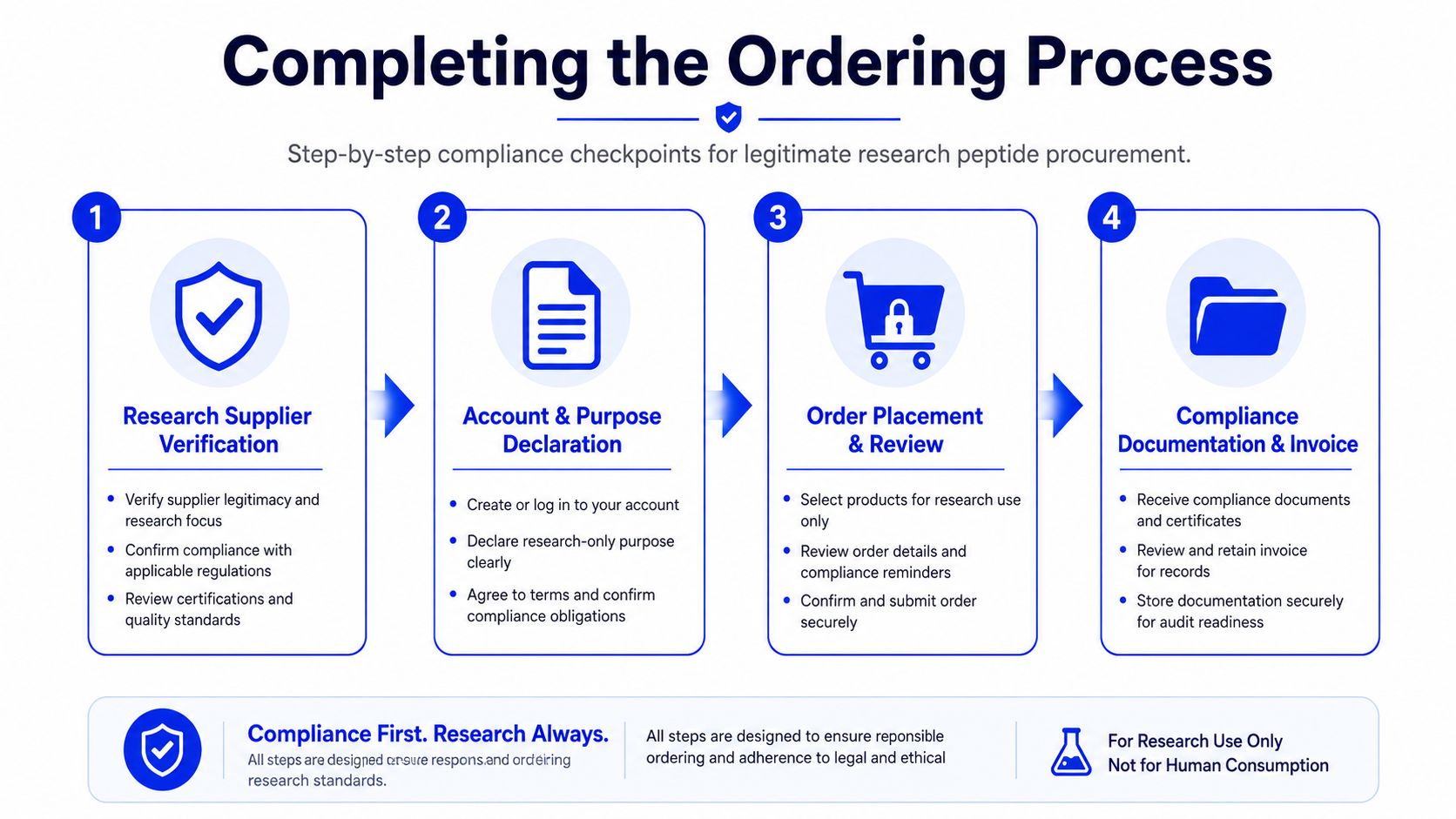
A compliant order usually feels more deliberate than a casual online purchase. The supplier may require account creation, age verification, confirmation of research intent, agreement to an FDA disclaimer, and review of shipping restrictions before accepting payment. Those checkpoints help separate laboratory procurement from personal-use ordering.
Have the institutional or laboratory information ready, along with the intended analytical or preclinical application. You may also need a delivery address that can receive temperature-sensitive or restricted research materials, depending on the supplier's shipping policy.
The normal workflow looks like this:
Payment and shipping policies can reveal how established the operation is. Clear invoices, order tracking, defined delivery terms, and a responsive help desk are more useful than anonymous contact forms or informal payment instructions. A written return policy should explain what happens if a package arrives damaged, mislabeled, or inconsistent with the order.
A professional checkout process protects the chain of custody before the material reaches the laboratory.
For a visual explanation of the procurement checkpoints, review the following compliance-focused resource.
Peptides can lose research value when laboratories treat receiving and storage as administrative details. The supplier's product-specific instructions should control, because storage requirements can vary with formulation, container, and intended use.
Lyophilized powder is commonly supplied for research because removing water can improve handling stability compared with an already-reconstituted solution. That doesn't eliminate sensitivity to moisture, light, repeated temperature changes, or poor aseptic technique.
Record the condition of the shipment immediately. Confirm the label, lot number, seal, and documentation before moving the vial into the storage environment specified by the supplier or your laboratory's approved procedure.
Use these controls:
Reconstitution is a laboratory procedure, not a consumer-use instruction. The lab should define the diluent, concentration, mixing method, labeling, hold time, and disposal process in its approved protocol. Never rely on informal dosing schedules or online administration instructions when the product is sold for research only.
If the vial arrives warm, wet, damaged, unlabeled, or inconsistent with its COA, quarantine it and contact the supplier before use. A retained sample, receiving photograph, and written support ticket can help preserve the investigation trail.
Responsible procurement continues after payment. A lab should be able to answer three questions at any point: what material was purchased, where it has been, and how it was handled.
Maintain the lot-specific COA with the invoice, receiving record, storage log, and experimental record. That chain of custody supports reproducibility and helps researchers identify whether an unexpected result may relate to the material, handling conditions, assay design, or another variable.
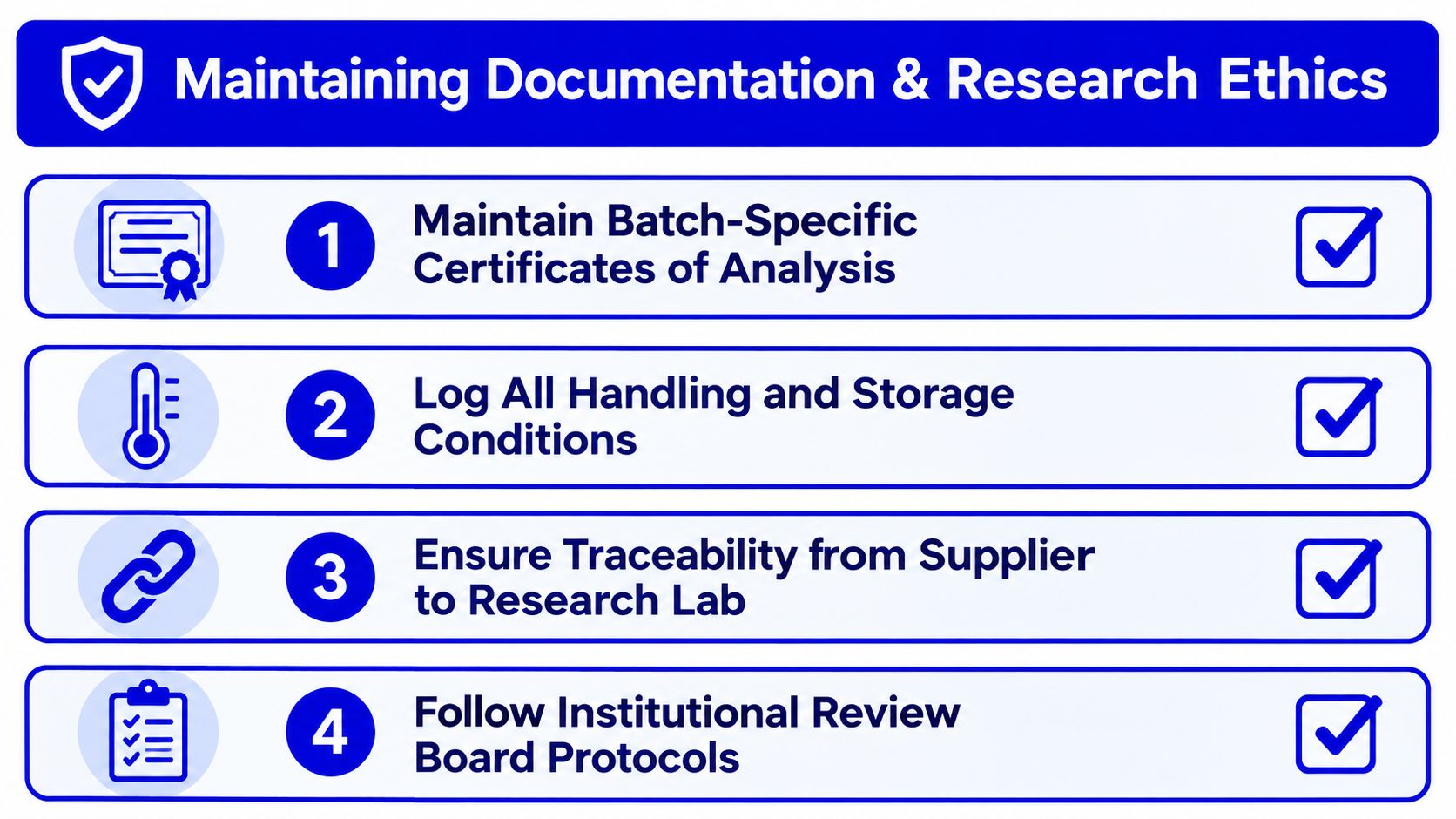
The ethics issue is just as important as the paperwork. Researchers should distinguish full-length thymosin beta-4 findings from direct TB-500 evidence, avoid unsupported human-use claims, and keep all work within institutional approvals and research-use-only boundaries. A research label isn't permission to bypass review, consent, biosafety, or applicable institutional procedures.
The most defensible TB-500 purchasing decision is therefore not the cheapest or fastest one. It's the order supported by a clear identity record, batch documentation, appropriate handling controls, and an honest description of what the evidence does and doesn't establish.
Peptide Warehouse USA offers USA-manufactured research peptides, including TB-500, with batch-specific documentation such as COAs, microbial and endotoxin reports, and stated purity information for laboratory, analytical, and preclinical applications. Visit Peptide Warehouse USA to review its research-use-only catalog, documentation, ordering support, and shipping information before selecting a supplier.