No products in the cart.



The most popular advice about the LL-37 peptide is also the least useful: because LL-37 can kill microbes in laboratory assays, it must be ready to replace conventional anti-infective strategies. That conclusion skips the difficult part. Activity in a controlled plate doesn't guarantee stability in physiological conditions, selectivity for microbial membranes, or practical performance in a formulation.
LL-37 is a valuable research molecule precisely because it sits at the intersection of antimicrobial activity, membrane biology, innate immunity, and tissue signaling. This guide explains its origin, structure, mechanism, experimental uses, assay limitations, sourcing considerations, and the translational gap that separates promising in vitro findings from reliable real-world applications. It also keeps the central research question in view: not whether LL-37 works, but whether a particular design, delivery system, and test environment allow it to work safely and reproducibly.
LL-37 is often introduced as a broad-spectrum antimicrobial peptide, and that description is accurate as far as it goes. The problem begins when researchers treat broad activity as proof of practical readiness. Native LL-37 can lose activity in physiological environments, degrade through proteolysis, cost more to produce than simpler research reagents, and become cytotoxic at higher concentrations. Those limitations can appear in the same biological settings where researchers hope to use it.
The peptide's behavior depends heavily on the assay. Salt, serum proteins, pH, lipid composition, peptide aggregation, and exposure time can all change the apparent result. A strong minimum inhibitory concentration in a defined medium therefore answers a narrow question. It doesn't automatically predict performance in a wound matrix, mucosal environment, biofilm, or systemic formulation.
A buyer or principal investigator should treat four issues as part of the experimental design, not as procurement details:
The 2025 review of LL-37 derivatives describes a field moving toward modified analogs, delivery systems, and antibiotic synergy, rather than relying on native LL-37 alone (review of LL-37 derivatives). That shift matters commercially and scientifically. A derivative may be less potent in one simplified assay but more useful overall if it remains stable, avoids aggregation, and preserves a workable safety margin.
Practical rule: Treat native LL-37 as a mechanistic reference standard first, and as a ready-made therapeutic solution only after stability, selectivity, and formulation have been demonstrated in the relevant model.
For new lab members, the main lesson is simple. A clean plate result is the beginning of a translational argument, not its conclusion. Design experiments that measure peptide integrity and host-cell effects alongside antimicrobial activity, then compare native LL-37 with engineered alternatives when the application demands durability.
LL-37 is the active 37-amino-acid C-terminal fragment of the human cathelicidin precursor hCAP18. The precursor is inactive until proteolytic processing releases the mature host-defense peptide. Keratinocytes and neutrophils participate in this biology, allowing LL-37 to appear at infection or wound sites where epithelial and immune defenses are engaged (LL-37 biology and processing).
The name is structural rather than commercial. LL-37 contains 37 amino acids, and it was first identified in 1995 as a human cathelicidin peptide. Researchers later recognized it as the only known human member of the cathelicidin family. A major early characterization paper appeared in 2006, while a later review summarized its dual antimicrobial and immunomodulatory roles (early characterization of LL-37).
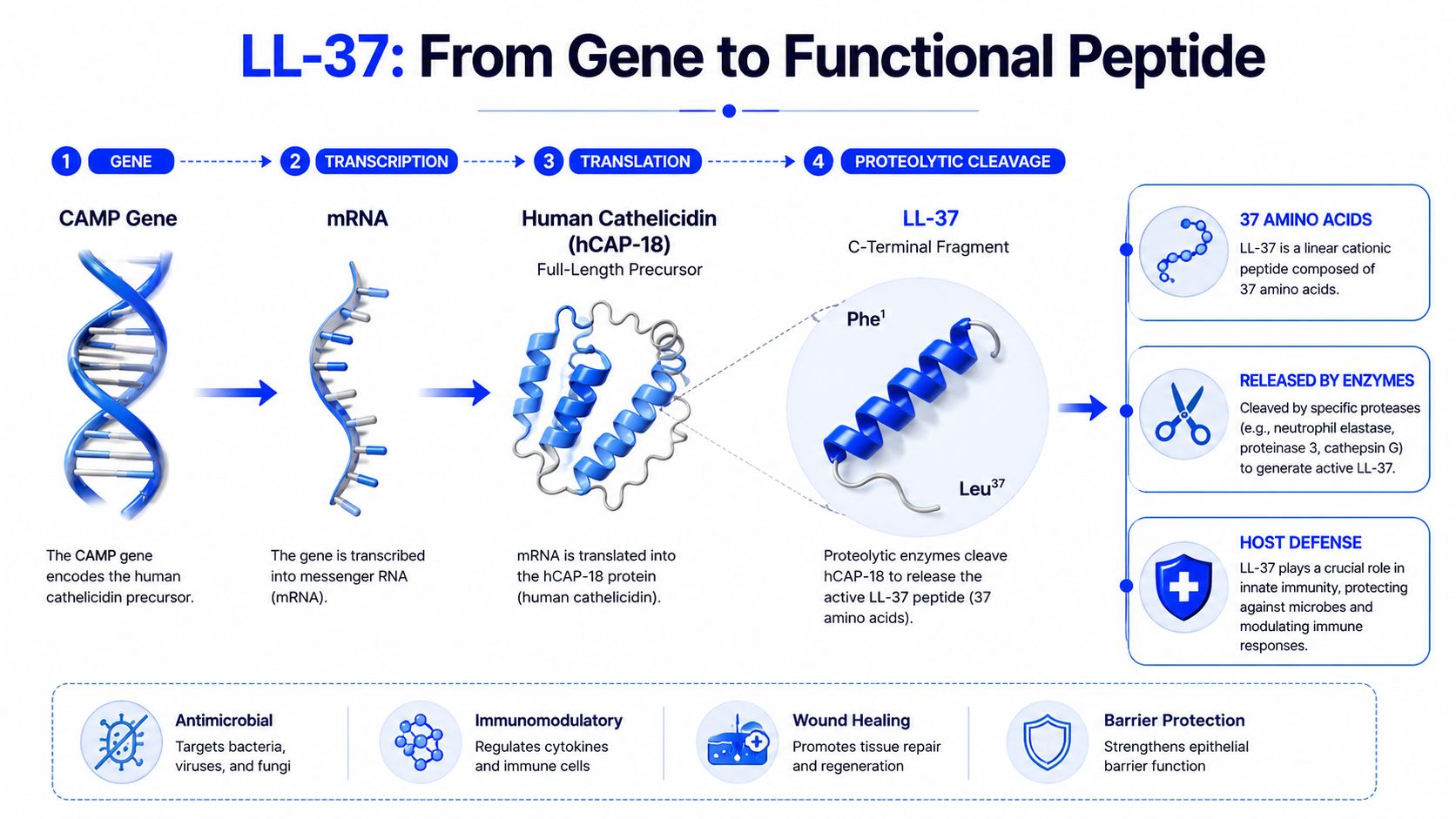
LL-37 has a net positive charge of +6. Its cationic character helps it associate with negatively charged microbial membranes, while its amphiphilic structure gives it both water-compatible and membrane-compatible surfaces (LL-37 structure and membrane activity).
That combination creates a useful conceptual sequence:
The cleavage step isn't a minor processing detail. It changes the molecule from a stored precursor into an active host-defense agent. Researchers who work with synthetic LL-37 are therefore studying the mature fragment directly, while biological systems control when and where that fragment becomes available.
LL-37's antimicrobial promise is easier to demonstrate in a membrane model than in a usable formulation. Its mechanism starts with electrostatic attraction. Negatively charged features on many bacterial membranes draw the positively charged peptide toward the cell surface. LL-37 then associates with the lipid bilayer, where peptide molecules can oligomerize and form membrane-associated channels or other disruptive assemblies (LL-37 membrane mechanism).
Membrane composition changes the outcome. LL-37 can form pores in unsaturated or cholesterol-containing lipid bilayers, while producing a more modulatory response in saturated lipids. It may also generate tubular and fibrillar peptide-lipid superstructures. These findings explain why results from one lipid system do not automatically predict behavior in another (LL-37 lipid-bilayer behavior).
A minimum inhibitory concentration, or MIC, describes an assay result under defined conditions. It is not a universal potency threshold. An early study reported these LL-37 values:
| Pathogen | MIC value | Assay conditions |
|---|---|---|
| Listeria monocytogenes | 1.5 µg/mL | Specific conditions reported in the original assay |
| Escherichia coli ML-35p | 7.6 µg/mL | Specific conditions reported in the original assay |
| Pseudomonas aeruginosa MR 3007 | 3.8 µg/mL | Specific conditions reported in the original assay |
| Bacillus subtilis | 0.5 µg/mL | Specific conditions reported in the original assay |
The values came from the 1998 study (original LL-37 antimicrobial study). They show activity against several organisms, but comparisons require care. Medium composition, inoculum preparation, incubation, endpoint definition, and peptide handling can all shift the measured MIC.
The same membrane activity can affect host cells. At micromolar concentrations, LL-37 may permeabilize human cell membranes and become cytotoxic. Formulation, aggregation, exposure time, and assay design therefore matter when translating in vitro antimicrobial findings into practical research use.
For environmental controls or microbial containment, this guide to bacteria-safe filtration explains what filtration can and cannot establish. Filtration physically removes organisms, whereas LL-37 acts on membranes. These approaches answer different experimental questions and should not be treated as interchangeable.
LL-37 isn't only a microbial killing reagent. Reviews describe roles in innate immune responses, angiogenesis, wound healing, mucosal barrier integrity, microbiota shaping, and protection against infections in the colon (recent review of LL-37 biology). Those functions make the peptide biologically interesting, but they also make interpretation more complicated.
A researcher studying wound repair, for example, may observe changes that don't result from direct bacterial killing alone. LL-37 can influence cell migration, immune-cell recruitment, barrier behavior, and inflammatory signaling. In another model, the same signaling capacity may complicate the result by activating injured host cells or altering the local inflammatory environment.
LL-37 can bind bacterial endotoxins and modulate inflammatory responses. That doesn't mean it has a uniformly anti-inflammatory effect. The outcome depends on concentration, cell type, timing, tissue condition, and the presence of microbial products or damage signals.
The current literature has expanded beyond classic antibacterial framing into biofilm disruption, antiviral activity, fungal defense, and complex cancer-related signaling. The 2025 review of LL-37 biology emphasizes that the peptide can support host defense in some contexts while also becoming harmful to human cells at micromolar concentrations (context-dependent LL-37 activity).
A useful experimental distinction is:
These categories can overlap in a single experiment. A reduction in microbial burden doesn't prove improved tissue recovery, and a cytokine change doesn't prove direct pathogen killing. Researchers should measure each endpoint separately rather than using one result as a proxy for all the others.
LL-37 experiments become harder to interpret as biological complexity increases. A broth-based inhibition test answers whether the peptide affects free-floating organisms under controlled conditions. A biofilm or mammalian-cell model asks a different question, with more variables and more opportunities for formulation, stability, and toxicity to shape the result. A practical workflow begins with a defined antimicrobial assay, then adds complexity when the initial signal is reproducible.
MIC testing helps compare peptide preparations, organisms, and assay conditions. It can show measurable activity and provide a reference for later experiments. The model remains limited because planktonic bacteria in controlled medium do not reproduce the extracellular matrix, nutrient gradients, slower growth, or altered physiology of a mature biofilm. The assay also cannot resolve whether the peptide remains stable or becomes toxic in a more realistic system.
Researchers should document:
Biofilm models provide greater biological relevance, but surface material, biofilm age, growth medium, washing steps, and biomass measurement introduce additional variability. The assay becomes more informative only when those factors are defined and reported.
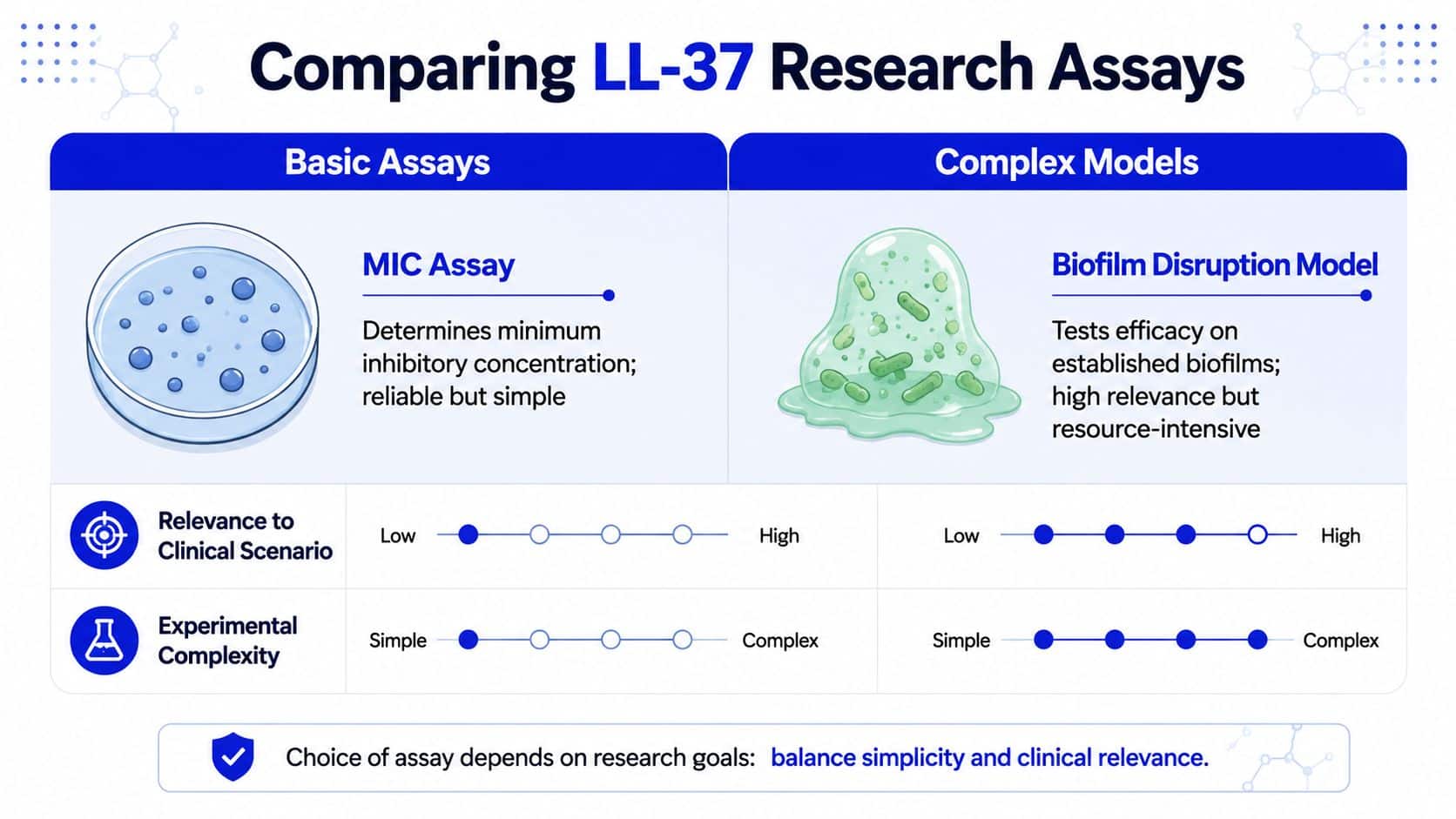
A 2019 study reported a 32 µM MIC against Staphylococcus aureus biofilms and more than a 4 log reduction in colony counts under its experimental conditions (LL-37 activity against S. aureus biofilms). Established biofilms are more demanding models than free-floating bacteria, so these findings are useful for assay planning. They remain model-specific and do not establish clinical efficacy.
A practical progression is:
Fragment-based designs and modified analogs follow this progression. They may provide a more workable balance among antimicrobial activity, stability, and host-cell compatibility than native LL-37 alone.
A well-designed assay can't rescue an unidentified or degraded peptide. LL-37 is sensitive to experimental context, so researchers should establish material identity and batch quality before troubleshooting biology. A supplier's product page is only the starting point. The relevant evidence is batch-specific documentation.
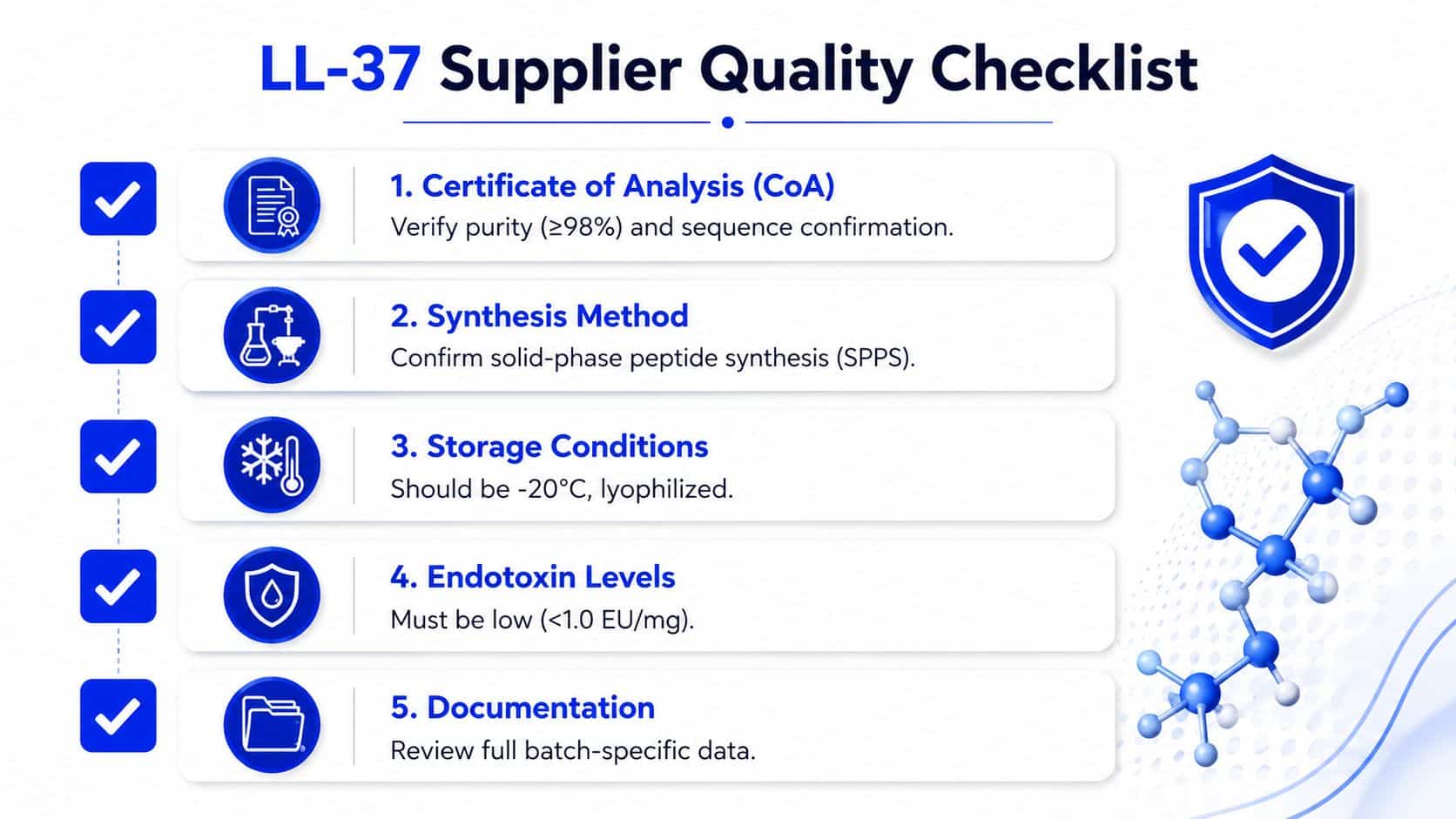
Look for a Certificate of Analysis, an explicit sequence assignment, stated purity, and analytical methods that match the intended research use. If your work involves cells, tissues, or sensitive immune readouts, microbial and endotoxin documentation deserves particular attention because contamination can create biological effects that resemble peptide activity.
A practical review should include:
Keep lyophilized peptide in a cool, dry, light-protected environment according to the supplier's documentation. Minimize repeated exposure to humidity, use suitable low-binding materials where appropriate, and avoid unnecessary freeze-thaw cycles after reconstitution. Researchers should validate their own working solution stability rather than assuming that a storage recommendation guarantees activity in every buffer.
Batch discipline matters: If activity changes between experiments, compare the lot number, reconstitution record, buffer, storage history, and assay conditions before blaming the biological model.
A strong quality program also separates chemical identity from functional qualification. Analytical purity tells you what is present. A standardized functional assay helps determine whether the lot behaves as expected in your system. Both records support reproducibility.
Native LL-37 makes sense when the research question concerns the biology of the human cathelicidin itself, membrane interactions, innate immune signaling, or benchmarking against engineered peptides. It becomes a less obvious choice when the project requires long exposure, physiological stability, precise tissue delivery, or a wide margin between microbial activity and host-cell toxicity.
Use a decision framework that matches the molecule to the question:
For broader laboratory planning, this resource on data-driven decisions for scientists offers a useful way to separate measured evidence from assumptions. That distinction is especially important for LL-37, where in vitro potency can coexist with formulation and toxicity constraints.
The strongest research program won't ask whether LL-37 is “good” or “bad.” It will define the organism, matrix, exposure, endpoint, host-cell model, and quality standard, then test whether the peptide remains effective under those conditions.
Peptide Warehouse USA offers a 5 mg lyophilized LL-37 research product for laboratory, analytical, and preclinical use, with batch documentation that includes Certificates of Analysis and related quality reports. Visit Peptide Warehouse USA to review the LL-37 research option, product documentation, and ordering details before planning your next experiment.