No products in the cart.


You're probably looking at a freezer-safe shipment on the bench, a few labeled vials, and a vendor page that looks polished enough to trust. That's exactly where bad buying decisions start. With combat research peptides, the key question isn't what the catalog says, it's whether the supplier can prove what's in the vial, how it was tested, and whether the paperwork would survive a serious lab audit.
The peptide field didn't start as a retail trend. The first therapeutic peptide, insulin, was synthesized in 1921, and a 2022 review reported more than 80 peptide drugs had been approved worldwide, including 33 non-insulin peptide drugs approved since 2000 source. That history matters because research peptides sit inside a mature analytical and regulatory ecosystem, not a novelty aisle.
A shipment lands, the dry ice is gone, and you've got one job before anything touches a protocol, prove the vial is usable research material. That's the moment where a supplier either looks like a documentation system or a label printer. If the lot number, COA, and testing trail don't line up, the catalog name means very little.
I treat peptide buying like procurement, not shopping. Two vials with the same name can still differ in purity, counter-ion form, residual solvent burden, and handling quality, and those differences show up later as inconsistent assay results or unusable material. A supplier that cannot support the batch with hard documents is asking you to absorb the risk after the sale.
Practical rule: if the vendor can't show batch-specific proof before checkout, assume you'll be the one doing the retest work later.
The loss isn't the purchase price. It's the reordering, the delay in downstream work, the time spent reconciling a weak chromatogram, and the awkward conversation with a PI who wants to know why the batch can't support the data package. In a lab environment, missing paperwork is not a small inconvenience, it's a procurement failure.
This is why I don't care about shiny product pages if the documents are thin. A supplier can call something high purity, research grade, or premium all day long, but those labels are only as strong as the analytical package behind them. If the vendor won't show the proof, the burden shifts to your team.
A vial label can look modern and still carry a long research lineage. The phrase combat research peptides points back to Soviet bioregulatory work that began in the early 1970s, with military-linked institutions in Leningrad studying ways to protect soldiers, cosmonauts, and athletes from radiation damage, immune suppression, and premature aging. That history matters because it shows these compounds were shaped around stress resistance and tissue protection, not consumer wellness branding source.
The same reporting describes Vladimir Khavinson's program as producing more than 700 publications and 205 patents over roughly 40 years. That does not make every modern catalog entry reliable, but it does show the field has a real institutional paper trail. If a peptide appears in a current storefront, ask where the sequence came from and what documentation followed it into civilian research use.
Older lineage usually means different assumptions about formulation and storage. Many of these sequences were developed for parenteral use, so counter-ions, lyophilized stability, and handling expectations can differ from a generic synthetic listing. If the vendor does not disclose sequence identity, salt form, and analytical support, you are guessing about the material before the first experiment starts.
The historical connection also helps separate real research interest from marketing cosplay. A compound with military or wound-healing roots may have a legitimate lab history, but that does not make a retail storefront credible. Provenance should push you toward better documentation, not toward belief.
A legitimate supplier starts with the Certificate of Analysis, but a COA by itself isn't enough. I want batch-specific documentation that shows the vendor tested the exact lot I'm buying, not some generic template used to decorate a product page. If the lot has a number on the vial, that number should appear on the COA, the label, and the shipping record.
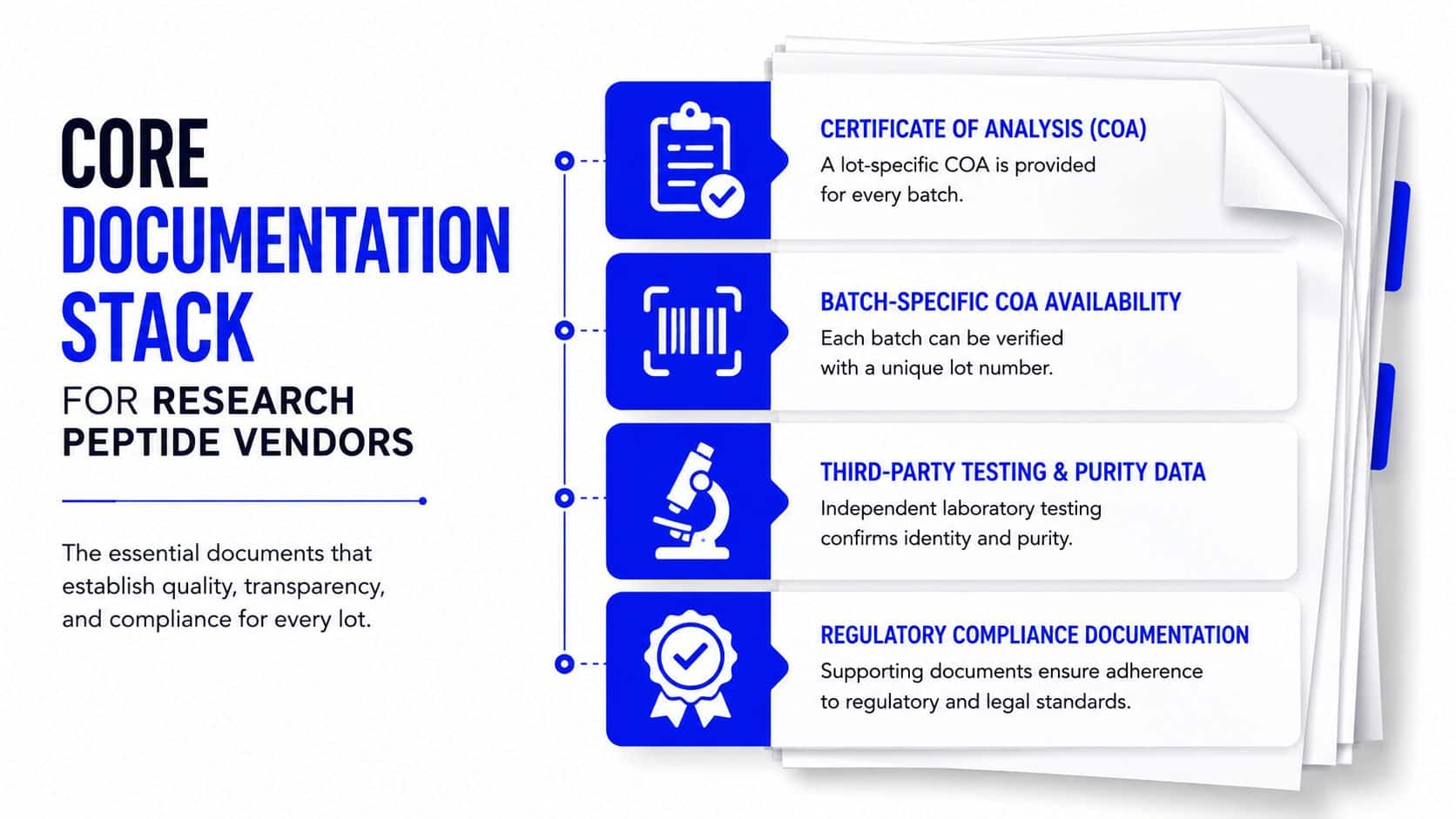
At minimum, I expect these items to exist and match the lot:
Independent guidance on peptide COAs specifically points to HPLC purity, mass spectrometry identity confirmation, and endotoxin testing by the Limulus Amebocyte Lysate, or LAL, assay as hard verification points source. Another source notes that quality COAs often report HPLC purity of 95% or higher, endotoxin below 5 EU/mg, and bacterial counts under 100 CFU/g source. Those are useful reference points, but only if the vendor gives you the actual batch data.
A strong compliance mindset also means thinking in terms of chain of custody for business compliance, not just product delivery. That's why the documentation trail matters as much as the vial itself, and why I'd point buyers to a practical overview like Packaging Panda's chain of custody guide when they need a clean framework for records and traceability.
If a vendor claims independent testing, I want the lab name, the method, and the raw output. If the product has a safety data sheet, it should match the actual product, not a recycled template. A supplier that can't produce the supporting file set is selling confidence, not verified material.
A COA should read like evidence, not decoration. I look first at the lot number, synthesis date, and analysis date, because those fields tell me whether I'm dealing with a live batch record or a stale upload. If the dates don't make sense together, the rest of the document gets a lot less believable.
The useful parts are the ones that let you verify the lot without guessing:
A COA that says “>95% pure” with no chromatogram is weak. So is a document with no operator name, no instrument reference, or no method details. The paper should let you connect the vial in your hand to a specific analytical run, otherwise it's just a branded PDF.
Bottom line: a COA is a chain-of-custody artifact, not a marketing badge.
Compare the document against the claims on the product page. If the page pushes a high-purity story but the COA hides the chromatogram, that's a mismatch. If the vendor claims third-party testing but only publishes an in-house summary, treat it as incomplete until you see the lab output.
The best vendors make the data easy to audit. The weak ones make you work for every fact, and that usually means the facts were never the selling point.
I use a simple pre-purchase check, and I don't care how expensive the catalog is if two or more items fail. Start with the product page, then move to the documents, then read the policies like a buyer who expects to be audited. If the site hides basic information, that's the answer.
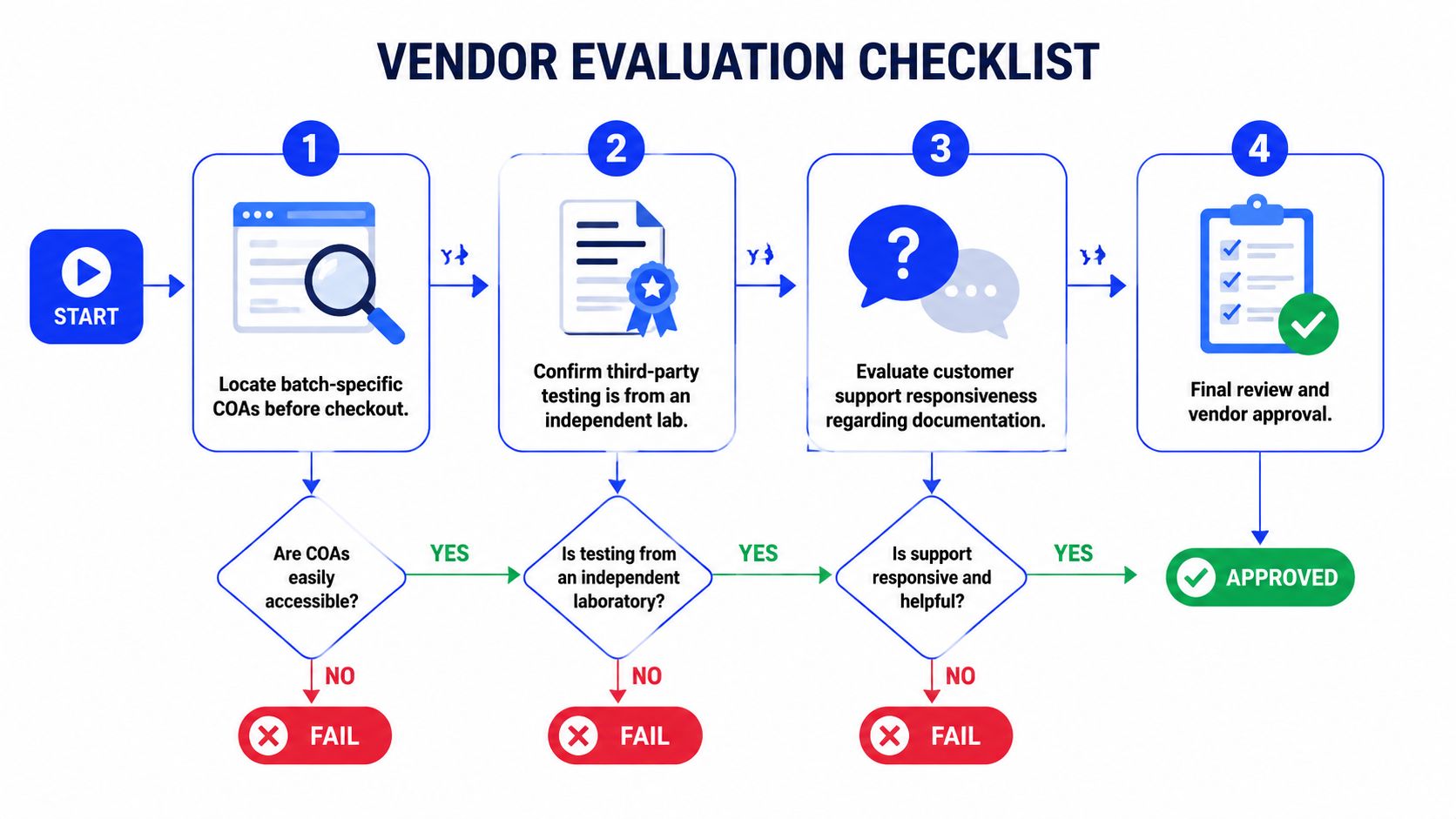
The checklist sounds basic because it is. That's the point. A lot of storefronts hide behind clean design while leaving the actual procurement trail incomplete. You're not buying a lifestyle object, you're buying a research input.
For a broader vendor-screening mindset, I also like comparing how other regulated supply chains handle selection criteria, such as the kryo lieferant auswahlkriterien blog. The category is different, but the logic is the same, quality vendors make proof easy to inspect.
Email the vendor with one technical documentation question and watch the reply. If support can't answer where the COA lives, what lab ran the test, or which lot the file belongs to, you already know how painful a problem shipment will be. Good suppliers make documentation retrieval boring.
If a vendor is transparent, you shouldn't need detective work to buy from them.
I also pay attention to whether product pages keep lot identifiers consistent across multiple SKUs, because sloppy labeling usually isn't isolated. If one page is sloppy, the rest of the catalog often is too. That's when I walk away.
A research use only label is not a shield by itself. Regulators look at intended use, so website copy, labeling, and the surrounding marketing are read together, not as isolated disclaimers source. If the site sounds like a wellness shop and hides the RUO line in fine print, it is a retailer's posture, not a research supplier's.
The better signals are practical. Real research suppliers state what they will not sell, avoid dosage guidance, never frame products as human-use solutions, and keep the checkout flow aligned with lab-only buying. A neutral overview of RUO language also notes that these products are not approved for diagnostic, therapeutic, or human use, and that the label is an intended-use statement rather than proof of composition source.
Regulatory pressure has also changed how this market reads. Neutral sources describe a 2024–2025 shift that ended interim bulk-substance categorization, triggered more than 50 warning letters in one enforcement wave, and removed nearly 20 peptides from permissible compounding lists source. That does not make research supply impossible, but it makes paperwork and intended-use discipline matter much more.
The market is splitting in two. Research access still exists, while human-use pathways are getting narrower and more paperwork-heavy. Buyers who ignore that split invite avoidable compliance trouble.
A scorecard keeps the decision honest. Without one, it's too easy to forgive weak paperwork because the price looks good or the site feels familiar. I'd rather use a simple weighted sheet and make the same call every time.
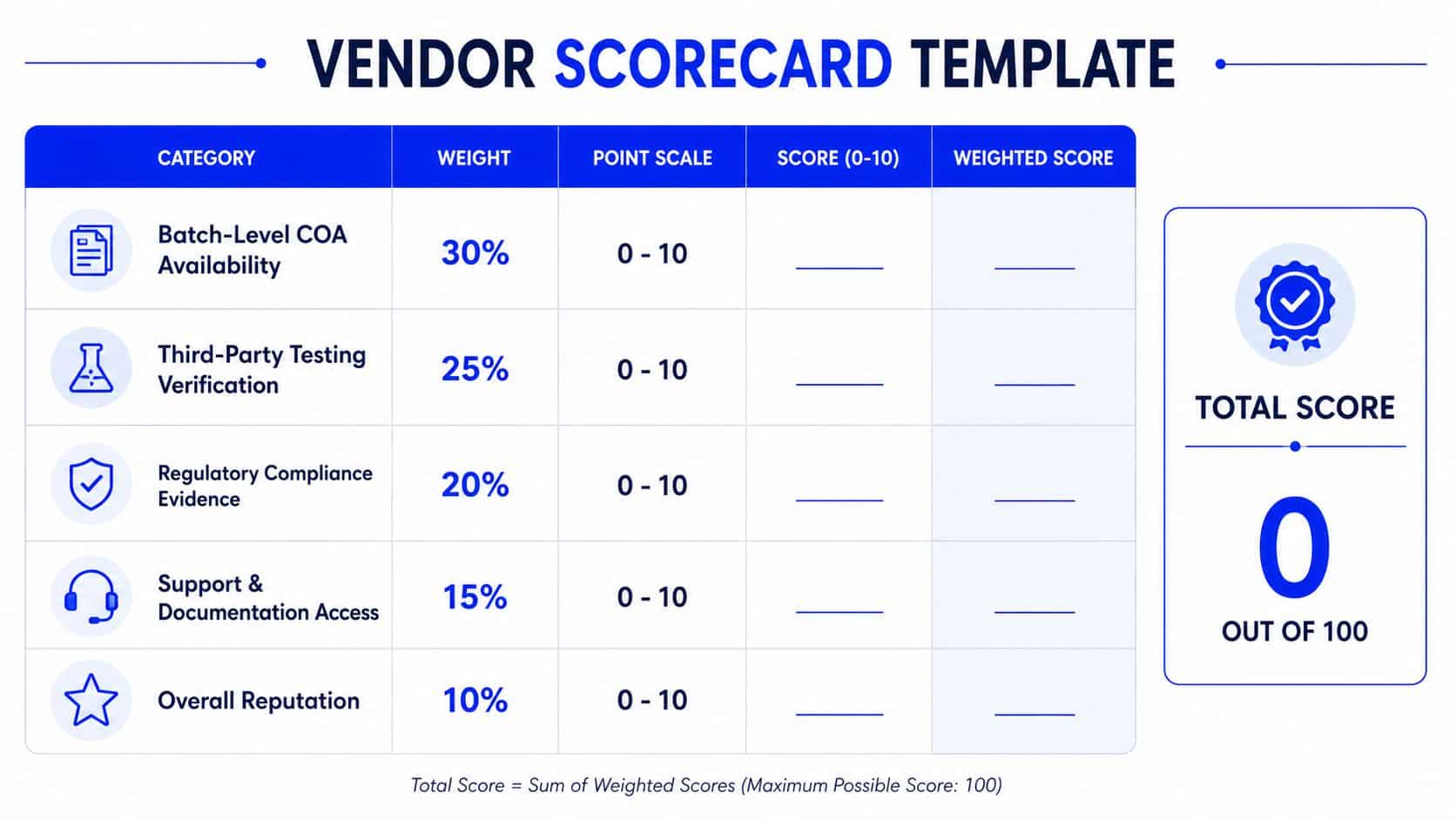
Use a 0 to 3 scale for each line, then weight the result:
That structure works because it rewards proof, not polish. A vendor with decent branding but thin data should never outrank a less flashy supplier with complete batch records. If you need stricter controls for cell-based work, push endotoxin and microbial documentation higher in the weighting.
Vendor A might have a clean storefront, but weak testing detail and slow document access. Vendor B might look less polished but provide batch COAs, third-party files, and fast support. On a scorecard, Vendor B wins because the procurement risk is lower.
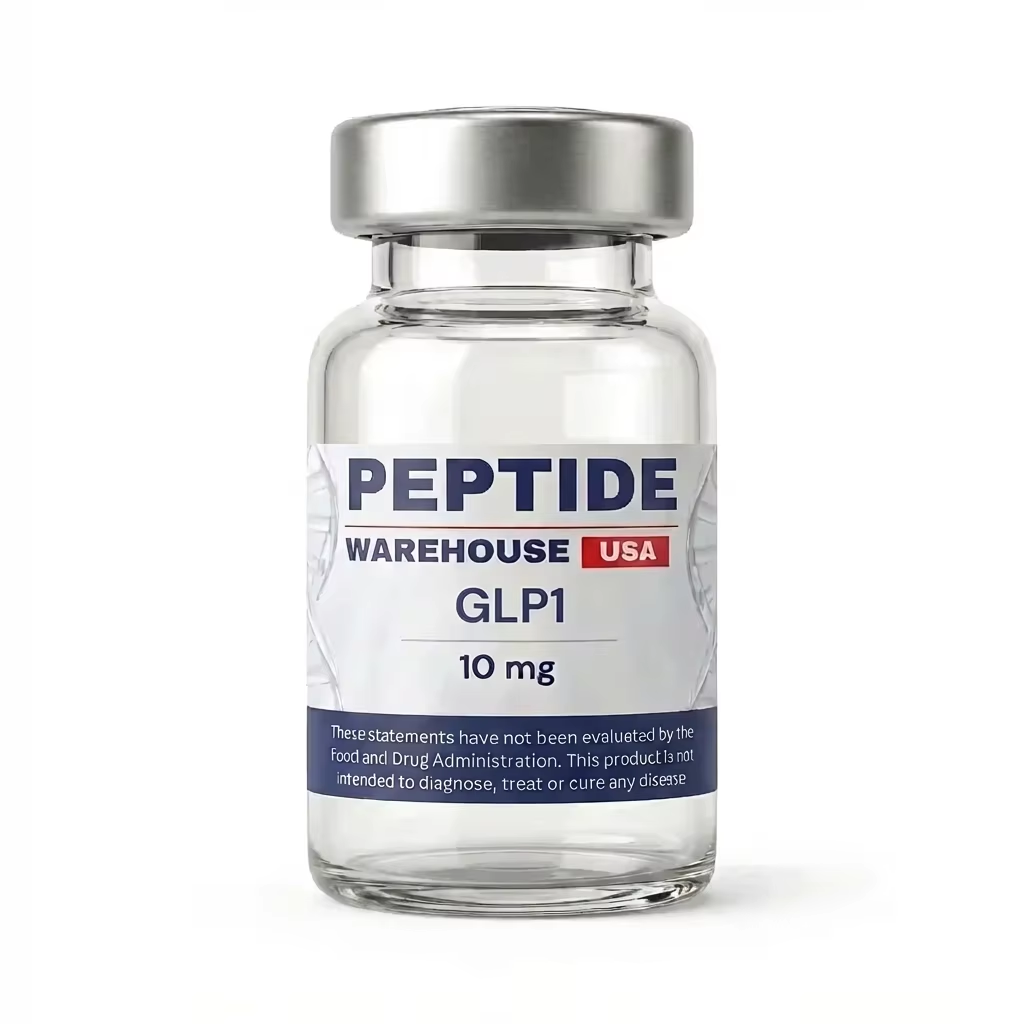
That's also where a supplier like Peptide Warehouse USA fits into the buying conversation, since it presents research-only products with batch documentation, COAs, and endotoxin and microbial reporting tied to the lot. I'd still score it like any other vendor, because the discipline is the point, not the brand.
A vendor scorecard also helps with grants, collaborations, and audits because you've created a repeatable record of why one source made the cut. For broader vendor-management discipline, a resource like vendor onboarding best practices with Matil is worth reading if you want to tighten internal procurement habits. Keep the scorecard updated whenever a supplier changes sources, adds a new compound, or revises its documentation format.
Use the sheet consistently and subjective bias drops fast. The best vendor is the one whose paperwork holds up when someone else asks hard questions.
If you want a supplier that treats documentation as part of the product, visit Peptide Warehouse USA and review how its research-only catalog, batch records, and COA access fit your lab's procurement standards. Then compare the lot-level paperwork against your own scorecard before you place the next order.