
No products in the cart.


You're looking at a vial or nasal-spray listing labeled PT-141, and the product page makes the route sound straightforward. The confusing part is that “PT-141 nasal spray” can describe a research formulation, while the FDA-approved product containing the same active ingredient is an injectable product with a narrow indication. Those are not interchangeable categories.
This guide treats the nasal format as a research, formulation, pharmacokinetic, and procurement problem. It explains what bremelanotide is, how melanocortin-receptor activity is studied, why clinical development moved away from intranasal delivery, how to review safety signals and batch documentation, and what responsible labeling should look like. It doesn't provide instructions for human use, dosing, sexual-performance enhancement, or self-experimentation.
PT-141, also known as bremelanotide, is a synthetic peptide associated with the melanocortin-receptor research field. Early development explored an intranasal route because nasal mucosal delivery can provide a non-injectable way to study systemic exposure and central nervous system-related pharmacology. The route is attractive in preclinical work because it avoids gastrointestinal degradation and first-pass hepatic metabolism, but those advantages don't guarantee consistent delivery.
The research identity of the molecule also needs careful handling. Bremelanotide is generally described as a modified melanocortin peptide with activity in the MC3R and MC4R receptor family. Its cyclic structure and chemical modifications were developed to support receptor activity and improve resistance to enzymatic breakdown compared with a simple endogenous peptide. For a laboratory, that makes PT-141 relevant to receptor-binding work, pharmacokinetic studies, formulation screening, and controlled animal research.
A nasal formulation can sit on a laboratory shelf for several reasons:
Research boundary: A product labeled for research use only isn't a substitute for an approved medicine, a prescription, or clinical supervision.
The distinction from Vyleesi is central. The FDA-approved product contains bremelanotide, but the approved formulation is a subcutaneous injection, not a nasal spray. The FDA approved Vyleesi on June 21, 2019 for acquired, generalized hypoactive sexual desire disorder in premenopausal women, an indication defined by marked distress or interpersonal difficulty and the absence of specified alternative explanations. The FDA prescribing label for Vyleesi is therefore the relevant regulatory reference for the approved injection, not evidence that a nasal product is approved.
That distinction should guide every later decision, from interpreting pharmacokinetic papers to selecting a supplier and documenting a batch.
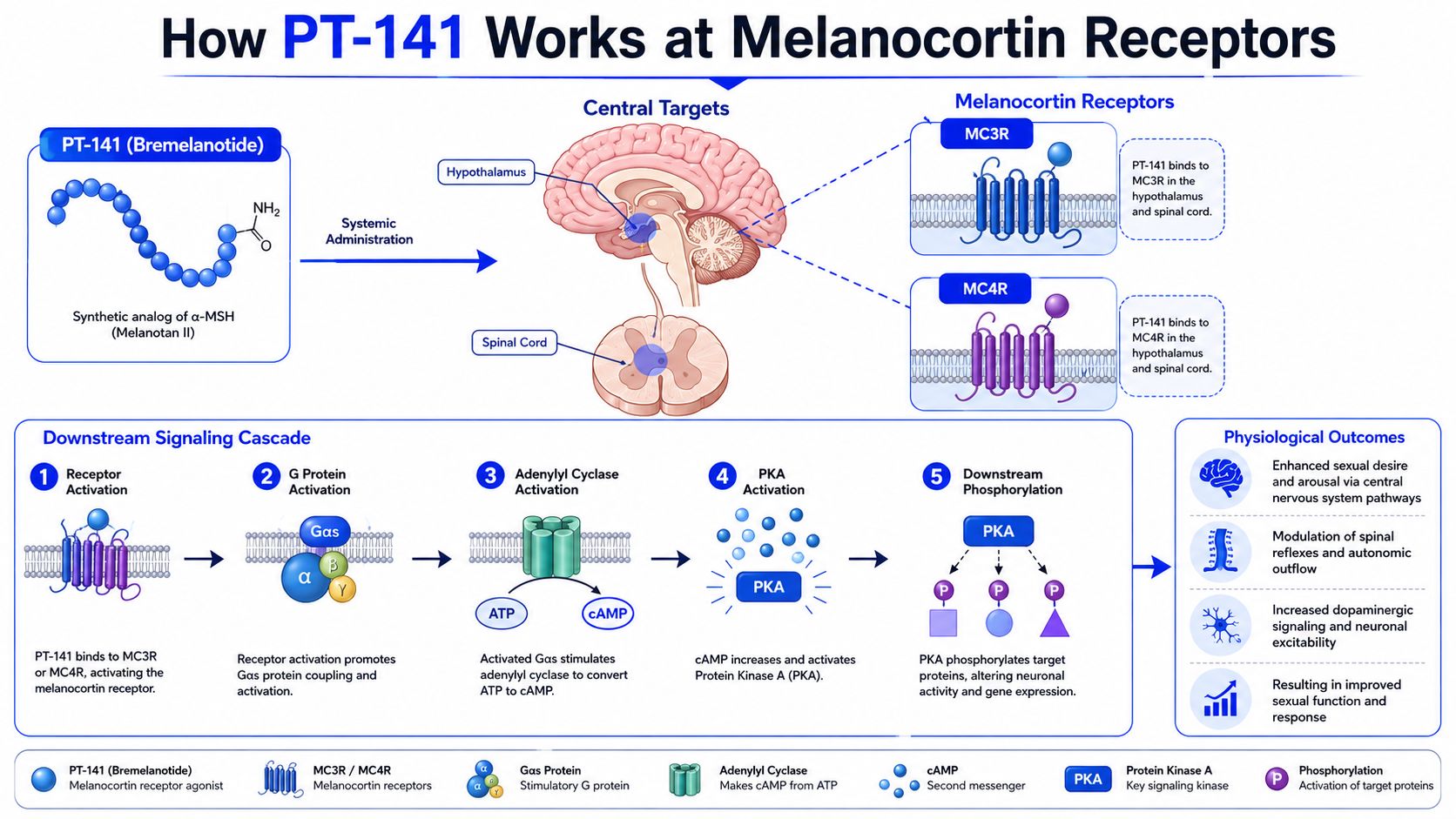
PT-141 research begins with receptor pharmacology, not with a promised outcome. Bremelanotide belongs to the melanocortin agonist field, where receptor activation can influence signaling in tissues involved in central nervous system regulation. MC3R and MC4R are particularly important targets in discussions of melanocortin biology, although a laboratory protocol must define the model, tissue, receptor expression, and assay endpoint rather than assume that one pathway explains every observation.
At a simplified signaling level, agonist binding can promote G-protein-linked intracellular signaling involving cyclic AMP and protein kinase A. The practical point is that an agonist activates receptor signaling, while an antagonist blocks or reduces signaling initiated by another ligand. A receptor assay should therefore distinguish binding affinity from functional activation. A peptide may bind a receptor without producing the same downstream response across cell systems.
Chemical structure matters because endogenous alpha-melanocyte-stimulating hormone and a modified research peptide don't share identical stability or receptor behavior. Bremelanotide's constrained peptide architecture and modifications are intended to preserve biologic activity in the face of enzymatic degradation. Researchers should still verify identity and purity for each lot, because a nominal sequence alone doesn't establish that the supplied material has the expected composition.
Intranasal delivery introduces a chain of variables that a subcutaneous route largely avoids. The peptide must wet the mucosa, remain in contact long enough for absorption, resist clearance by mucociliary transport, and avoid being lost through swallowing or external drip. Nasal congestion, mucosal condition, formulation pH, spray pattern, and operator technique can all affect the delivered amount.
The available intranasal pharmacokinetic study found dose-proportional exposure, meaning mean Cmax and AUC increased with dose. Median Tmax was 0.50 hours, and the mean terminal half-life ranged from 1.85 to 2.09 hours, as reported in the PubMed record for intranasal bremelanotide pharmacokinetics. That profile suggests a formulation change may alter peak exposure and variability more readily than it extends the molecule's terminal duration.
The result is a key lab principle: absorption consistency is often the performance bottleneck. A nasal spray can look convenient on paper while producing wider exposure variation between animals, operators, or study days than the nominal concentration implies.
The development history explains why PT-141 nasal spray appears in research catalogs even though the marketed U.S. product is injectable. A 2004 PubMed record describes Palatin developing bremelanotide as a nasal spray for potential treatment of erectile dysfunction and female sexual dysfunction. That early program established the intranasal route as a serious development path, not merely a later consumer invention.
Clinical development then exposed a practical problem. Intranasal absorption was variable, and blood-pressure concerns emerged alongside tolerability signals such as flushing. Professional drug information describes variable intranasal bioavailability as a factor that could increase adverse effects or reduce efficacy, contributing to the eventual choice of a subcutaneous product. A later randomized phase I study of 20 mg intranasal bremelanotide found the route generally safe and well tolerated, with no clinically significant ethanol interaction, but that result didn't resolve the larger challenge of reproducible mucosal delivery. The bremelanotide professional monograph provides that context.
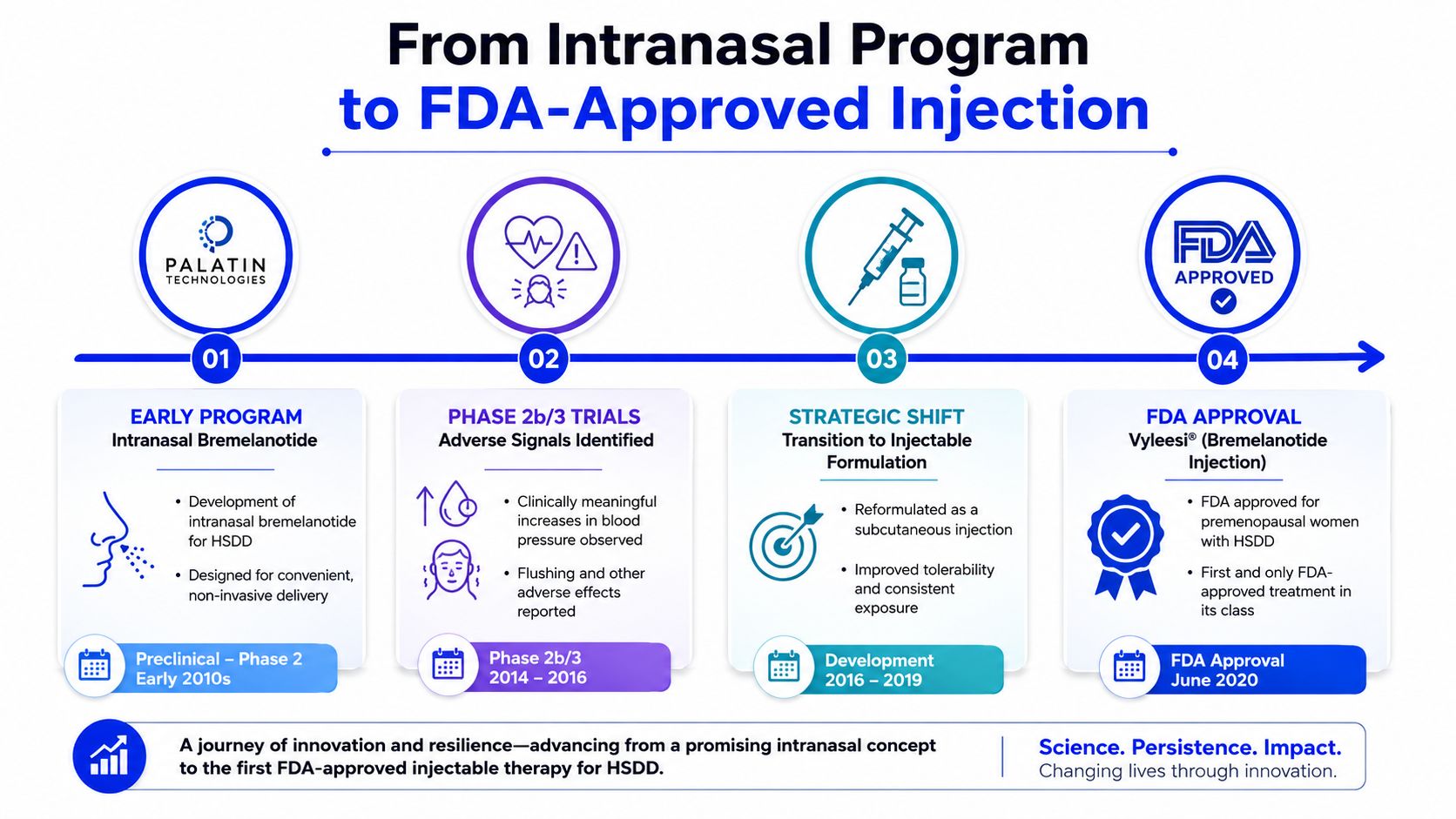
The development sequence is easier to understand as a series of decisions:
The approved product's label confirms that Vyleesi is a subcutaneous injection. The FDA has not approved a commercially available PT-141 nasal spray, and intranasal products described by suppliers are characterized as experimental or research-use material, as reflected in this research-use PT-141 nasal spray description.
For procurement teams, the regulatory arc changes what responsible packaging should say. A current nasal listing shouldn't imply that it represents an active FDA-approved clinical format. It should identify the material as research-use only and provide enough lot, storage, and testing information for a laboratory to evaluate it.
Human trial data can inform what a preclinical team watches, but they shouldn't be converted into consumer instructions. The clinically reported adverse-event profile for bremelanotide includes nausea around 40%, flushing around 20%, and headache around 11%. Nausea was the most common reason for discontinuation, and the clinical data also showed small but statistically significant transient blood-pressure increases and rare focal hyperpigmentation. These figures are summarized in the clinical review of bremelanotide safety and efficacy.
A nasal route adds an exposure question rather than removing the safety question. If mucosal absorption varies, two subjects receiving the same nominal preparation may experience different systemic concentrations. A well-designed animal protocol should therefore pair behavioral or pharmacodynamic observations with exposure measurements and, where appropriate, cardiovascular telemetry.
| Adverse Signal | Human Trial Frequency | Preclinical Tracking Approach |
|---|---|---|
| Nausea | Around 40% | Record feeding behavior, emesis where the species permits it, posture, activity, and time to recovery |
| Flushing | Around 20% | Observe skin or mucosal color changes, temperature-related behavior, and time course |
| Headache | Around 11% | Use species-appropriate proxies such as altered activity, facial expression, posture, or withdrawal |
| Blood-pressure increase | Small, statistically significant transient increases | Use validated blood-pressure measurements or telemetry with predefined observation windows |
| Focal hyperpigmentation | Rare | Inspect skin and mucous membranes during repeated-dose studies and document lesion location and progression |
The table's human frequencies shouldn't be treated as expected animal rates. Species differences, receptor distribution, administration technique, and study design can change the observed pattern. The value lies in creating a structured observation plan before dosing begins.
Humane endpoints should be defined in the approved protocol, not improvised after an adverse event appears.
For repeat-dose work, the record should connect each observation to the animal identifier, batch, formulation, route, administration time, and sampling schedule. Institutional Animal Care and Use Committee requirements remain controlling, including veterinary oversight, humane endpoints, and documentation of unexpected findings.
Alcohol and interaction questions also need disciplined interpretation. Intranasal bremelanotide has been studied with ethanol in healthy participants, and earlier research examined co-administration with sildenafil in specific study settings. Those results are narrow experimental findings, not a general safety endorsement for combinations or unsupervised use.
A nasal research formulation is only as useful as its delivery system. The peptide concentration, vehicle, pH, viscosity, spray device, container, and storage history all influence what reaches the nasal mucosa. Treat the formulation as part of the experimental variable, not as an invisible container around the active ingredient.
Solvent selection should begin with the study objective and the peptide's measured solubility. Bacteriostatic water, saline, and acetic-acid-containing vehicles may behave differently in solubilization, buffering, preservative compatibility, and mucosal tolerance. A vehicle that dissolves the peptide well may still create unacceptable irritation or alter spray performance.
A responsible development sequence includes:
The plan notes associated with nasal formulation often mention propylene glycol and short-term refrigerated storage for reconstituted material. Those conditions must be validated for the particular formulation rather than assumed from a generic peptide protocol. Stability claims require time-point testing, not just a visual inspection.
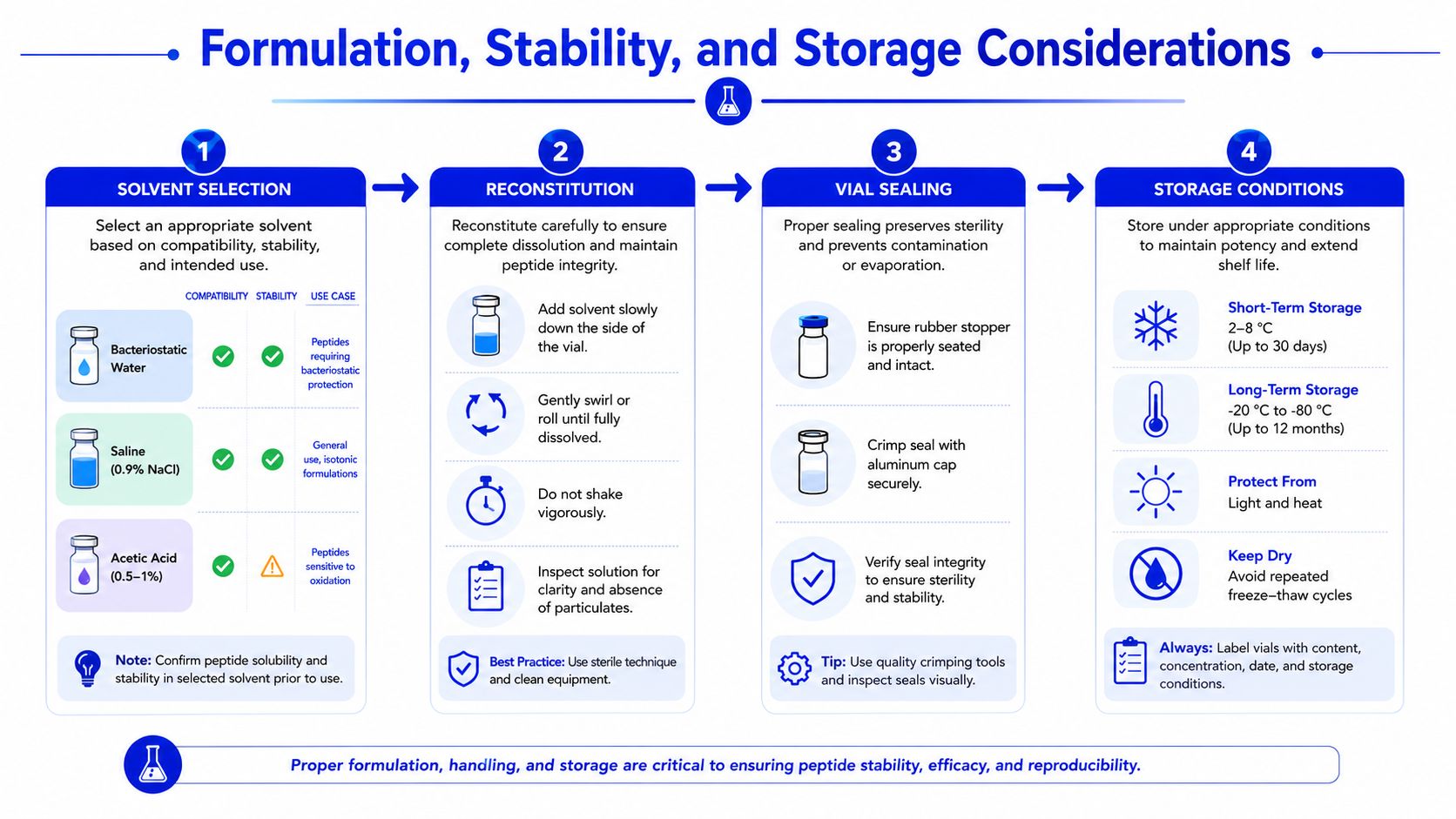
Sterility assurance becomes especially important when a preparation contacts nasal mucosa in animal work. Filter sterilization may be appropriate for compatible solutions, but filtration doesn't correct endotoxin contamination, adsorption losses, poor container closure, or an unstable peptide. The final protocol should define microbial testing, endotoxin controls, handling conditions, and disposal requirements.
For teams comparing external formulation support, a resource describing custom formulations for vape brands may help illustrate how specialized formulation providers present development and customization services. It isn't evidence that a vape formulation is suitable for peptide nasal research, so the lab must still require peptide-specific compatibility, sterility, stability, and analytical documentation.
A certificate of analysis is a receiving gate, not a decorative attachment. Before a vial enters a study, the receiving lab should confirm that the certificate belongs to the exact lot, identifies the material clearly, and reports methods that can support the stated conclusions.
A credible COA commonly addresses several distinct questions:
A high purity statement without supporting data is incomplete. At a high level, a clean dominant peak with clearly identified minor peaks gives more information than a single percentage printed on a generic template. Early-eluting or late-eluting signals may indicate synthesis byproducts, truncated sequences, degradation products, or formulation-related components, although interpretation requires the method and reference standards.
Batch comparison matters just as much as one-time review. Reorders should show consistent identity methods, comparable chromatographic behavior, compatible storage instructions, and lot-specific documentation. A sudden change in appearance or analytical profile should trigger investigation rather than immediate use.
The FDA-linked product-labeling material for intranasal bremelanotide notes that a 20 mg intranasal dose didn't prolong the QTc interval to any clinically relevant extent. That narrow finding illustrates why researchers should match each claim to its exact study condition. One cardiac endpoint doesn't replace identity, purity, sterility, endotoxin, or stability testing for a supplied batch.
A basic verification workflow should include:
Research-only labeling should make the intended use unmistakable. A responsible package for PT-141 nasal spray should identify the material, lot number, storage conditions, supplier identifier, and a clear statement such as “For Research Use Only. Not for Human or Veterinary Use.”
That language is not a substitute for a compliance program. Institutional receiving teams should preserve the supplier documentation, review the safety data supplied with the material, and relabel secondary containers according to applicable workplace hazard communication requirements. GHS pictograms and hazard phrases should reflect the available hazard assessment, not a marketing description.
| Element | Purpose | Example |
|---|---|---|
| Research-use statement | Prevents clinical-use ambiguity | For Research Use Only. Not for Human or Veterinary Use |
| Lot number | Connects material to testing and experiments | Supplier-assigned lot identifier |
| Storage condition | Protects material integrity | Follow the documented temperature and light requirements |
| Supplier identifier | Preserves accountability | Legal supplier name and contact information |
| Product identity | Distinguishes the peptide and formulation | Bremelanotide, PT-141, nasal research formulation |
| Documentation reference | Supports traceability | COA number or linked receiving record |
Age gating is common among research-chemical suppliers, but an age gate doesn't make a product clinically appropriate. Marketing copy that promises sexual performance, erectile benefits, libido enhancement, or human results should be treated as a serious vendor red flag because it conflicts with research-only positioning.
Jurisdiction also matters. The United States, European Union, United Kingdom, Canada, and Australia apply different frameworks to research chemicals, peptide handling, labeling, importation, and institutional use. A purchasing decision that appears acceptable under one jurisdiction may require additional review elsewhere, so the lab's compliance officer and institutional policies should control the final determination.
Procurement should begin with documentation, not with a product photograph or a headline purity claim. The supplier should provide a current, lot-specific COA and enough technical information for the receiving lab to judge whether the material fits the intended experiment.
Use this workflow before approving a PT-141 nasal spray purchase:
Supplier categories involve different trade-offs. A large peptide reseller may offer catalog breadth and repeat ordering, while a contract research organization may provide more structured analytical or formulation support. A boutique vendor may offer custom nasal vehicles or smaller development runs, but the buyer should examine minimum order requirements, batch continuity, method transparency, and sterility documentation before treating customization as an advantage.
The central decision is not whether a nasal spray sounds more convenient. It's whether the supplier can demonstrate identity, composition, stability, traceability, and research-only handling for the exact batch being purchased. No vendor can make intranasal PT-141 legitimate for human use when there is no FDA-approved commercial PT-141 nasal spray.
For labs comparing documented research-use options, Peptide Warehouse USA lists PT-141 nasal spray as a research-use product and describes a U.S.-based supply process with batch documentation, including COAs and microbial and endotoxin reports. Researchers should still review the current lot-specific records, storage instructions, and institutional acceptance criteria before ordering.
Peptide Warehouse USA offers research-use PT-141 nasal spray and related peptide products with batch documentation intended to support laboratory, analytical, and preclinical procurement. Visit Peptide Warehouse USA to review the current catalog, documentation, storage information, and research-use terms before selecting a batch for your lab.
Leave a comment