
No products in the cart.


The most popular advice about certified peptides online is also the least reliable: find a product marked “certified,” check for “research use only,” and assume the paperwork settles the question. It doesn't. Those labels can describe a seller's positioning, but they don't prove that the material is authentic, that the batch matches the report, or that the surrounding marketing complies with regulatory expectations.
A careful buyer evaluates the evidence behind the label. That means matching lot numbers, reviewing HPLC and mass spectrometry results, checking laboratory credentials, confirming storage and shipping controls, and separating product quality from intended-use compliance. This guide explains what legitimate documentation looks like, how to verify it, and which supplier practices should make you stop before placing an order.
“Certified” sounds precise, but online peptide sellers don't use it according to one universal standard. A product page may call a compound certified, pharmaceutical grade, or 99% pure without explaining who performed the testing, which batch was tested, or what the result proves. In practice, a marketing label isn't the same thing as an independent quality credential.
The same caution applies to research use only, or RUO. FDA guidance describes RUO as a designation connected to intended use for laboratory research or early investigation, not as a quality certification or evidence of FDA approval. The FDA guidance on RUO labeling and distribution supports the important distinction: RUO language describes how a product is intended to be used, but it doesn't independently validate identity, purity, sterility, or performance.
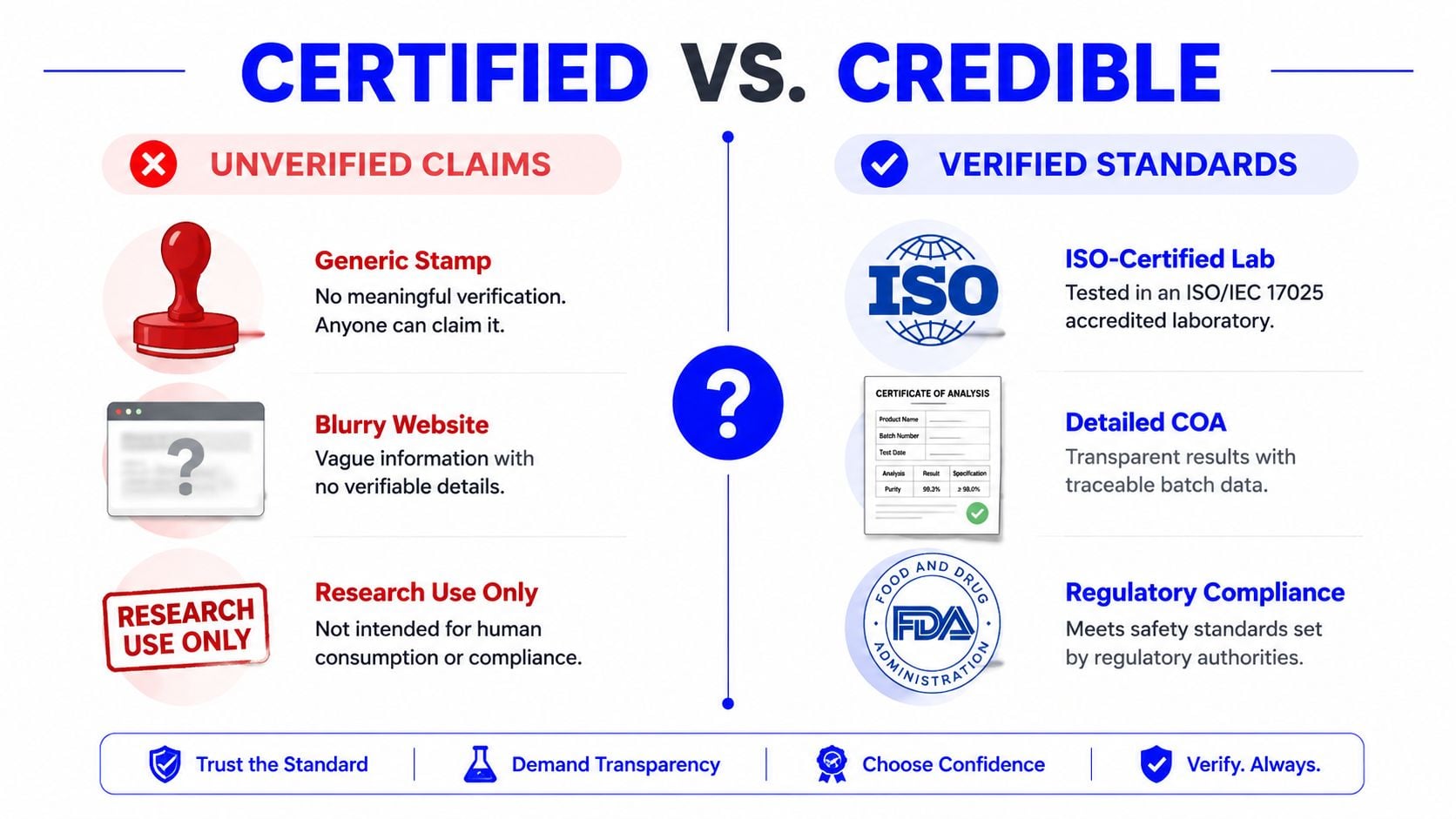
A credible supplier should be able to connect the product in your cart to a defined production lot and a test report issued for that lot. The report should identify the peptide, show the analytical methods used, include the testing date, and identify the laboratory or provide a practical way to verify the document. A polished PDF with a logo, a high purity figure, and no traceable batch information has limited procurement value.
Independent compliance summaries also emphasize conspicuous RUO language such as “For Research Use Only. Not for use in diagnostic procedures,” while making clear that RUO products generally sit outside premarket clearance pathways. That positioning matters, but it doesn't rescue a product page that implies treatment, weight loss, performance enhancement, healing, or other human outcomes. Independent RUO labeling guidance explains why the wording and the surrounding presentation must be assessed together.
Practical rule: Treat “certified” as a question, not an answer. Ask, “Certified by whom, for which lot, using which methods, and verified how?”
The strongest purchasing decision combines analytical proof and compliant presentation. A COA can support a quality assessment, but it can't by itself determine whether a seller's claims, checkout flow, labeling, storage, or distribution practices create a separate compliance problem.
A useful quality file answers different questions with different tests. HPLC purity estimates how much of the sample consists of the target component, while mass spectrometry checks whether the molecule has the expected identity and molecular weight. Those results complement each other. High purity doesn't prove the material is the correct peptide, and a matching molecular identity doesn't prove that unwanted impurities are absent.
A defensible COA should be batch-specific, not a generic document reused across product pages. Independent guidance recommends looking for the peptide name, lot or batch number, testing date, purity percentage, mass spectrometry data, laboratory contact information, and a verification mechanism such as a code or QR system. The peptide purity and COA checklist provides a practical reference for these fields.
| Document / Test | What It Proves | Acceptable Benchmark |
|---|---|---|
| Certificate of Analysis | Connects a defined lot to reported test results and laboratory details | Batch or lot number, testing date, methods, laboratory identity, and verification path |
| Reverse-phase HPLC | Estimates the proportion of the sample represented by the target component and shows an impurity profile | A clear chromatogram and reported result that can be interpreted with the stated method |
| Mass spectrometry | Supports molecular identity by comparing observed mass with the expected peptide | A result tied to the same lot and an expected molecular mass or sequence reference |
| Amino acid analysis | Provides additional compositional information about the material | Method, sample identity, and results that are consistent with the claimed peptide |
| Microbial testing | Evaluates microbial contamination relevant to laboratory handling and application | A report identifying the tested lot, method, and laboratory interpretation |
| Endotoxin testing | Assesses bacterial endotoxin contamination | A lot-specific result with the assay method and reporting units |
| Heavy metal screening | Checks for specified metal contaminants | Named analytes, method details, detection information, and lot traceability |
The word acceptable needs context. A single universal threshold doesn't apply to every peptide, assay, research model, or intended laboratory application. A responsible supplier should state the method and result rather than hide behind a broad purity claim, and the buyer should ask the laboratory or their own quality team how the result fits the planned work.
In-house testing can provide useful process control, but it creates a different level of independence from third-party testing. An ISO 17025-accredited laboratory operates under a recognized competence framework for testing and calibration, which gives procurement teams a stronger basis for assessing the laboratory itself. Accreditation still doesn't make every report automatically correct, so the report must remain tied to the exact lot and method.
The core standard is simple: require HPLC and MS together, then add microbial, endotoxin, and other screens when the application warrants them. The HPLC and mass spectrometry explanation explains why relying on only one of those two identity and purity tools is technically weak.
Start with the laboratory, not the purity number. A report that says “99%” is only useful if you can determine who tested the sample, whether the lab is independent, and whether the report belongs to the lot you're considering.
Identify the issuing laboratory. Look for the laboratory's legal name, address, contact details, methods, and accreditation information. Don't treat a manufacturer's internal quality document as equivalent to independent confirmation.
Match the lot information. Compare the COA's batch or lot number with the product listing, container label, invoice, and any shipping record. A mismatch means you can't confidently connect the document to the material received.
Review the testing date and method. A date alone isn't enough. Check whether the report identifies the instrument or method used, the sample description, and the analytical conditions needed to interpret the result.
Read the actual data. For HPLC, look for a chromatogram rather than only a headline purity figure. For MS, compare the observed result with the expected molecular weight or identity information supplied for that peptide.
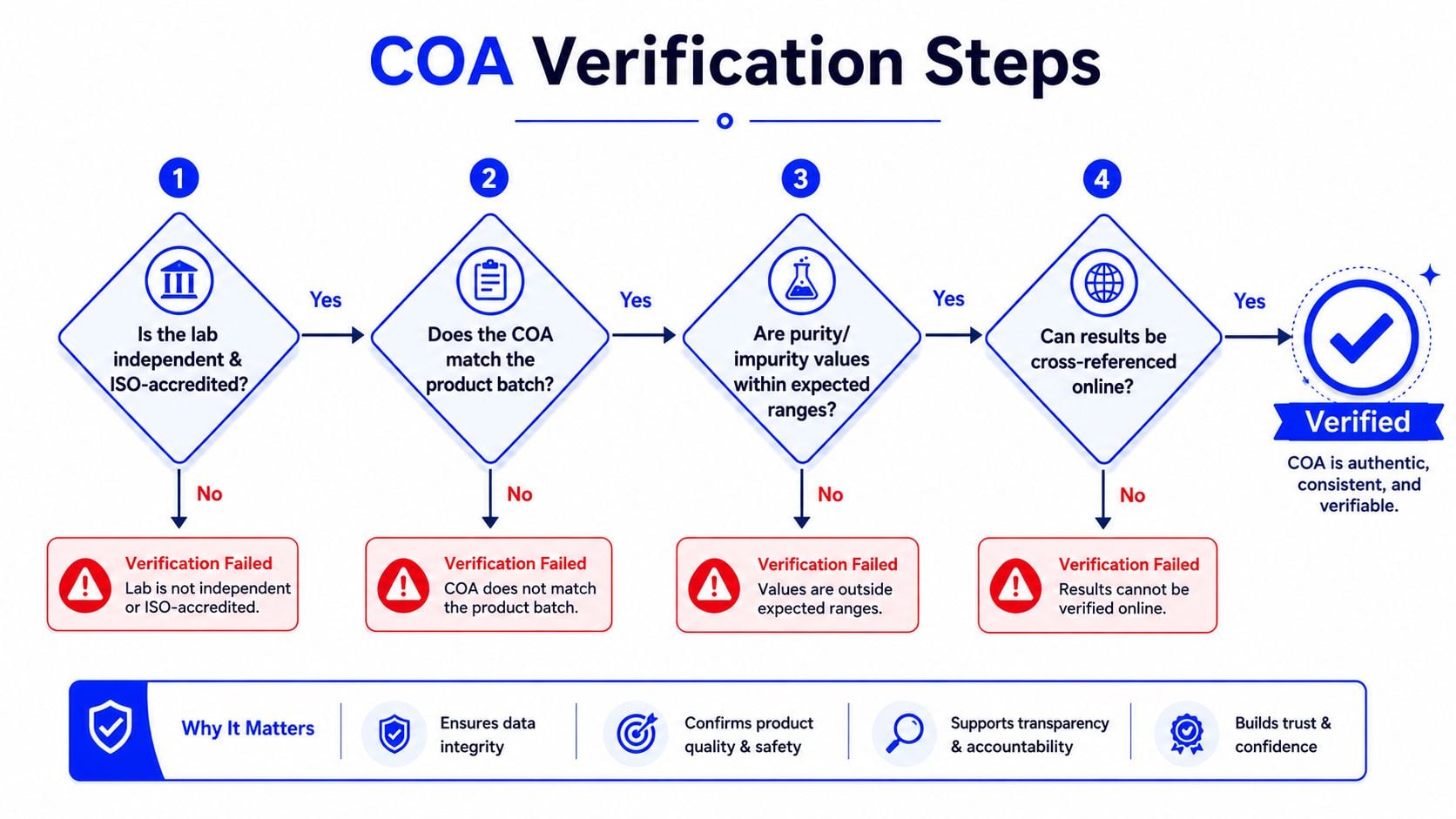
Use independently sourced laboratory contact information when possible. Contact the lab directly, provide the report number or verification code, and ask whether it issued the document for the named lot. Don't rely solely on a phone number or email address printed inside a questionable PDF.
Look for internal consistency as well. Repeated formatting errors, unexplained redactions, identical purity values across unrelated products, missing signatures, or a report that names no laboratory should trigger further review. These signs don't prove fraud on their own, but they weaken the chain of evidence.
Procurement standard: If the vendor can't provide complete, lot-specific documentation or won't allow reasonable verification, don't fill the gap with trust. Choose a supplier whose records can be checked.
A COA also doesn't answer every compliance question. The product title, advertising language, labeling, storage instructions, checkout experience, and distribution model can all influence how the product is presented. Buyers should therefore assess the whole purchasing environment, not just download a PDF and move on.
Experienced buyers often use a rapid triage system. They don't begin by debating whether a website looks modern. They look for evidence that the supplier controls its batches, understands laboratory documentation, and can explain how its products move from manufacture to delivery.
| Criteria | Legitimate Supplier | Red Flag Supplier |
|---|---|---|
| COA specificity | Provides a report tied to the product's lot or batch | Reuses a generic PDF with no lot number or testing date |
| Analytical coverage | Shows HPLC purity plus MS identity confirmation | Lists only a purity percentage or HPLC result |
| Contamination data | Can provide relevant microbial and endotoxin documentation | Can't produce contamination testing when asked |
| Laboratory identity | Names an independent laboratory with verifiable credentials | Uses an unnamed lab, an internal report, or an unverifiable logo |
| Business information | Publishes a usable business address and responsive contact channel | Hides its location or offers only a disposable contact form |
| Packaging and transport | Explains storage and shipping controls appropriate to the material | Ships without clear handling instructions or protective controls |
| Product claims | Keeps research positioning separate from human-use promises | Uses RUO wording while advertising wellness or therapeutic outcomes |
| Batch consistency | Explains how results vary by production run | Shows identical purity figures across unrelated sequences |
Price deserves careful interpretation. A lower price can reflect efficient production, packaging, or order volume, but a dramatic unexplained discount paired with weak documentation creates a poor risk trade-off. You may save on the invoice while losing time to failed experiments, disputed shipments, or material that can't be defended in an audit.
A missing document might result from a website error, but the supplier should correct it promptly. Multiple problems, such as no lot number, no independent laboratory, no MS result, and vague answers about shipping, should disqualify the vendor rather than invite a larger order.
A vendor's use of “pharmaceutical grade” also deserves scrutiny. That phrase can create an impression of medical authorization even when the seller hasn't shown a recognized standard behind it. Ask for the exact certification, issuer, scope, and lot relationship instead of accepting the phrase at face value.
Regulatory scrutiny has made online peptide procurement less forgiving. In December 2024, the FDA issued a warning letter to Summit Research Peptides after reviewing the company's website in October 2024. The agency concluded that products including semaglutide, retatrutide, cagrilintide, tirzepatide, and mazdutide were unapproved new drugs introduced into interstate commerce in violation of the Federal Food, Drug, and Cosmetic Act. The FDA import and peptide enforcement analysis identifies this as an important marker because website content can become evidence of intended use.
That point changes how a buyer should read “research use only.” RUO wording doesn't protect a listing if the rest of the page suggests that people should use the product for treatment, body composition, performance, or general wellness. A 2026 analysis of FDA action involving RUO peptide advertising describes the same practical concern.
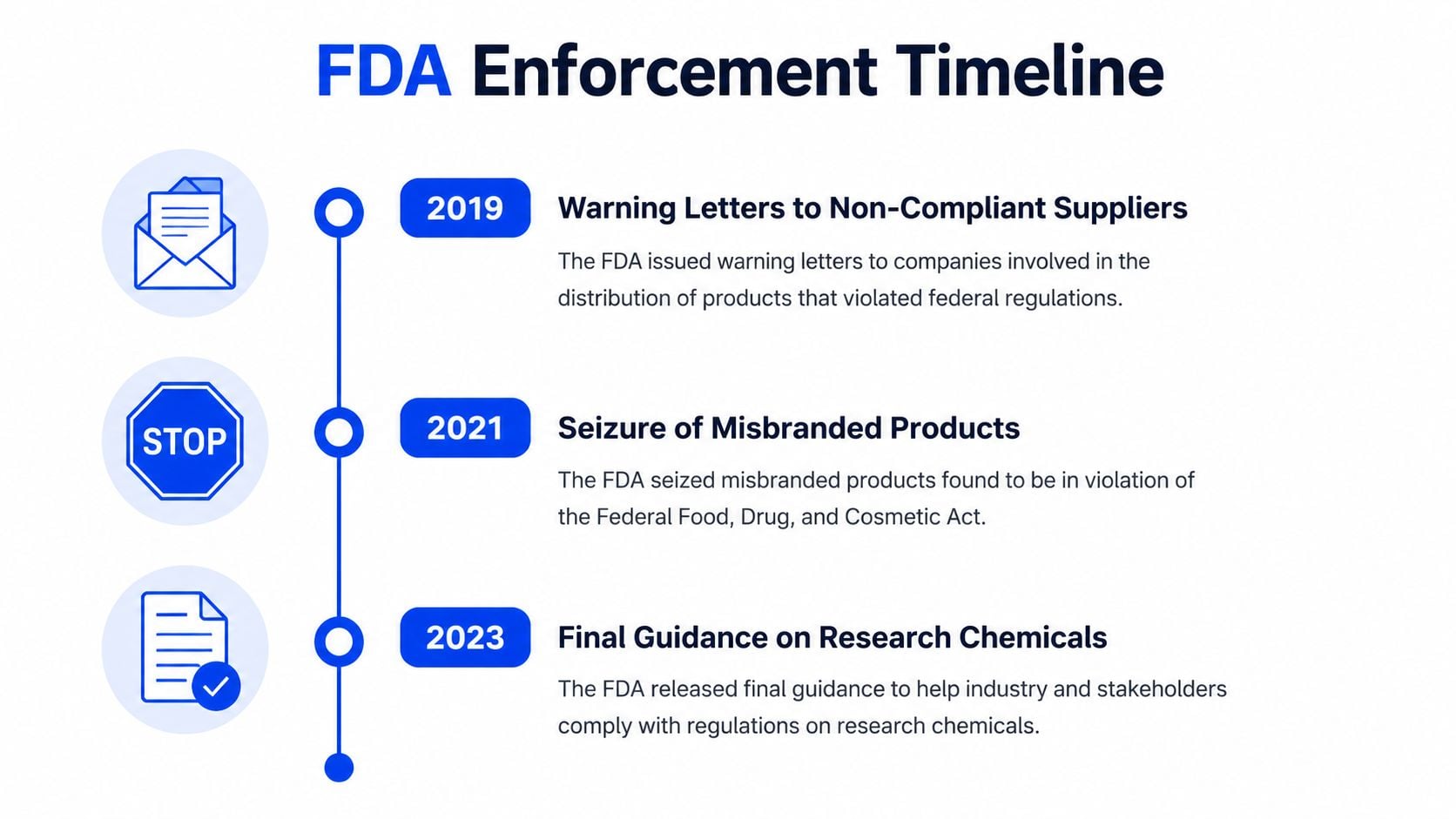
The FDA established Import Alert 66-80 in September 2025, described as a Green List for GLP-1 active pharmaceutical ingredient manufacturers whose products may enter the U.S. supply chain when the source is verified as compliant. Industry analysis also reported that Import Alert 66-78 was expanded in 2025 to add 12 more unapproved peptides subject to detention without physical examination. The analysis of FDA import alerts and peptide warning letters connects those developments to traceability, documentation, and seizure risk.
For procurement teams, the lesson is practical. Quality files should sit alongside supplier identity, manufacturing information, shipping records, storage instructions, and chain-of-custody documentation. A supplier may provide a strong COA and still create risk through unclear labeling, weak handling controls, or claims that imply human use.
A short video can help teams discuss the broader compliance context, but it shouldn't replace primary documentation or legal review.
The regulatory environment doesn't make every online research supplier illegitimate. It does mean that documentation, intended-use language, and distribution practices must be evaluated together.
Use this checklist before payment and again when the shipment arrives. It's a minimum procurement control, not a substitute for application-specific quality assurance.
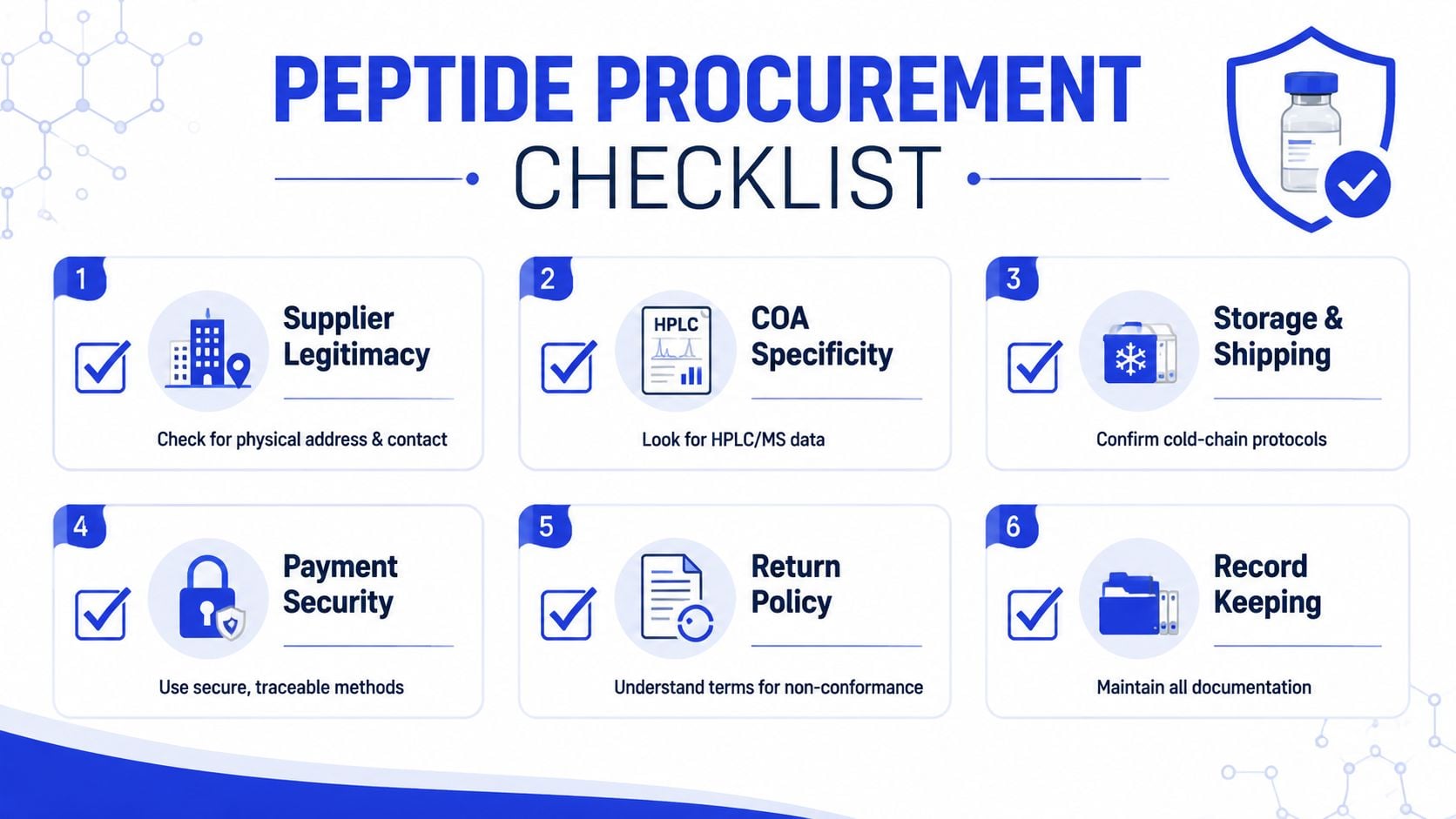
Inspect the outer packaging, labels, seals, and container condition before accepting the material into inventory. Compare the received lot number with the COA, invoice, and supplier records, then archive the complete file in a location your laboratory can retrieve during an audit or investigation.
Record discrepancies immediately. Don't alter labels, discard packaging, or merge material into a shared stock until the issue is resolved and documented.
Reliable peptide procurement is a continuing quality discipline, not a one-time search for a product stamped “certified.” Maintain a living vendor dossier that includes every COA, lot number, test result, shipping record, communication, and non-conformance decision associated with the supplier.
A second useful control is supplier diversification. Maintaining relationships with two or three vetted suppliers can reduce dependence on one source, but only if each supplier passes the same documentation and verification standards. Recheck trusted vendors periodically because manufacturing arrangements, laboratories, formulations, and website claims can change.
Research communities also provide practical intelligence. Colleagues can flag delayed shipments, inconsistent documentation, packaging problems, or changes in responsiveness before those issues affect a larger project. That informal feedback should support, not replace, formal testing and record keeping.
The next order is the right time to put the process into practice. Run the verification checklist, request current batch documents before payment, confirm the lot after delivery, and reject vague assurances when hard data is missing.
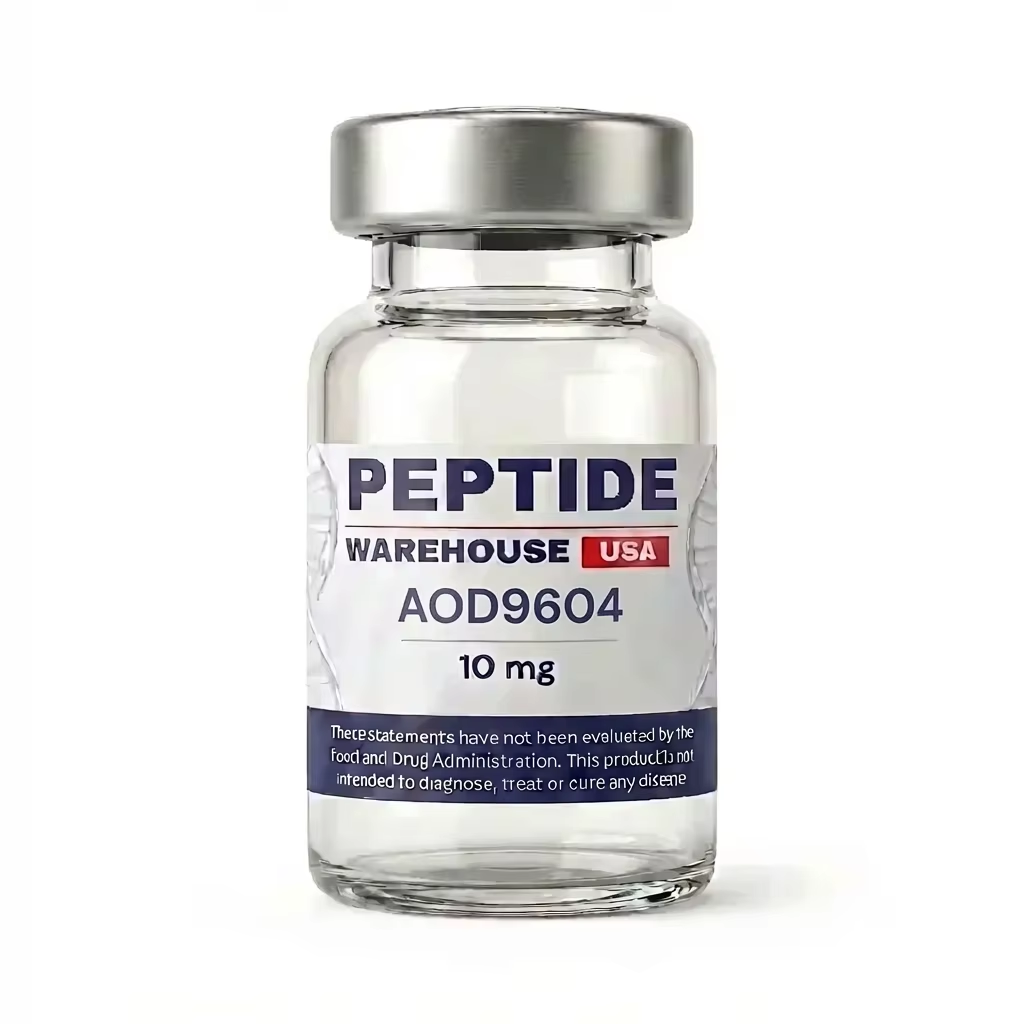
Peptide Warehouse USA provides U.S.-manufactured research peptides and related compounds with batch-specific COAs, stated purity information, and third-party microbial and endotoxin documentation for laboratory, analytical, and preclinical applications. Visit Peptide Warehouse USA to review available research-use products, documentation, shipping information, and support options before your next procurement decision.
Leave a comment