
No products in the cart.


The worst advice about bioglutide peptide for sale is simple, if it's listed online, it must be ready for lab use. That assumption is wrong. In this market, a sales page can mean anything from a legitimate research material with traceable documentation to speculative inventory built around an investigational asset that still lacks the evidence depth buyers should demand.
If you manage procurement, you need a sharper filter than price or packaging. Bioglutide sits in a messy corner of the peptide and metabolic research market, where marketplace language often runs ahead of the science. The right question isn't whether a listing exists, it's whether the listing can survive document review, identity verification, and a reality check on regulatory status.
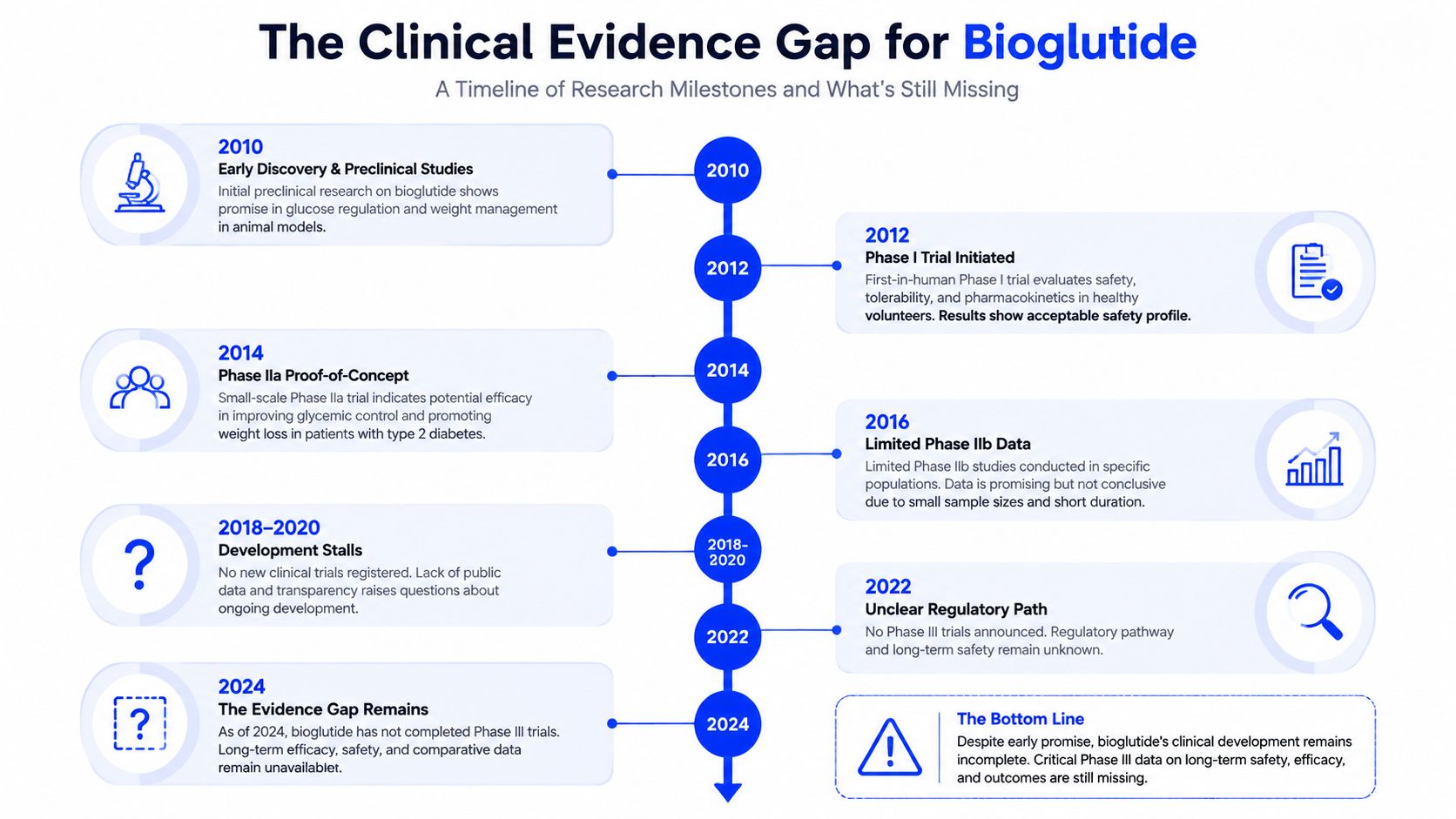
Commercial availability does not equal research maturity. Buyers get that wrong when they search for bioglutide peptide for sale and treat the listing itself as proof that the compound is established. Bioglutide (NA-931) remains an early-stage obesity drug candidate, and the public record still points to limited human data rather than a mature, broadly validated research product.
Independent coverage describes Bioglutide, also called NA-931, as an orally administered quadruple receptor agonist developed by Biomed Industries Bioglutide overview and development status. That distinction matters because many marketplace pages present it like ordinary peptide stock, while the scientific record still reflects an investigational compound with limited publication depth.
A listing can be perfectly polished and still tell you almost nothing useful.
Practical rule: If a vendor's page sounds more confident than the evidence base, treat it as a sales pitch, not a validation package.
Marketplace wording creates false certainty. Some pages list raw powder, others offer capsule formats, and some fold NA-931 into generic peptide inventory. None of that proves the material is standardized, and none of it shows whether the seller can document what is in the vial or capsule.
Bioglutide is still tied to development-stage evidence, not a mature commercial use case. That makes buyer caution mandatory. A page that says "for sale" may signal inventory movement, not suitability for meaningful laboratory work.
The procurement standard is blunt. If the listing cannot state the exact compound identity, intended research use, and documentation trail, do not treat it as procurement-ready. Treat it as a lead that still needs proof.
The gap in evidence explains why every bioglutide peptide for sale listing deserves skepticism. Publicly visible support still comes from short human studies, not from a mature clinical package. The verified research summary points to a Phase 1 study and a 13-week randomized, double-blind Phase 2 trial in 125 adults, with placebo-adjusted weight loss of 12.4% at 150 mg/day and 72% of treated participants achieving at least 12% weight loss versus 2% on placebo Bioglutide Phase 1 and Phase 2 summary. Those findings are interesting, but they do not make a product ready for procurement outside research use.
Short studies can show biological activity. They do not establish long-term safety, durability, or cardiovascular outcome data. Procurement teams should not read early efficacy signals as proof of readiness.
The same source describes Bioglutide as an investigational drug with no approved dose and says Phase 3 trials are planned, not completed Bioglutide dosing and trial summary. That leaves the scientific question open. A material built around an open question belongs in research, not in routine buying decisions.
Bioglutide sits in the broader incretin and metabolic research area, but it does not match the maturity of established obesity therapies. Semaglutide first received U.S. FDA approval in 2017 under the brand name Ozempic, then received another approval in 2021 as Wegovy for chronic weight management FDA approval history for semaglutide. That history is why semaglutide-related products became embedded in the market, while Bioglutide remains an investigational topic.
Bottom line: If you are buying for a research program, the standard is not whether a vendor has listed the compound. The standard is whether the material has enough evidence and documentation to be treated as validated research stock.
A sound procurement decision follows the evidence, not the sales copy. If your project needs a compound with broad clinical validation, Bioglutide is not there yet.
The marketplace around bioglutide peptide for sale is fragmented enough to raise immediate caution. Search results and listings describe it as raw powder, capsules, and generic peptide stock, sometimes with inconsistent pack sizes and shifting product language. That's not a normal sign of a coherent research supply chain, it's a sign that sellers are borrowing the same search term for different offerings.
Independent coverage describes Bioglutide, or NA-931, as an oral small-molecule medicine in development for obesity, not a standard retail peptide with a settled human-use protocol Bioglutide product description and market fragmentation. That mismatch is the core issue. If the underlying compound is described as an oral development asset, but the listing sells it like bulk peptide powder, the labeling needs scrutiny.
| Marketplace Claim | Scientific Reality | Red Flag Level |
|---|---|---|
| Raw peptide powder available | Public descriptions frame NA-931 as an oral development compound | High |
| Capsules offered for purchase | Oral format may fit development-stage use, but it still needs traceable identity and documentation | Medium |
| Generic peptide inventory listing | Generic merchandising doesn't confirm compound coherence or research validation | High |
| Variable pack sizes and prices | Commercial packaging doesn't prove scientific consistency | Medium |
| “Pure” or “high-quality” claims without full documentation | Marketing language isn't a substitute for batch-specific verification | High |
A credible research supplier doesn't hide behind flexible product language. It tells you exactly what the material is, what it isn't, and what proof backs the claim. If a seller can't reconcile an oral development asset with a powder listing, you're probably looking at marketplace noise rather than procurement-grade inventory.
A good procurement team asks one simple question: does the product description make scientific sense on its own? If it doesn't, don't try to rescue it with optimism. Move on.
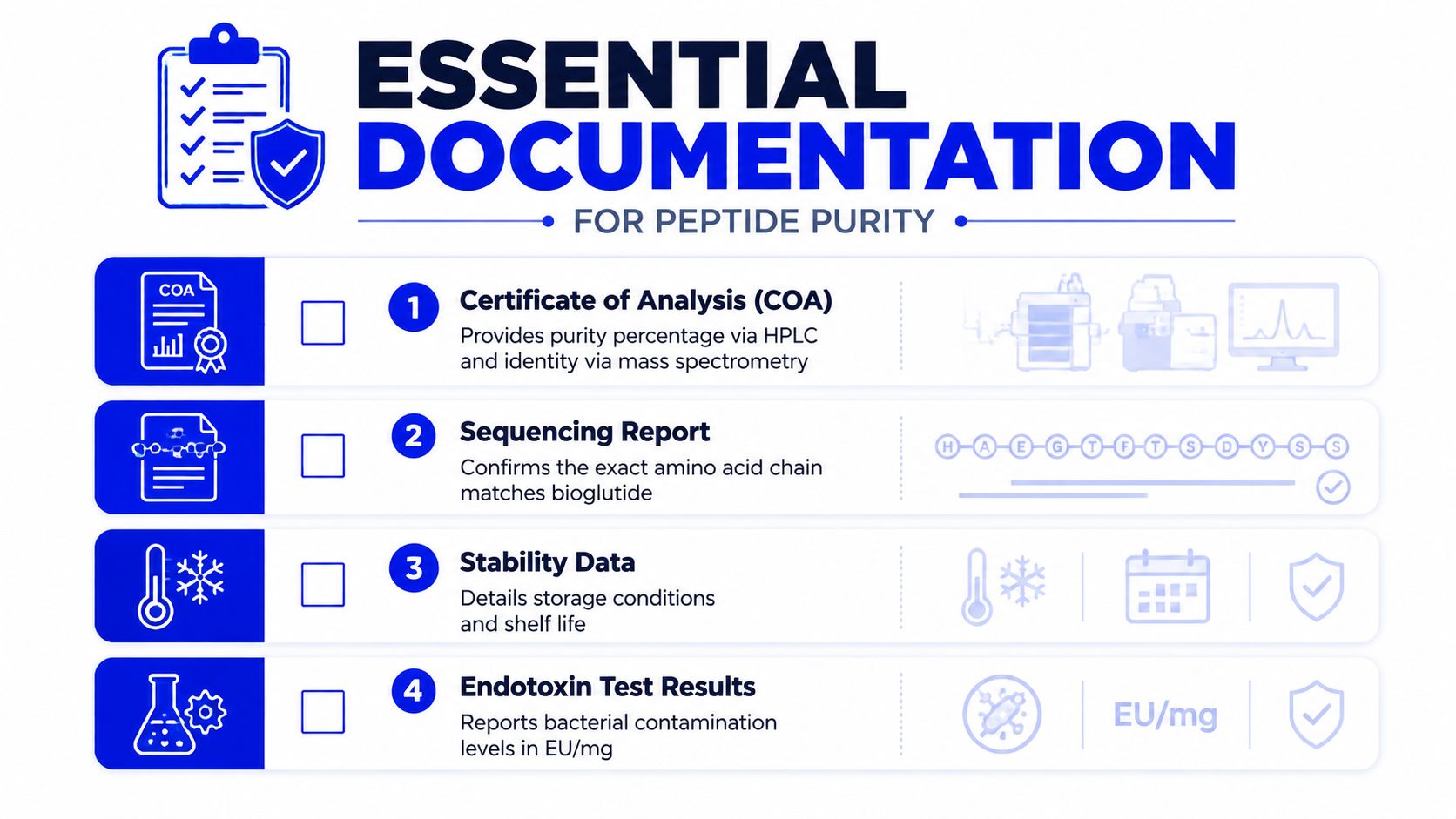
A Certificate of Analysis is the starting point, not the finish line. For research peptides, the paper trail has to show identity, purity, and contamination control. A quality-control guide explains that HPLC and mass spectrometry can confirm purity and molecular identity, but they cannot detect bacterial endotoxin, so separate endotoxin testing is required for material that may be used in injectable-relevant research Peptide purity verification and endotoxin guidance.
A usable procurement file should include more than a vendor invoice. It should give batch-specific proof that the material matches the claimed compound and that contamination has been checked independently.
One industry guide says research-grade peptides typically meet a 98%+ purity threshold, while sterility and endotoxin remain separate pass or fail or measured fields Research-grade peptide legal and purity guidance. That is the number buyers should remember, not whatever is printed in a sales banner.
A COA alone creates a false sense of safety. Analyses discussed in Peptide purity verification and endotoxin guidance and broader grey-market peptide analysis reviews show that products labeled near 99% purity can fall far below claim and still carry measurable endotoxin contamination. That is enough to derail a research program if the material goes in without independent verification.
Practical rule: If the seller will not provide batch-specific documentation and separate endotoxin data, the material is not procurement-ready.
Documentation quality matters because pharma failures are often data failures first. For a broader reminder of how weak records distort decisions, review pharmaceutical data quality failures.
If the paperwork cannot travel with the vial, the vial does not belong in your freezer.
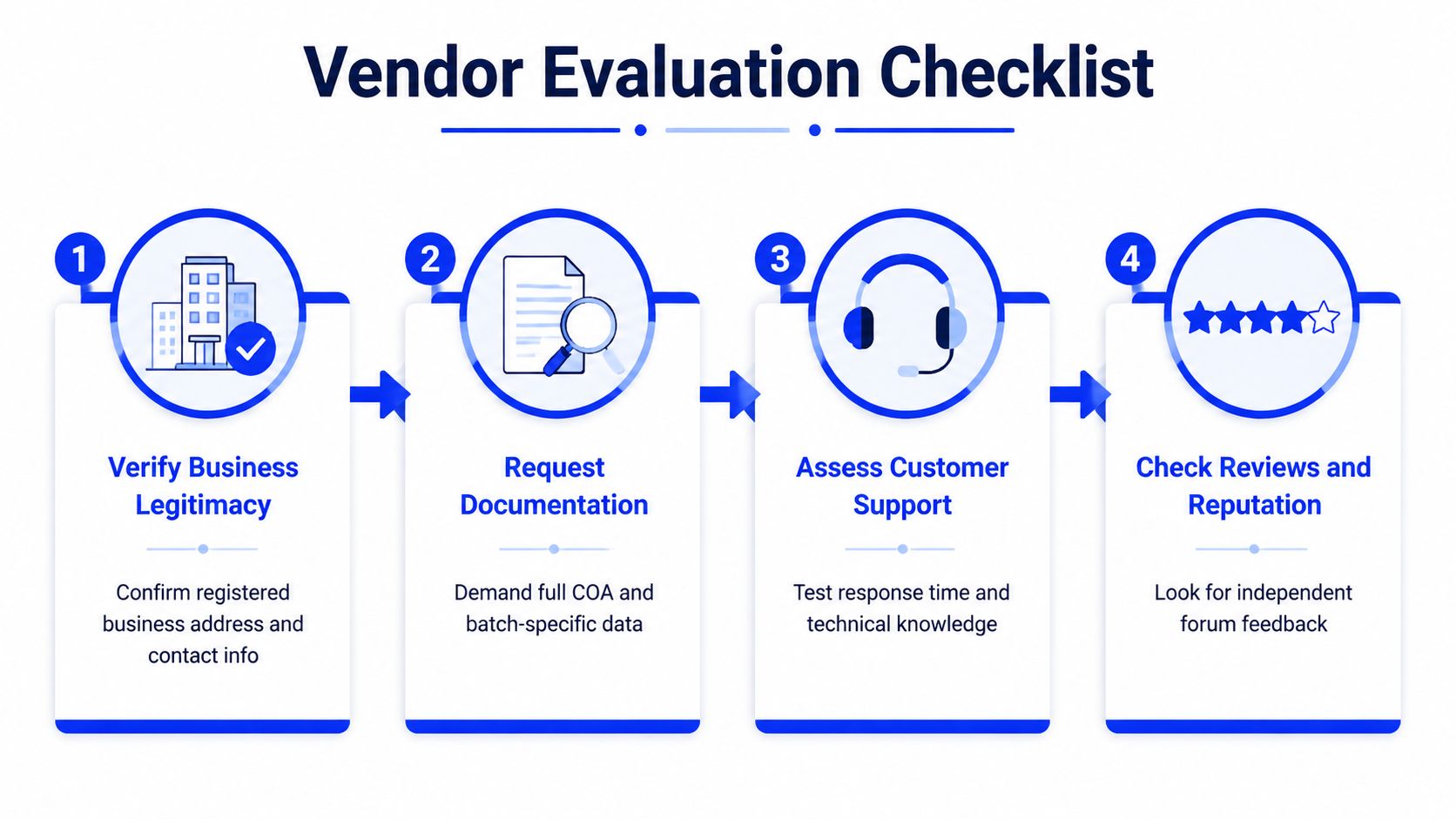
Start with the seller, not the listing. A bioglutide peptide for sale page can look polished while still pointing to speculative inventory, so procurement teams should verify whether the vendor can support real research use or only copy marketplace language. The difference shows up in records, not in slogans.
Legitimate suppliers leave a paper trail. They show a registered business identity, batch-level documentation, and support staff who can separate purity claims from regulatory claims without improvising.
A supplier like Peptide Warehouse USA fits this standard. It presents itself as a U.S.-based research peptide supplier with batch testing, COAs, microbial and endotoxin reports, and research-only labeling. That is the documentation posture lab managers should expect from a serious research-facing seller.
Cut a vendor if it cannot explain what it sells. Vague product titles, no batch data, no source information, or disclaimers that clash with the actual product format are warning signs. A site built to capture search traffic, rather than support procurement, belongs in the discard pile.
Fast test: If a seller will not answer plain questions about batch testing and source traceability, do not waste time arguing with the listing.
Procurement teams need coherent records, responsive support, and products that can survive an audit. That standard is basic, and many marketplace sellers still fail it.
The regulatory line matters because some sellers blur it on purpose. FDA rules distinguish outsourcing facilities from ordinary compounders. Drugs compounded by an outsourcing facility can qualify for exemptions from FDA approval requirements and from the requirement to label products with adequate directions for use, but they're still subject to current good manufacturing practice requirements FDA compounding and research-use compliance guidance.
Research chemical suppliers should make the use case obvious. They should state that products are sold for research, laboratory, or analytical use only, not for human consumption. Age-gates and FDA disclaimers help keep that boundary visible.
That labeling is not decoration. It shows the seller understands its regulatory lane. If the page reads like consumer e-commerce while the product is still in a research gray zone, the compliance posture is weak.
Mixed messaging is the biggest warning sign. A page that sells a development-stage compound while implying consumer readiness is not careful about regulatory boundaries. That is especially risky with peptide products because buyers can confuse research use with clinical suitability.
Procurement teams should keep the standard simple. Check whether the seller behaves like a research supplier with documented controls, or like a storefront trying to turn curiosity into sales. The first model can be usable. The second creates audit problems later.
The cleanest way to evaluate bioglutide peptide for sale claims is to stack four questions on top of each other. First, is the evidence base mature enough for your use case. Second, does the documentation prove identity and purity. Third, does the vendor act like a real research supplier. Fourth, does the regulatory labeling line up with the product format.
If the answer to any of those questions is weak, stop there. Don't let a low price or a polished storefront override the basics. Research procurement is supposed to reduce uncertainty, not import it.
Walk away if the product description is inconsistent, if the seller can't explain the test package, or if the listing mixes research language with consumer-style promises. Walk away if the material format doesn't match the scientific description. Walk away if the only proof is a COA screenshot with no batch context.
The right procurement decision isn't about finding the most exciting listing. It's about finding the most defensible one. If you need a research peptide supplier that keeps the paperwork front and center, review the catalog and documentation standards at Peptide Warehouse USA, then compare them against the batch evidence you're willing to accept before you order.
Leave a comment