No products in the cart.



You've found a peptide supplier USA listing that promises high purity, fast shipping, and research-grade material. Then the shipment arrives, and the vial label shows a lot number that doesn't match the Certificate of Analysis. The document lists purity but says nothing about endotoxins, microbial testing, or molecular identity. Your experiment is already scheduled, so replacing the material creates more than an administrative inconvenience. It can disrupt timelines, consume samples, and leave you questioning whether an unexpected result came from your protocol or your supplier.
That's why peptide procurement should be treated as a documented supply-chain decision, not a simple online purchase. This guide focuses on the checks that matter in practice, including batch-specific COAs, HPLC and mass spectrometry data, endotoxin reporting, RUO compliance, shipping reliability, and backup sourcing.
A sealed vial can look acceptable while still creating a serious procurement problem. Appearance does not confirm sequence identity, purity, residual solvents, microbial contamination, or endotoxin burden. Those questions depend on analytical records linked to the exact production lot, not on the label or product-page description.
Begin with the vial label. Record the lot or batch identifier, product name, stated quantity, storage instructions, and date received. Compare each item with the supplier's Certificate of Analysis. A valid COA covers one production lot, so the batch number must match the vial label exactly. Batch-specific COA guidance explains why a COA from another lot cannot verify the material in your possession.
Treat a mismatch as a release-blocking issue, not a formatting error. The document no longer establishes that your sample received the reported testing. Ask for the correct record before the peptide enters the study, and keep the shipment on hold until the discrepancy is resolved. For institutional purchasing, this simple control prevents an avoidable dispute later.
An unsuitable batch can invalidate an experiment, but the operational effects reach beyond the assay:
Endotoxin reporting deserves particular attention when the peptide will contact sensitive cell systems or enter a workflow with defined acceptance limits. A supplier that reports only a headline purity value leaves buyers unable to compare the lot against their protocol requirements.
Practical rule: Approve the specific lot only after the label, COA, analytical results, and intended use align.
A dependable peptide supplier USA should make that verification practical. It should provide lot-specific records, identify testing methods, explain whether testing is internal or independent, and label products clearly for research use only. The goal is to identify supply and documentation risks before they reach the bench.
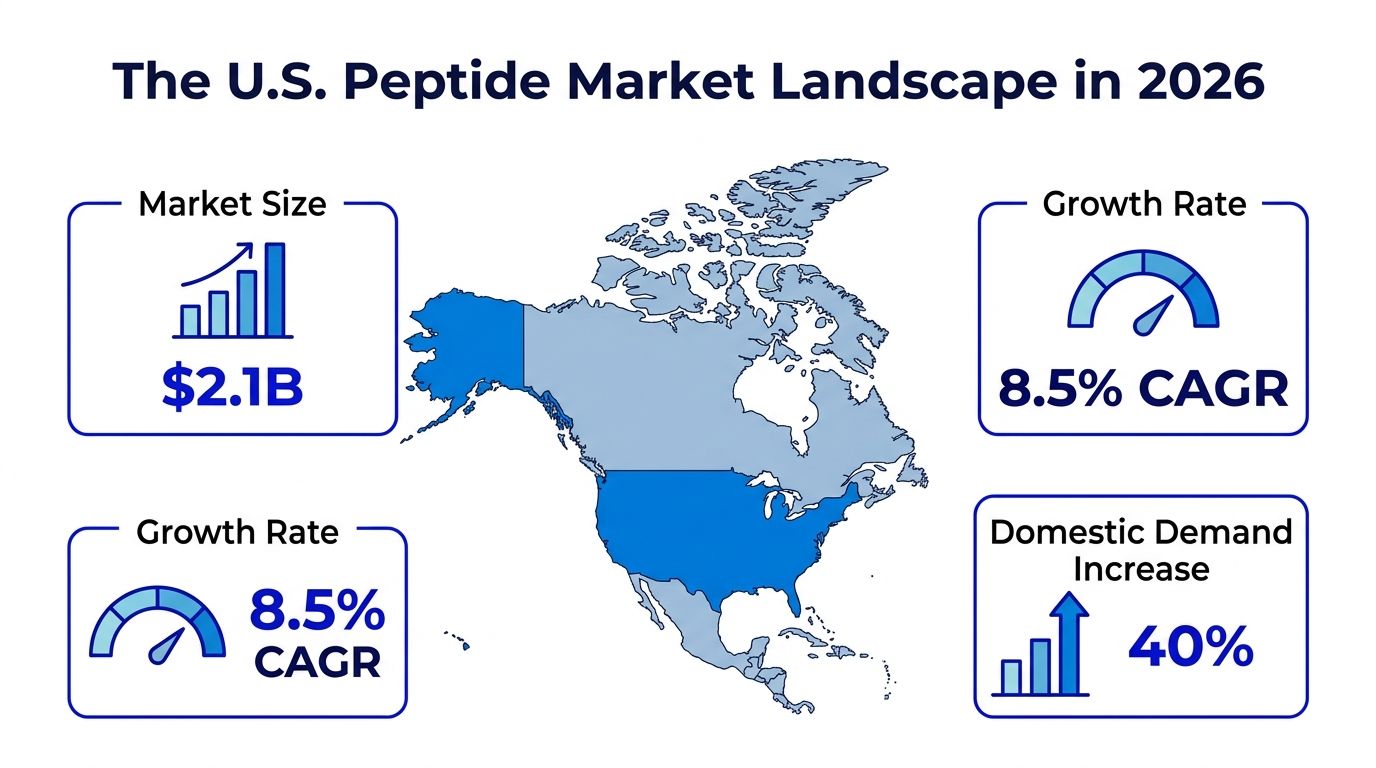
A procurement team qualifying a new peptide supplier is working within a large and expanding therapeutic and research market. One 2026 market estimate places the global peptide therapeutics market at USD 140.9 billion in 2025 and projects it to reach USD 294.6 billion by 2033. Depending on market scope, the same analysis reports projected CAGRs from roughly 7.1% to 10.8%. Market Research Future's peptide market analysis provides that context.
North America accounted for more than 44.6% of a USD 43.1 billion peptides market in 2024, representing approximately USD 19.3 billion in regional revenue. That demand affects manufacturers, distributors, contract organizations, and research buyers. It also increases the value of supplier records that support lot qualification, including batch-specific COAs, identity results, and stated endotoxin limits.
Peptides have a substantial clinical history. A 2024 scientific review states that more than 100 peptide-based medicines have received FDA approval, including 31 approvals in the last 7 years. It traces therapeutic peptide development to insulin's first patient use in 1922. The review in the Journal of Peptide Science describes that development arc and the pace of recent approvals.
The review lists tirzepatide, trofinetide, zilucoplan, and motixafortide in 2023, followed by palopegteriparatide and a peptide-based fluorescence imaging agent in 2024. These milestones do not make a research peptide suitable for human use. They do explain why institutional buyers increasingly request traceability, defined testing methods, and documentation that can survive internal review.
A 2026 market report claims that domestic research-peptide sources have fallen by about 40% since October 2023. The Peptide List's 2026 market report also warns that relying on one supplier can expose laboratories to abrupt outages.
Procurement teams therefore need to assess continuity alongside price and delivery speed. Qualifying a second source, confirming batch-specific documentation before purchase, and checking whether the supplier can report endotoxin results against the laboratory's acceptance threshold reduce avoidable interruptions. Demand remains substantial, while dependable domestic options may be harder to qualify.
A useful supplier review turns broad promises into records you can inspect. Ask for evidence before ordering, not after an issue appears.
The COA should identify the product, lot number, test date where provided, analytical methods, reported results, and responsible laboratory or manufacturer. Check that the lot identifier matches the vial label character for character.
A complete RUO COA commonly includes more than a headline purity value. COA reading guidance for research peptides identifies identity, net peptide content, endotoxin levels, and batch traceability as important parts of the record.
For identity and purity, look for both a chromatogram and a mass spectrum. HPLC and mass spectrometry answer different questions, so one cannot automatically replace the other.
Also ask about microbial purity, endotoxins, residual solvents, elemental impurities, and storage conditions. The European Medicines Agency guideline for synthetic peptides lists bacterial endotoxins, microbiological purity, residual solvents, and elemental impurities among relevant specification tests.
| Criterion | What to verify | Red flags |
|---|---|---|
| Batch traceability | COA lot number matches the vial exactly | Generic or undated document |
| Purity | Reverse-phase HPLC chromatogram and reported result | Purity claim with no chromatogram |
| Identity | ESI-MS or MALDI-TOF result showing expected molecular mass | No mass spectrum or unclear identity |
| Endotoxins | Batch result and stated specification suitable for the intended assay | “Low endotoxin” with no result |
| Microbiology | Microbial purity or bioburden information where relevant | No microbiological documentation |
| Manufacturing origin | Clear synthesis, testing, packaging, and shipping locations | “U.S.-based” with no manufacturing detail |
| RUO status | Research-use-only label and appropriate disclaimer | Human-use language or therapeutic promises |
| Logistics | Storage, packaging, shipment tracking, and replacement process | No delivery or stability policy |
| Commercial terms | Pricing, minimums, lead times, and re-order process | Low price paired with opaque records |
Research-use-only peptides aren't pharmaceutical GMP products and aren't approved for human use. They're supplied for laboratory research, in vitro work, animal testing, analytical chemistry, or preclinical investigation. Research-use-only enforcement guidance explains why clear RUO labeling and disclaimers matter.
A supplier that markets a research product with dosing instructions, disease-treatment promises, or human-use framing creates avoidable compliance risk. Your lab's intended use matters, but so does the supplier's public positioning.
Supplier type should match the study's operational requirements. Catalog material suits routine work, while custom synthesis, larger purchasing programs, or specialized experimental support may require a different partner. Evaluate each option through batch documentation, endotoxin limits, delivery reliability, and the consequences of a failed lot.
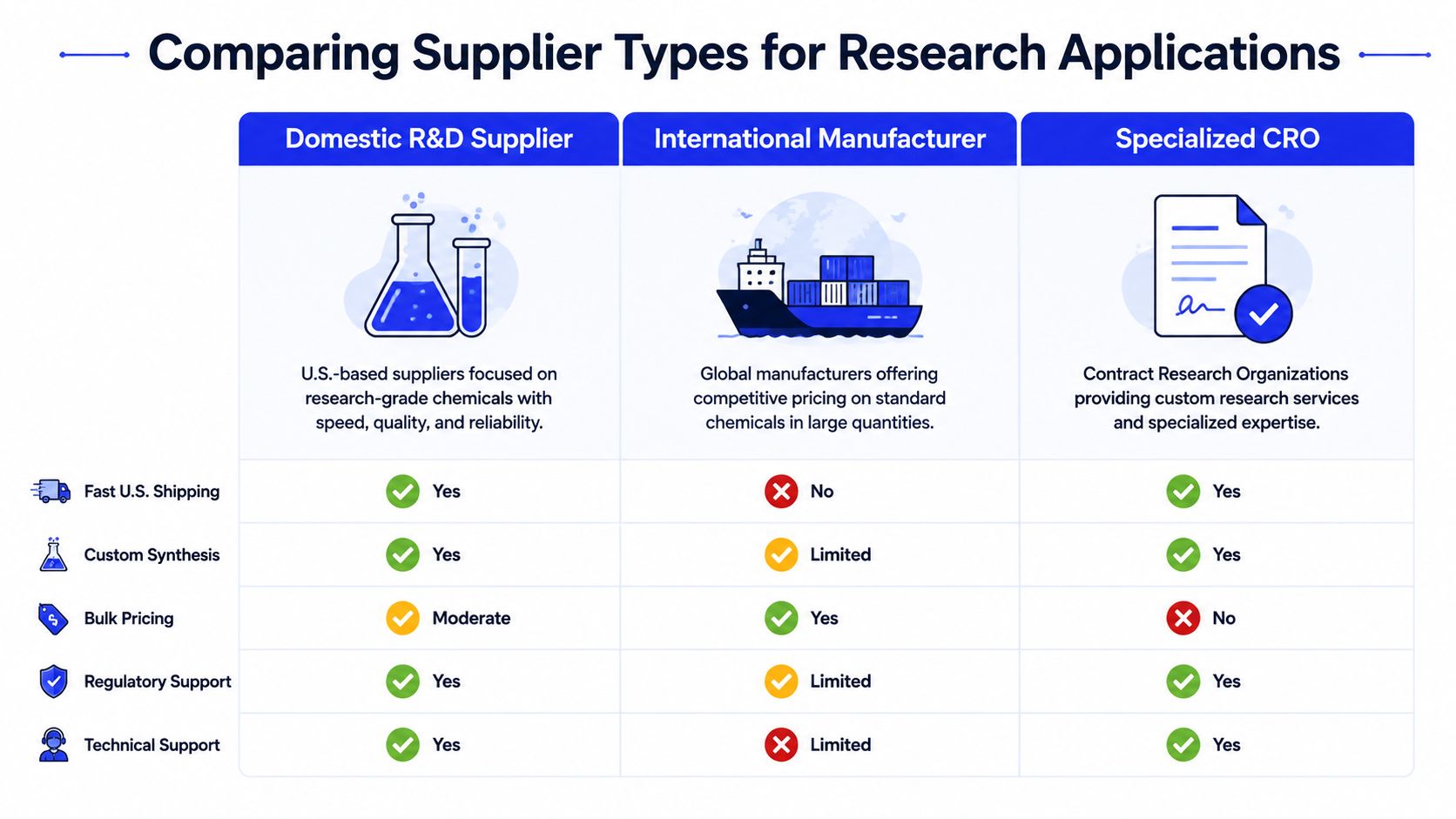
Domestic RUO suppliers can make communication, shipping, returns, and lot replacement easier for U.S. laboratories. Catalog ordering may also fit routine procurement. Before approval, request the actual batch COA, stated endotoxin specification, and manufacturing details.
A U.S. address does not establish U.S. manufacturing. Confirm where synthesis, purification, testing, lyophilization, and packaging occurred. A domestic office or warehouse may distribute material produced elsewhere, so “U.S.-based” and “U.S.-manufactured” describe different supply-chain positions.
International manufacturers may support custom synthesis, broader production capacity, or better commercial terms for larger orders. They can work well when chain of custody is documented and technical questions receive prompt answers.
Import handling introduces more variables. Confirm who owns the batch record, where final testing occurred, how temperature or transit issues are handled, and what the supplier does if a shipment arrives damaged or its records are incomplete. Lead time and replacement procedures matter as much as quoted cost for time-sensitive studies.
Compounding pharmacies operate in a different channel from research suppliers. Their products are prepared under requirements applicable to their operations, rather than sold as catalog research chemicals. Do not treat a pharmacy product, an RUO peptide, and an approved medicine as interchangeable.
Low prices and therapeutic language deserve scrutiny. Risk increases when a seller blurs research and human-use channels, conceals the manufacturing source, or supplies generic COAs instead of batch-specific records.
A legitimate RUO supplier should clearly state what the product is not. Research labeling, analytical records, defined endotoxin limits, and restrained product language provide stronger procurement evidence than aggressive claims about peptide benefits.
A purity percentage answers only part of a procurement decision. Reverse-phase HPLC is widely used to quantify peptide purity by measuring the principal peptide peak against the total chromatographic area. The result is useful, but it does not by itself confirm that the material has the intended molecular identity.
ESI-MS or MALDI-TOF confirms molecular identity by comparing the measured mass with the expected molecular mass. It can also reveal impurity species that a purity result may not distinguish. Bachem's quality-control guide explains how HPLC and mass spectrometry answer different quality questions.
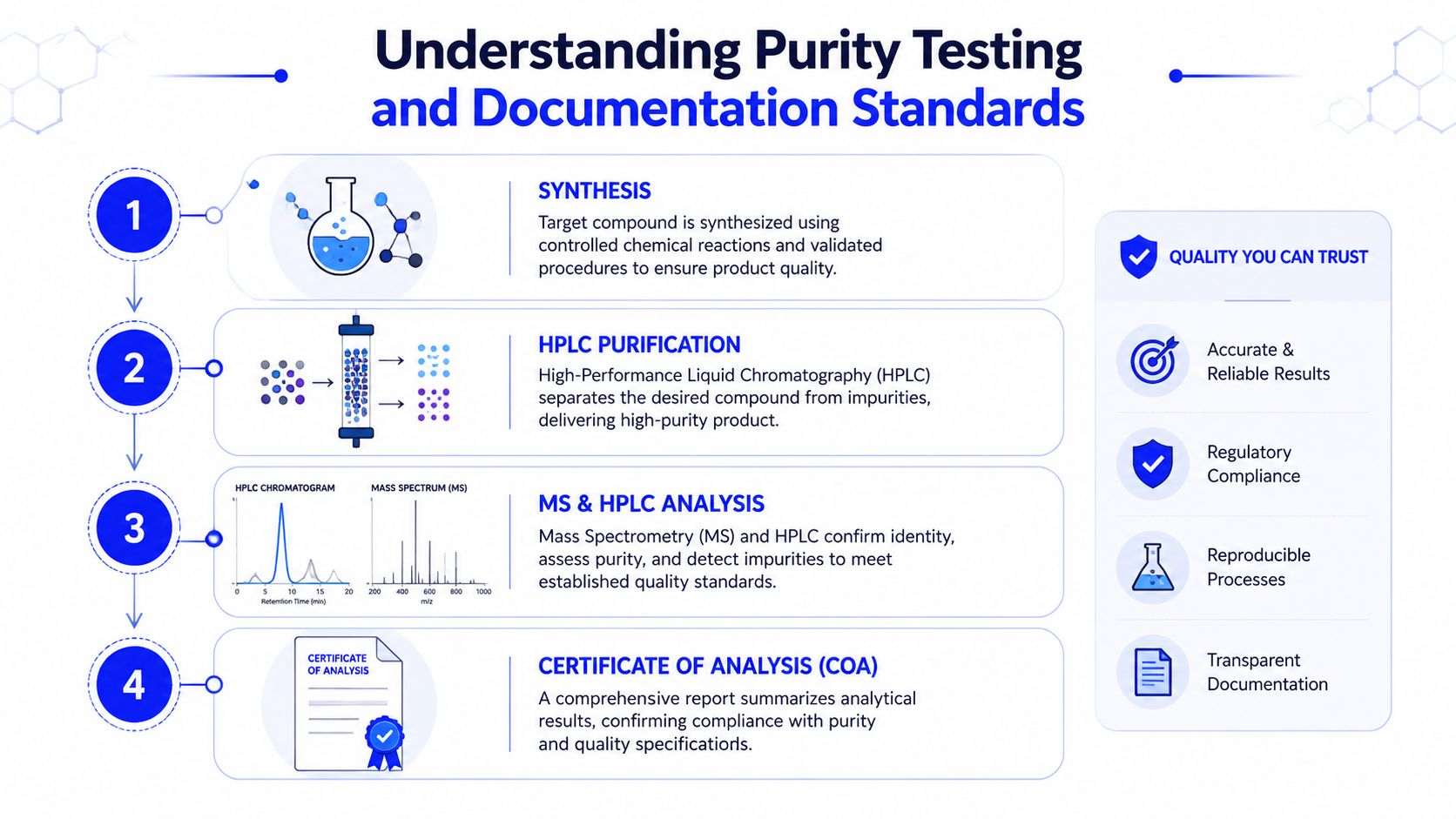
A sample can show a strong main peak while still needing identity confirmation. Wrong-sequence material, truncation products, and closely related compounds can complicate interpretation, especially when they co-elute or remain difficult to distinguish from the purity result.
For that reason, independent testing commonly combines HPLC for purity with mass spectrometry for identity. Independent peptide testing guidance describes this paired approach for checking whether the material matches both the stated compound and the stated purity grade.
For cell-based or preclinical work, require a batch-specific endotoxin result and compare its specification with the assay's tolerance. Some suppliers target below 0.1 EU/mg for high-sensitivity applications, but the suitable threshold depends on the study design and should be agreed with the responsible scientific or quality team.
Request residual-solvent and elemental-impurity information when the application calls for it. Confirm net peptide content as well, since vial mass and actual peptide content measure different things.
A usable COA connects the exact vial, the analytical method, the result, and the intended research application. If the record is generic, lacks batch identification, or omits methods and acceptance criteria, treat that gap as a procurement risk rather than as proof of quality.
Treat every order as a controlled procurement step, even with a familiar supplier. Prior relationships reduce friction, but they do not replace batch verification.
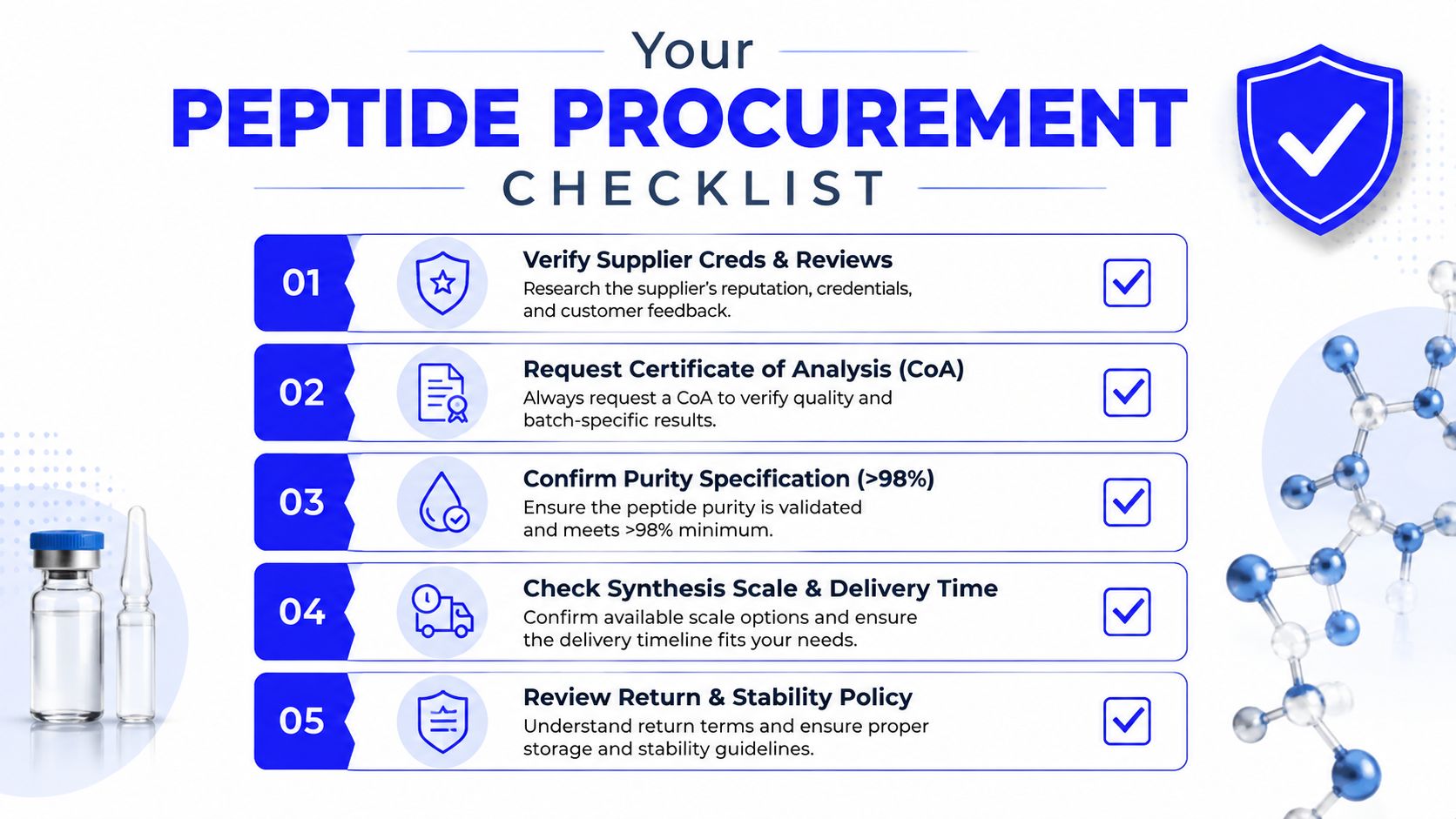
Screen the supplier: Verify the business identity, research-use-only positioning, support contact, manufacturing origin, and stated testing practices. Treat therapeutic claims on a product labeled RUO as a warning sign.
Request the lot record: Obtain the COA for the batch you will receive, or confirm how the supplier assigns and documents lots. Check for identity, purity, net content, endotoxin, microbial, and traceability information relevant to your study.
Confirm the specification: Review the underlying HPLC result and identity confirmation instead of accepting a headline purity threshold. If the specification does not fit your assay, request technical clarification or choose another material.
Inspect immediately: Match the vial name, lot number, quantity, seal, label, storage instructions, and shipping condition against the purchase record. Photograph discrepancies before placing the material in inventory.
Release or quarantine: Release the shipment only when its documentation matches and the records meet your lab's requirements. If a discrepancy appears, quarantine the material, contact the supplier in writing, and record the resolution or replacement decision.
File the approved COA, invoice, receiving record, correspondence, and storage entry together. This creates a defensible chain of custody, supports batch-specific review, and makes repeat ordering easier. A missing lot record or unclear endotoxin result should delay release until the responsible scientific or quality team resolves it.
A lab that relies on one peptide vendor has a single point of failure. A stockout, slow response, discontinued product, or shipping problem can interrupt work even when that supplier previously performed well. Domestic research-peptide availability can also contract, so continuity planning belongs in procurement rather than after a disruption.
Qualify a backup supplier with the same controls used for the primary source, then document the result:
A lower price does not offset an untraceable batch or a supplier unable to support a replacement claim. Documentation depth protects both experimental validity and operational continuity, making it part of the product rather than an optional service.
Resilience also requires a practical requalification plan. Keep the backup vendor's current specifications, contact records, and prior lot documentation accessible. For high-impact materials, confirm that the alternate source can meet the same identity, purity, endotoxin, microbial, packaging, and storage requirements before an urgent order is needed.
Peptide Warehouse USA lists U.S.-manufactured research peptides and related compounds, with documentation that includes COAs, microbial reports, endotoxin reports, stated purity levels, and shipping information. Visit Peptide Warehouse USA to review research-use options and assess whether its documentation and fulfillment process fit your laboratory's procurement requirements.