No products in the cart.


The most popular advice about peptides TB-500 starts with a mistake: it treats TB-500 and full-length thymosin beta-4 as interchangeable names. They aren't. That shortcut can distort literature reviews, weaken study design, and turn promising animal findings into human claims the evidence doesn't support.
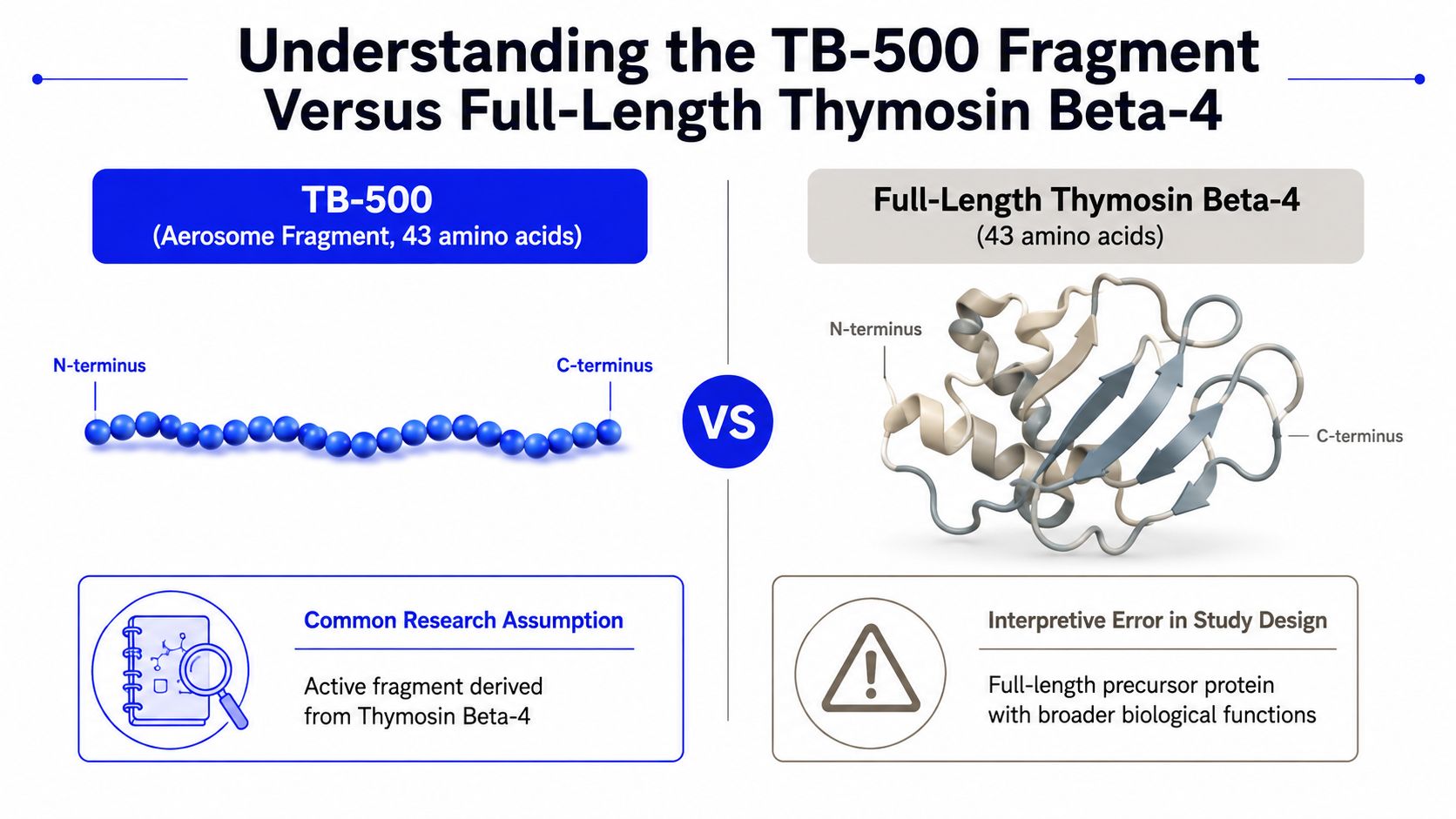
TB-500 is a synthetic fragment associated with the parent molecule thymosin beta-4, while most human clinical development has involved the full-length parent peptide. This distinction affects mechanism, sourcing, regulatory interpretation, storage decisions, and the way researchers should evaluate proposed benefits of peptides for tissue repair.
Thymosin beta-4, or Tβ4, is a 43-amino-acid protein isolated from bovine thymus in 1981 by Teresa L. K. Low and Allan L. Goldstein, following thymus-extract research that began in the 1960s. Later commercial TB-500 formulations came from this biology. They weren't a novel standalone discovery, as summarized in this historical overview of TB-500 and thymosin beta-4.
TB-500 is generally described as the N-terminally acetylated 17-23 fragment, Ac-LKKTETQ. In practical terms, it represents a shorter synthetic sequence connected to the parent peptide's actin-binding region, not the complete 43-amino-acid protein. The WADA-related metabolism and synthesis reference for TB-500 is useful for keeping that vocabulary precise.
Modern summaries describe a much larger research history for the parent molecule, with more than 1,000 published studies across tissue types, while human development for thymosin beta-4 advanced through multiple clinical programs in the 2000s. Those findings shouldn't automatically be assigned to the synthetic fragment.
The parent molecule has been studied in ophthalmic, dermal, and cardiac programs. By contrast, independent reviews report that the synthetic TB-500 fragment has no registered human trial history of its own, and there are no completed Phase 2 or Phase 3 human trials establishing systemic TB-500 efficacy.
Interpretation rule: If a paper names recombinant or full-length thymosin beta-4, cite it as Tβ4 evidence. Don't relabel it as direct TB-500 evidence simply because the molecules share a biological history.
This matters in protocol writing and procurement. A laboratory testing full-length Tβ4 may need the parent molecule, while a fragment study should identify the exact sequence, chemical modifications, formulation, and analytical specifications. Treating the names as synonyms can create an experimental variable before the first assay begins.
The central biochemical idea is actin binding. Thymosin beta-4 binds monomeric G-actin in a 1:1 complex through the central LKKTET motif, helping regulate the balance between free G-actin and filamentous F-actin. The mechanism is described in the biochemical research summary of TB-500 and actin.
G-actin is the individual building block. F-actin is the assembled filament network that helps a cell maintain shape and move. A useful laboratory analogy is a parts room: actin-binding activity helps control how many components remain available for rapid cytoskeletal remodeling rather than allowing every component to assemble immediately.
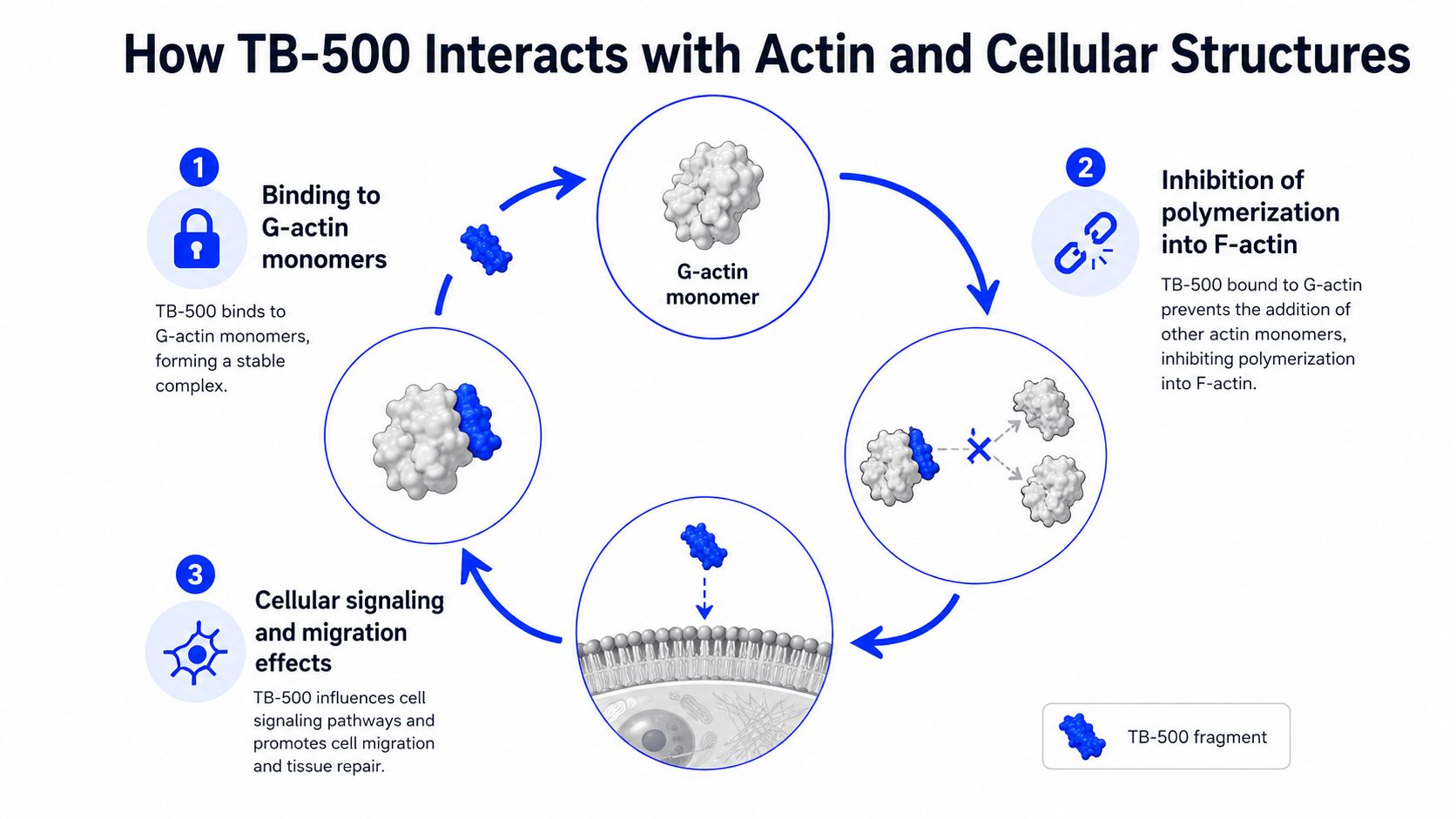
When cells migrate, they must repeatedly extend, attach, contract, and reorganize their edges. Actin availability is part of that process. Reviews describe thymosin beta-4 as supporting cell migration, mobilizing stem or progenitor cells, reducing apoptosis and inflammation, and lowering scar formation or fibrosis by decreasing myofibroblast numbers in wounds. The peer-reviewed review on thymosin beta-4 and tissue repair also makes an important qualification: the exact receptor-mediated pathway remains unidentified.
That means the most defensible description is actin sequestration and cytoskeletal remodeling, not activation of one fully mapped receptor pathway. Researchers should be cautious with product language that presents a single linear mechanism as settled fact.
The biological effects discussed around Tβ4 also include angiogenesis, extracellular-matrix remodeling, inflammation modulation, and tissue architecture. These are connected outcomes, but they don't prove that every TB-500 preparation will produce the same response in every cell type or animal model.
The embedded video provides another visual way to think about the relationship between a short peptide sequence, actin behavior, and cellular migration.
Animal evidence for the parent molecule is biologically interesting, but it needs a precise label. In a rat full-thickness wound model, topical or intraperitoneal thymosin beta-4 increased re-epithelialization by 42% at day 4 and up to 61% at day 7 versus saline, while also increasing wound contraction, collagen deposition, and angiogenesis, according to the published rat wound study.
Those results support a cause-and-effect profile in that model. They don't establish that the TB-500 fragment has validated human wound-healing efficacy, and they don't justify extrapolating directly to orthopedic recovery, muscle growth, tendon repair, or athletic performance.
The table below separates the main evidence categories. “Evidence strength” refers to how directly the result answers a TB-500 human-use question, not how interesting the biological observation is.
| Study Model | Molecule Tested | Key Outcome | Evidence Strength |
|---|---|---|---|
| Rat full-thickness wound model | Full-length thymosin beta-4 | Faster re-epithelialization, wound contraction, collagen deposition, and angiogenesis | Strong preclinical support for Tβ4 in this model, indirect for TB-500 |
| Cell migration and cytoskeletal assays | Tβ4 or related fragment systems | Actin-linked migration and structural remodeling | Mechanistic support, limited translation |
| Ophthalmic clinical programs | Full-length thymosin beta-4 | Human development included a positive Phase 3 randomized controlled trial in neurotrophic keratopathy and two Phase 2 dry-eye randomized trials | Human evidence for selected Tβ4 indications, not TB-500 |
| Cardiac clinical programs | Full-length thymosin beta-4 | A Phase 2 cardiac trial was completed, and Phase 1 intravenous safety testing involved 124 volunteers | Human parent-molecule evidence, not proof of TB-500 systemic efficacy |
| TB-500 fragment research | Synthetic TB-500 | No completed Phase 2 or Phase 3 systemic human trials | Direct human efficacy remains unestablished |
A recent review focused on the Tβ4 and TB-500 evidence split reinforces the central limitation. Preclinical wound-healing and angiogenesis findings are not the same as validated human outcomes, and human orthopedic data for TB-500 remain absent.
Clinical-trial records show the field is still active, including a TB-500-related study that started on 2026-02-05 and has a scheduled primary completion date of 2027-02-14, as reported in an independent TB-500 clinical and regulatory summary. A listed study isn't a completed result, however. For a researcher, that distinction is as important as the molecular distinction between Tβ4 and TB-500.
Handling instructions deserve stricter scrutiny than many product pages receive. A lyophilized vial can appear normal while still presenting questions about identity, moisture exposure, degradation, sterility, and chain-of-custody. Your laboratory's approved SOP and the supplier's batch-specific documentation should control the final procedure.
The handling specifications often repeated online for peptides TB-500 include storage of unopened lyophilized material at −20 °C or below, followed by refrigerated storage of reconstituted material at 2-8 °C. However, the supplied evidence doesn't verify the precise stability window, freeze-thaw limit, solvent choice, or visual degradation markers listed in some commercial protocols. Those details must come from validated stability data, the product's COA, or an institutional procedure, not from assumption.
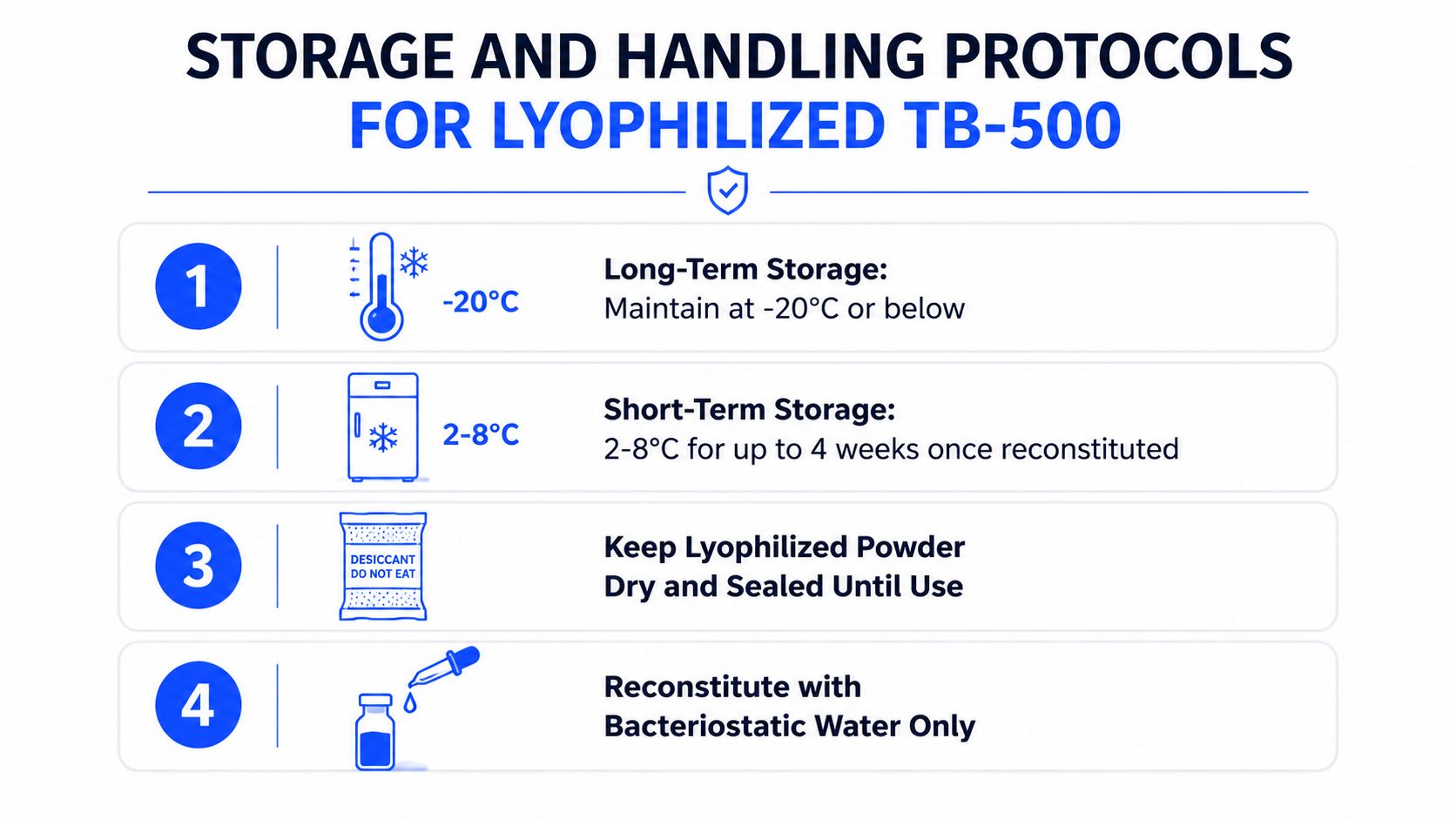
Keep the vial sealed and dry. Record the product name, lot identifier, receipt condition, and storage location before opening it. Avoid repeated temperature excursions and don't assume a product remains suitable merely because the cake or powder looks unchanged.
Verify the reconstitution medium. Use only the solvent specified by the validated protocol. Bacteriostatic water, sterile water, acidity, ionic strength, and preservative content can affect a peptide solution and its downstream assay. If the supplier doesn't specify compatibility, ask for technical documentation rather than improvising.
Use gentle mixing. Avoid vigorous vortexing unless a validated method explicitly permits it. Gentle swirling or controlled inversion may reduce mechanical stress, but the correct method depends on the formulation and experimental application.
Label every prepared solution. Include the reconstitution date, concentration, solvent, operator, lot number, and storage condition. Store aliquots according to validated stability information so the same vial isn't repeatedly warmed and cooled during routine work.
Cloudiness, unexpected color, precipitate, or particulate matter should trigger quarantine and investigation. Visual inspection can't confirm identity or potency, but it can identify a preparation that shouldn't proceed directly into an assay.
Practical rule: Temperature control protects the material, but documentation protects the result. A clean notebook entry is part of peptide handling, not administrative clutter.
A supplier's headline purity figure is only one part of a sourcing decision. Researchers need to know what was tested, which lot was tested, how the result was obtained, and whether the reported value refers to total powder or net peptide content.
A credible research-peptide file should make it possible to connect the vial in your freezer to a specific analytical record.
Residual trifluoroacetic acid salts can affect calculations when a supplier reports gross mass without explaining the salt form or net content. That doesn't automatically make a material unusable, but it does make the label incomplete for quantitative study design.
| Criterion | Reputable Supplier | Red Flag |
|---|---|---|
| Identity | Batch-linked mass-spectrometry documentation | Generic product page with no identity record |
| Purity | HPLC result tied to the lot | Unsupported purity language |
| Content | Clear distinction between net peptide and gross powder | No salt or content disclosure |
| Contamination controls | Microbial and endotoxin documentation where applicable | No analytical or contamination information |
| Traceability | Lot number, production details, and accessible COA | Vendor can't connect the vial to a batch |
| Packaging | Packaging appropriate for the declared storage condition | Unexplained heat exposure or damaged shipment |
The most useful comparison isn't cost per milligram. It is cost per usable, documented, traceable lot. A lower purchase price can lose its value if an assay fails and the laboratory can't determine whether the cause was sequence identity, concentration, contamination, degradation, or handling.
TB-500 sits outside the category of established, approved human therapies. Recent independent summaries of the 2026 FDA review process report that briefing materials identified no human patient studies, no human pharmacokinetic or pharmacodynamic studies, no adequate nonclinical toxicology package, and no clinical evidence establishing wound-healing effectiveness for TB-500. The FDA-focused safety summary explains why biological plausibility isn't enough to establish an approved indication.
Human development has occurred for full-length thymosin beta-4. One FDA-cleared Phase 1A cardiac program was planned as a double-blind, placebo-controlled study in 40 healthy volunteers, using intravenous administration to evaluate single-dose safety across escalating dose levels, as described in this clinical-development announcement. That record belongs to the parent molecule's development history, not to a general approval for TB-500.
The World Anti-Doping Agency lists thymosin-beta4 and its derivatives, including TB-500, under section S2.3 of the Prohibited List, with the prohibition applying at all times for athletes under WADA jurisdiction, according to this WADA-related anti-doping reference.
A research-use label doesn't override an athlete's governing rules. A person subject to testing should consult the relevant anti-doping organization before exposure, including accidental exposure through a product with uncertain identity or contamination.
Institutional research also needs appropriate oversight. Animal work may require IACUC review, while human research requires IRB oversight and a properly authorized investigational pathway. A vendor's ability to ship a vial doesn't establish that a study is approved, that a material is suitable for administration, or that the intended use is lawful.
Compliance boundary: “Research use only” describes the product's stated market position. It doesn't convert an unapproved compound into a therapy or make it acceptable under sport regulations.
Start with the molecule, not the marketing term. If your assay asks how full-length thymosin beta-4 behaves across several biological functions, a synthetic fragment may not model the parent protein adequately. If your question specifically concerns the LKKTETQ fragment or actin-linked behavior, TB-500 may be a logical exploratory material, provided the study identifies the exact compound and limits its conclusions.
For exploratory in vitro work, TB-500 can be considered as a defined research variable, not as a shortcut to clinical translation. For translational studies, the lack of direct human TB-500 data should be treated as a central limitation in the protocol, grant, manuscript, and sourcing decision.
Peptide Warehouse USA offers a 10 mg lyophilized TB-500 research product with stated batch documentation, USA manufacturing, and microbial and endotoxin testing information, and it also lists research-use-only blends that combine TB-500 with other peptides. To compare documentation and current research-use options, visit Peptide Warehouse USA, and verify that the selected lot matches your institution's analytical and compliance requirements.