No products in the cart.



What if the biggest mistake in the TB-500 thymosin beta-4 conversation is assuming those names describe the same molecule? Thymosin beta-4 has a documented history in cell biology, wound-repair research, and early clinical testing. TB-500, by contrast, is commonly described as a fragment-based research compound, and the evidence for the fragment cannot inherit every finding from the full-length peptide. This distinction matters for anyone evaluating mechanism, benefits, safety, regulatory status, or research procurement.
This guide separates demonstrated biology from popular inference. You'll learn how thymosin beta-4 interacts with actin, where wound-healing evidence is strongest, why claims about performance and muscle growth require caution, what human safety data show, and how researchers can evaluate certificates of analysis, storage, and research-use-only labeling.
Could two names that sound interchangeable describe different research materials? Thymosin beta-4, commonly abbreviated Tβ4, is an endogenous peptide. By the early 1980s, researchers had identified it as a discrete 43-amino-acid peptide with a molecular weight of about 4,921 daltons. Its research history began with thymus-derived peptide work in the 1960s, followed by molecular studies linking it to actin regulation. (Thymosin beta-4 review)
TB-500 generally refers to a synthetic fragment-based research compound associated with some biological activity of Tβ4. That association does not establish molecular equivalence. Commercial descriptions may present TB-500 as a practical material for studying repair-related signaling, yet findings from the full endogenous sequence cannot automatically be assigned to a fragment. Direct human research on TB-500 itself is absent or extremely limited, while better-known clinical work involved specific thymosin beta-4 formulations rather than the material sold under the TB-500 name. (TB-500 and thymosin beta-4 comparison)
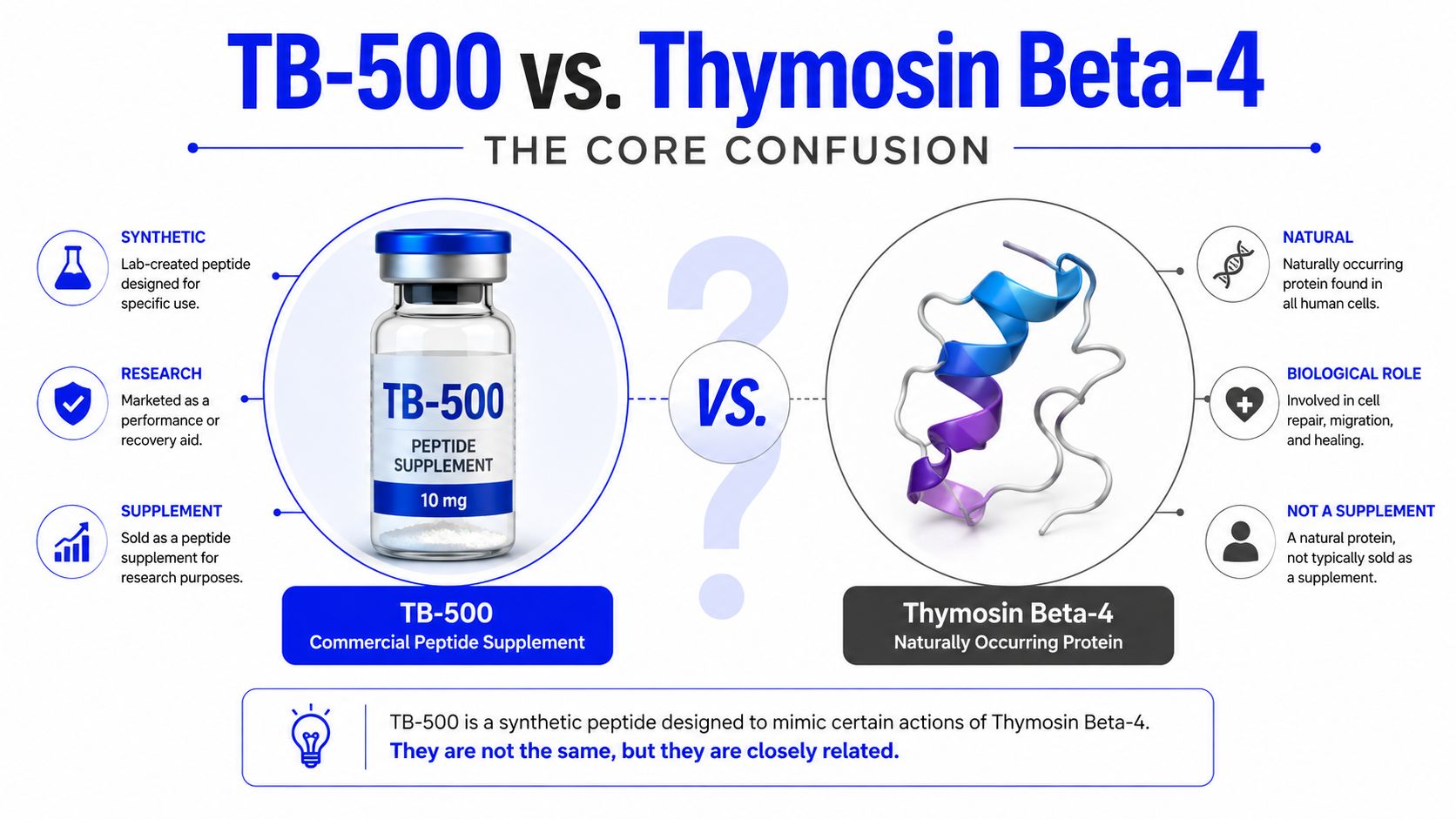
Tβ4 is encoded by the TMSB4X gene and occurs throughout mammalian tissues. Researchers have examined it in platelets, thymus tissue, wound fluid, and cells that reorganize their cytoskeleton during movement. It also has post-translational and metabolic forms, including the oxidized Ac-SDKP metabolite, which has been studied separately in cardiovascular and tissue-repair research.
For procurement, molecular labels are only the starting point. A researcher should verify whether a supplier identifies the exact sequence, provides lot-specific analytical results, reports purity, and explains storage conditions. A certificate of analysis can support identity and quality review, but it does not turn TB-500 into full-length Tβ4 or establish human efficacy.
Four questions keep interpretation precise:
This framework separates demonstrated Tβ4 biology from inferences about TB-500.
Could a peptide first studied through thymus biology become a model for understanding tissue repair? The answer developed gradually. Research in the 1960s examined peptide material associated with the thymus, and later studies separated those mixtures into defined molecular components. By the early 1980s, investigators had characterized Tβ4 as a distinct 43-amino-acid peptide. That gave researchers a specific molecule to examine rather than an undefined fraction. (Research history and clinical development)
The research focus shifted in 1991, when Tβ4 was identified as the principal actin-monomer-sequestering peptide in mammalian cells. This finding connected thymosin beta-4 with the supply of soluble actin available for cell movement, changes in cell shape, and tissue remodeling. It also provided a biological explanation for why repair models became an important part of later research.
During the 1990s and 2000s, investigators tested Tβ4 in dermal and ocular injury models. A rat full-thickness wound study reported 42% greater re-epithelialization at day 4 and up to 61% greater re-epithelialization at day 7 compared with saline. It also reported at least 11% greater wound contraction by day 7, while keratinocyte migration increased two to three fold in vitro with as little as 10 picograms of peptide. These findings describe a specific full-length Tβ4 research material and model, not proof that every product labelled TB-500 behaves identically. (Rat wound-healing study)
Corneal repair became another research model. Reviews describe faster corneal re-epithelialization after alkali injury and scrape wounding, with possible effects on inflammatory signaling and extracellular matrix remodeling. A separate review presents Tβ4 as a regulator of angiogenesis relevant to wound healing, cardiovascular repair, and tumour progression. Those areas show both its research interest and its biological complexity. (Mechanistic review, Angiogenesis review)
Human development was narrower than public discussion often suggests. Early-phase studies examined defined Tβ4 preparations in healthy volunteers and wound-related settings. The TB-500 fragment itself did not complete a comparable formal human development program, so results from full-length Tβ4 should not be transferred to the fragment without qualification.
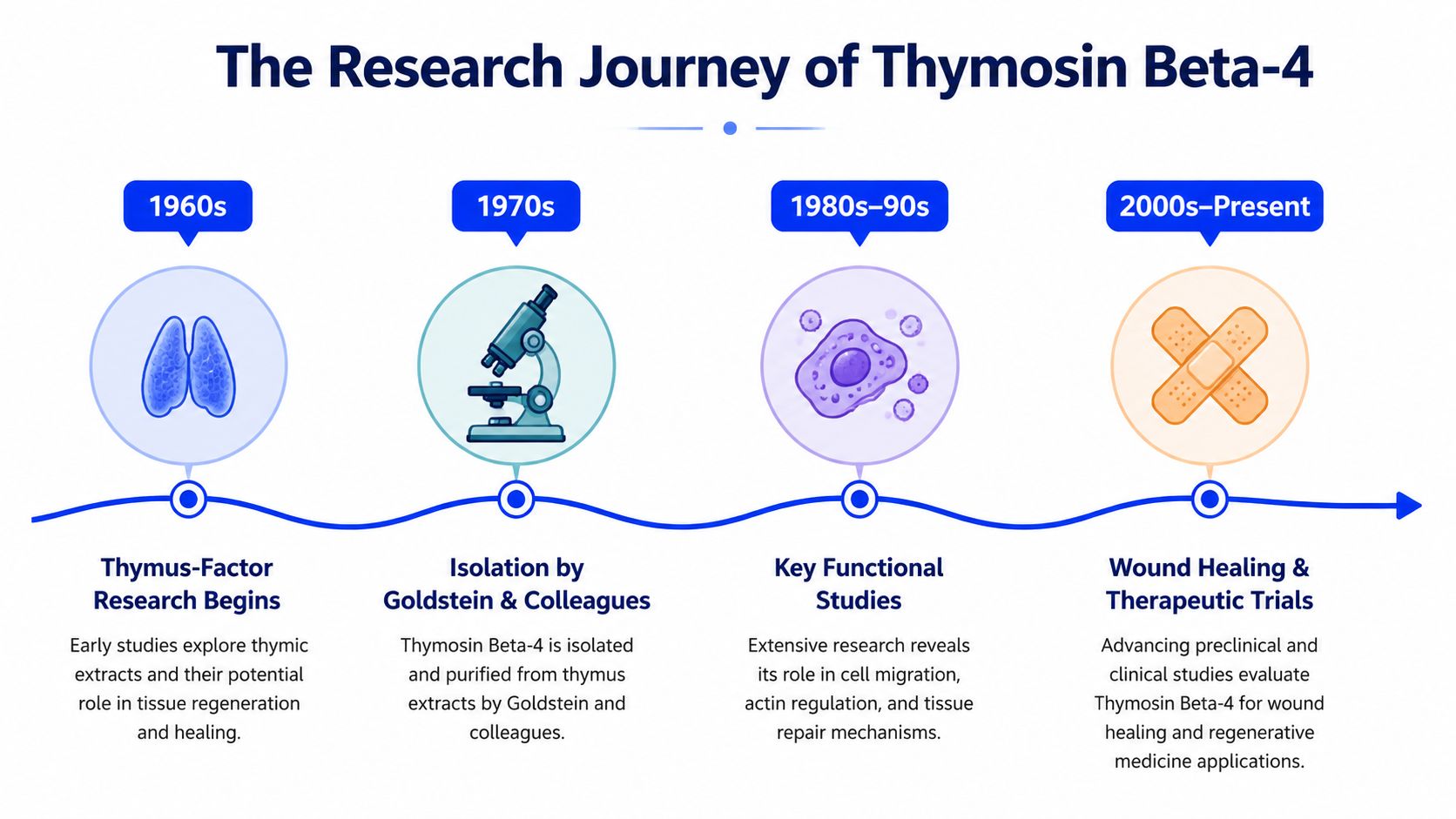
The research journey is also available in this embedded educational video:
The easiest way to understand Tβ4 is to start with actin, a structural protein that helps cells change shape and move. Cells use individual actin units, called G-actin monomers, to build filaments known as F-actin. Those filaments form part of the internal framework that allows keratinocytes, endothelial cells, and other cell types to migrate across damaged tissue.
Tβ4 binds G-actin through a central actin-binding region that includes the LKHAE sequence around residues 17 to 21. This interaction helps maintain a soluble reservoir of actin rather than allowing uncontrolled polymerization. During repair, cells can draw from that reservoir and rapidly reorganize their cytoskeleton when they need to move.
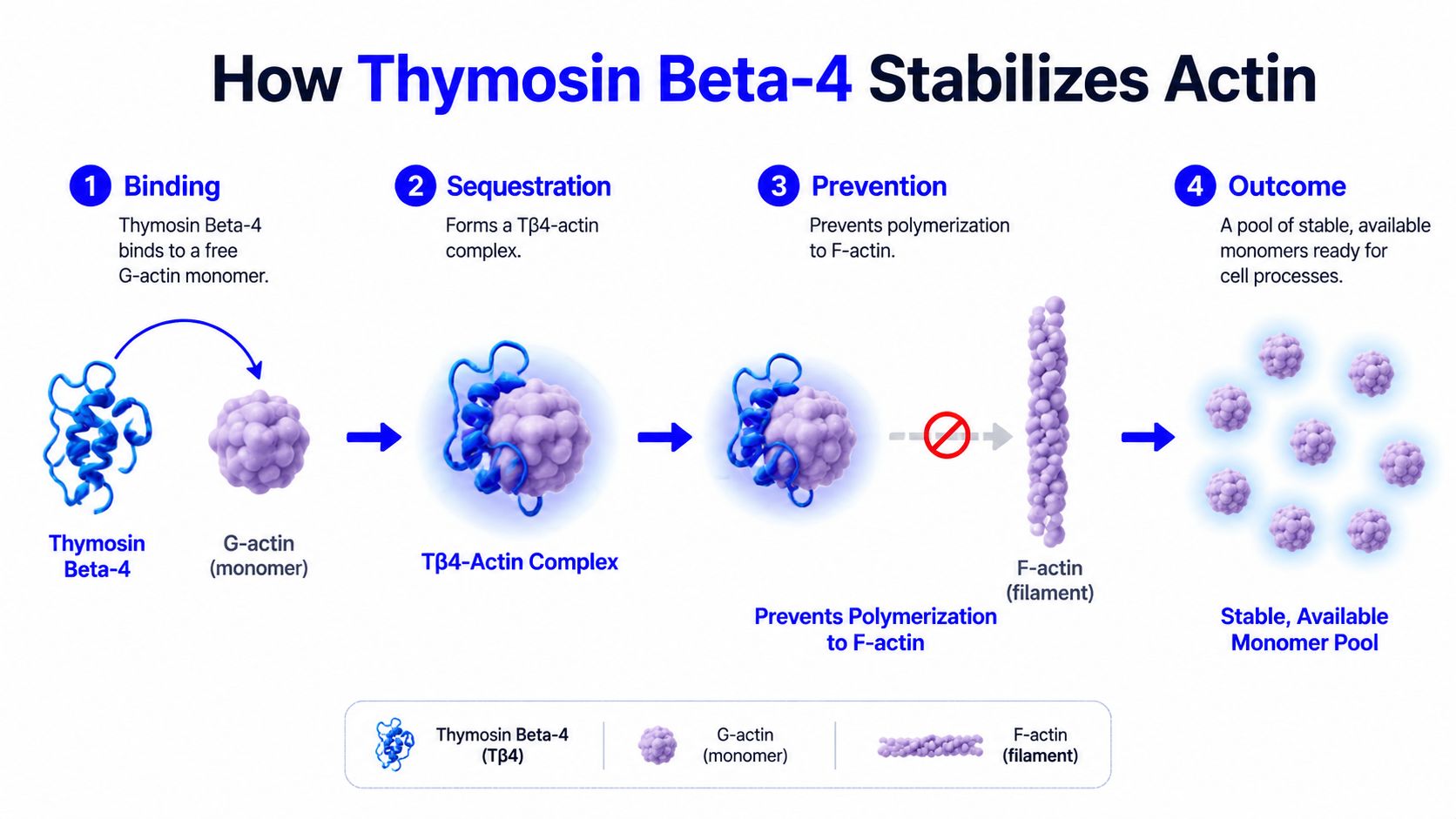
Wound closure isn't just a matter of producing more tissue. Cells must travel into the damaged area, attach to changing extracellular matrix, and coordinate new surface coverage with inflammation and blood-vessel development. Tβ4 research links these processes with:
A useful example comes from ocular injury research, where Tβ4 accelerated corneal re-epithelialization in animal models. The result illustrates the chain of reasoning: actin regulation supports cell migration, migration supports surface closure, and tissue-level repair can then be measured. It doesn't prove that every formulation or fragment produces the same outcome in humans.
TB-500 is presumed to share some actin-sequestering activity because of its relationship to Tβ4 research. However, the fragment hasn't been independently mapped residue by residue against full-length Tβ4 in a way that justifies treating all published Tβ4 findings as direct TB-500 evidence.
The strongest evidence concerns wound repair, especially dermal and corneal models. In rats, topical or intraperitoneal Tβ4 improved re-epithelialization and contraction relative to saline, while laboratory testing showed increased keratinocyte migration. These are defined experimental outcomes, not proof of broad recovery or performance benefits. (Rat wound-healing study)
Human evidence is more limited but not absent for specific Tβ4 preparations. Reviews describe phase 2 work involving pressure and stasis ulcers, and early-phase studies found defined synthetic or recombinant Tβ4 preparations well tolerated in healthy volunteers. Those findings support continued study of selected wound-repair applications, but they don't validate the fragment sold as TB-500 for every popular use. (Clinical and mechanistic review)
| Claimed use of TB-500 or thymosin beta-4 | Evidence type | Confidence level |
|---|---|---|
| Dermal wound repair | Animal models and limited human wound-related studies using Tβ4 preparations | Strongest for Tβ4, not automatically transferable to TB-500 |
| Corneal surface repair | Preclinical ocular injury models | Promising preclinical evidence |
| Cell migration and matrix remodeling | In vitro, ex vivo, and mechanistic studies | Biologically supported |
| Muscle growth | Popular claims and indirect biological inference | Low confidence |
| Performance enhancement | Community use claims without direct validated TB-500 trials | Low confidence |
| Tendon or ligament recovery | Extrapolation from tissue-repair biology and non-equivalent studies | Uncertain |
The gap becomes especially important in discussions of muscle growth, athletic performance, and accelerated ligament recovery. Those claims may draw on actin biology, animal research, or adjacent peptide discussions, but they aren't the same as direct, controlled studies of commercially labeled TB-500 in humans.
Researchers interested in broader regenerative biology may also find rejuvenate stem cells naturally useful as general background, but that topic shouldn't be treated as evidence that TB-500 has been clinically validated for stem-cell rejuvenation.
Safety evidence must be separated by molecule and formulation. In one phase I study, 40 healthy volunteers received single intravenous doses of 42, 140, 420, or 1,260 mg/kg over 14 days, with no dose-limiting toxicities or serious adverse events reported. Another phase I study involving 54 healthy volunteers tested recombinant human Tβ4 at single-dose levels from 0.05 to 25.0 μg/kg and daily levels of 0.5, 2.0, and 5.0 μg/kg for 10 days. The preparation was reported as well tolerated and suitable for further study. (Human phase I safety data)
Those findings describe selected clinical formulations of Tβ4, not necessarily a vial labeled TB-500 from a research marketplace. They also don't establish long-term safety, reproductive safety, drug-interaction behavior, or safety in people with complex medical conditions.
Recent regulatory summaries state that thymosin beta-4 isn't FDA-approved for any indication. Related TB-500 and thymosin beta-4 fragment products appear in compounding-policy discussions, but policy review isn't the same as approval. (Regulatory summary)
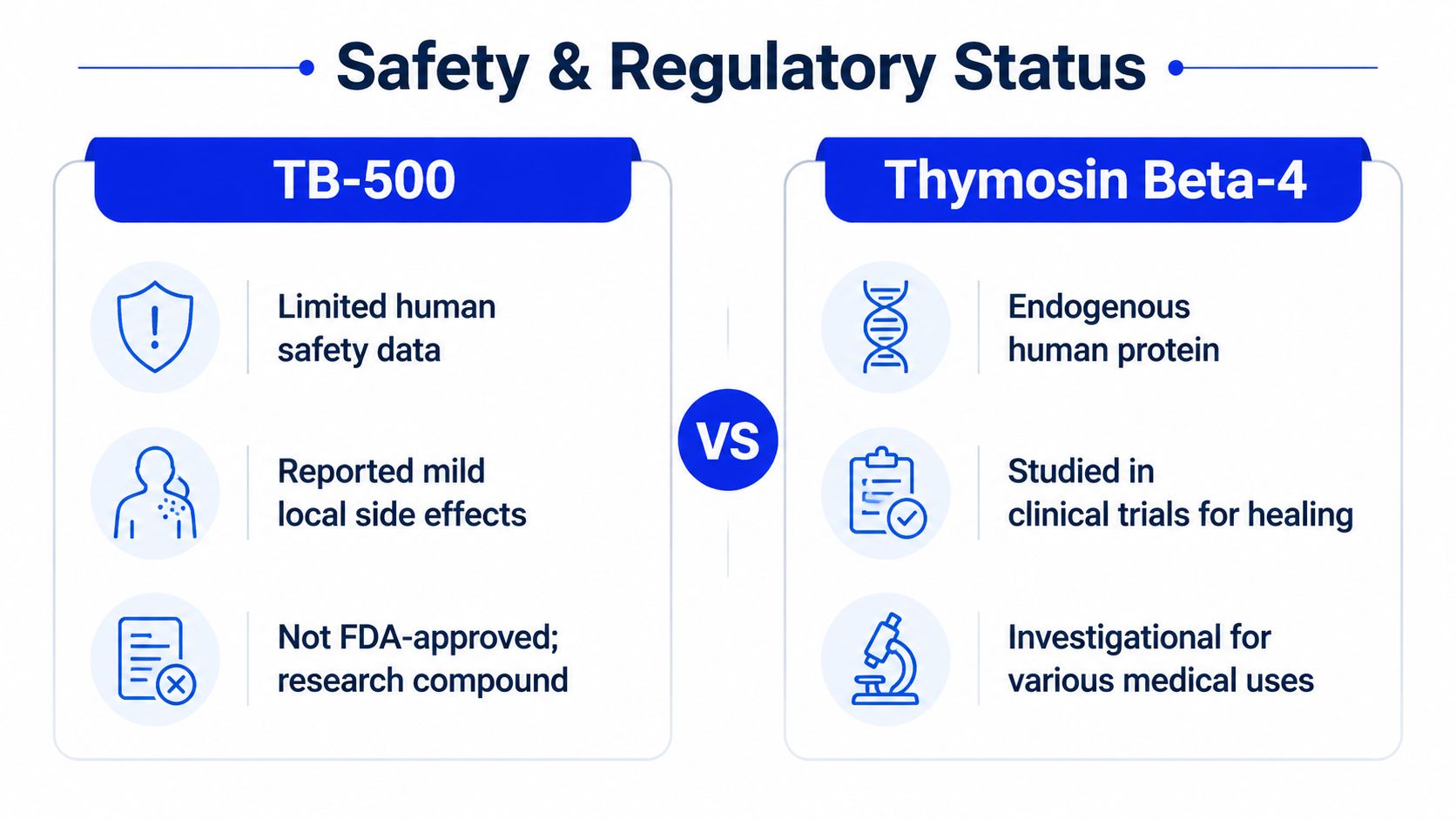
A practical reading of the safety record looks like this:
Readers comparing peptide topics can also review AOD9604 weight loss peptide explained for an example of how another research peptide is discussed in relation to evidence and regulatory boundaries. That comparison doesn't establish safety or efficacy for TB-500.
A research-use procurement decision starts with the lot, not the marketing page. A credible supplier should identify the material clearly and provide a certificate of analysis tied to the exact batch. Researchers should be able to compare the vial label, order record, and analytical document without guessing whether they refer to the same production run.
Look for analytical evidence that answers distinct questions:
A COA is evidence about a sample and a batch. It isn't a substitute for independent validation, and it doesn't turn a research compound into a medicine.
Lyophilized peptide is commonly stored at minus 20 degrees Celsius, while reconstituted material is commonly kept at 2 to 8 degrees Celsius. Researchers should follow the supplier's product-specific documentation, minimize exposure to heat and light, and avoid repeated freeze-thaw cycles.
Practical rule: A low price can't compensate for missing identity data, unclear cold-chain handling, or a COA that doesn't match the vial.
Red flags include pre-reconstituted liquids, generic or undated COAs, unexplained pricing, and claims that a research product is “human grade.” Sterile technique still matters during laboratory handling, but a sterile-looking vial isn't proof that the contents are sterile or correctly labeled.
“Research use only” is a real operational boundary, not a decorative phrase. It means the material is labeled for laboratory, analytical, in vitro, or ex vivo investigation and isn't marketed as a treatment. Packaging and product descriptions shouldn't make therapeutic claims or provide instructions for administration to humans or animals outside an approved protocol.
Thymosin beta-4 hasn't received FDA approval for any indication, and commercial TB-500 products shouldn't be represented as approved medicines. Researchers must also account for sports rules. Thymosin beta-4 is included on the World Anti-Doping Agency Prohibited List, and related use can create reporting or eligibility issues in competitive and equine sports contexts.
Common compliance failures include:
Descriptions should carry an FDA disclaimer such as: “These statements have not been evaluated by the FDA. This product is not intended to diagnose, treat, cure, or prevent any disease.” The wording doesn't override the law, but clear labeling helps prevent misleading presentation. Any downstream work involving humans or animals requires the appropriate institutional approvals, documentation, and oversight.
The most defensible conclusion is also the least sensational. Thymosin beta-4 is a defined endogenous peptide with a substantial research history, including actin sequestration, cell migration, extracellular matrix remodeling, angiogenesis, and wound-repair studies. The most concrete results involve dermal and corneal repair models, while human clinical data remain limited to selected Tβ4 preparations and specific investigational contexts.
TB-500 is related, but the evidence gap matters. Claims about muscle growth, athletic performance, or faster tendon recovery are often inferred from full-length Tβ4 biology, animal work, or community experience rather than direct, controlled human TB-500 trials. Researchers should name the exact material, route, model, and endpoint before drawing a conclusion.
For procurement, prioritize:
Use primary literature and peer-reviewed reviews to investigate mechanism, then ask suppliers for transparent COA libraries and explicit research labeling. Peptide Warehouse USA lists TB-500 as a 10 mg lyophilized research peptide and provides product documentation, including COA-related information, for laboratory and analytical procurement. Treat the page as a sourcing reference, not as clinical guidance, and bookmark this article while your lab evaluates the compound.
Peptide Warehouse USA offers research-use TB-500 and related peptide materials with batch documentation, stated purity information, and supporting microbial and endotoxin reports for laboratory, analytical, and preclinical work. Visit Peptide Warehouse USA to review the available research options and verify the documentation before placing an order.