No products in the cart.


You've found a supplier listing a peptide for sale, the price looks attractive, and the product page displays a polished Certificate of Analysis. That still doesn't tell you whether the vial you receive matches the document, contains the stated sequence, or will survive shipping in usable condition.
For a first-time buyer, the central question isn't whether a peptide is available. It's whether you can establish a defensible chain from supplier, lot, identity, purity, handling, and permitted use. This guide focuses on the controls that prevent a bad order, with particular attention to the verification gap most buyers miss: a COA may look legitimate while remaining unconnected to the vial in your hand.
A postdoctoral researcher at a mid-sized university lab ordered a custom 15-mer from a vendor offering aggressive pricing. The sequence looked straightforward, the quote fit the remaining procurement budget, and the supplier provided a COA.
The first warning came during a failed SPR run. The team repeated the assay, checked the immobilization chemistry, and reviewed instrument performance. Three months later, a core-facility mass spectrometry result showed that the vial contained a truncated fragment at roughly 40 percent of the target mass. The grant line was exhausted, the research timeline slipped by a quarter, and a co-author's name had to be removed from the manuscript.
That kind of failure rarely announces itself at the bench. A mislabeled, degraded, under-purity, or contaminated peptide can look like an ordinary lyophilized powder while invalidating weeks of work.
Procurement rule: Treat every peptide batch as a biological manufacturing output with its own QC history, not as a generic reagent.
Peptides aren't interchangeable with salts, buffers, or routine solvents. Synthesis produces sequence-specific material, and the final result depends on assembly, cleavage, purification, counterion handling, drying, packaging, and storage. A supplier's catalog description can't substitute for evidence tied to the actual lot.
The global peptide therapeutics market has been estimated at about US$45.3 billion in 2024 in one industry forecast, while another estimate places it at US$49.13 billion in 2024 and projects US$83.75 billion by 2034 (Transparency Market Research's peptide therapeutics market forecast). That scale explains why peptide sourcing has become a serious commercial category across laboratory research, drug discovery, and preclinical workflows. It also means buyers face a wide range of manufacturing maturity, documentation quality, and commercial incentives.
The right mindset is risk control. Before you evaluate biological relevance or compare prices, filter the supplier for legal clarity, inspect the COA, arrange independent testing when the work matters, and protect the material after delivery.
A supplier that resists these basic checks isn't offering convenience. It's transferring manufacturing risk to your lab.
The first ten minutes on a supplier site should function as a triage exercise. You're not trying to resolve every regulatory question from a product page. You're screening out vendors whose language, checkout process, or shipping practices make the order difficult to defend.
Look for visible wording that states “For research use only. Not for human or veterinary use.” The statement should appear on the product page, order documentation, and shipping label. A vague phrase such as “for laboratory applications” isn't equivalent because it leaves the intended use unclear.
The site should also identify the supplier's business location, country of manufacture, support contact, and documentation process. A vendor that won't name where the material is manufactured has already created a traceability problem.
Reject the order if the page:
The FDA issued seven warning letters to online peptide sellers in April 2026 over disease, performance, and wellness claims, according to coverage of the FDA's 2026 warning letters. That enforcement context makes marketing language a practical procurement signal, not a cosmetic concern.
A serious research supplier should be comfortable asking for a principal investigator, institution, and end-use statement. Refusal to ship to residential addresses or individuals without institutional affiliation can be a positive control because it limits casual consumer distribution.
Payment and shipping deserve the same scrutiny. Opaque third-party payment routing, unexplained cross-border fulfillment, and missing country-of-manufacture information create avoidable problems for institutional purchasing and import review.
Research-use-only labeling doesn't authorize human or veterinary consumption. Products carrying that label are intended for laboratory research and aren't FDA-approved for medical or diagnostic use, as explained in this overview of research-use-only peptide restrictions. If your intended use is outside laboratory, analytical, or approved institutional research, stop and obtain guidance from your compliance office or qualified counsel before ordering.
A COA is useful only when it identifies the material you received. Read it as a traceability record first and a purity advertisement second.
The vendor name, catalog ID, peptide name or sequence, batch or lot number, synthesis date, and issue date should be present. The lot number on the COA must match the lot number on the vial, invoice, packing slip, and any independent laboratory report.
A missing lot number is a serious defect. So is a document that uses “N/A” for synthesis or testing dates, or a COA created after the invoice's ship date without a clear explanation.
Identity testing should include mass spectrometry. HPLC retention time alone isn't enough because unrelated materials can elute in a similar region, and retention can shift with column, solvent, gradient, and instrument conditions. The observed mass should align closely with the calculated monoisotopic or average mass, with the expected charge-state pattern documented where relevant.
A purity result describes the measured signal under a particular method. It doesn't prove that the dominant peak is the intended sequence.
For HPLC data, look for:
Appearance, storage instructions, and solubility notes can help with handling, but they don't establish identity. A white powder can still be the wrong sequence, a truncated fragment, or a degraded product.
| COA Field | What It Confirms | Red Flag to Reject |
|---|---|---|
| Vendor name | Issuing organization | Name differs from invoice or vial |
| Catalog ID | Product identity | Missing or inconsistent identifier |
| Lot number | Batch traceability | No lot number or mismatch with vial |
| Synthesis date | Manufacturing timing | Date marked “N/A” |
| Testing date | When analysis occurred | Report appears after shipment without explanation |
| Mass spectrometry | Molecular identity | No MS result or mass inconsistent with target |
| HPLC purity | Method-specific chromatographic profile | Purity number without method details |
| Column and gradient | Comparability of the separation | Omitted analytical conditions |
| Chromatogram | Visible separation evidence | No trace supplied |
| Appearance | Physical description | Treated as proof of identity |
| Storage | Handling guidance | Generic instructions unrelated to known stability |
| Solubility | Preparation reference | Presented as evidence of purity |
For routine work, set a written acceptance standard before purchasing. A single HPLC purity below 95 percent for routine work or 98 percent for sensitive assays should trigger rejection under the stated procurement criteria. A mass result off by more than one Dalton, missing chromatogram traces, or a COA dated after the ship date on the invoice are also rejection triggers.
Supplier-stated purity is not the same as verified composition. A reported HPLC value above 95 percent or even 99 percent can coexist with active contaminants detectable at the parts-per-million level, according to the analysis of synthetic peptide quality-control limitations in this peer-reviewed review of peptide contamination and orthogonal testing.
That distinction matters because HPLC can show how a sample behaves under one chromatographic method, but it may not reliably reveal an unrelated peptide contaminant, a sequence error, or a contaminant that absorbs differently. A 98 percent trace can still hide the wrong sequence or a truncated fragment if the method doesn't separate or identify those species.
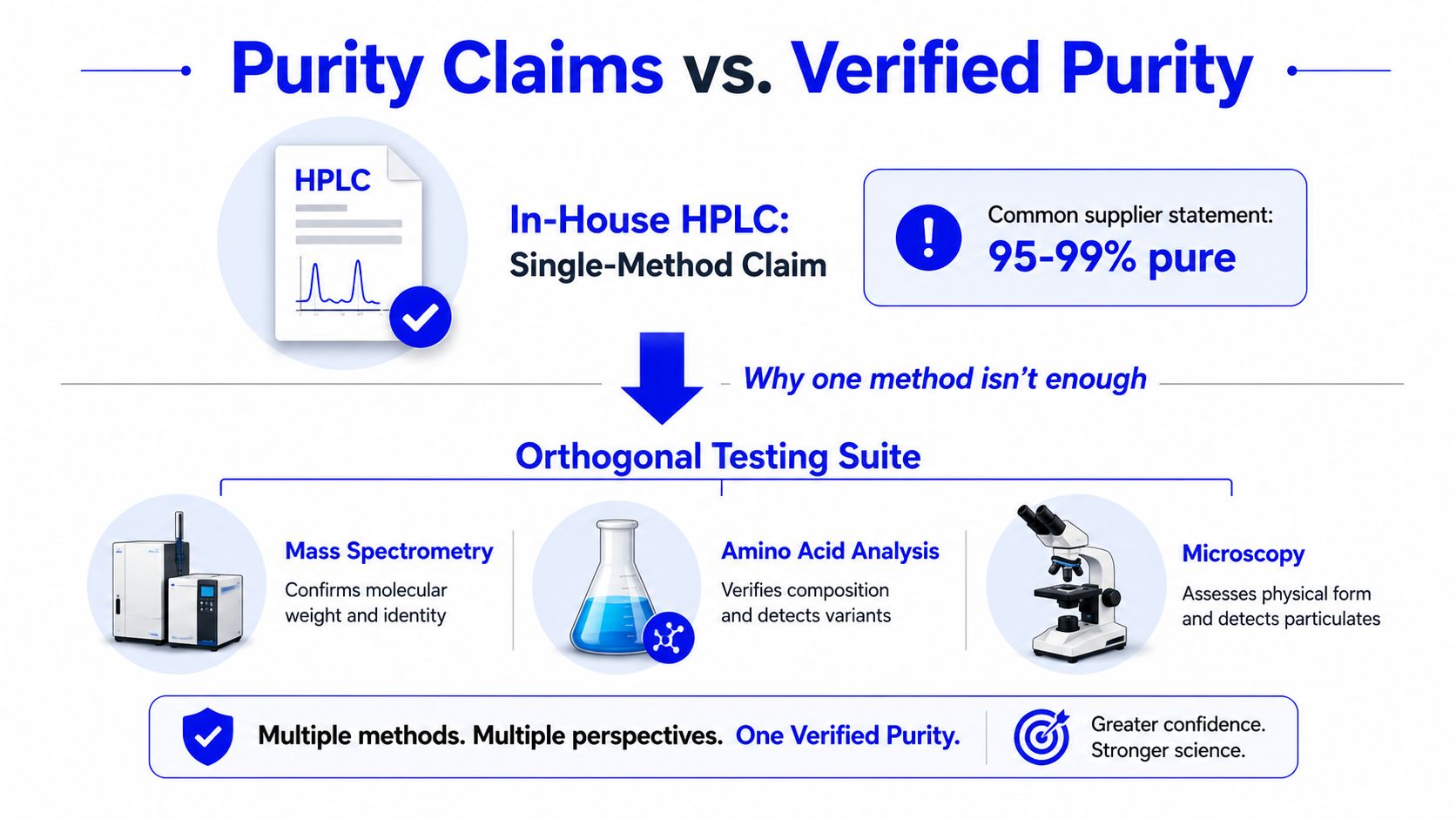
In-house HPLC is a useful starting point. It can reveal major chromatographic impurities and provides a repeatable profile when the method is fully documented. It shouldn't be treated as complete proof of identity or batch authenticity.
Mass spectrometry adds molecular-weight evidence. It can expose a truncated sequence, an unexpected modification, or a material whose mass doesn't fit the stated target.
Amino-acid analysis and sequence confirmation provide additional checks that don't depend on the same analytical assumption as HPLC. For peptide drug and research-material characterization, regulators and analytical specialists increasingly recommend UHPLC-HRMS because conventional HPLC-UV has limited resolving power for structurally related impurities. The cited benchmark is to identify each peptide-related impurity at 0.10 percent or greater of the drug substance, with attention to deletion and insertion products, racemization, residual solvents, counterions, and microbiological attributes (FDA-linked analytical guidance record).
Use this hierarchy when deciding how much evidence your project needs:
Look for rounded purity figures, chromatograms without lot numbers, and reports older than the synthesis date. The single most important question is simple: Was this exact vial, from this exact batch, tested by someone independent of the seller?
A verified peptide can still arrive unusable if the order record is incomplete or the shipment ignores the material's stability requirements. Protect the batch from the moment you request a quote.
Ask the supplier to confirm the lot number that will ship, then compare it with the COA and invoice. Request the safety data sheet and retain the quotation, purchase order, shipping record, COA, and receiving inspection with the project files.
Documenting chain of custody helps with internal reviews, grant audits, publication questions, and troubleshooting. If a result fails later, you need to know whether the problem began with synthesis, shipping, receipt, storage, preparation, or the assay itself.
Peptide stability depends on the material's physical form and chemistry. Lyophilized material, solution, long sequences, and modified peptides can have different handling requirements, so don't apply one storage rule blindly to every product.
Ambient summer shipping is a common failure point, particularly when the supplier hasn't specified acceptable exposure conditions. Review the shipment's temperature indicators or temperature log when provided, and record the condition of the outer package before opening.
At receipt, check:
Receiving standard: If the vial, lot number, seal, or temperature record doesn't match the order, quarantine it before anyone uses it.
Follow the peptide-specific stability information supplied by the manufacturer or your institutional protocol. Protect lyophilized material from moisture and light, and use aseptic technique when opening or reconstituting it.
Aliquoting can reduce repeat freeze-thaw cycles, but it must be done with suitable containers, labeling, and contamination controls. Record the reconstitution solvent, concentration, date, operator, storage location, and any observed change in appearance.
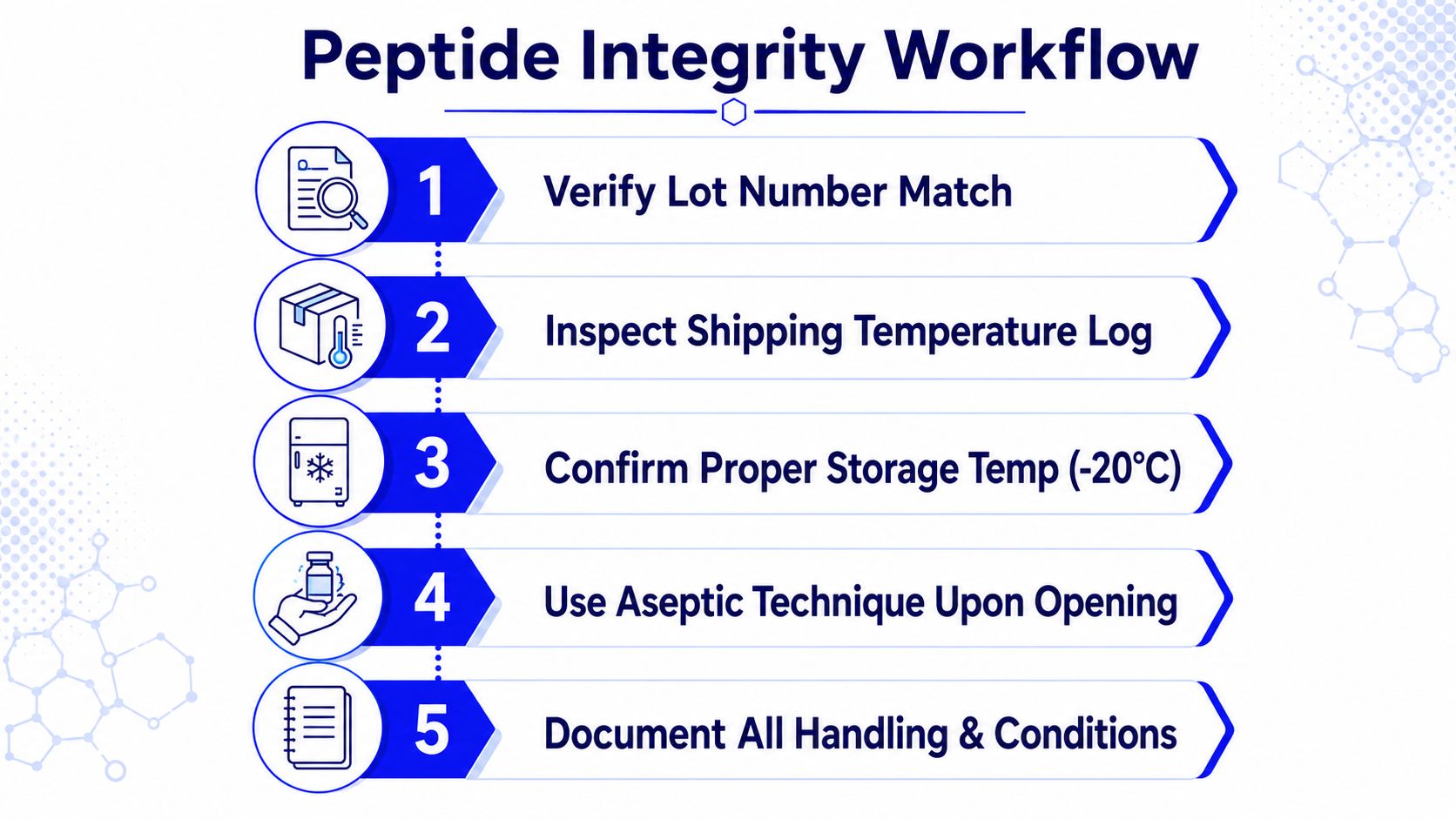
Use the workflow as a checklist, not decoration. Verification, temperature inspection, storage, aseptic opening, and handling records work together. Skipping one step weakens the evidence supporting the others.
“Research use only” isn't a casual label. It defines the permitted setting and prohibits human or veterinary consumption, medical use, and diagnostic application.
The label doesn't turn an unapproved peptide into a treatment, supplement, or injectable product. It also doesn't give a buyer permission to repackage the material for another user or distribute it outside the stated research context. In the United States, the supply includes approved therapeutics, regulated compounding, and research-use-only materials, and those categories must remain separate. More than 80 peptide drugs have reached FDA approval through standard drug pathways, according to the regulatory history summarized in this peptide synthesis market overview. Approval of some peptide drugs doesn't confer approval on unrelated research compounds.
Keep RUO vials in the research inventory, not in a clinical medication freezer. Segregate them from compounded pharmaceuticals, preserve the original labeling, and don't transfer them into unlabeled tubes without carrying the product name, lot number, and restriction forward.
Every experimental notebook should record the lot used. Retain the COA with raw data, instrument files, and assay records. Rotating lab members need direct training because a new student may understand the chemistry while missing the regulatory boundary.
A practical compliance file includes:
| Requirement | Compliant Practice | Common Mistake |
|---|---|---|
| Intended use | Restrict material to laboratory, analytical, or preclinical research permitted by the institution | Treat the label as a formality |
| Storage | Keep RUO material in a clearly identified research inventory | Store it beside clinical or compounded products |
| Labeling | Preserve the original restriction and lot information | Repackage without transferring controls |
| Documentation | Retain COAs with notebooks and raw data | Save only a product-page screenshot |
| Distribution | Limit access to authorized research personnel | Hand material to an unaffiliated individual |
| Marketing | Avoid disease, wellness, performance, and consumption claims | Describe the compound as a treatment or supplement |
| Shipping | Review jurisdiction, recipient, and end-use requirements | Assume an online checkout makes the transaction lawful |
Regulatory changes don't erase these boundaries. In 2023–2024, 19 popular peptides were reported as moving from Category 1 to Category 2, limiting compounding access for several compounds. In April 2026, the FDA formally moved 12 peptides back to Category 1, while BPC-157 and TB-500 remained restricted, according to the regulatory history summarized by Precedence Research. A category change is not the same as FDA approval, and it doesn't authorize over-the-counter consumer use.
For cross-border orders, freight documentation and recipient controls deserve their own review. A practical resource on freight forwarder compliance with Coreties can help teams assess shipping roles, documentation, and regulatory risk before a shipment moves.
Compliance position: If your team can't explain who may possess the vial, where it may be stored, and how it will be used, don't place the order.
A responsible buyer should reject any supplier that markets RUO peptides for consumption, hides batch identity, or refuses independent verification. Start with a lot-matched COA, arrange third-party HPLC and mass spectrometry when the work justifies it, and document receipt and storage from day one. Peptide Warehouse USA offers research peptides and related compounds with batch documentation, including COAs and stated microbial and endotoxin reports, for laboratory, analytical, and preclinical use only. Visit Peptide Warehouse USA to review available research options and verify the documentation before submitting an order.