No products in the cart.


You've just received a vial of research peptide. The supplier's page promised high purity, fast shipping, and reliable sourcing, but the paperwork seems limited to a percentage and a product name. Before the vial enters an assay, you need to know whether the documentation proves identity, purity, contamination control, and provenance, or merely repeats marketing language.
This guide treats bio labs peptides as a procurement and quality-control decision, not a shopping exercise. You'll learn how to read the specific tests on a peptide Certificate of Analysis, compare those results with the supplier's website and manufacturing claims, inspect the shipping label, and identify compliance signals that should make you pause.
A new researcher can make a reasonable purchase and still discover that the accompanying COA answers almost nothing. The document may list a peptide name, a lot number, and a purity figure, yet omit the chromatogram, observed mass, endotoxin result, analyst details, or manufacturing location. That gap between the vial in your hand and the evidence behind it is where avoidable procurement problems begin.
Catalog price isn't a quality test. Two suppliers can list similar products while offering very different levels of lot traceability, analytical detail, storage information, and post-sale support. A high headline purity figure can look persuasive, but purity alone doesn't confirm identity, exclude microbial contamination, or show how the material was handled before shipment.
Practical rule: Treat every supplier claim as a question that needs a matching document.
The same discipline used to evaluate data workflows in healthcare systems and WebscrapingHQ applies here. You need a traceable path from the source record to the decision, rather than a polished summary with no underlying evidence.
Four checks provide a useful purchasing framework:
A reliable purchase leaves an auditable record. If the supplier can't provide that record, the low price or attractive product page shouldn't carry the decision.
A research peptide is a short chain of amino acids prepared for laboratory, analytical, or non-clinical work. Commercial material may be produced through solid-phase peptide synthesis, or through recombinant methods for appropriate sequences. The phrase “bio labs peptides” describes the kind of catalog material researchers encounter from laboratory suppliers. It doesn't turn an unapproved compound into a pharmaceutical.
That distinction matters. Research-use material isn't automatically suitable for administration, clinical use, or human consumption. A research-grade designation describes intended laboratory use, while the actual quality assessment depends on the analytical evidence supplied for the specific batch.
Suppliers commonly report purity as area percent from a reversed-phase HPLC chromatogram. The instrument separates compounds as they move through the column, and software calculates how much of the integrated signal belongs to the principal peptide peak. A stated figure such as 98% or 99% therefore means the main integrated peak accounts for that share of the measured chromatographic area under the stated method.
Those benchmarks are useful procurement shorthand, but they aren't a complete identity certificate. Area percent can be affected by the column, solvent system, detection wavelength, integration settings, and sample preparation. The peptide purification literature also identifies practical synthesis-related contaminants such as deletion peptides, racemization products, and cleavage or workup residues.
Common material that may need consideration includes:
A useful COA pairs the HPLC result with identity testing and, where relevant, endotoxin and microbial data. The headline purity number is a starting point, not the entire quality argument.
The practical analytical backbone for peptide QC is reversed-phase HPLC plus LC-MS. HPLC addresses separation and relative purity. Mass spectrometry addresses molecular identity by comparing the observed mass with the expected mass. The two methods answer different questions, so replacing one with the other weakens the conclusion.
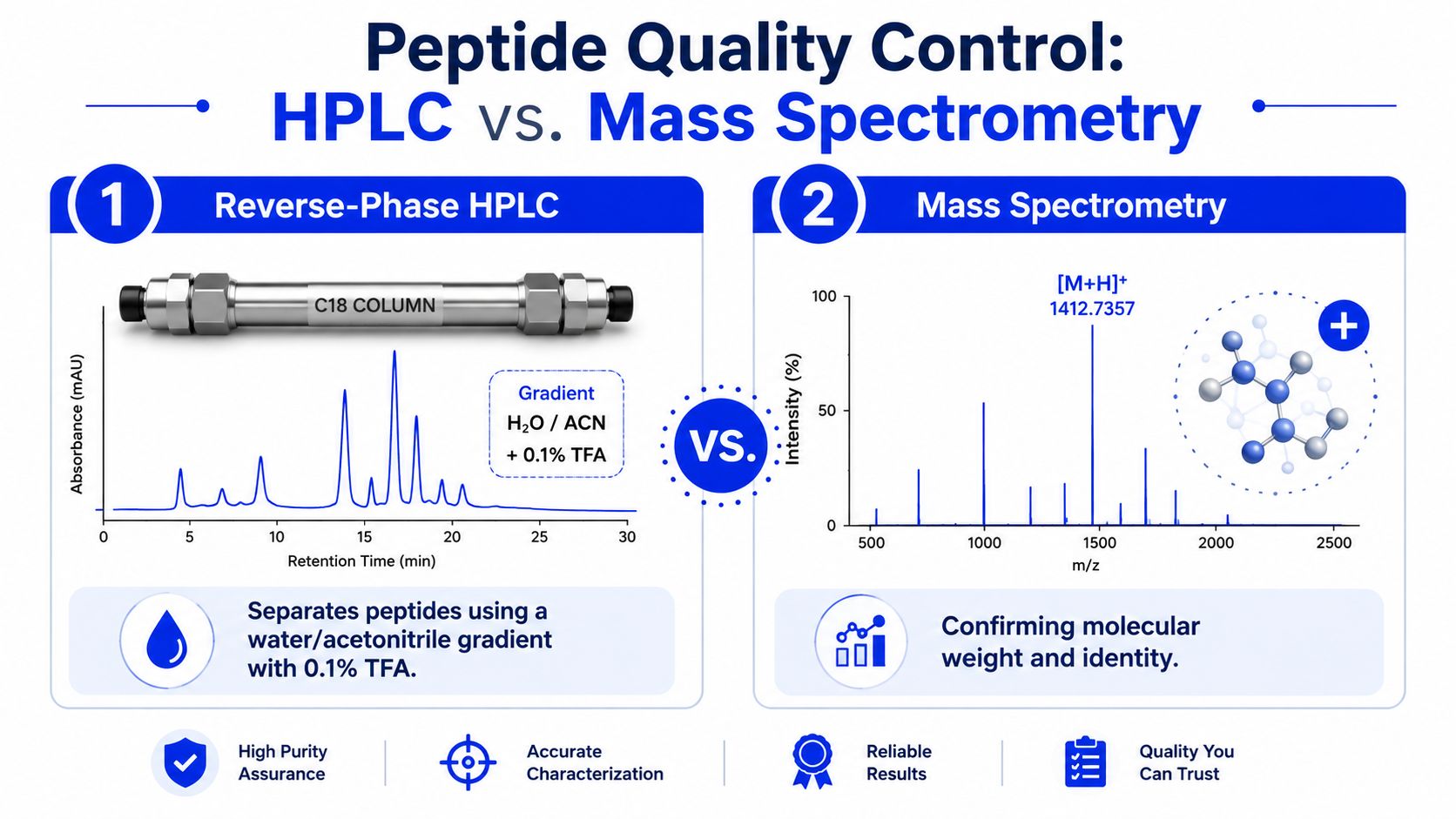
A clean reversed-phase trace generally shows a dominant, appropriately shaped main peak with smaller resolved signals representing impurities. Late-eluting shoulders can indicate closely related hydrophobic material or incomplete separation. Early-eluting peaks may represent shorter deletion products or more polar components. A broad main peak can signal poor resolution, aggregation, or method limitations, although the trace needs interpretation alongside the method conditions.
The COA should identify the method clearly enough for another laboratory to understand what was measured. A bare statement of “HPLC purity” without a trace or method context is much weaker than a chromatogram showing retention time, integration, and the impurity profile.
LC-MS, often using electrospray ionization, can confirm whether the measured molecular weight is consistent with the intended peptide. It can also flag many sequence variants and truncations. It doesn't, however, distinguish every structural possibility. Isobaric species, such as leucine and isoleucine, can share a mass, and mass spectrometry alone doesn't reliably establish every stereochemical substitution.
That limitation explains why neither method should stand alone. HPLC can't prove that the principal peak is the intended sequence. MS can support identity but isn't a substitute for quantitative impurity profiling. For higher-risk or high-value work, an orthogonal approach such as amino-acid analysis can add another layer of confirmation. The comparative peptide quality-control guidance supports using complementary evidence rather than treating one purity label as conclusive.
A vial arrives with a polished COA showing 99% purity. Before accepting it, compare the certificate with the physical shipment. If the lot number belongs to another batch, the document does not verify the material in your hands.
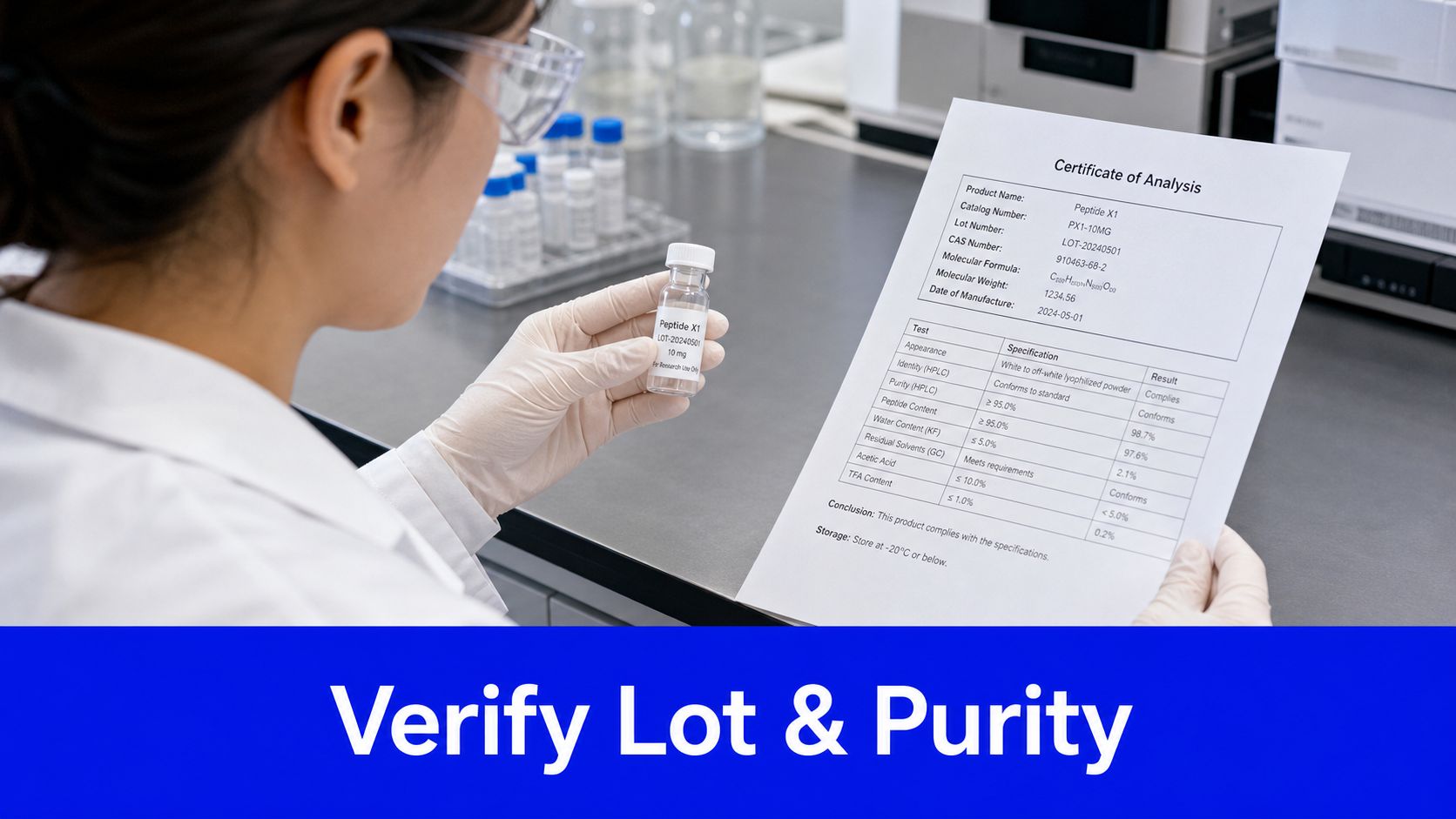
Match the lot number exactly across the vial label, COA, and packing slip. Check capitalization, hyphens, and suffixes. Guidance on how to read a peptide COA also stresses that the batch number should match the vial label and connect the testing to one specific lot.
Review the product description, amount, chemical form, test date, storage statement, and expiration or retest date. The analyst's name, approval signature, and release date provide a clearer chain of accountability. If any of these are missing, ask for clarification before placing the material into a study.
Look for HPLC purity reported as area percent, with the chromatogram when available. A result such as 99% represents the principal peak compared with the integrated signal captured by that method. It does not exclude isomers, residual solvents, endotoxin, microbial contamination, or impurities the method does not resolve.
Check the identity section separately. The observed mass should be compared with the calculated monoisotopic or average mass, and the COA should name the instrument method or tolerance. A “pass” box alone is difficult to review because it omits the observed and expected values.
For sensitive assays, review endotoxin and microbial testing rather than treating purity as a complete safety statement. Endotoxin may be reported in EU/mg or EU/mL. Microbial results may include TAMC and TYMC, together with acceptance criteria. Guidance on peptide COA reporting details also identifies residual-solvent information as relevant where applicable.
A missing field does not prove that the material is unsuitable. It does create a procurement question: was the test not performed, considered inapplicable, or left off the customer-facing certificate? Ask the supplier to state which explanation applies and to provide supporting results when the assay requires them.
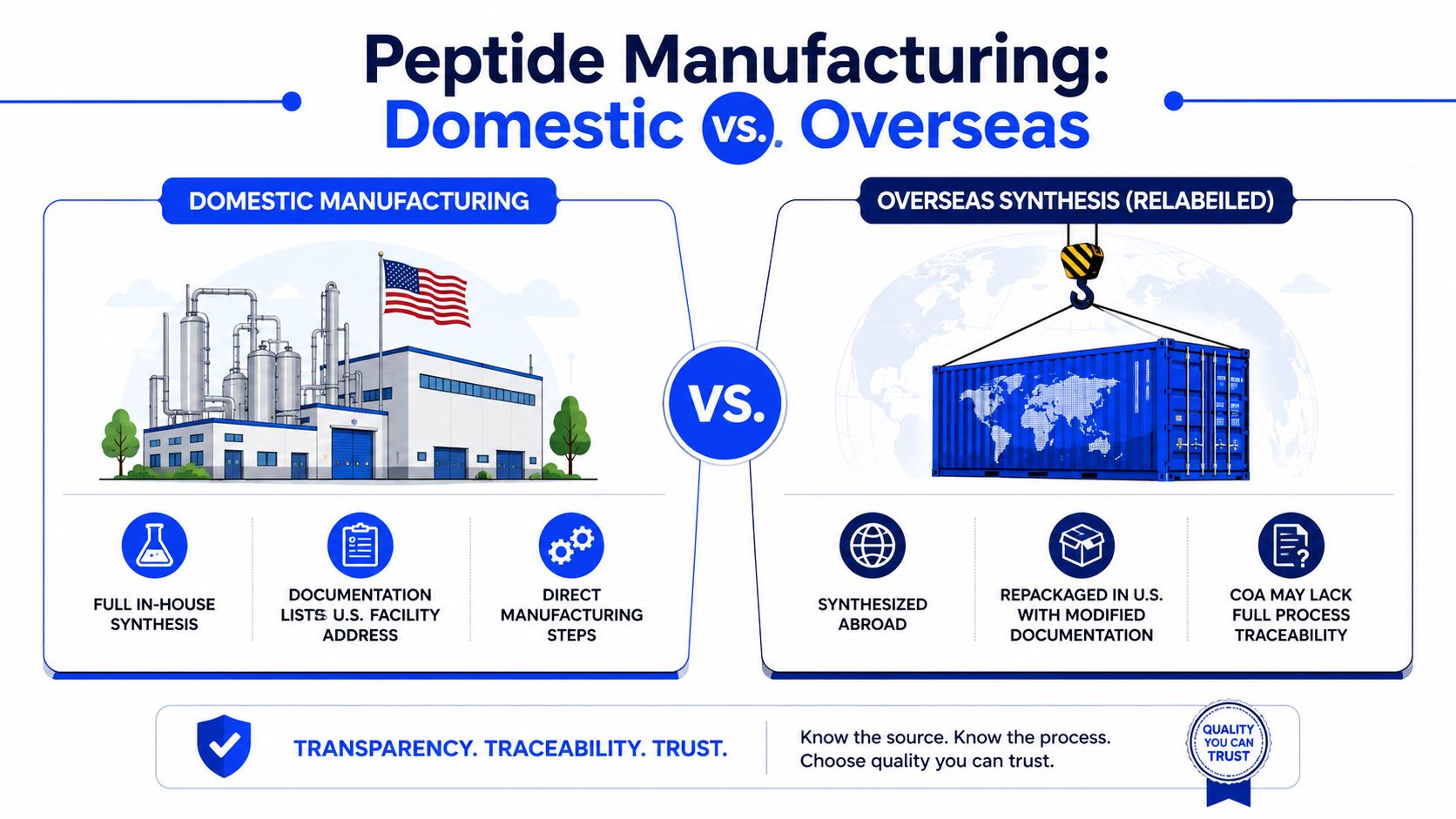
“Manufactured in the USA” should describe a documented manufacturing activity, not merely the location where a finished vial received a new label. A meaningful domestic claim should leave a traceable path through raw-material receipt, synthesis, cleavage, purification, lyophilization, quality-control testing, and release.
Overseas synthesis followed by domestic relabeling can still produce usable research material, but the buyer should be able to see that distinction. The paperwork should identify the synthesis site or country of origin, the packaging location, and the point at which final release testing occurred. A US packaging date that appears long after an unexplained manufacturing interval is a reason to request more information, not a reason to assume the worst.
| Signal | Deeper traceability | Documentation gap |
|---|---|---|
| Manufacturing location | Facility identity and address are stated | Only a country or broad regional claim appears |
| Process history | Batch records cover synthesis and purification steps | COA references final testing only |
| Packaging | Packaging and release dates are documented | A sudden repackaging date lacks context |
| Storage | Conditions correspond to the product's handling requirements | Shipping instructions are generic or absent |
Shipping matters because peptide stability depends on the compound, formulation, moisture exposure, temperature history, and assay conditions. A 2024 comparative plasma stability study found that sample-preparation choices can cause major analyte loss, with strong-acid precipitation performing poorly compared with organic-solvent mixtures in that comparison. The practical lesson is broader than shipping alone. Labs should standardize extraction, matrix selection, and reporting before comparing degradation or half-life results.
A research-only label isn't decorative. It establishes the intended use that the supplier communicates, and the surrounding website, product copy, images, and customer instructions need to support the same message. Compliance commentary on research peptides notes that the FDA can evaluate intended use from the totality of marketing, not just from a disclaimer (research peptide labeling and intended use).
A supplier creates avoidable risk when a product page combines “research use only” language with therapeutic outcome claims, before-and-after images, condition-specific promises, or consumer dosing directions. Those messages can contradict the laboratory-use label and make the disclaimer look cosmetic.
| Label Element | Compliant Practice | Red Flag |
|---|---|---|
| Intended use | “For Research Use Only” or “For Laboratory Research Use Only” | Language aimed at personal treatment or performance |
| Consumption warning | “Not for Human Consumption” | No restriction or consumer-facing administration language |
| Product identification | Peptide name, form, lot number, and supplier contact | Generic vial with no traceable batch information |
| Handling | Storage conditions and expiration or retest information | No storage guidance or an unsupported shelf-life promise |
| Website language | Laboratory, analytical, or preclinical context | Dosing instructions, therapeutic claims, or before-and-after framing |
The label should also align with the COA. If the vial has a lot number but the supplier sends only a generic certificate, request the lot-specific record. Research use only is a baseline expectation, not a substitute for identity, purity, or contamination data.
Before checkout, I reduce the decision to evidence that can be saved in the study file. A supplier doesn't need to answer every scientific question on a product page, but it should answer the procurement questions without forcing the researcher to infer basic facts.
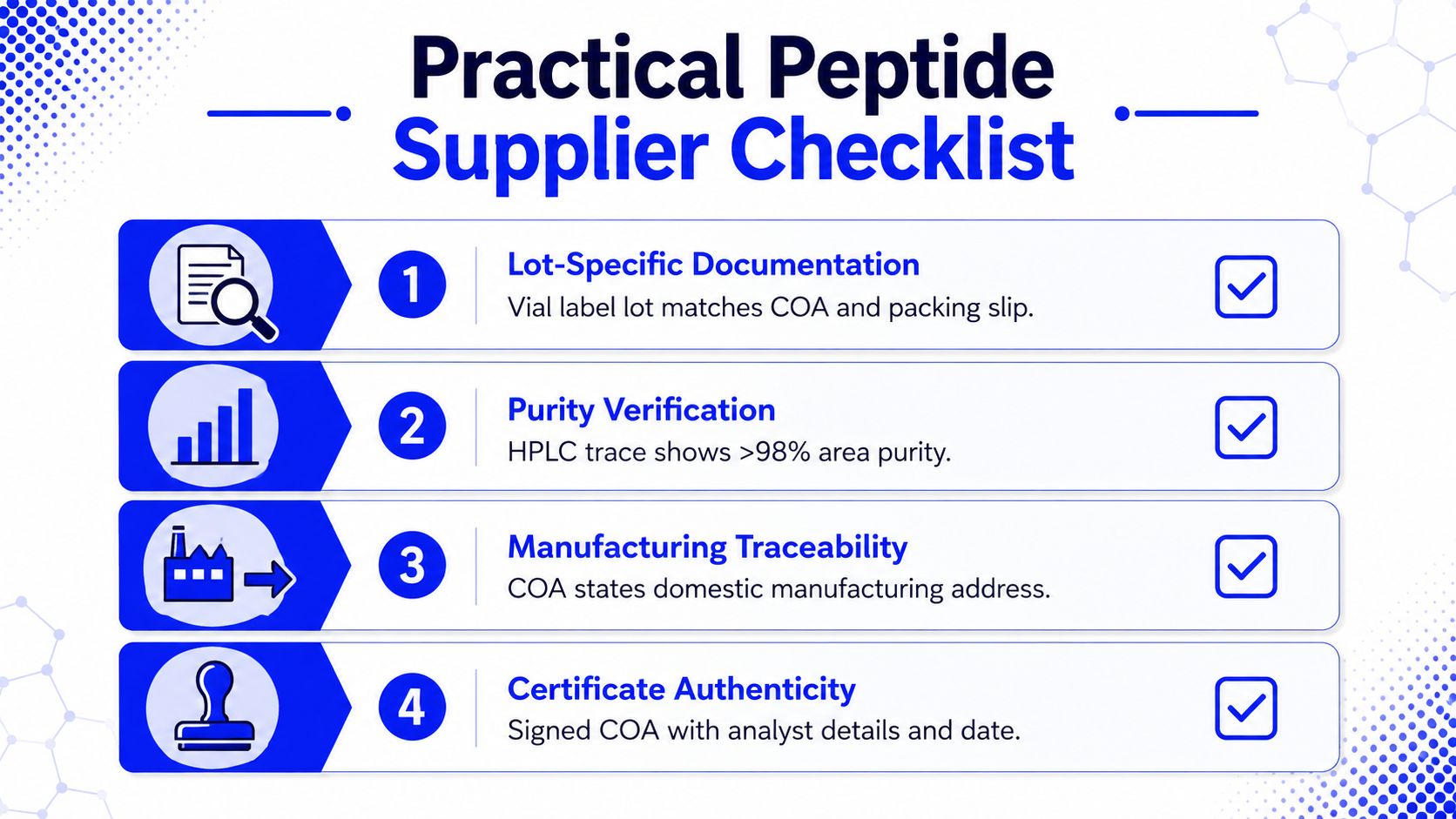
Use this pre-order screen:
Storage and shipping should be evaluated against the actual peptide and study design. Don't apply a universal handling rule to every sequence. Ask the supplier to state the recommended storage condition for the supplied form and explain how the shipment was protected.
Before treating two offers as comparable, ask:
Unusually low per-milligram pricing can reflect efficient production, but it can also accompany thin documentation or a different material specification. Compare the evidence package, not just the catalog number. Peptide Warehouse USA is one research supplier whose catalog presents peptides and related compounds with lot documentation, COAs, microbial and endotoxin reports, and stated purity information. Treat those materials as records to review against the checklist, just as you would with any other vendor.
A sound peptide purchase rests on four linked questions: Is this the intended molecule? Is it sufficiently pure for the planned assay? Are contamination controls documented? Can the material be traced to a real lot and manufacturing path? Each answer should point to a document, a result, or a label, not a slogan.
Take these steps before your next order:
The same checklist keeps comparisons fair across peptide suppliers. It also protects the lab from a common mistake, accepting a confident product page as a replacement for lot-level analytical evidence.
Research-use-only labeling should be present, but it shouldn't be the feature that persuades you. Identity, purity, contamination control, and provenance remain the useful basis for deciding whether a material fits your laboratory or preclinical workflow.
Review the Peptide Warehouse USA catalog to compare available research peptides and related compounds, then request the lot-specific COA, chromatogram, microbial results, and endotoxin documentation before ordering. Use the supplier's support resources to clarify sourcing, storage, and batch records so your procurement decision is documented from checkout through the final assay.