No products in the cart.



The surprising finding behind many Prostamax peptide benefits claims isn't a human treatment result. It's a laboratory observation in lymphocytes from donors aged 60–79, where Prostamax and related short peptides were associated with reactivated constitutive heterochromatin and increased ribosomal RNA gene transcription. That makes the compound scientifically interesting, but it also defines the central limitation: the available evidence remains preclinical, and major trial-registry searches found no registered randomized human trials as of June 2026 (evidence review of Prostamax research).
For a lab buyer, that distinction matters more than a long list of promised outcomes. The relevant question isn't whether marketing pages describe urinary relief, prostate support, or anti-inflammatory activity. It's which findings come from cultured cells, which come from animals, and which have been tested in controlled human research. This analysis maps those claims to their actual evidence strength, then covers mechanism, procurement, storage, and documentation for research use.
Prostamax, commonly identified as Lys-Glu-Asp-Pro, or KEDP, is a short synthetic tetrapeptide described in experimental literature as a prostate-tissue bioregulator. A published paper presents it as a new tetrapeptide and reports tissue-specific effects in laboratory and animal research, not as an established human therapy (experimental paper on Prostamax).
The term bioregulator reflects a research hypothesis distinct from conventional prostate pharmacology. Investigators are examining whether a short peptide can carry biological information that influences tissue-specific gene-expression programs. That proposed activity does not establish a hormone effect, classical receptor agonism, or 5-alpha-reductase inhibition.
The evidence falls into three tiers:
This hierarchy limits how far researchers can extend reported Prostamax peptide benefits. A plausible mechanism may support laboratory testing, and an animal model may show a measurable histologic change. Neither finding demonstrates improved outcomes in men with BPH or prostatitis.
Researchers study Prostamax to assess whether tissue-selective peptides can influence cellular maintenance rather than block a symptom pathway. The proposed areas of interest include prostate tissue architecture, inflammatory remodeling, and gene-expression regulation.
For procurement and study design, the compound should be treated as a research chemical. The available literature supports experimental investigation. It does not establish approval for human therapeutic use or show that laboratory findings translate directly into clinical benefit.
Evidence rule: A plausible biological mechanism can justify an experiment. It cannot replace controlled human efficacy or safety data.
Prostamax's proposed mechanism remains a research hypothesis, not a confirmed therapeutic pathway. Preclinical descriptions report that labeled peptide enters cells and accumulates in the nucleus within 1–3 hours. From there, it may interact with promoter and chromatin structures associated with epithelial differentiation, tissue repair, and inflammatory signaling (Prostamax mechanism overview).
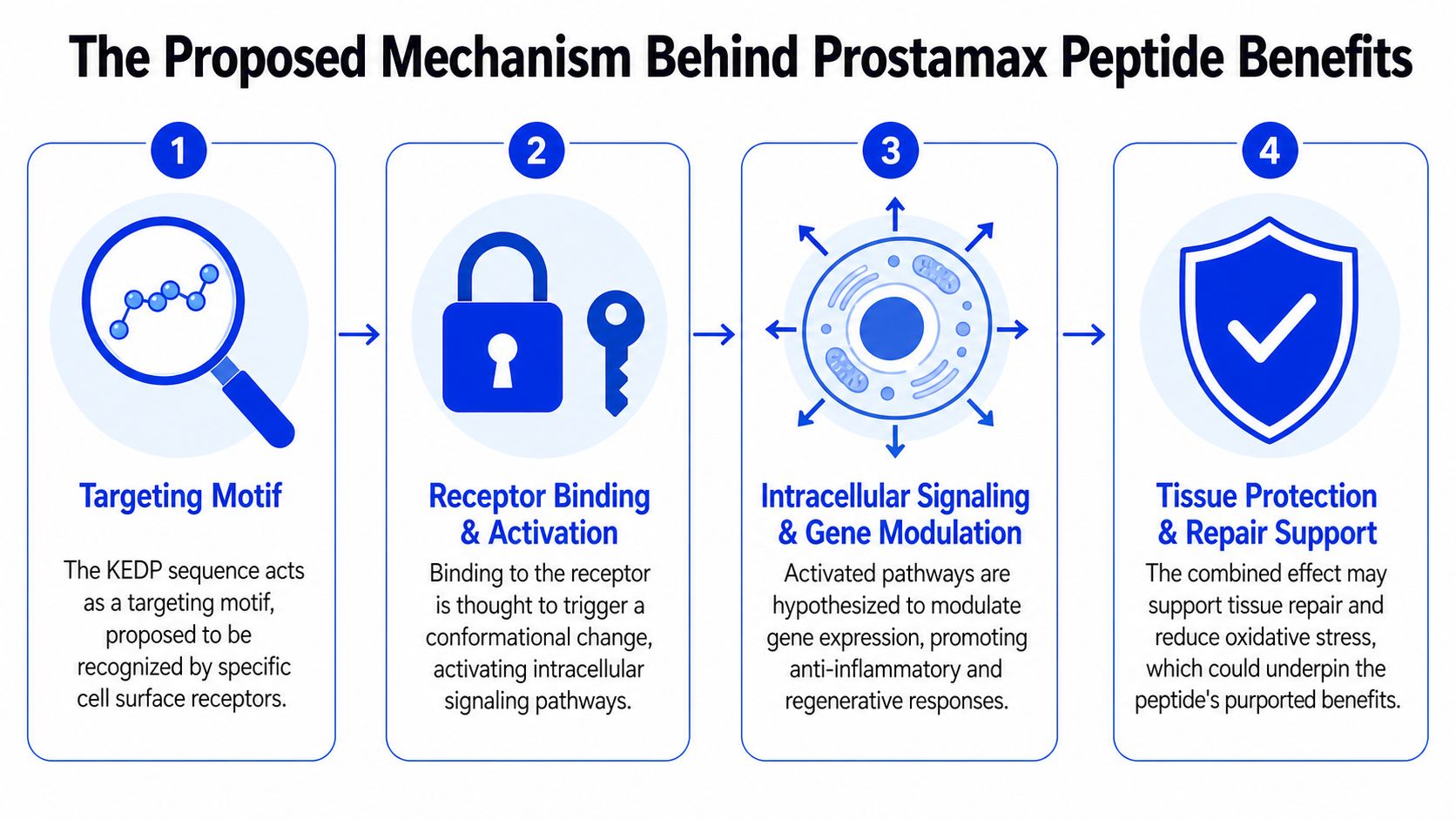
The evidence is easier to assess when each reported observation is separated from its interpretation:
The appropriate label is therefore mechanistic, not clinical. Nuclear localization does not establish symptom relief, disease modification, or a human safety profile.
Research buyers comparing this candidate with other peptide categories can consult an overview of effective growth peptides, while keeping the evidence categories separate. Shared peptide classification does not demonstrate shared pharmacology, prostate targeting, or clinical performance.
The strongest early signal for Prostamax is molecular, not therapeutic. A 2004 PubMed-indexed paper linked KEDP-related peptide exposure with measurable changes in cultured human cells. In lymphocytes from donors aged 60–79, Prostamax and related short peptides were reported to reactivate constitutive heterochromatin and increase rRNA-gene transcription, according to this published Prostamax research summary.
Heterochromatin is tightly packed genetic material. Greater accessibility could allow transcriptional machinery to reach genes with lower baseline activity. rRNA genes direct production of ribosomal components required for protein synthesis, so changes in rRNA transcription provide a mechanistic marker related to cellular maintenance. They do not, by themselves, establish a prostate-specific effect.
The study supports mechanistic interest in cultured human cells. It does not demonstrate delivery to prostate tissue in a living person, a change in urinary function or prostate volume, or improvement in prostatitis symptoms.
| Endpoint | Model | Reported direction | Evidence strength |
|---|---|---|---|
| Constitutive heterochromatin activity | Lymphocytes from donors aged 60–79 | Reactivation reported after peptide exposure | In vitro, preclinical |
| rRNA-gene transcription | Cultured lymphocytes | Increased transcription reported | In vitro, preclinical |
| Prostate-specific therapeutic outcome | Human participants | No controlled outcome established | Human evidence absent |
| Randomized trial registration | Human research record reviewed through June 2026 | No registered randomized human trials identified | Major evidence gap |
The paper remains influential because later Prostamax discussions use it as the molecular basis for a prostate-bioregulator theory. Its historical importance does not convert the experiment into a prostate efficacy trial. Nor does it independently confirm later claims concerning inflammation, urinary symptoms, sexual function, or anti-aging effects.
The defensible conclusion is narrow: KEDP-related peptides have been associated with chromatin and rRNA-transcription changes under controlled cellular conditions. Independent replication, prostate-specific validation, pharmacokinetic characterization, and controlled human testing remain necessary before these findings can support therapeutic language.
Prostamax is investigated as a tissue-bioregulator hypothesis, not as a substitute for an established prostate drug. Conventional agents are built around defined pharmacologic targets, including smooth-muscle receptors, androgen metabolism, or reproductive hormone pathways. Prostamax studies instead examine whether a short peptide can affect nuclear or chromatin-associated processes in prostate tissue.
The comparison therefore concerns research questions as much as mechanisms. Alpha-blockers are assessed through receptor-mediated changes in smooth-muscle tone. 5-alpha-reductase inhibitors are assessed through enzyme inhibition and its effects on androgen-dependent prostate biology. GnRH analogues act through reproductive hormone signaling. Prostamax research asks whether KEDP-related activity can influence tissue-level gene-expression regulation.
| Agent class | Primary target | Mechanism type | Evidence tier for Prostamax comparison | Approved status |
|---|---|---|---|---|
| Prostamax, KEDP | Proposed prostate-tissue chromatin and gene-expression processes | Tissue-bioregulator hypothesis | In vitro and animal research | No established human therapeutic approval in the cited evidence |
| Alpha-blockers | Receptor systems involved in smooth-muscle tone | Receptor-mediated pharmacology | Conventional clinical-care category, not evidence for Prostamax | Not applicable to Prostamax |
| 5-alpha-reductase inhibitors | Enzyme pathway involved in androgen metabolism | Enzyme inhibition | Conventional clinical-care category, not evidence for Prostamax | Not applicable to Prostamax |
| GnRH analogues | Reproductive hormone signaling | Hormonal pathway modulation | Conventional clinical-care category, not evidence for Prostamax | Not applicable to Prostamax |
This distinction prevents an unsupported equivalence claim. The available Prostamax evidence is preclinical, whereas conventional agents are categorized by established pharmacologic targets and clinical use. The proposed endpoint is therefore closer to tissue maintenance or regulation than to immediate symptom blockade, although that proposed role has not been confirmed in controlled human studies.
For background on prostate symptoms and conventional discussions of enlarged prostate relief, readers should separate general educational information from evidence specific to KEDP. A prostate-health resource cannot establish Prostamax-specific effects.
For a lab buyer, the practical decision is to match the material to the protocol. Prostamax fits experiments examining KEDP biology, tissue responses, or gene-expression mechanisms. It should not be ordered for a study that assumes proven clinical equivalence to an alpha-blocker or 5-alpha-reductase inhibitor.
The clearest support for Prostamax-related claims about inflammation and prostate structure comes from animal experiments, not controlled human research. A 2013 experimental report described lower-intensity chronic inflammation in animal prostate models after Prostamax exposure, including reduced swelling, vascular hyperemia, and lymphoid infiltration. It also reported fewer sclerotic and atrophic changes and increased sexual activity in the animals. The authors presented these findings as superior to preparations derived from Serenoa repens and animal prostate extracts, a comparison that remains limited by the study design and available reporting (2013 experimental report).
A separate rat model of sulpiride-induced benign prostatic hyperplasia associated Prostamax exposure with a 22.4% reduction in the area of acini epithelium versus controls (rat-model research summary). This is a histologic endpoint. It measures tissue structure under experimental conditions, rather than human prostate volume, urinary performance, or symptom change.
Taken together, the findings form a coherent preclinical signal. Prostamax may affect inflammatory remodeling and epithelial expansion in selected prostate disease models. They do not establish human dosing, long-term safety, comparative clinical effectiveness, or cross-species reproducibility.
Protocol details determine how much weight a lab buyer should assign to these results. The original methods should be obtained where possible, including animal numbers, randomization, dosing, endpoint definitions, and statistical analysis. Limited reporting can still justify exploratory work, but it weakens confidence in replication and interpretation.
A favorable histology result should refine the next experiment, not support a human treatment claim.
The central limitation is the missing controlled human evidence chain between molecular activity and patient outcomes. The available record is preclinical, covering an animal organotypic-culture study and in vitro work with cultured human lymphocytes. It does not establish controlled human trials or adverse-event data from administered Prostamax (Prostamax evidence assessment).
Claim labels should reflect that boundary. Anti-inflammatory can describe an observation in an animal model. Supports prostate tissue research accurately describes a laboratory use. Relieves BPH symptoms would imply a human clinical result that the cited record does not provide.
Regulatory expectations reinforce the distinction between laboratory findings and therapeutic claims. FDA guidance describes the evidence needed to assess safety and effectiveness for an intended peptide drug use, including clinical pharmacology considerations (FDA guidance on peptide drug products). That framework does not validate Prostamax. It shows why preclinical signals alone cannot support treatment positioning.
For a lab buyer, the practical conclusion is straightforward: document each claim by source type, label animal and in vitro results separately, and design follow-up studies around mechanism and reproducibility. Research remains reasonable, but efficacy should not be presumed before controlled human evidence exists.
A defensible Prostamax experiment depends on material identity, batch records, and handling history before any assay begins. Published findings do not establish that commercial vials are interchangeable, so procurement should match the planned protocol and its analytical requirements.
The documentation package should remain tied to the experiment, not stored only in a purchasing system.
For lyophilized material, follow the supplier's validated instructions and protect the vial from moisture and repeated temperature cycling. Frozen storage at -20°C with desiccant is a commonly specified laboratory approach, but compatibility should be confirmed against the product certificate and handling guidance rather than assumed from a generic rule.
Reconstitution should follow the experimental design. Record the solvent, concentration, preparation time, container, dilution, and storage conditions, and prepare only the working quantity required for the short-term study. Bacteriostatic water may appear in laboratory workflows for short-term solutions, but it does not replace protocol-specific validation.
Traceability practice: Keep the vial label, lot number, COA PDF, analytical reports, shipment records, and reconstitution notes in one experiment folder.
Prostamax has a preclinical evidence base, not a demonstrated clinical one. Published material describes a proposed bioregulator mechanism, a frequently cited 2004 lymphocyte study involving heterochromatin and rRNA-gene transcription, and animal findings involving inflammation and prostate tissue structure. These observations support controlled laboratory investigation, while leaving the claimed Prostamax peptide benefits unconfirmed in humans.
The available record contains no registered randomized human trials as of June 2026. It also does not establish adverse-event data for administered Prostamax in humans. Buyers should therefore separate reported animal or cellular findings from clinical evidence rather than treating them as interchangeable.
For a lab buyer, the purchasing decision should follow the mechanism under investigation. A study of KEDP-specific nuclear or prostate-tissue activity requires documented material that supports experimental reproduction. A benefits list that combines animal observations with unsupported human promises is not an adequate selection basis.
Vendor comparison should focus on analytical documentation, batch traceability, and research-use labeling. Peptide Warehouse USA supplies research peptides and related compounds with batch records, including certificates of analysis and other laboratory documentation, while identifying products for research, laboratory, or analytical use only.
Peptide Warehouse USA offers US-manufactured research peptides and related compounds supported by batch documentation for laboratory and preclinical work. Visit Peptide Warehouse USA to review available materials and evaluate sourcing records before planning Prostamax-related experiments.