No products in the cart.



You've probably seen the search phrase BRP peptide for sale appear after a journal club, a headline about new appetite research, or a discussion about alternatives to GLP-1 drugs. The difficult part isn't finding a product page. It's determining whether the vial represents the same BRP molecule described in the published research, whether the C-terminal modification is correct, and whether the supplier can support the batch with meaningful analytical records.
BRP, or BRINP2-related peptide, is a promising but preclinical research compound. It isn't an approved treatment, and human safety, dosing, and pharmacokinetic data don't yet exist. This guide approaches procurement from the lab bench, not the consumer marketplace. You'll learn what BRP is, how its evidence differs from semaglutide and tirzepatide, which documents to request, how to inspect a COA, and how to complete a practical order review before accepting a shipment.
A postdoc hears BRP mentioned during journal club, opens the published paper, and walks into the stockroom asking whether anyone has found a dependable source. The question sounds straightforward, but it immediately raises several others. Is the listed material BRP? Does it have the correct sequence and amidation state? Can the supplier prove what's in the batch?
Interest has grown because BRP sits at the intersection of two active research areas. Media attention around GLP-1 drugs has made appetite biology highly visible, while early work on a BRINP2-derived peptide has introduced a possible non-incretin pathway for reducing food intake. The wider peptide therapeutics field is also substantial. Grand View Research estimates the global peptide therapeutics market at USD 140.9 billion in 2025, with a projection of USD 294.6 billion by 2033 and a 8.7% CAGR from 2026 through 2033. Those figures describe the therapeutic market, not the unregulated retail market for laboratory compounds, but they help explain why peptide research attracts suppliers and buyers alike. Grand View Research's peptide therapeutics market estimate provides that market context.
BRP shouldn't be treated as “natural Ozempic.” That shortcut collapses important differences between an experimental molecule and a clinically studied medicine. The published evidence supports appetite and body-composition findings in mice and pigs, while human efficacy and safety remain unanswered.
The search term also attracts listings that may use BRP-related language without demonstrating a connection to the research molecule. A product can have a familiar name and still lack sequence confirmation, amidation details, mass analysis, or lot-specific testing.
Procurement principle: A product page creates a purchasing lead. The batch record determines whether the material is suitable for a defined laboratory experiment.
By the end of this review, a buyer should be able to separate three questions:
That distinction protects a lab from overinterpreting early findings and helps researchers spend budget on material they can document later.
BRP means BRINP2-related peptide. It's a 12-amino-acid peptide derived from the BRINP2 prohormone, and the published work describes anti-obesity effects in preclinical models. In pharmacologic experiments, BRP reduced food intake and produced weight-related effects in mice and pigs without observed nausea or aversion. The reported mechanism acted independently of leptin, the GLP-1 receptor, and melanocortin 4 receptor signaling. The PubMed record for the BRP discovery work is the appropriate starting point for checking the molecule's research identity and findings.
The Stanford animal studies provide the clearest numerical context. An intramuscular dose before feeding reduced short-term food intake by up to 50% in lean mice and minipigs, while 14 days of daily treatment in obese mice produced an average 3 g weight loss, driven largely by fat loss. Stanford Medicine's report on the animal studies describes those observations.
The evidence supports a research hypothesis involving appetite regulation and body composition. It doesn't establish a human dose, a human therapeutic benefit, or a clinically acceptable safety profile. Those conclusions require formal human studies, including pharmacokinetic, tolerability, and longer-term safety work.
A buyer should also avoid treating every BRP listing as interchangeable with the published material. The sequence, terminal chemistry, and analytical identity all matter, particularly for a short peptide where a small structural difference can alter activity.
| Research question | What the current evidence indicates |
|---|---|
| Molecule | BRP is a 12-amino-acid peptide derived from BRINP2. |
| Models | Findings come from mice and pigs, not human participants. |
| Observed activity | Reduced food intake and anti-obesity effects were reported in preclinical work. |
| Signaling distinction | The reported action was independent of leptin, GLP-1 receptor, and MC4R signaling. |
| Human data | Human safety, dosing, and pharmacokinetic data aren't available. |
The Nature publication is especially important for source verification because it anchors the research identity, while later commentary has highlighted uncertainty around commercial offerings and their documentation. The published Nature article on BRP should be compared with the supplier's stated sequence and lot paperwork, not just cited as proof that any commercial vial is equivalent.
BRP and GLP-1 medicines may appear together in search results because both relate to appetite and metabolic research. They aren't interchangeable compounds. BRP is a short, endogenous peptide studied in animals, while semaglutide and tirzepatide belong to clinically developed drug categories with human evidence and different receptor activity.
Semaglutide is a modified GLP-1 receptor agonist designed for longer activity than native GLP-1. Tirzepatide is a dual GIP and GLP-1 receptor agonist. BRP's reported pathway is distinct from GLP-1 receptor signaling, and the current BRP evidence remains preclinical.
Researchers comparing treatment options in a patient context should use clinical resources rather than research-vendor listings. For general background on prescription access pathways, readers can browse semaglutide telehealth options from Weight Method. That resource belongs to the clinical and consumer healthcare discussion, not to the procurement of laboratory BRP.
Molecular origin: BRP is derived from the BRINP2 prohormone and is only 12 amino acids long. Semaglutide is a modified GLP-1 analog, while tirzepatide is engineered around dual incretin receptor activity.
Evidence depth: BRP's results come from animal models. Semaglutide and tirzepatide have human clinical evidence and regulated prescription uses. A promising animal result can justify further investigation, but it can't substitute for clinical validation.
Regulatory position: BRP is a research-only compound. Semaglutide and tirzepatide are approved prescription medicines for specified uses. A BRP vial shouldn't be ordered, labeled, or discussed as a substitute for either drug.
| Attribute | BRP | Semaglutide | Tirzepatide |
|---|---|---|---|
| Molecular origin | BRINP2-derived, 12-amino-acid peptide | Modified GLP-1 analog | Engineered dual GIP and GLP-1 receptor agonist |
| Primary research distinction | Reported non-GLP-1 appetite pathway | GLP-1 receptor activity | GIP and GLP-1 receptor activity |
| Evidence status | Preclinical animal evidence | Human clinical evidence | Human clinical evidence |
| Regulatory category | Research use only | Approved prescription drug | Approved prescription drug |
| Procurement meaning | Verify identity and analytical proof | Obtain through regulated clinical channels | Obtain through regulated clinical channels |
Treating BRP as an interchangeable GLP-1 analog is a category error. The comparison is useful for designing research questions, such as whether distinct appetite pathways produce different tolerability or body-composition findings. It isn't a basis for human dosing or self-directed use.
A legitimate procurement file should answer a basic question: what exactly is this lot, and how was it tested? The Certificate of Analysis is central, but it shouldn't stand alone. A buyer needs enough documentation to connect the product page, the physical vial, the test results, and the intended laboratory use.
Use this document check before approving a BRP peptide for sale:
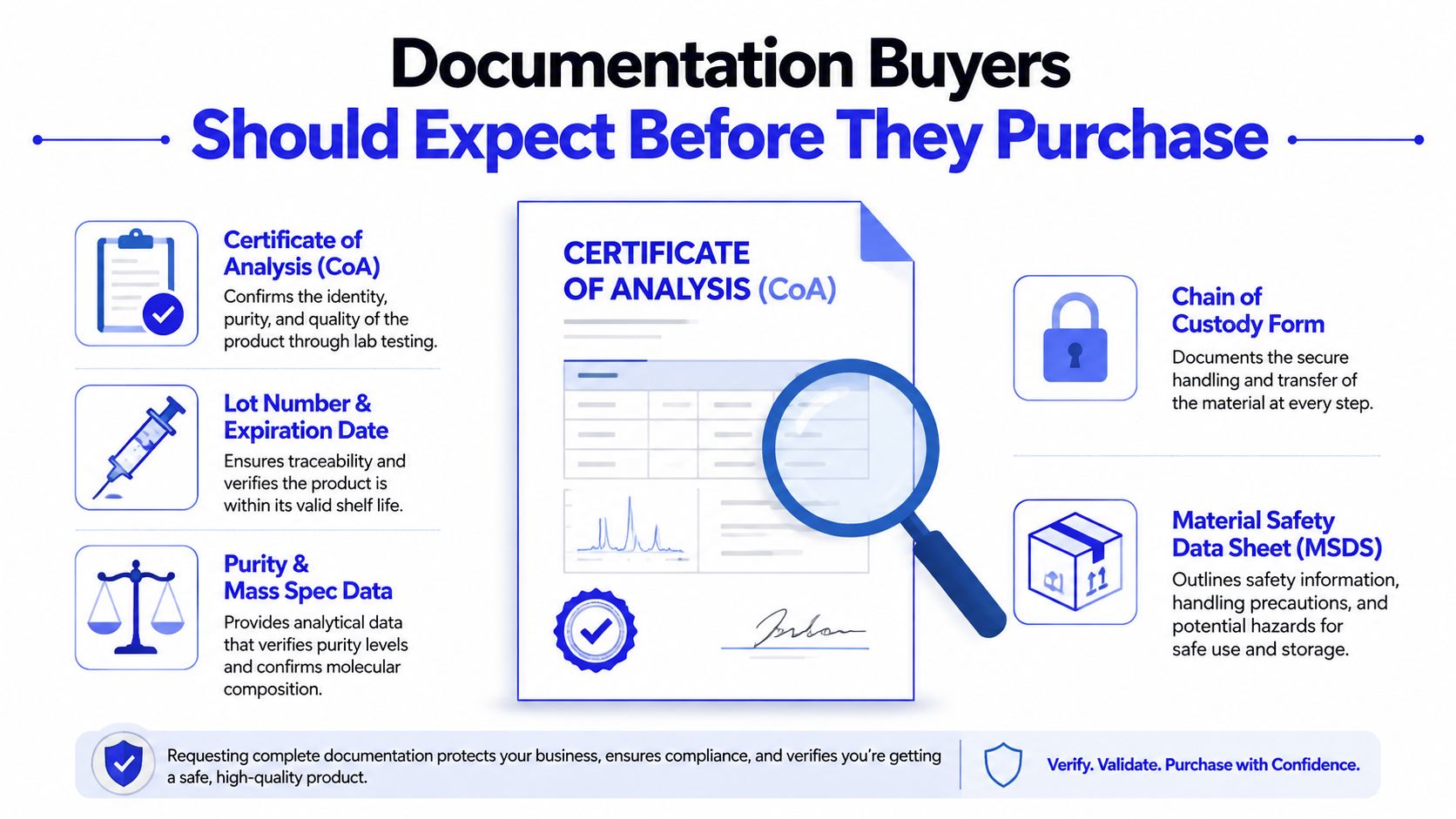
In-house HPLC can provide useful information, but it may not be enough for a high-confidence purchasing decision. Third-party testing adds an independent review, particularly when the laboratory name, test date, chromatogram, mass trace, and lot identifier are visible.
Don't confuse purity with clinical suitability. Purity describes an analytical result under a particular method. It doesn't establish that the material is sterile, endotoxin-free, correctly formulated for injection, safe for people, or approved for treatment.
The same logic applies to the phrase “research use only.” The label describes intended use. It doesn't certify purity or make a product suitable for clinical work, as explained in FDA guidance on research-use-only labeling.
Open the COA beside the published BRP reference and inspect it line by line. The first field should identify the product name, followed by the claimed sequence and terminal form. If the document says only “BRP peptide” without a sequence, amidation state, or lot identifier, it doesn't provide enough information to establish identity.
The lot number should match the vial, invoice, packing slip, and any attached chromatograms. The document should also state the test date and the testing laboratory name. A PDF with no batch connection may be a reusable marketing sheet rather than a lot record.
Appearance and net weight provide basic physical checks. Lyophilized peptide may be described by color, form, or visible condition, while net weight helps reconcile what was ordered with what was released. These fields don't prove activity, but missing or contradictory entries make the record harder to trust.
Purity percentage and HPLC chromatogram should appear together. The percentage is a summary, while the chromatogram lets the reviewer inspect the underlying separation. A single HPLC number without the trace leaves unanswered questions about the method and the peak profile.
LC-MS or LC-MS/MS data supports molecular identity by showing whether the observed mass aligns with the claimed peptide form. This is particularly important when amidation changes the expected molecular mass.
Endotoxin LAL results and microbial testing address separate quality questions. The COA should state the result and method rather than just saying “passed.” Recommended storage should also be clear, because handling after receipt can affect future experimental consistency.
| COA field | What to look for |
|---|---|
| Product name | A specific BRP identity, not a vague peptide category |
| Sequence | The claimed 12-amino-acid sequence, matched to the published reference |
| Terminal chemistry | Clear statement of amidation or another stated form |
| Lot number | Exact match across vial, invoice, COA, and test attachments |
| Appearance | Physical description of the released material |
| Net weight | Stated quantity for the specific batch |
| Purity | Method-linked result, with the HPLC chromatogram attached |
| HPLC chromatogram | Trace labeled with product and lot information |
| LC-MS or LC-MS/MS | Mass data supporting the claimed molecular form |
| Endotoxin LAL result | Reported value or defined result, not an unexplained claim |
| Microbial testing | Batch-specific screening information where supplied |
| Storage recommendation | Clear handling and storage conditions |
Compare typography, lot details, test dates, and laboratory names across the COA pages. A generic document may use a different product name in one field, omit the terminal modification, or show a chromatogram that doesn't carry the same lot number.
The supplier should also explain discrepancies before purchase. A clean-looking PDF isn't a substitute for a coherent chain of identity.
Research Use Only, or RUO, is an intended-use designation. It means the product is supplied for laboratory, analytical, or preclinical research and not for diagnostic procedures or human consumption. The FDA's wording makes the intended-use connection clear, so buyers should read the label alongside the entire product page, SDS, order record, and packaging.
A supplier can't rely on RUO language while surrounding marketing encourages consumer use. Regulatory commentary on peptide sellers describes FDA challenges to “research use only” claims when advertising points toward human applications. This FDA-focused legal analysis of peptide advertising and RUO language explains why the disclaimer and the marketing context need to agree.
Look for alignment across the purchasing record:
Red flags include dosing instructions for people, testimonials, promises about fat loss or healing, injection guidance, or language that presents BRP as an alternative to an approved medicine. Those claims create confusion even if a small RUO disclaimer appears at the bottom of the page.
Compliance check: RUO isn't a shield for therapeutic advertising. The intended use has to remain consistent across the full chain of custody.
Institutional buyers should also consider import review, biosafety procedures, grant records, and internal purchasing controls. A lab may need to show why the compound was ordered, who approved it, how it will be stored, and which experiments it supports.
Buying BRP under RUO terms means accepting non-clinical intent for the entire transaction. It doesn't create permission for human administration, and it doesn't convert an experimental peptide into an approved product.
A procurement officer can run this review quickly if the supplier has organized its records. Start with identity, then move to testing, logistics, and documentation retention.
Verify the sequence first. Confirm that the vendor lists the canonical 12-amino-acid BRP sequence derived from BRINP2. Match the product page to the lot-specific COA, and confirm that the terminal chemistry is stated rather than assumed.
Request the complete COA. Look for the HPLC purity result and chromatogram, LC-MS or LC-MS/MS molecular-weight confirmation, appearance, net peptide content, and test-laboratory details. A purity percentage alone isn't enough to establish identity.
Ask about residual solvents and microbial controls. Require the supplier to state whether residual solvent data is available and request endotoxin results below a stated threshold. Don't accept “clean” as a substitute for a reported method or result.
Confirm manufacturing origin. Ask whether the peptide is synthesized in the United States and what quality system the manufacturing site operates under. Keep the answer with the lot records rather than relying on a verbal assurance.
Review shipping and storage. Confirm the material's shipping conditions, receipt requirements, solubility information, and recommended storage. The procurement file should record what happened from dispatch through freezer placement.
Align the purchase order with RUO intent. State that the material is for research, laboratory, analytical, or preclinical work only. Store the COA, SDS, invoice, shipping record, and lot number together so future users can trace the material back to its release documents.
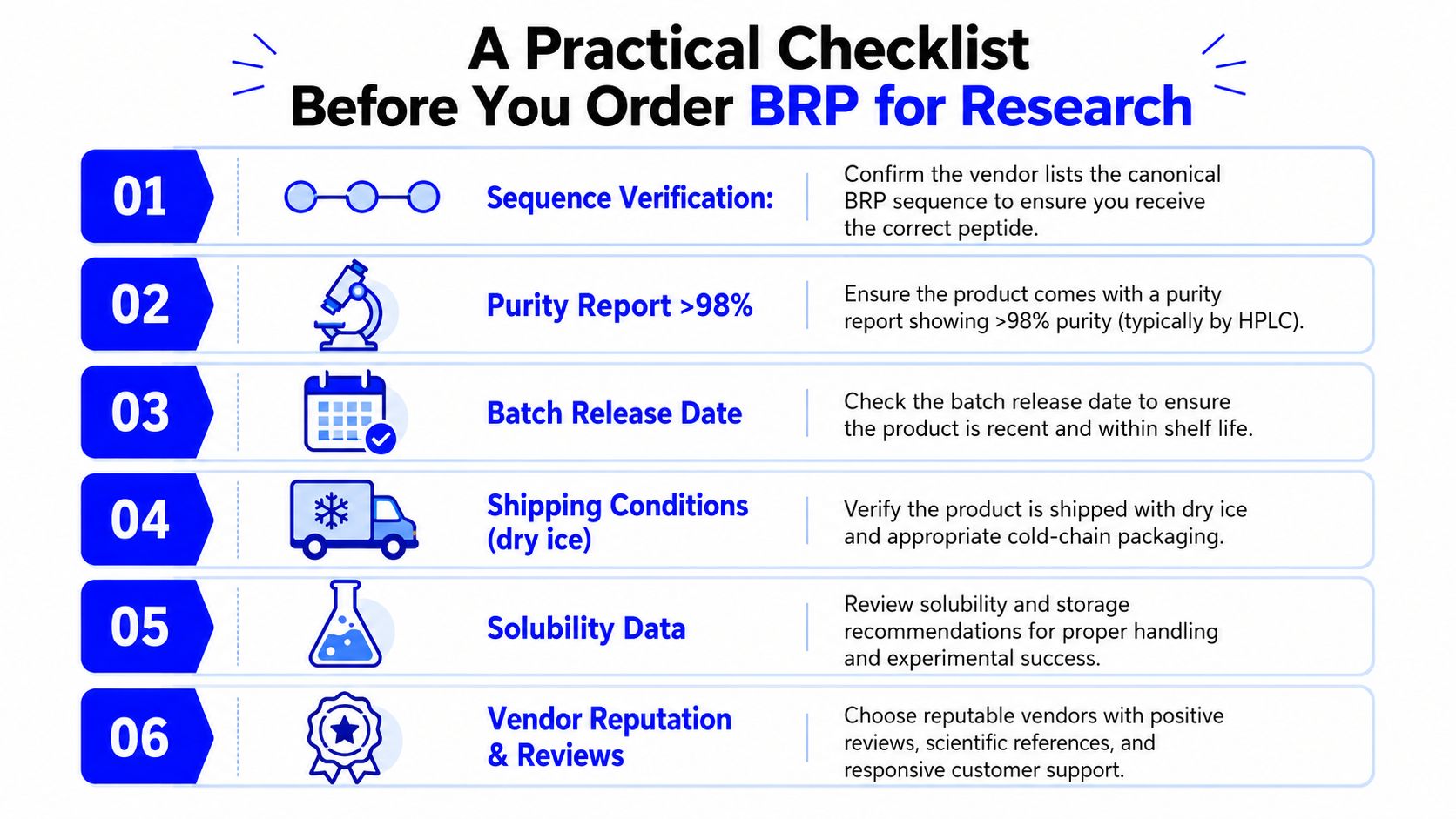
A supplier's response to these questions tells you more than a polished product page. If the sequence is absent, the amidation state is unclear, the COA is generic, or the lab can't connect analytical files to the lot, pause the order until the record is complete.
Peptide Warehouse USA offers USA-manufactured research peptides and related compounds for laboratory, analytical, and preclinical applications, with batch documentation that includes COAs plus microbial and endotoxin reports where provided. To compare available research materials and review sourcing information, visit Peptide Warehouse USA, keeping all purchases aligned with research-only use and your institution's approval processes.