No products in the cart.



Have you noticed how often BPC-157 peptide benefits are described as established facts, even though most of the supporting research comes from animals rather than people? That gap changes how every claim should be read. A promising result in a rat tendon model can justify further research, but it can't prove that the same outcome will occur in a person using a product marketed online.
This guide separates the evidence into clear tiers. You'll learn what BPC-157 is, why researchers study it, what preclinical models report for tendons, ligaments, muscle, bone, wounds, and vascular repair, and what the limited human evidence can support. You'll also see why human safety, dosing, interactions, and long-term effects remain the central unanswered questions, not minor footnotes.
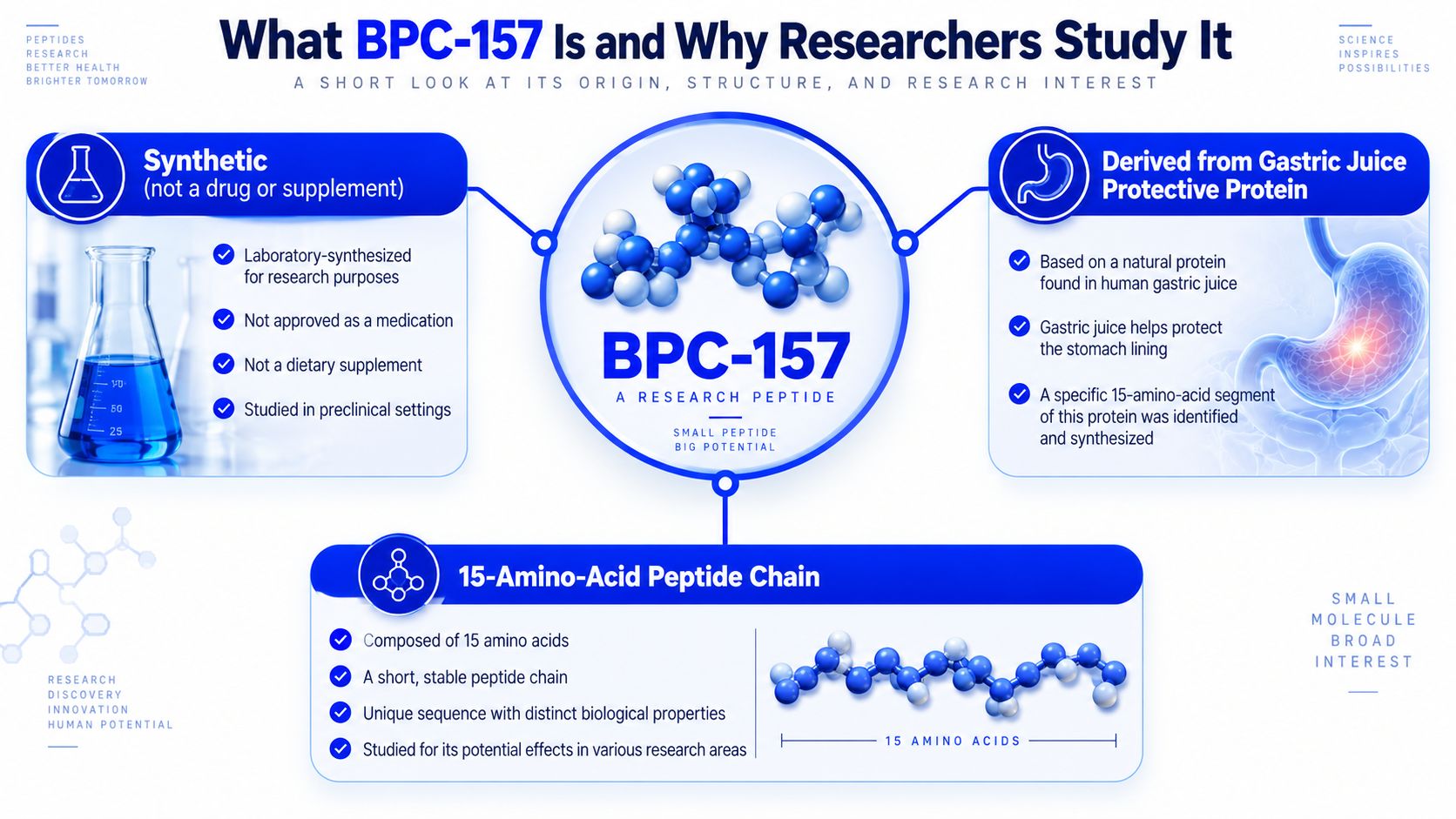
The first point of confusion is simple. BPC-157 is a synthetic peptide, not a conventional dietary supplement and not an approved drug. It's described as a 15-amino-acid fragment derived from a protective protein associated with gastric juice. A peptide is a short chain of amino acids, so its name describes its molecular structure rather than proving that it provides a particular health outcome.
Researchers study BPC-157 because laboratory models suggest activity in several repair-related processes. Early work has examined tissue injury, blood-vessel formation, inflammation, and gastrointestinal protection. That broad activity makes the compound scientifically interesting, but it also creates a risk of overgeneralization. A signal in one tissue or species doesn't automatically establish a benefit for muscle growth, fat loss, anti-aging, or human injury recovery.
A useful way to evaluate BPC-157 is to sort claims into three categories:
Readers who want broader background on peptide terminology and research categories can consult this peptide treatments guide 2024. For BPC-157 specifically, the responsible starting point is its classification as a research-use compound, not an approved human therapy.
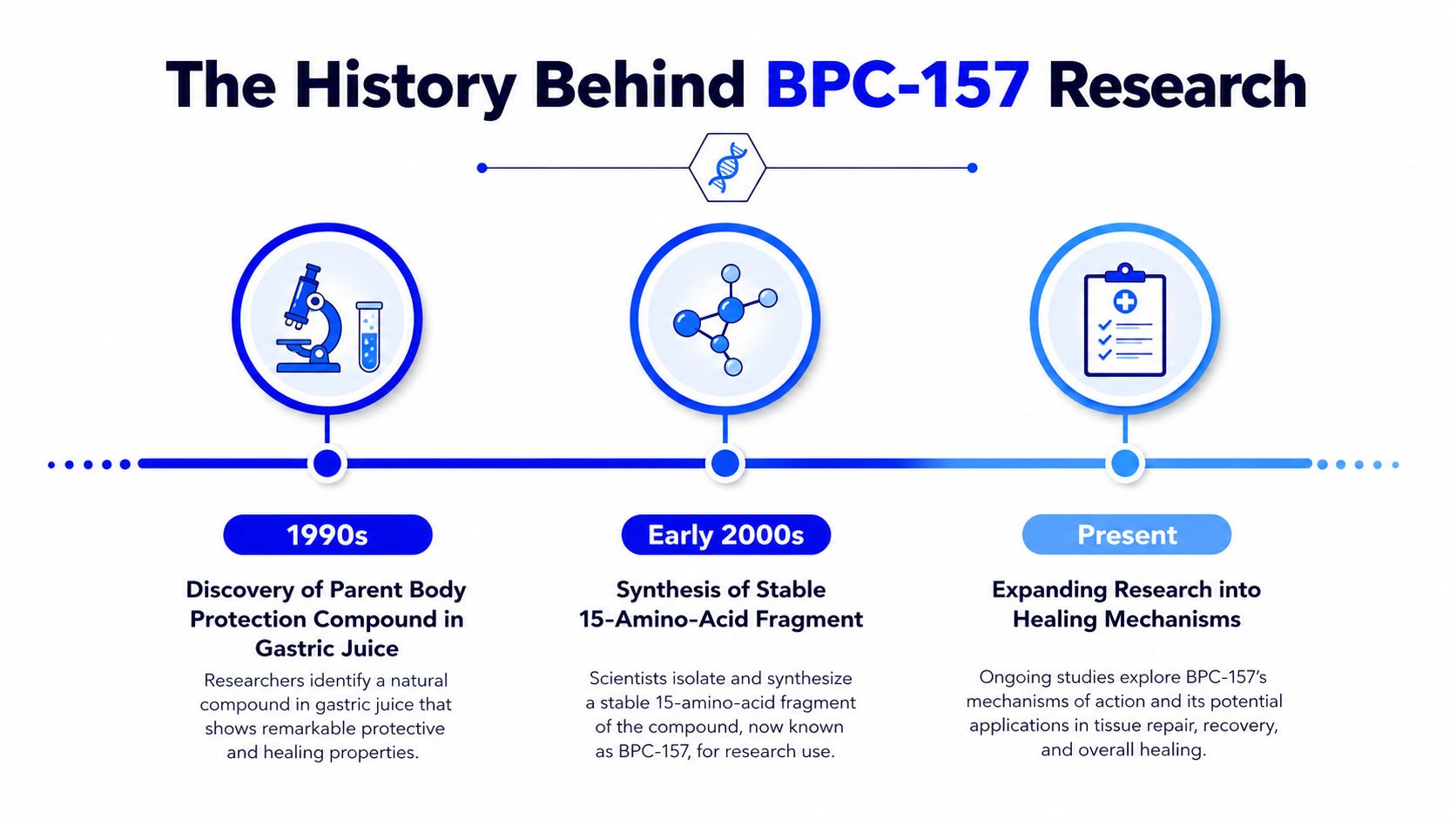
BPC-157's reputation developed through a long preclinical research program rather than through a large clinical launch. The compound is associated with a protective protein identified in gastric juice research, and later work focused on a stable synthetic fragment containing 15 amino acids. This history helps explain why the peptide is often discussed in relation to gastric protection and tissue repair.
One early landmark was a 1999 rat study that reported significantly improved healing of segmental bone defects and an angiogenic effect. That finding helped establish the peptide's early reputation in tissue-repair research and gave later investigators a reason to examine other injured tissues. The original program is commonly associated with Croatian-led laboratory research, but the key scientific point is the progression from gastric-related biology to broader repair models. The original PubMed record documents this early preclinical direction.
Later animal studies expanded into ligaments, muscle, tendons, wounds, and other injury settings. A 2010 rat study reported improved quadriceps healing and full functional restoration even when systemic corticosteroids impaired recovery, extending interest beyond bone and into muscle repair.
That expansion matters because it shows scientific interest was earned through repeated laboratory investigation across different injury types. It still doesn't demonstrate clinical effectiveness. Decades of animal work can reveal biologic activity and possible mechanisms, but they can't replace controlled human trials designed to measure benefit, adverse effects, pharmacokinetics, and interactions.
The historical lesson is balanced. BPC-157 moved from an obscure gastric-peptide research candidate into a widely discussed regenerative compound because preclinical findings accumulated. Its public-facing reputation, however, has grown faster than the human evidence base.
The clearest BPC-157 benefits appear in injured-tissue models, especially where researchers can measure both visible repair and mechanical performance. These studies don't ask whether a person feels better after buying a peptide. They examine wound closure, tissue organization, strength, and function under controlled laboratory conditions.
Rodent wound models have reported faster repair patterns involving granulation tissue, collagen deposition, and re-epithelialization. In plain language, researchers observe more repair tissue forming, greater structural protein deposition, and quicker restoration of the surface layer. Those findings support the idea that BPC-157 may influence several stages of wound repair rather than acting only as a temporary pain signal.
The interpretation still needs restraint. A controlled excision wound in a rodent is not the same as a chronic human wound affected by infection, circulation problems, diabetes, medication use, or repeated mechanical stress. Preclinical wound findings are therefore biologically informative, but they aren't a substitute for clinical wound-care evidence.
Tendon research provides some of the more concrete structural results. In rat Achilles tendon transection and detachment models, BPC-157 increased load to failure, stiffness, and Young's modulus, while histology showed more fibroblasts, improved collagen and reticulin organization, and smaller tendon defects. One paper also reported restored tendon integrity and higher Achilles Functional Index values. The tendon study abstract describes these structural and mechanical outcomes.
Young's modulus is a measure of material stiffness. A higher value in this context means the repaired tendon resists deformation more effectively, while load to failure describes how much force the tissue tolerates before breaking. Together, those measurements are more informative than a claim that a compound “supports recovery,” because they examine the quality and strength of the repair tissue.
Animal work has also reported improved muscle healing and bone repair. The quadriceps model mentioned earlier found improved healing and full functional restoration under conditions where corticosteroids impaired recovery. Bone research reported improved healing of segmental defects, along with angiogenic activity.
The evidence is strongest when multiple outcomes point in the same direction, such as better histology, stronger mechanics, and improved function. It becomes weaker when an outcome is reported only once, uses a narrow model, or lacks independent replication. The available evidence supports continued study, not a universal claim about human injury treatment.
| Tissue | Reported preclinical outcome | Model used | Evidence strength |
|---|---|---|---|
| Bone | Improved healing of segmental defects and angiogenic activity | Rat bone-defect model | Early historical preclinical evidence |
| Tendon | Greater strength and stiffness, improved collagen organization, smaller defects | Rat Achilles tendon transection and detachment models | Detailed structural and mechanical preclinical evidence |
| Muscle | Improved quadriceps healing and functional restoration | Rat quadriceps injury model with corticosteroid-impaired recovery | Promising animal evidence |
| Wound tissue | More granulation, collagen deposition, and re-epithelialization | Rodent wound models | Preclinical evidence, with human translation unresolved |
A useful way to understand the proposed mechanism is to imagine a construction site after a storm. The workers need traffic control, supplies, new access routes, and a plan for removing damaged material. BPC-157 is sometimes discussed as if it could act like a foreman, coordinating several repair-related signals. That analogy is helpful, but it doesn't mean researchers have proved one single pathway explains every observed result.
The most supported technical explanation involves vascular signaling. BPC-157 has been reported to activate an Src-Caveolin-1-eNOS pathway, increasing nitric oxide generation and producing concentration-dependent, nitric-oxide-dependent vasomotor effects in isolated rat aorta. Blood-vessel signaling can influence oxygen and nutrient delivery to injured tissue. The Journal of Applied Physiology research provides the relevant mechanistic context.
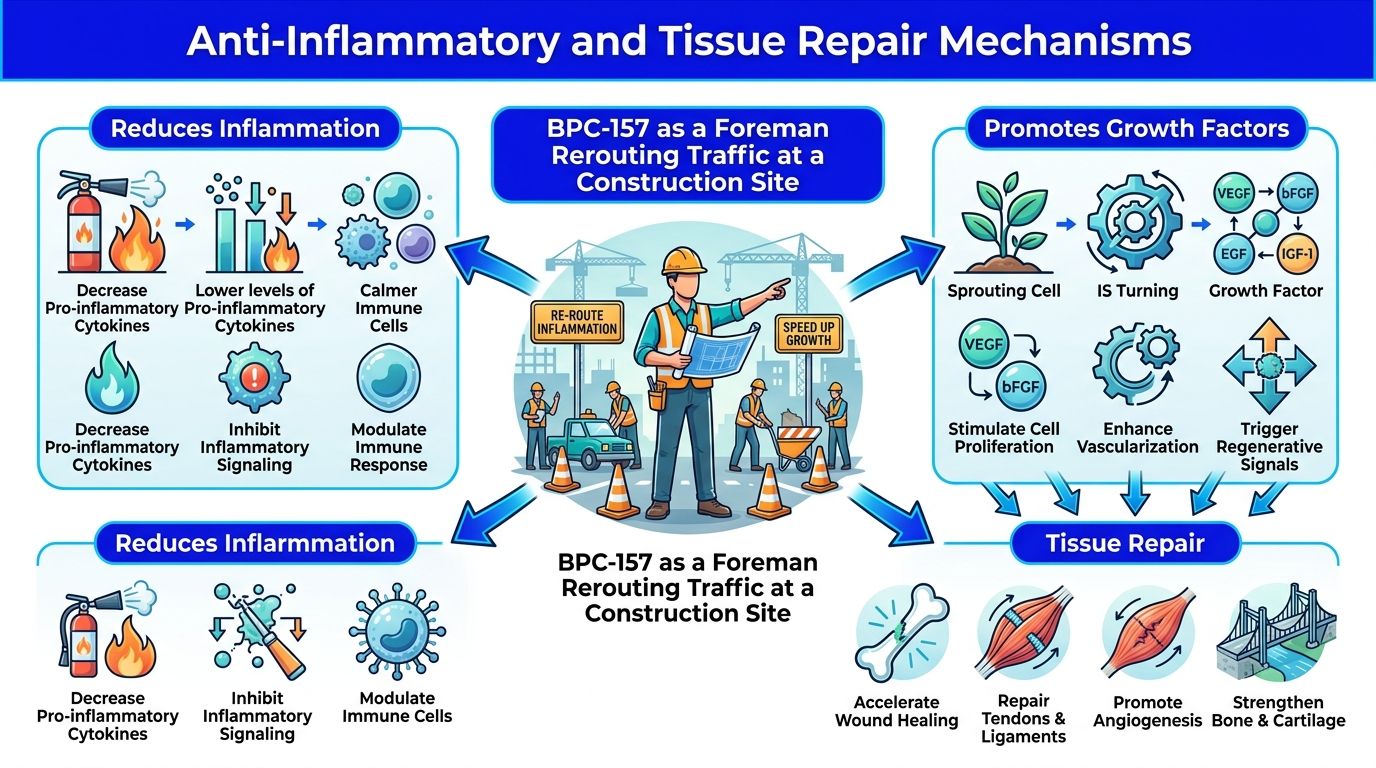
Tendon-focused reviews describe possible effects on fibroblast proliferation, survival, migration, and FAK-paxillin signaling. Fibroblasts help produce and organize extracellular-matrix components, including collagen. If those cells move into an injury site and organize repair material more effectively, the tissue may show improved structure and mechanical performance in a laboratory model.
The proposed chain looks like this:
Inflammation is more complicated than "good" or "bad." Researchers investigate whether BPC-157 changes inflammatory mediators, including TNF-α and COX-2, while supporting repair rather than merely suppressing every inflammatory response. Some of these links are mechanistic observations, while others remain correlations between pathway activity and improved tissue outcomes.
For readers studying why some wounds repair slowly, a separate discussion of circulation, infection, pressure, and other barriers appears in these hyperbaric therapy wound insights. The comparison is useful because it reinforces a central point: healing depends on multiple biological conditions, not one compound in isolation.
The human record is much smaller than the animal literature. One orthopaedic sports medicine review cited a human study in which 7 of 12 people with chronic knee pain reported relief lasting more than six months after a single BPC-157 knee injection. The review in the National Library of Medicine presents this as an early human observation, not as proof of a broadly effective treatment.
That distinction matters because a small uncontrolled or early-stage study can't reliably separate a compound's effect from placebo response, natural symptom fluctuation, changes in activity, concurrent care, or selection bias. It also can't establish whether the result applies to acute tendon injury, muscle recovery, gut conditions, fat loss, muscle growth, or anti-aging claims.
The best independent summary of the published human record describes three pilot studies, one Phase I/II program reported only as conference abstracts, and one cancelled Phase I trial. The clinical-trial research database emphasizes how small the total evidence base remains.
| Study type | Typical sample size | Evidence confidence |
|---|---|---|
| Early human pilot | Small, including a report involving 12 people | Low |
| Conference-abstract program | Not fully available in peer-reviewed form | Limited |
| Cancelled or incomplete trial | No completed outcome set | None for efficacy |
| Large controlled clinical trial | Not established in the available evidence | Not established |
Current human evidence doesn't establish broad benefits for muscle growth, fat loss, anti-aging, or common consumer recovery claims. Historical reviews describe earlier clinical interest in ulcerative colitis and multiple sclerosis, including reports of no observed toxicity in those contexts, but those historical observations don't create a modern safety profile or approval status.
BPC-157 isn't an approved therapeutic for human use. Human pharmacokinetics, long-term dosing, interactions, and real-world risks remain incompletely characterized, so the most honest conclusion is that early human signals justify research, not self-directed treatment.
BPC-157 should be handled as a research-use compound for laboratory and analytical work, not as a human or veterinary administration product. A careful workflow begins before the vial arrives. Researchers should choose suppliers that publish batch documentation and make the identity and quality data available for review.
A certificate of analysis can help document a batch, but researchers should read what the certificate tests. Useful documentation may include:
These checks don't turn a research compound into a medicine. They improve reproducibility and help a laboratory distinguish a failed experiment from a contaminated, degraded, or misidentified material.
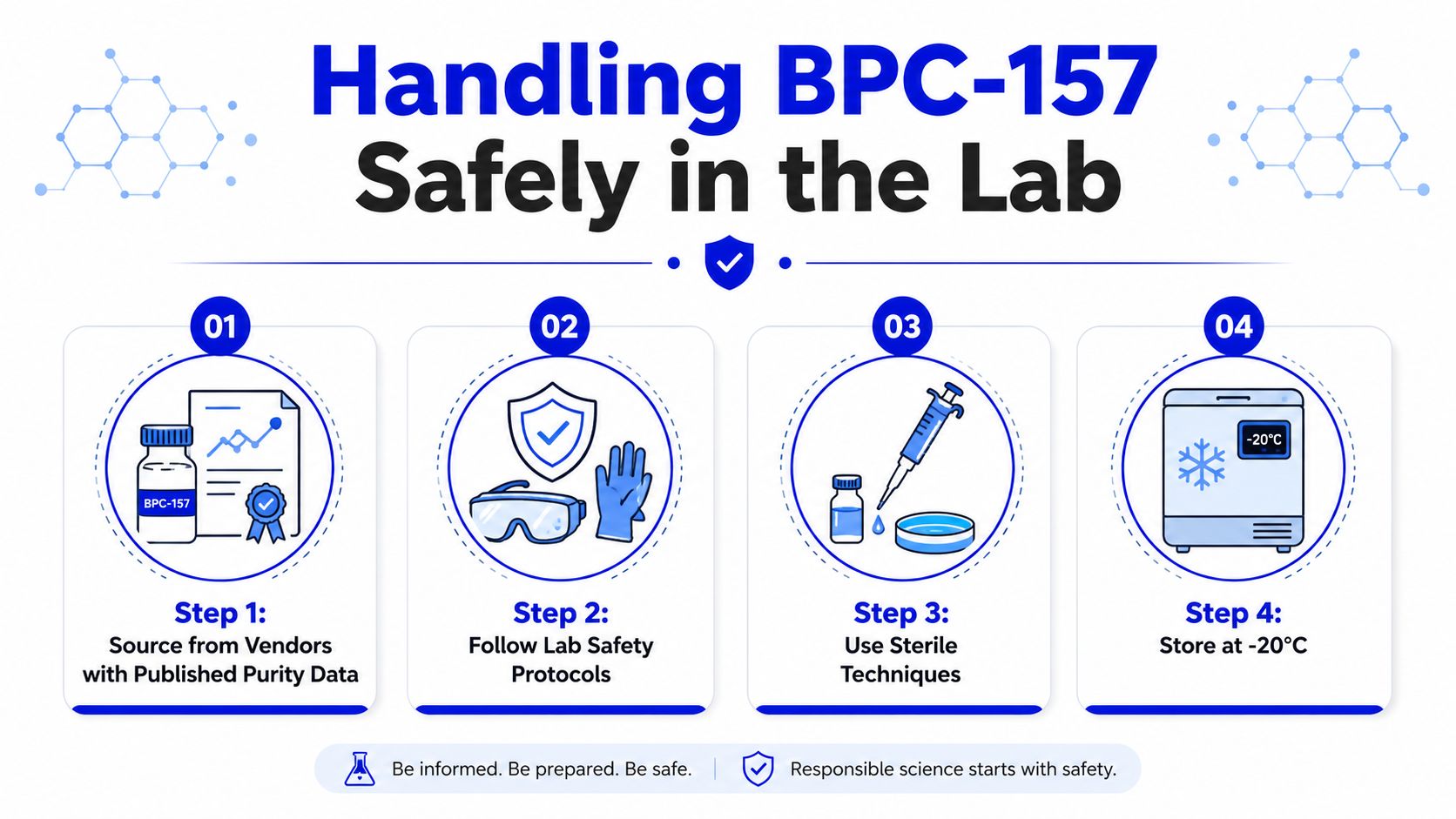
For laboratory work, researchers should follow their institution's written biosafety and chemical-handling procedures. Reconstitution should use sterile water or sterile bacteriostatic water under an appropriate aseptic workflow, with sterile filtration when required for a cell-based assay. Gloves, a lab coat, and eye protection provide basic protection during handling.
Lyophilized material is commonly stored at -20°C according to the supplied laboratory plan and product documentation. Aliquoting can reduce repeated freeze-thaw exposure, which may contribute to degradation. Each aliquot should carry a clear label stating the compound name, concentration, lot, date, storage condition, and research use only status.
Practical rule: If a laboratory can't document identity, storage history, and disposal route, it can't confidently interpret the result.
Dispose of unused material through the facility's approved chemical-waste process. Peptide Warehouse USA offers research peptides and related compounds with batch documentation for laboratory, analytical, and preclinical applications, including a BPC-157 spray labeled for research use only. It isn't a compounding pharmacy or outsourcing facility, and its products aren't intended for human consumption.
BPC-157 is best viewed as a research candidate with strong preclinical signals and insufficient clinical validation. The animal evidence is most persuasive for tissue-repair biology, especially where studies measure collagen organization, wound closure, tissue strength, or functional recovery. The human evidence is too limited to support broad claims about effectiveness or safety.
The unanswered question isn't whether BPC-157 “works.” It's where the human safety boundary lies. A recent review describes no completed human safety evidence, apart from a tiny intravenous pilot involving 2 healthy adults. The musculoskeletal safety review reports that no short-term biomarker changes or side effects were observed in that pilot, while also emphasizing that this can't resolve long-term risk.
A separate report of the strongest directly observed human safety signal found that intravenous doses up to 20 mg in those 2 healthy adults produced no measurable changes in heart, liver, kidney, thyroid, or blood-glucose biomarkers and no reported side effects. The PubMed record for that pilot is useful precisely because it shows both what was measured and how narrow the evidence remains.
Researchers need better-designed studies that answer practical clinical questions:
Questions about oral bioavailability, formulation stability, cancer-related concerns surrounding angiogenic signaling, and individual drug interactions also remain open. Researchers and readers should follow peer-reviewed updates and use appropriate FDA adverse-event reporting channels when relevant, so future safety signals are tracked systematically rather than through anonymous anecdotes.
For now, the evidence-based position is clear. Preclinical BPC-157 peptide benefits are promising, human efficacy is unproven, and the safety boundary remains inadequately defined.
Peptide Warehouse USA provides research-use BPC-157 products and related compounds for laboratory, analytical, and preclinical investigation, with batch documentation such as Certificates of Analysis and stated purity information. Visit Peptide Warehouse USA to explore research options, review product documentation, and make sourcing decisions that match your lab's quality and traceability requirements.