No products in the cart.



The most popular advice about cognitive enhancing peptides is also the least useful: choose the compound with the most exciting mechanism, combine it with several others, and expect sharper focus. Biology rarely works that neatly. A peptide that changes a growth-factor pathway in a rat is not automatically a validated nootropic for a healthy adult, and a compound that reduces anxiety isn't necessarily improving memory.
A better evaluation asks three questions: what mechanism is being affected, how is the peptide delivered, and which population has been studied? This approach separates Semax and Selank, which have the strongest human evidence in this category, from experimental candidates whose support remains largely mechanistic or preclinical. It also explains why route, endpoint, study design, and laboratory quality matter more than a long product label.
Peptides are short chains of amino acids that act less like conventional “brain pills” and more like biological messages. Their sequence helps determine which receptors, signaling pathways, or tissues they can influence. That makes them different from small-molecule nootropics such as racetams or stimulants, which generally interact with targets through a different chemical framework.
The category is broad, but its members can be grouped by the kind of signal they influence:
That distinction matters because “peptide” describes a chemical format, not a guaranteed cognitive effect. Some peptide medicines have established medical uses, while many compounds sold online remain investigational or are labeled for research use only. A plausible receptor pathway can support a hypothesis, but it doesn't establish safety, efficacy, or an appropriate use in people.
Readers comparing peptides with more conventional products may find a broader overview of top brain-boosting supplements in the UK useful, especially because supplements and investigational peptides sit in very different evidence and regulatory categories.
The clearest way to study this field is to move in sequence:
That framework keeps “possible cognitive benefit” from becoming “proven focus enhancer.”
Think of memory as an electrical circuit that changes with use. Neurons are switches, synapses are adjustable connection points, and plasticity is the rewiring process that strengthens useful routes or weakens inefficient ones. Learning doesn't require every neuron to become more active. It requires selected connections to change in a coordinated way.
Peptides can influence that circuit at different levels. Some adjust the chemical environment that supports synaptic change. Others affect receptor signaling directly. Still others may provide a mixture of neurotrophic or protective signals, which makes their mechanism harder to reduce to one pathway.
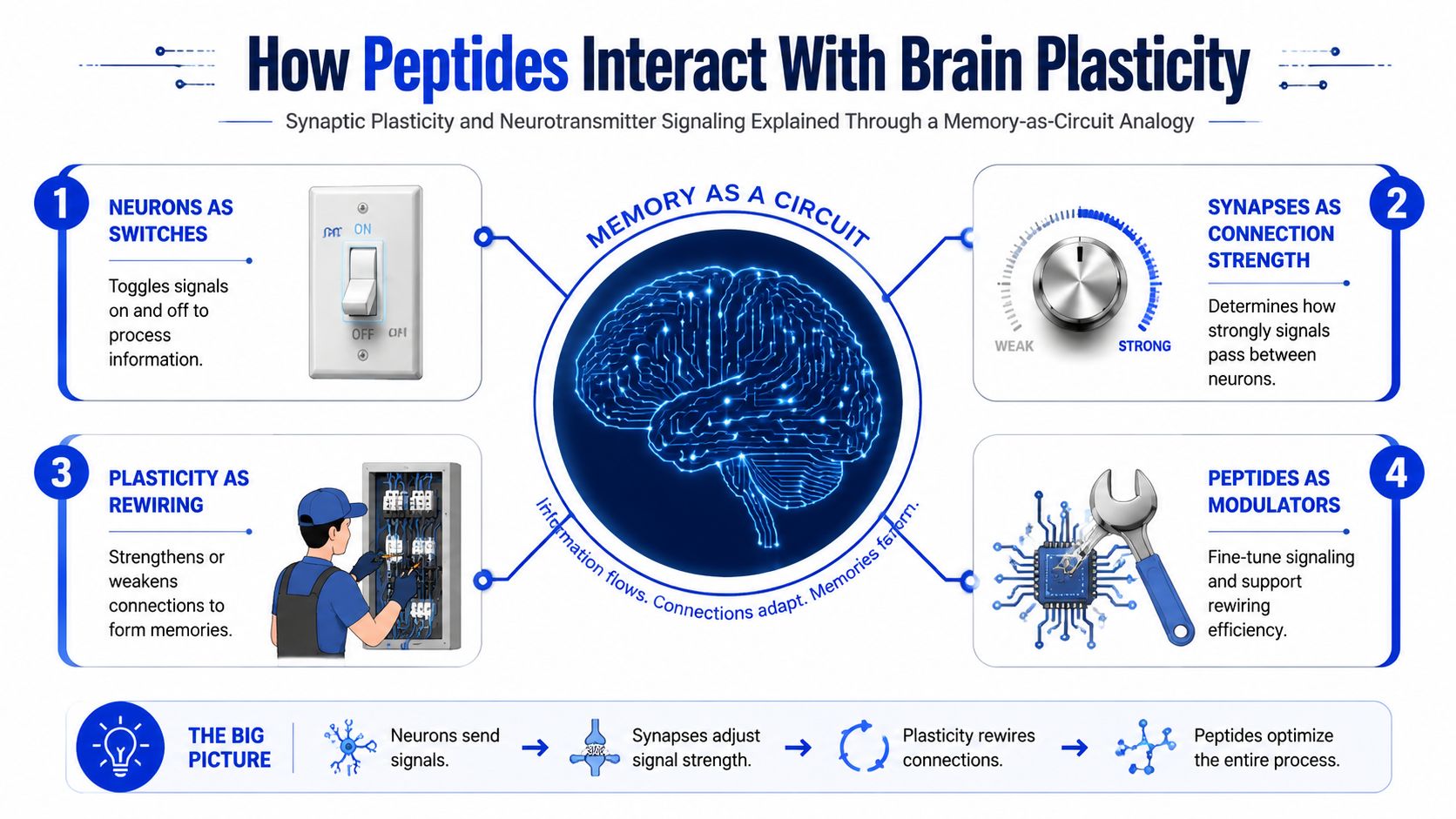
BDNF, or brain-derived neurotrophic factor, is one of the best-known examples of a plasticity-related signal. It acts through TrkB receptors, helping regulate processes involved in synaptic strengthening, learning, and memory formation. A peptide that changes BDNF expression is therefore not acting like a stimulant that raises arousal. It may be influencing the conditions under which neural circuits adapt.
Semax is associated with this type of neurotrophic modulation. In a rat study, a single 50 µg/kg dose produced a maximal 1.4-fold increase in hippocampal BDNF protein, a 1.6-fold increase in TrkB tyrosine phosphorylation, a 3-fold increase in exon III BDNF mRNA, and a 2-fold increase in TrkB mRNA, alongside increased conditioned avoidance reactions, as reported in the PubMed study on Semax and hippocampal BDNF signaling. Those findings support a mechanism. They don't establish the same cognitive response in humans.
Other candidates are discussed in relation to acetylcholine, a neurotransmitter involved in attention and encoding. Selank is commonly framed around GABAergic and serotonergic modulation, with possible relevance to anxiety-linked concentration. That distinction is important. If a person performs better because distracting anxiety is reduced, the result may feel like improved focus without demonstrating a direct enhancement of memory formation.
Cerebrolysin occupies another position. Rather than being a single receptor-selective peptide, it is a peptide mixture studied for neurotrophic factor-like activity in neurological populations. The biological question is closer to protection and repair than general productivity.
Practical rule: A mechanism tells you what a compound might change. An endpoint tells you whether that change translated into a measurable cognitive result.
The central insight is that plasticity is not the same as acute stimulation. A rapid subjective lift and a sustained change in learning or memory involve different questions, which is why duration, route, and testing schedule must be interpreted together.
Semax is a synthetic heptapeptide analog of ACTH(4-10). Its modern development traces to the Institute of Molecular Genetics in Russia during the 1980s, placing it within a multi-decade pharmacological history rather than a recent social-media trend. Russia later added Semax to its List of Vital and Essential Drugs on December 7, 2011, a regulatory milestone described in the historical review of cognitive peptides.
The most coherent biological story centers on the hippocampal BDNF/TrkB signaling axis. In animal work, Semax changed BDNF protein and messenger RNA measures, increased TrkB phosphorylation, and was accompanied by improved conditioned avoidance performance, as documented in the linked PubMed research above. This is meaningful preclinical evidence because the pathway connects to synaptic plasticity, learning, and memory formation.
It still needs careful translation. A rat behavioral task isn't the same as a validated human attention test, and a molecular signal isn't itself a clinical outcome.
A peer-reviewed review identifies Semax as one of the better-studied cognitive-enhancing peptides because it combines animal research with limited human evidence. The same review emphasizes that human findings are concentrated in relatively small studies rather than large Western-style randomized trials, and that intranasal delivery is the main route associated with reported acute cognitive and neuroprotective effects. The peer-reviewed review of peptide nootropics also notes that strong placebo-controlled evidence in healthy adults remains limited.
That makes Semax more clinically mature than many experimental compounds, but not a general-purpose productivity supplement. The strongest rationale is narrower, involving selected neurological or attention-related outcomes studied in particular populations. Western Phase III evidence and FDA approval for general nootropic use remain absent.
| Mechanism | Best-Studied Endpoint | Evidence Depth | Regulatory Status |
|---|---|---|---|
| BDNF and TrkB pathway modulation | Learning, memory, attention, and neuroprotective outcomes in selected models and clinical contexts | Stronger preclinical base, limited human evidence | Added to Russia's List of Vital and Essential Drugs, not FDA-approved as a general nootropic |
The sensible conclusion is neither dismissal nor promotion. Semax offers a credible neurotrophic hypothesis and a comparatively developed research history, but readers should not confuse that position with proof of reliable cognitive enhancement in healthy adults.
The comparison becomes more useful when each compound is judged by mechanism, endpoint, and evidence depth, rather than by the intensity of its marketing.
Selank is a synthetic tuftsin analog generally studied in relation to anxiety, GABAergic signaling, serotonin, and neurotrophic pathways. Its relevance to cognition may be indirect in some settings. Reduced anxiety can improve clarity or task engagement, but that isn't identical to demonstrating enhanced memory in a healthy population.
Cerebrolysin is different in composition and intended research context. It's a porcine brain-derived peptide mixture with neurotrophic factor-like activity, and its clinical record is more closely associated with neurological injury and neurodegenerative populations than with general productivity. The best-supported question is therefore not “does it make a healthy person sharper?” but “what outcomes have been investigated in people with neurological impairment?”
GHK-Cu is a copper-binding tripeptide studied primarily in tissue repair and related peripheral biology. Cognitive claims generally extrapolate from mechanisms outside the brain, so its position in a cognition comparison is substantially less mature.
The same caution applies to Dihexa, BPC-157, and the misspelled or inconsistently marketed compound “Noopeil.” These newer or heavily promoted candidates may have interesting mechanisms or animal signals, but current reviews describe major gaps in human safety, replication, and clinical translation. The review of peptide mechanisms and clinical maturity is useful for separating biological plausibility from demonstrated human benefit.
| Peptide | Primary Mechanism | Best-Studied Endpoint | Evidence Depth | Research Status |
|---|---|---|---|---|
| Semax | BDNF and TrkB modulation | Selected learning, memory, attention, and neuroprotective outcomes | Comparatively stronger, but human evidence remains limited | Investigational for general nootropic use |
| Selank | GABAergic, serotonergic, and possible neurotrophic modulation | Anxiety-linked clarity and selected cognitive outcomes | Limited, with evidence concentrated in Russian studies | Investigational |
| Cerebrolysin | Neurotrophic factor-like activity from a peptide mixture | Neurological injury and neurodegenerative populations | Larger but heterogeneous clinical record | Narrow clinical research context |
| GHK-Cu | Copper-binding and tissue-repair signaling | Peripheral repair-related endpoints | Cognitive evidence is indirect | Experimental for cognition |
| BPC-157 | Mechanistic and animal research involving repair pathways | Preclinical tissue and neurological models | Human cognitive evidence is absent or indirect | Experimental |
| Dihexa | Synaptogenesis-related HGF and c-Met pathway hypothesis | Preclinical memory and synaptic models | Human safety and efficacy data are inadequate | Experimental |
The table shows why a “strongest peptide” ranking can mislead. A compound may be interesting for one endpoint and unsuitable for another. Population and outcome define relevance.
Delivery changes the experiment. A peptide reaching nasal mucosa, circulating through peripheral tissue, or entering a digestive tract faces different barriers, so researchers can't treat route as a minor product detail.
Intranasal administration is central to Semax and Selank research because it can provide a route toward central nervous system exposure while avoiding some gastrointestinal degradation. Reviews identify intranasal delivery as the route most associated with acute cognitive and neuroprotective effects for Semax, but that association doesn't prove that every nasal formulation has the same absorption, dose, or clinical result.
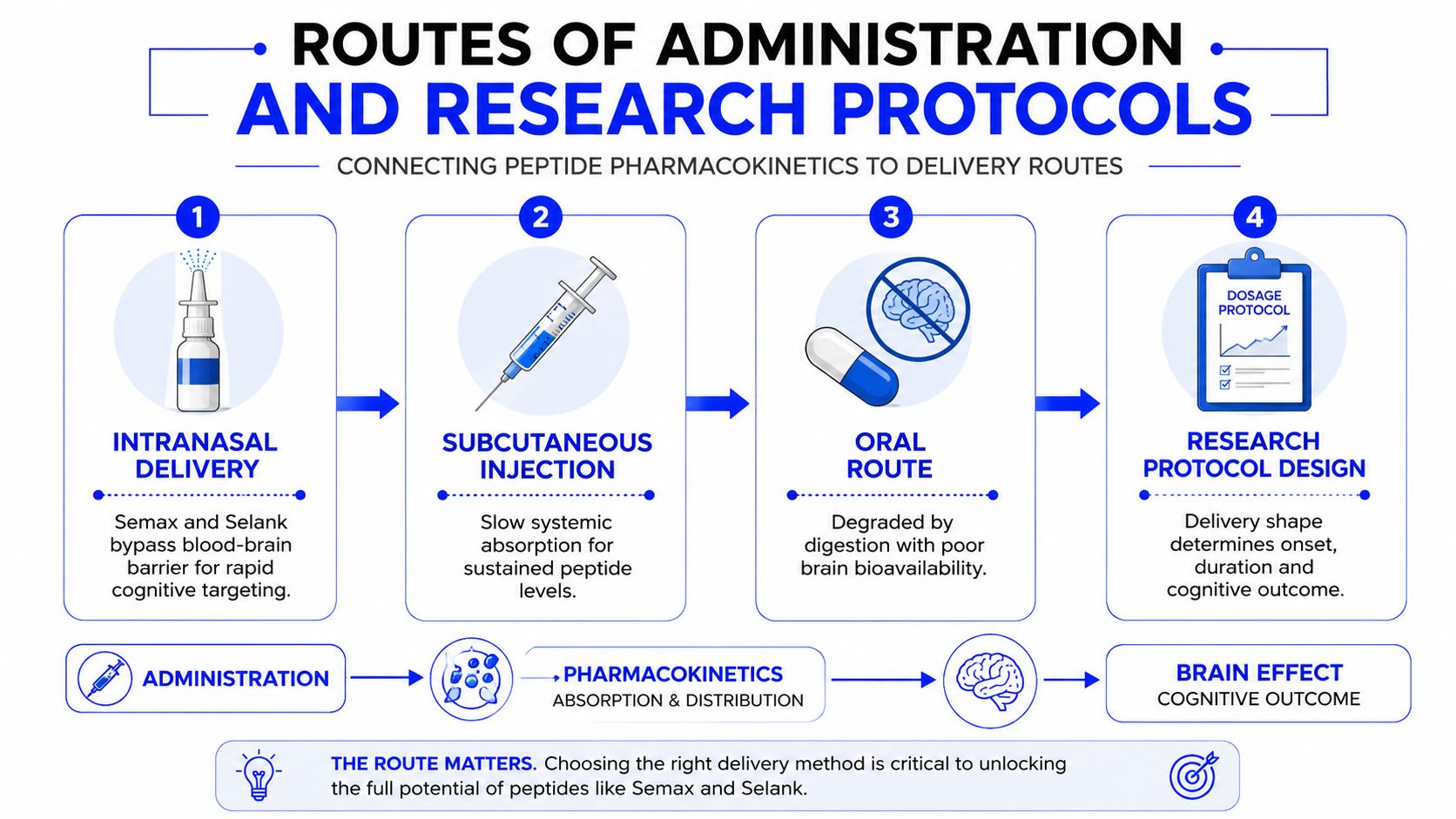
Researchers also distinguish between an acute experiment and a sustained plasticity protocol:
Cerebrolysin research uses clinical administration routes appropriate to its medical context, while GHK-Cu studies often focus on peripheral biology. Comparing either directly with intranasal Semax can produce a false equivalence because the route changes the pharmacokinetic question.
A protocol also needs a defined endpoint. “Mental clarity” is a subjective description. A stronger design specifies whether it measures attention, encoding, recall, reaction time, neurological function, or another outcome, then includes a comparator capable of testing whether the change exceeds expectancy effects.
The following video can help orient new readers to the broader discussion of peptide administration and research practice.
Newer doesn't mean stronger. In cognitive peptide marketing, a detailed pathway description can create the appearance of clinical maturity even when human evidence is absent.
A useful hierarchy has three separate rungs:
The gap between those rungs is where most overstatement occurs.
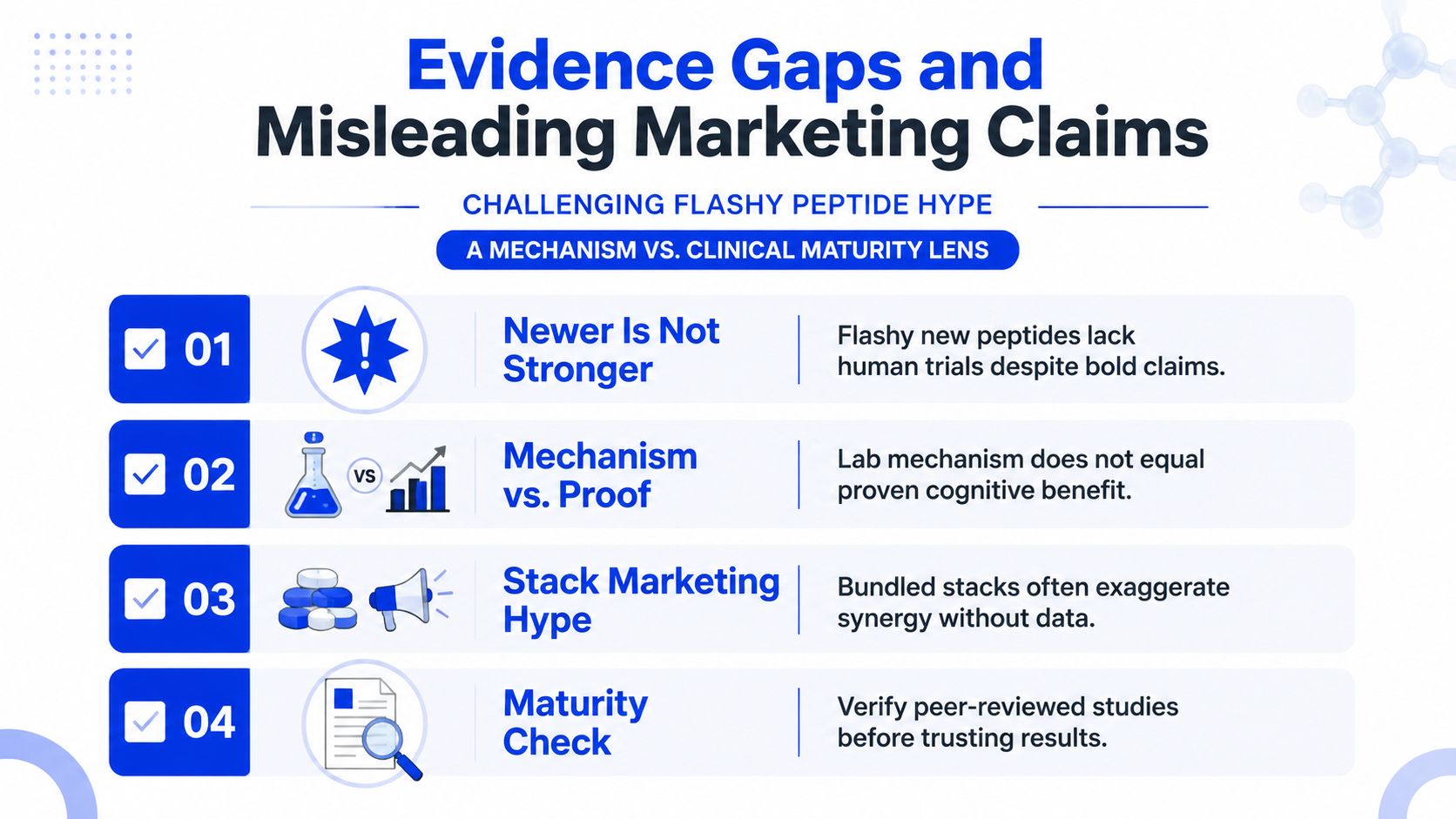
A Morris water maze result may demonstrate learning behavior in rodents, but it doesn't directly establish improved focus in humans. Likewise, an open-label study can generate a useful hypothesis without controlling for expectation, practice effects, or natural recovery.
Watch for these recurring problems:
Current reviews specifically highlight the mismatch between strong mechanistic or animal signals and the limited human safety data for compounds such as Dihexa, BPC-157, and peptide stacks marketed for brain repair. They also emphasize that no peptide in this category has a published, pre-registered, placebo-controlled randomized trial showing significant cognitive improvement in healthy adults, as summarized in the evidence review of cognitive peptide claims.
Ask, “Which population, which endpoint, which route, and which comparator?” If the seller can't answer those four questions, the claim isn't ready for serious interpretation.
A research peptide isn't adequately identified by a polished label or a high purity number alone. The material needs a chain of evidence connecting the vial to a defined sequence, a defined batch, and analytical testing that can detect meaningful problems.
Start with the Certificate of Analysis, or COA. A useful document should be batch-specific, not a generic file reused across products. It should identify the lot, report HPLC purity, and include mass spectrometry confirmation of the expected molecular weight or sequence identity.
Look for:
Amino-acid analysis or nitrogen-based peptide content isn't enough by itself. Those methods may indicate that amino acids are present without confirming the precise sequence. A truncated peptide can still contribute to a total content result while interacting differently with a receptor or producing an unexpected experimental signal.
For readers exploring the wider relationship between laboratory testing, peptides, and healthy aging, the discussion of how to feel better at 50 naturally offers broader context, though it shouldn't replace compound-specific analytical documentation.
A practical vendor check is simple: verify the lot, inspect the full COA, confirm identity testing, review contamination reports, and make sure storage instructions are clear. If any link in that chain is missing, the experiment becomes harder to reproduce and the result harder to trust.
Five conclusions deserve to stay with you:
The broader scientific framing is mature enough to support dedicated review literature. A 2018 review of peptides acting as cognitive enhancers discusses how selected peptides can influence learning and memory through synaptic function and number, including a PTD4-PI3KAc peptide that activates PI3K signaling to promote synapse and spine formation and enhance hippocampal-dependent memory, as described in the PubMed review of cognitive-enhancing peptides.
That finding illustrates the opportunity, not a license for general use. No peptide in this category is approved as a general nootropic supplement, and research-only compounds shouldn't be treated as personal medical products. Researchers can explore catalogs, lyophilized formats, nasal preparations, and supporting documentation, but each selection should begin with a defined hypothesis and an evidence-matched endpoint.
Peptide Warehouse USA offers research-use-only peptides and related compounds for laboratory, analytical, and preclinical work, with batch documentation that includes Certificates of Analysis plus microbial and endotoxin reports. Visit Peptide Warehouse USA to review options such as Semax and Selank alongside the available quality and sourcing information, and match any order to a legitimate research purpose.