No products in the cart.



What's the story with TB 500, a lab-fragment people talk about for recovery, while the science, the regulations, and the product quality questions all point in different directions? If you're trying to separate signal from hype, the first step is simple, TB 500 is not the same thing as the full thymosin beta-4 molecule, and that distinction changes how you read the research, the safety conversation, and the quality paperwork.
This guide breaks the topic down in plain language. You'll see where TB 500 comes from, how it relates to thymosin beta-4, what the mechanism data show, where human evidence stops, why regulatory status matters, and how a lab can verify quality without leaning on marketing claims. The goal is a clean mental model, not a promise of outcomes.
TB 500 sits in a strange place in peptide conversations. People often mention it alongside recovery, tissue repair, and performance, but the label itself is already a clue that you're looking at a research fragment, not a full-length biological protein with a long human use history.
That matters because the strongest evidence base belongs to thymosin beta-4, the parent molecule, not to the TB-500 fragment. The historical trail starts with the broader beta-thymosin family described in 1966, later work identified thymosin beta-4 as a major actin-sequestering molecule in platelets in 1991, and the TB-500 fragment itself was analytically characterized in 2012 as the sequence Ac-LKKTETQ-OH, residues 17 to 23 of thymosin beta-4 (historical review).
That timeline is useful because it tells you what the conversation is really about. The fragment got attention because it sits inside a much larger research lineage, not because it has decades of standalone human trial data. In practical terms, that means readers need to separate mechanistic interest from clinical proof.
Practical rule: if a product page or forum post treats TB 500 and thymosin beta-4 as interchangeable, slow down and check which molecule the data actually studied.
A lab-focused lens helps because it keeps the discussion grounded. Instead of asking whether a peptide sounds impressive, the better questions are: What was studied, in what model, under what conditions, and with what documentation? That's the standard that keeps procurement, interpretation, and compliance aligned.
TB 500 is commonly discussed as a synthetic fragment derived from thymosin beta-4, a 43-amino-acid peptide first isolated from calf thymus in 1966 by Allan Goldstein's laboratory (historical review). The parent molecule is the foundation. TB 500 is the smaller research-name fragment that came out of that larger story.
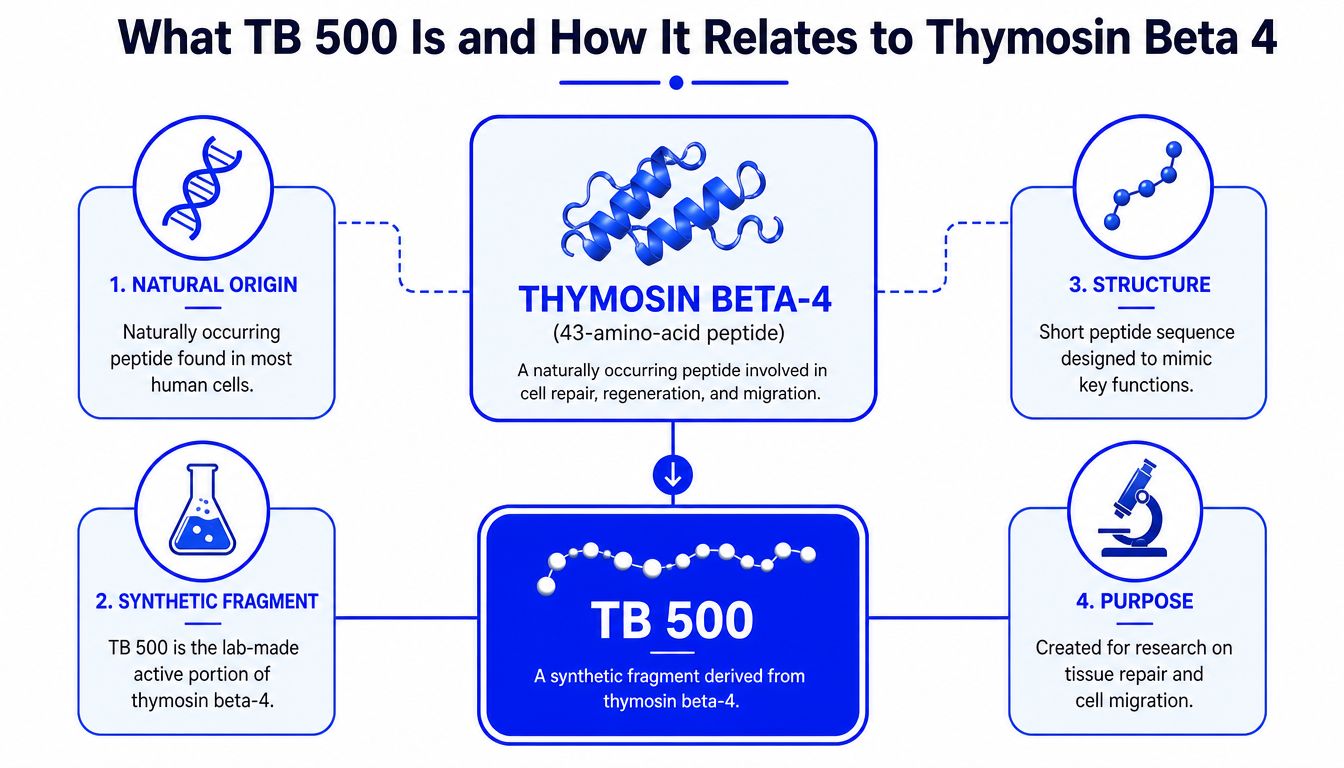
Think of thymosin beta-4 like a long instruction strip, and TB 500 like a short excerpt that researchers kept studying because it seemed to sit in a biologically interesting region. That short fragment is why TB-500 gets grouped with the parent molecule in anti-doping and research conversations, even though the two are not identical (WADA context).
Thymosin beta-4's core mechanism is actin sequestration. It binds G-actin monomers, which reshapes the cytoskeleton and supports the movement of keratinocytes, fibroblasts, and endothelial cells (mechanism study). In plain terms, actin is part of the cell's internal scaffolding. If you picture the cytoskeleton as a construction site, thymosin beta-4 helps organize the building materials so cells can move and remodel tissue more efficiently.
The fragment itself became a distinct analytical topic much later, in 2012, when its sequence was characterized as Ac-LKKTETQ-OH (historical review). That's one reason people get confused. They hear a single name, but the science spans a long arc from the parent peptide to the isolated fragment to modern research use.
The anti-doping angle also sharpened the distinction. TB-500 was added to the World Anti-Doping Agency prohibited list in 2018 (historical review). The 2026 WADA Prohibited List names “Thymosin-β4 and its derivatives e.g. TB-500” under S2.3, and substances in that section are prohibited at all times for athletes under WADA jurisdiction (WADA listing summary).
The cleanest mental model is this, thymosin beta-4 is the parent biology, TB 500 is the fragment label, and the evidence base is not equally strong for both.
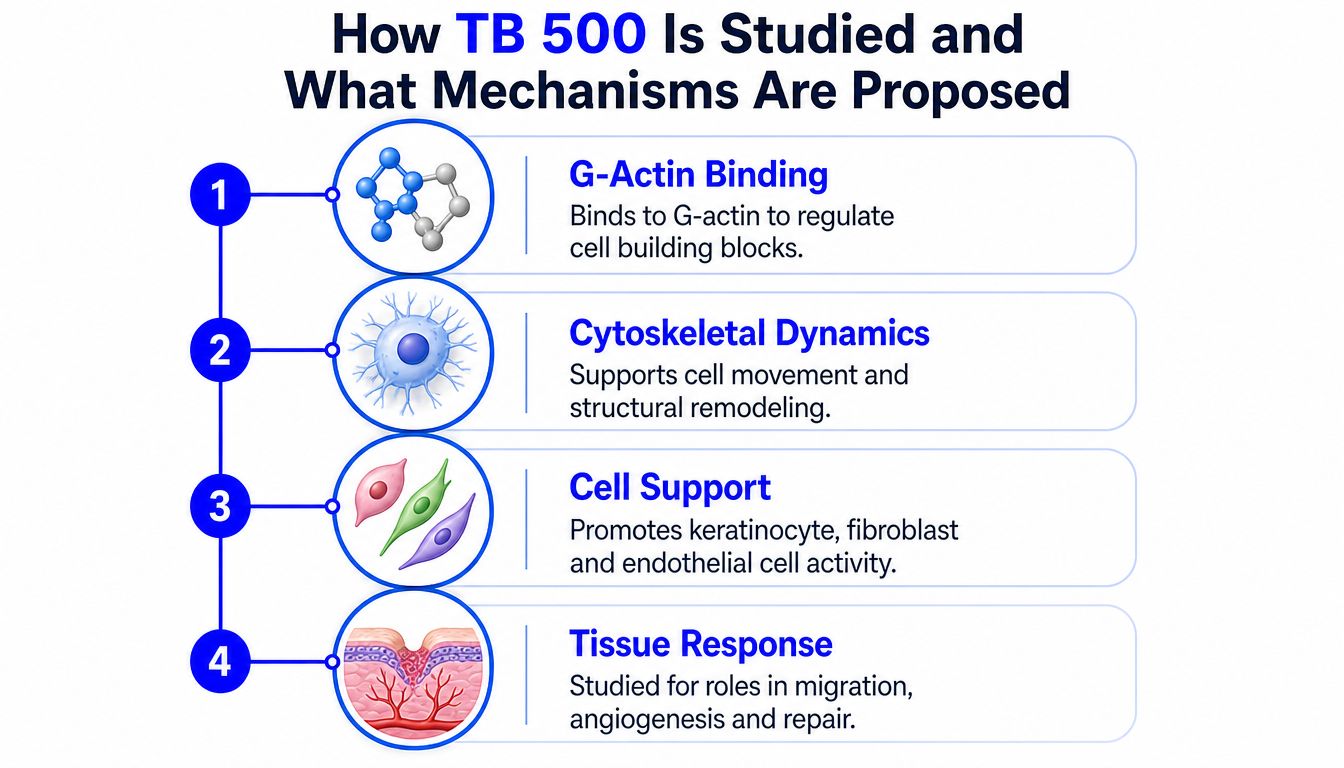
The mechanism conversation starts with G-actin binding, because that's the biochemical move that makes the rest of the story make sense. When thymosin beta-4 binds actin monomers, it changes how cells organize their internal structure, and that supports movement in cell types involved in repair (mechanism study).
That actin-related movement shows up in preclinical wound models as faster closure through re-epithelialization and angiogenesis. In one wound study, thymosin beta-4 produced a 42% increase in re-epithelialization at day 4 and up to 61% at day 7 versus saline controls (wound model data). Those numbers belong to the parent molecule evidence, not to a completed human TB-500 efficacy program.
The reason researchers care about this pathway is straightforward. Keratinocytes help re-cover the surface, fibroblasts help lay down repair tissue, and endothelial cells support vessel formation. When those cells move efficiently, tissue response can look more coordinated in experimental models.
The proposed biology is usually described in a chain:
The important boundary is this, mechanism data are strongest for full-length thymosin beta-4, and that does not automatically validate every claim made about the TB-500 fragment.
The broader preclinical literature has explored wound closure, corneal healing, cardiac repair, stroke recovery, and muscle satellite-cell recruitment, but those are still largely experimental contexts (2021 review summary via registry background). So when someone talks about “how TB-500 works,” it's more accurate to say the fragment is associated with a mechanism-rich parent research line than to imply a finished human pharmacology package.
The biggest confusion around TB 500 is not what people hope it does. It's whether there's enough human data to support the confidence that often gets attached to it. The answer is restrained, and that restraint is useful.
Public trial registries in 2026 show a Phase 1/2, randomized, double-blind, placebo-controlled, sequential dose-escalation study of TB-500 in adults with stable atherosclerotic cardiovascular disease (trial registry). That tells you the fragment has entered formal clinical evaluation only recently.
The same registry background also makes the split clear. Published human data for full-length thymosin beta-4 includes at least three Phase I safety studies and two clinical ophthalmic programs, while TB-500's standalone human history is much thinner (trial registry). The practical result is easy to miss if you're reading casually, the fragment's reputation comes from association with a much larger research lineage.
Independent sources consistently note that TB-500 and thymosin beta-4 are still supported mainly by animal and laboratory data, with no completed human efficacy trials for the 17-amino-acid TB-500 fragment and no established human dosing or safety profile (human evidence gap). That doesn't mean the molecule is meaningless. It means claims should stay within the evidence that exists.
A useful counterpoint is that a phase I study of full-length intravenous thymosin beta-4 found it was well tolerated in healthy volunteers and showed predictable pharmacokinetics (human evidence gap). That supports interest in the broader thymosin beta-4 story, but it still doesn't validate TB-500 itself as if the two were interchangeable.
If you're screening research compounds, that distinction keeps expectations honest. It also helps explain why many lab buyers now ask for stronger documentation before considering a batch for analytical work.
A lot of researchers compare TB 500, BPC-157, and GHK-Cu because all three show up in repair-oriented conversations, but they don't sit in the same biological lane. The value of a side-by-side view is that it keeps selection tied to the pathway under study, not to social media shorthand.
| Peptide | Parent or Origin | Proposed Research Mechanism | Common Study Models |
|---|---|---|---|
| TB 500 | Synthetic fragment related to thymosin beta-4 | Actin-related cell migration, cytoskeletal remodeling, repair signaling | Wound, vascular, cardiac, and movement-related preclinical models |
| BPC-157 | Synthetic peptide derived from a protein found in the digestive tract | Tissue repair and gut-focused signaling | Gut lining, tendon, ligament, and inflammation models |
| GHK-Cu | Copper peptide studied for signaling and skin-related support | Collagen support and skin-focused repair pathways | Skin, cosmetic, and extracellular-matrix models |
For a deeper skin-focused comparison, Skin Perfection's GHK peptide guide is a useful reference point because it stays centered on GHK-Cu rather than mixing categories together.
A lab studying movement and migration tends to look at TB-500 because the actin story is central. A lab interested in gut-linked repair pathways would be closer to BPC-157. A team working on skin matrix and copper-peptide signaling would usually point toward GHK-Cu instead.
That doesn't mean these peptides can't be discussed together. It means a stack only makes sense when the research question is broader than one pathway. The often-mentioned Wolverine Blend is an example of that kind of combined framing, but a blend is still just a convenience label until the underlying compounds are documented, sourced, and tested as discrete materials.
Decision rule: pick the peptide that matches the model first, then decide whether a combination study is actually justified.
TB-500, like other lyophilized research peptides, needs handling discipline if you want clean analytical work. The simplest storage principle is also the most important, keep the powder cool, dry, and protected from light. That won't replace a validated stability protocol, but it does reduce avoidable degradation risk.
A Certificate of Analysis should do more than name the peptide. It should show purity, batch identity, and supporting tests such as microbial and endotoxin reporting when available. Batch traceability matters too, because a label without lot history doesn't tell you much about consistency.
There's a market reason for that caution. One independent 2025 to 2026 review reported 40% of 47 commercial TB-500 samples tested below claimed purity, with actual purity ranging from 72% to 94% (quality review). That doesn't describe every supplier, but it does show why source verification matters as much as the molecule name.
Practical rule: if the documentation is thin, assume the product risk is higher until proven otherwise.
A clean procurement review usually checks:
Peptide Warehouse USA is one example of a supplier that presents TB-500 as a 10MG lyophilized powder with COA verification and USA manufacturing claims, alongside a TB-500 spray and a Wolverine Blend in its catalog. That kind of documentation-first presentation is exactly what a lab should compare against other suppliers before ordering.
TB 500 is best understood as a synthetic fragment associated with thymosin beta-4, not as a standalone compound with decades of completed human evidence. The parent molecule has the deeper research history, the fragment has the stronger popularity narrative, and the gap between those two is where careful reading matters.
The most defensible scientific framing is simple. Mechanism data are strong in preclinical thymosin beta-4 research, human TB-500 data are still emerging, and regulatory context matters because the compound is prohibited in sport under WADA and not FDA-approved for human use in the United States (historical review, WADA listing summary, regulatory summary). If you're evaluating it for research, the right question isn't whether the name sounds promising. It's whether the batch, the documentation, and the study model all line up.
Before procurement, use a short decision framework:
If you want to keep digging, look for related peptide explainers, COA guides, and source-verification resources that stay focused on research use. That's the fastest way to keep your lab work grounded in documentation rather than forum noise.
If you're sourcing research materials for TB 500, Peptide Warehouse USA offers COA-backed, USA-made peptide products for laboratory use, including TB-500 options and related research blends. Visit Peptide Warehouse USA to review documentation, compare formats, and explore options with source verification in mind.