No products in the cart.


You've found a peptide supplier with an attractive catalog, downloaded a Certificate of Analysis, and still can't answer a basic question: does the document belong to the vial in your hand? That uncertainty is common in the research peptides market, where purity claims can appear without enough lot-level evidence, sourcing details, or independent verification.
Peptides now sit at the center of drug discovery, analytical testing, formulation work, and preclinical research. The peptide therapeutics market was valued at USD 140.9 billion in 2025 and is projected to reach USD 294.6 billion by 2033, reflecting the compounds' growing importance in biomedical development (Grand View Research market analysis). This guide focuses on the practical side of that growth, how to classify compounds, assess synthesis and purity, read a COA, evaluate suppliers, understand U.S. compliance, and preserve sample integrity at the bench.
Research peptides are synthetic or naturally derived short chains of amino acids used in laboratory, analytical, and preclinical work. Their value depends on more than the name printed on a vial. Sequence accuracy, impurity profile, lot traceability, storage history, and documentation quality all affect whether another researcher can reproduce the result.
That lifecycle starts with synthesis and continues through purification, testing, packaging, shipping, receipt, storage, and preparation. A peptide can meet a vendor's stated purity target at release and still become unsuitable for a particular experiment if it is exposed to moisture, repeated temperature changes, contamination, or an incompatible buffer.
Practical rule: Treat the vial, the lot number, and the supporting records as one analytical package. A purity claim without matching documentation is incomplete evidence.
The field has also become broader than a list of familiar compounds. Peptide development now touches metabolic disease, oncology, endocrinology, rare disease, formulation science, and delivery technology. Insulin, first used clinically in 1922, remains a defining milestone in peptide medicine, and an updated industry timeline estimates roughly 100 FDA-approved peptide-based drugs since its introduction, with peptide products representing about 10% of new FDA drug approvals between 2020 and 2024 (Towards Healthcare peptide timeline).
For a legitimate researcher, the purchasing decision should therefore answer several questions before an order is placed:
The rest of the process becomes much easier once those questions become routine rather than an afterthought.
A useful way to understand a peptide is to think of it as a short biological message. The amino acid sequence determines the shape and chemical behavior, while the surrounding experiment determines how that molecule is observed. Two compounds may both be called peptides but behave very differently because they interact with different receptors, pathways, or assay systems.
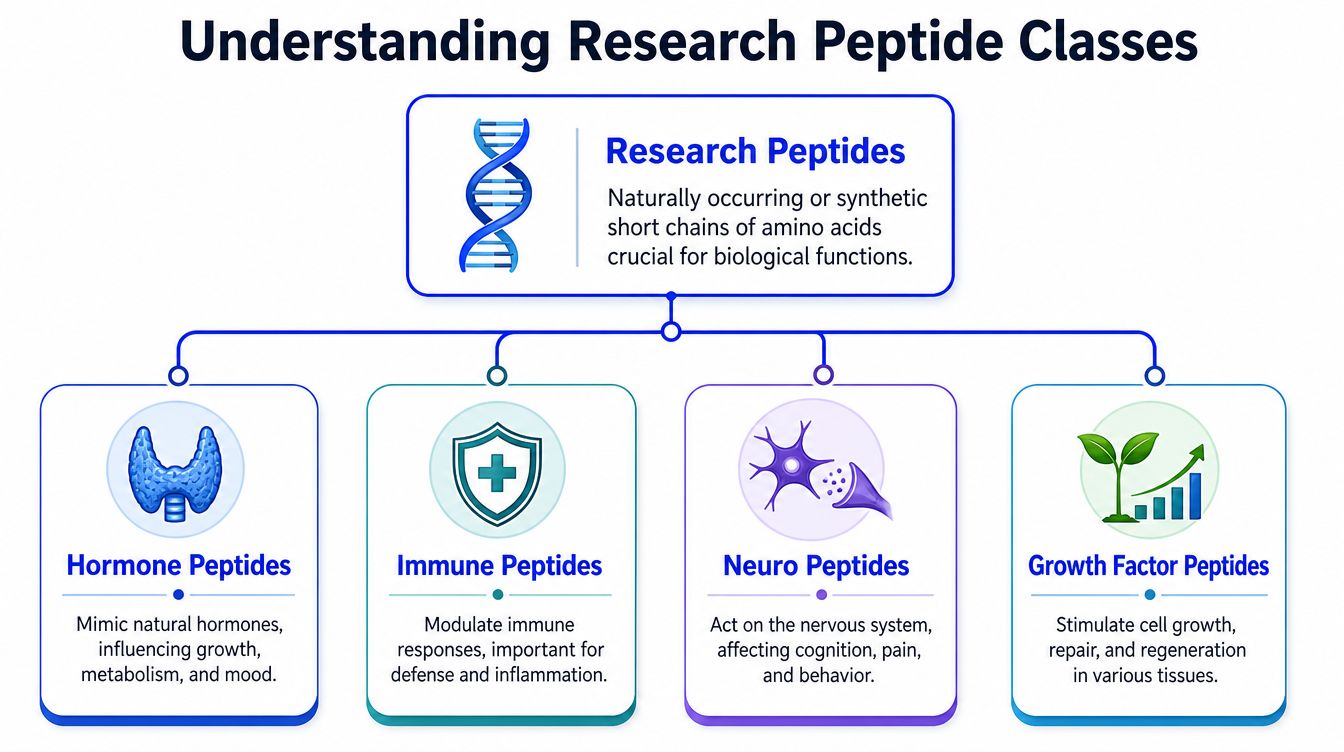
Researchers often organize commonly discussed compounds by their primary area of study. These categories aren't substitutes for a protocol, but they provide a practical starting point for literature review, assay selection, and procurement.
Growth Hormone Secretagogues, often abbreviated as GHS, are studied for their relationship to growth hormone signaling. CJC-1295 and Ipamorelin are frequently grouped in this area. A researcher working with these compounds should define the biological endpoint first, then confirm whether the selected material is appropriate for receptor, signaling, binding, or analytical work.
Metabolic research includes familiar peptide systems such as GLP-1-related compounds, as well as newer molecules designed to act at more than one receptor. The important distinction is between a peptide's research role and an approved clinical product. A laboratory compound may be useful for controlled investigation without being authorized for human administration.
The thymosin family includes compounds such as BPC-157 and TB-500, which appear frequently in preclinical discussions of tissue repair, inflammation, vascular biology, and cellular responses. These names describe active research interests, not established directions for self-treatment.
LL-37 is another example that researchers may encounter in antimicrobial and immune-response contexts. Here, assay design matters greatly because peptide activity can change with ionic strength, protein binding, pH, surface adsorption, and concentration.
Selank and Semax are commonly discussed in neurobiology and behavioral research. Their inclusion in a catalog doesn't establish a clinical indication. It merely identifies materials that may be investigated in controlled laboratory systems, subject to institutional oversight and an approved protocol where required.
PT-141 is associated with melanocortin research. As with every peptide, the researcher should distinguish the compound name from the intended experiment, verify the exact form supplied, and avoid assuming that a product marketed for research has the same specifications as an approved pharmaceutical.
A good procurement request therefore includes more than a product name. Specify the sequence or recognized identifier, requested quantity, format, required testing, intended assay, and acceptable documentation before comparing prices.
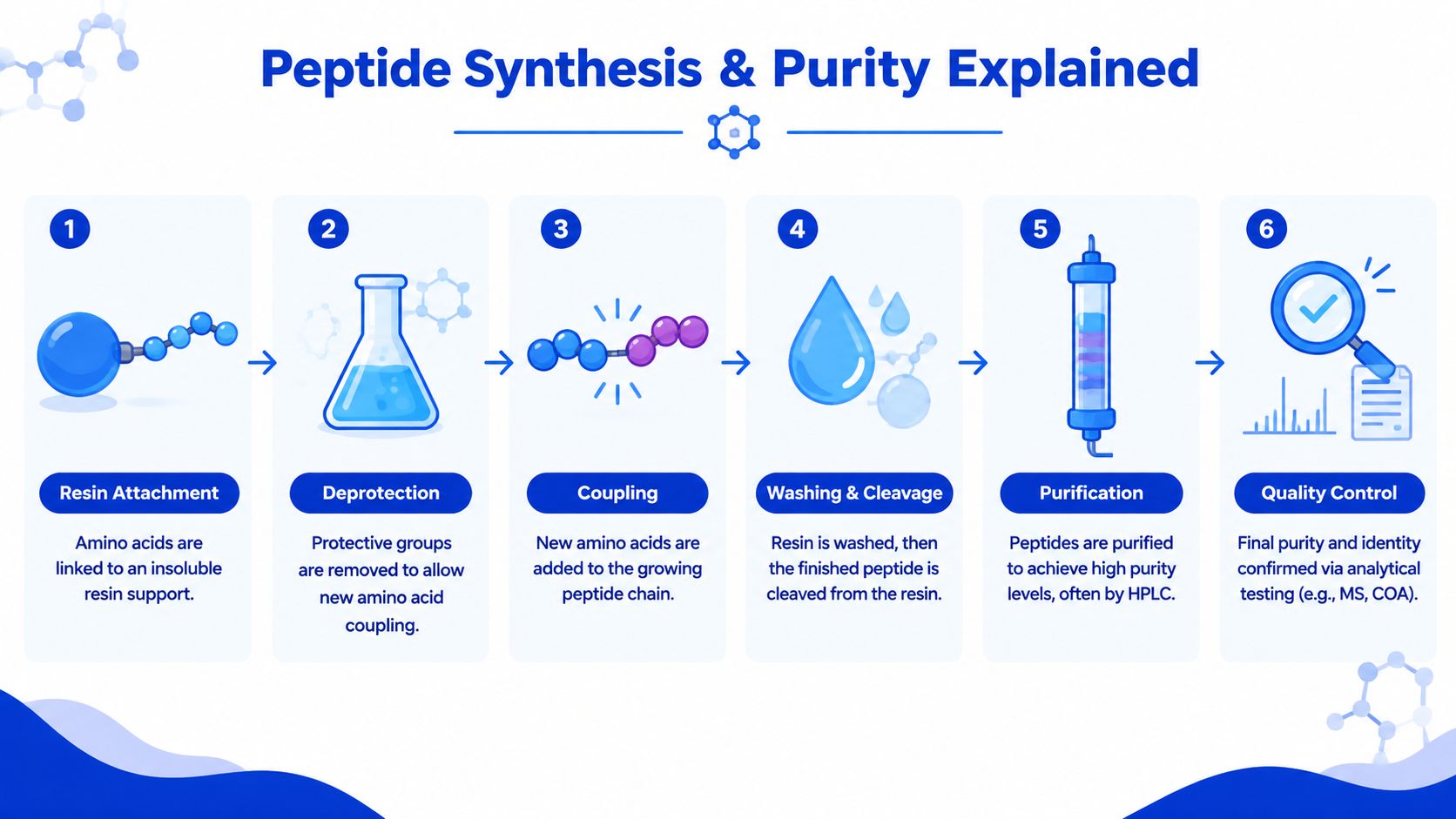
Most modern peptide manufacturing begins with Solid-Phase Peptide Synthesis, or SPPS. In this method, the first protected amino acid is attached to an insoluble resin. Additional amino acids are then coupled in sequence, with protective groups removed between coupling cycles. Once the chain is complete, the peptide is cleaved from the resin and taken through purification and analytical testing.
The approach is valuable because the growing chain remains attached to a solid support while soluble reagents and by-products can be removed through washing. It isn't a guarantee of a perfect final product. Incomplete coupling, side reactions, deletion sequences, oxidation, deamidation, and cleavage-related impurities can all remain concerns.
A stated purity percentage usually refers to the proportion of the principal chromatographic peak under defined analytical conditions. That information matters, but it doesn't answer every quality question. A main peak can be consistent with the expected peptide while the sample still requires separate evaluation for molecular identity, residual solvents, water content, microbial burden, endotoxins, aggregation, or assay-specific performance.
The most robust identity-and-purity workflow combines reversed-phase HPLC with Mass Spectrometry. RP-HPLC separates the principal peptide from related impurities and quantifies the chromatographic profile. MS confirms the molecular mass, helping identify truncations, oxidation products, deamidation, and other species that a single purity number can't fully characterize (peptide identity and purity workflow).
HPLC detection at 214 nm is commonly used because it tracks absorbance from the peptide backbone's amide bonds. That wavelength supports routine quantification, while MS adds molecular-mass evidence and, where appropriate, fragmentation information.
A strong QC plan uses orthogonal methods because peptides can fail physically or chemically. Size-exclusion chromatography and electrophoretic methods can help track aggregation or fragmentation, while separation systems paired with spectroscopic, electrochemical, or mass-spectrometric detection can reveal chemical degradation (peptide stability methods).
For a new lot, ask whether the documentation addresses:
A reported purity level is useful only when the method and lot context make it interpretable.
A Certificate of Analysis should let you connect a specific vial to a specific production batch and a defined test record. Start at the top, not at the largest purity number.

Check the product name, lot number, manufacturing or test date, stated quantity, formulation, and storage conditions. The lot number on the COA should match the label on the vial and the purchasing record. If those identifiers don't align, pause the work and request clarification before opening the material.
Next, review the test panel. A useful document may include identity confirmation, purity quantification, potency, sterility, product quality information, and, where applicable, bacterial endotoxin results and downloadable lot documentation (peptide COA documentation).
The HPLC result describes chromatographic composition under the stated method. The MS result addresses whether the material's measured molecular mass is consistent with the expected peptide. Neither result, by itself, proves that the sample will perform in every assay.
Look for method names, acceptance criteria, units, and result fields rather than relying on a bold headline claim. A document that shows only “high purity” without a lot identifier, test method, analyst or laboratory information, and result details gives you little basis for independent review.
Researchers who regularly interpret complex laboratory documentation may also find this guide to decoding virology reports useful for its emphasis on reading results in context rather than isolating a single value.
Vendor self-testing can provide useful release information, but it is performed within the selling organization. Independent third-party testing is different because the analytical work is performed by a laboratory with no financial stake in the sale, and the outside laboratory issues the resulting COA (third-party peptide testing explained).
Ask for documentation that identifies the outside laboratory and clearly ties the report to your lot. Be cautious with generic PDFs that lack batch-specific information, use inconsistent formatting, omit methods, or cannot be reconciled with the vial label.
Documentation standard: If you can't trace the result from the report to the lot, treat the result as unverified for your project.
Price should be part of procurement, but it shouldn't lead the decision. A low-cost vial that lacks traceability can create greater expense through failed assays, repeated experiments, uncertain records, and questionable conclusions.
Recent market analysis indicates that buyers and laboratories increasingly prioritize documentation quality and lot traceability over simple purity claims because supply-chain transparency and trust remain major unmet needs (research peptide procurement trends).
A credible supplier should make it easy to answer practical questions before payment:
A supplier's website can look polished while still leaving essential gaps. Download the available records, compare them against the product label, and retain the full procurement file with your study documents.
Avoid vendors that make therapeutic promises for research-only materials, hide the lot number until after purchase, provide a single reusable COA for multiple batches, or refuse to identify the testing laboratory. The FDA evaluates the total marketing context when determining intended use, so an “RUO” or “not for human consumption” disclaimer doesn't automatically resolve concerns if surrounding claims suggest human administration (FDA marketing-context summary).
A reliable purchasing process protects the experiment before the experiment begins. Require the records first, then evaluate cost and delivery.
In the United States, research peptides labeled “For Research Use Only” and “Not for Human Consumption” are not FDA-approved for human use. They're intended for legitimate laboratory, analytical, and preclinical applications, with the researcher responsible for maintaining that boundary (U.S. research peptide regulatory summary).
That designation isn't a substitute for good laboratory practice. It establishes the intended use communicated for the product, but it doesn't authorize a researcher to administer the material to people or animals outside the approvals, oversight, and legal requirements applicable to the specific study.
A research chemical supplier isn't a pharmacy, compounding pharmacy, or outsourcing facility. Its role is to provide materials for laboratory and analytical work, along with product information and quality documentation. A pharmacy operates within a different regulatory framework and serves a different purpose.
Researchers should keep product claims, purchasing records, protocols, safety assessments, and institutional approvals aligned. Don't rely on a disclaimer while using promotional content, dosing language, or administration instructions that contradict research-only status.
For readers dealing with adjacent professional rules rather than laboratory procurement, a separate overview of requirements for natural medicine practitioners in Colorado illustrates why jurisdiction-specific requirements should be checked directly instead of generalized across fields.
Before ordering, confirm that your institution permits the compound and planned work. Review chemical hygiene requirements, biosafety procedures, shipping restrictions, waste handling, and any human or animal research approvals that apply to your setting.
Keep the COA, safety documentation, receiving inspection, storage log, preparation record, and disposal record together. That paper trail supports accountability and helps investigators determine whether a questionable result came from the biology, the analytical method, or the material itself.
A high-quality peptide can lose value after delivery if the lab treats it like an ordinary dry reagent. Handling should begin with a receiving inspection. Check the vial, seal, label, lot number, physical appearance, shipping condition, and accompanying documents before placing the material into storage.
Lyophilized peptide powder and reconstituted solution require different handling decisions. The dry material is generally more resistant to short-term handling than a prepared solution, but moisture, heat, light, and repeated temperature changes can still affect stability. Follow the supplier's stated storage requirements and your institution's validated procedures rather than relying on a generic internet protocol.
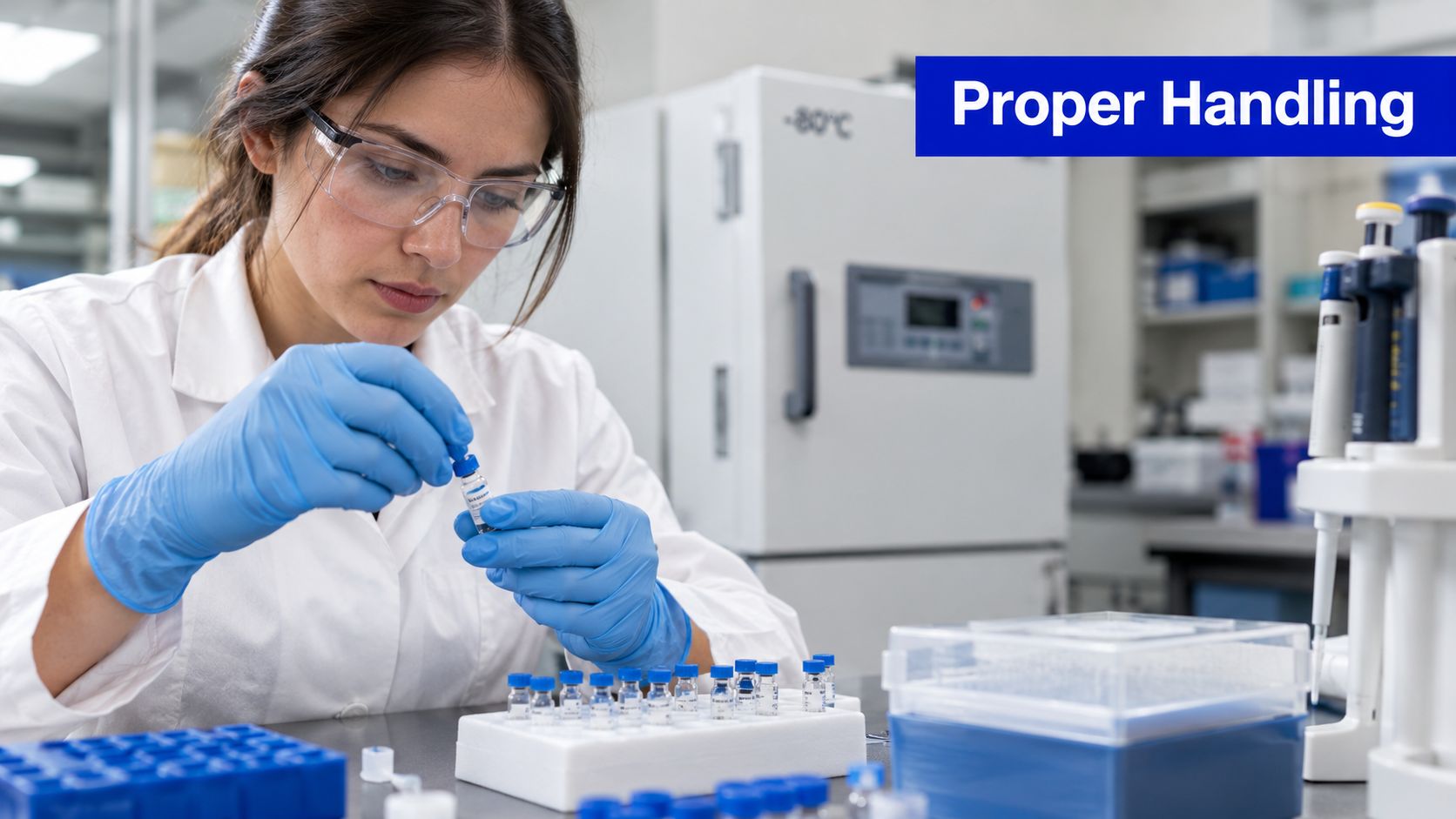
Before reconstitution, confirm the peptide's stated mass, solvent compatibility, concentration range, pH requirements, and intended assay. Use appropriate laboratory-grade materials and aseptic technique. Bacteriostatic water may be specified for some research workflows, but it isn't universally suitable for every peptide or analytical application.
A sound preparation record should capture:
Avoid vigorous shaking when the protocol doesn't require it. Gentle mixing can reduce foaming and unnecessary stress, while aliquoting can limit repeated freeze-thaw exposure. Don't use a solution that shows unexpected particles, discoloration, precipitation, or an unexplained change in appearance without investigating the cause.
Use clean, compatible containers and label every aliquot with the compound, concentration, lot, preparation date, operator, and discard or review date established by your laboratory. Separate research materials from clinical supplies, food, and personal-use products.
Routine environmental controls matter too. Labs that need supplemental surface or equipment controls can evaluate powerful UV disinfection units as one component of a broader validated cleaning program. UV equipment doesn't replace cleaning, containment, PPE, or proper aseptic technique.
Bench rule: Storage conditions should be written into the protocol before reconstitution, not reconstructed after a result looks unusual.
The most defensible workflow is simple: verify the lot, document the preparation, minimize exposure, control storage, and investigate deviations. Peptide Warehouse USA offers USA-manufactured research peptides and related compounds for laboratory, analytical, and preclinical applications, with batch documentation such as COAs, microbial reports, and endotoxin reports. Visit Peptide Warehouse USA to review research-use options and documentation before selecting materials for your laboratory workflow.