
No products in the cart.

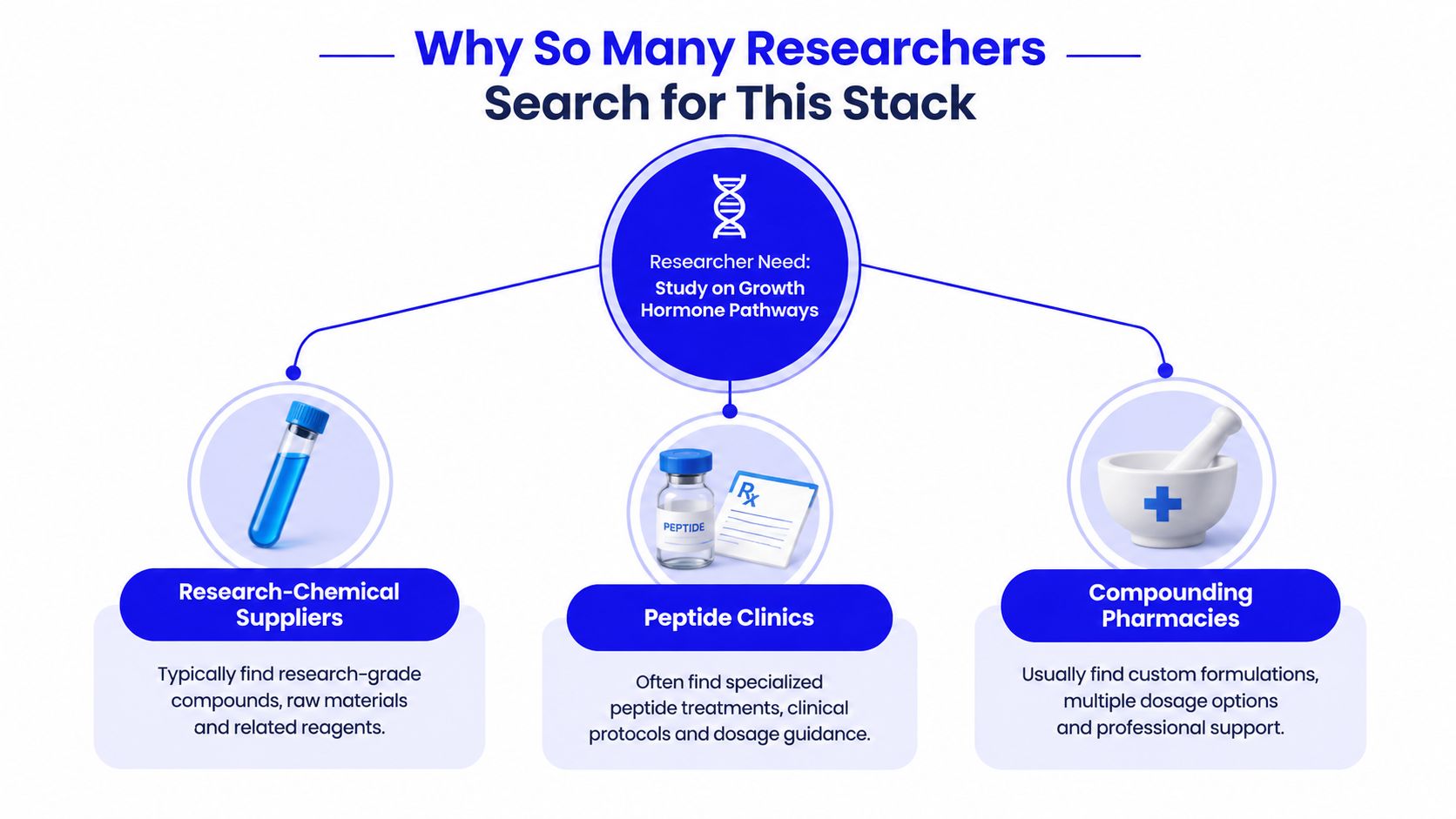
A lab buyer searching “CJC-1295 Ipamorelin where to buy” can quickly end up comparing research-chemical suppliers, peptide clinics, and compounding pharmacies as if they were interchangeable. They aren't. Each channel serves a different purpose, follows different documentation practices, and operates within a different regulatory framework.
The practical answer starts with your intended use. If you're purchasing material for laboratory, analytical, or preclinical work, you need identity, lot traceability, purity data, and handling records. If you're seeking administration to a person, the question becomes one of licensed medical supervision, prescription requirements, and current FDA restrictions. This guide separates those paths and shows how to evaluate a supplier's documentation before a purchase order changes hands.
A typical buyer begins with a protocol, two compound names, and a deadline. A search for CJC-1295 and ipamorelin produces vendors selling lyophilized research material, clinics describing supervised peptide programs, and pharmacies discussing compounded preparations. Some pages use precise laboratory language, while others make broad wellness claims that don't help a researcher identify the actual compound in the vial.
Interest in the combination comes from a research hypothesis, not from an FDA-approved finished product. CJC-1295 is commonly discussed as a long-acting growth hormone-releasing hormone analog, while ipamorelin is studied as a selective ghrelin-receptor agonist. Researchers may examine the two compounds together because they relate to different entry points in growth-hormone-axis signaling, but a paired listing doesn't prove that a combination is clinically established or automatically superior.
Before comparing prices or shipping speed, match the material to the study protocol. “CJC-1295” can refer to different research forms, including CJC-1295 with DAC and CJC-1295 without DAC. Ipamorelin may also be listed in a particular salt form, such as ipamorelin acetate. Those labels aren't interchangeable for a traceable experiment.
Record the following before contacting a supplier:
Procurement rule: A vendor blog can describe a product, but it can't replace a validated protocol or an auditable batch record.
The rest of the buying decision follows from that distinction. Researchers need to understand what each peptide represents, why a study might pair them, which purchase channel fits the intended use, and how to inspect a COA instead of treating a purity claim as proof.
CJC-1295 and ipamorelin influence related research pathways through different receptor-level concepts. A useful working model is to treat CJC-1295 as the GHRH-side component and ipamorelin as the ghrelin-receptor-side component. That model helps explain why researchers may study them together without implying a therapeutic result.
CJC-1295 is generally described in research discussions as a GHRH analog. The exact variant matters because conjugation and the presence or absence of DAC can affect the experimental characteristics a laboratory is trying to measure. A supplier listing that says only “CJC-1295” leaves an important identity question unanswered.
Ipamorelin is commonly characterized as a selective ghrelin-receptor agonist and growth-hormone secretagogue in experimental contexts. Its classification distinguishes it from older compounds with broader activity profiles, but a label describing selectivity doesn't establish safety, efficacy, or suitability for human administration.
| Feature | CJC-1295 | Ipamorelin |
|---|---|---|
| Research classification | GHRH analog | Ghrelin-receptor agonist |
| Procurement concern | Variant, DAC status, sequence or modification | Salt form, such as ipamorelin acetate |
| Functional research concept | GHRH-side signaling | Ghrelin-receptor-side signaling |
| Buying requirement | Exact form and lot identity | Exact form and lot identity |
| Interpretation limit | A product name doesn't prove identical properties across vendors | A paired listing doesn't make it interchangeable with CJC-1295 |
Before buying, define the research form, sequence or modification, salt, stated quantity, storage conditions, and COA identifier. A traceable supplier should be able to connect those details to a specific batch. If the page omits the form or provides only a broad “research peptide” description, pause the order and request clarification.
This step also prevents a common error. Two compounds sold in one blend aren't necessarily one standardized product, and two products with similar marketing language aren't necessarily comparable experimental materials.
The reason researchers pair CJC-1295 and ipamorelin is pathway complementarity. A study may examine GHRH-axis activity alongside ghrelin-receptor signaling, then compare the combined condition with each compound alone. The useful question isn't whether a supplier can promise “synergy.” It's whether the study design can test additive, overlapping, or antagonistic effects.
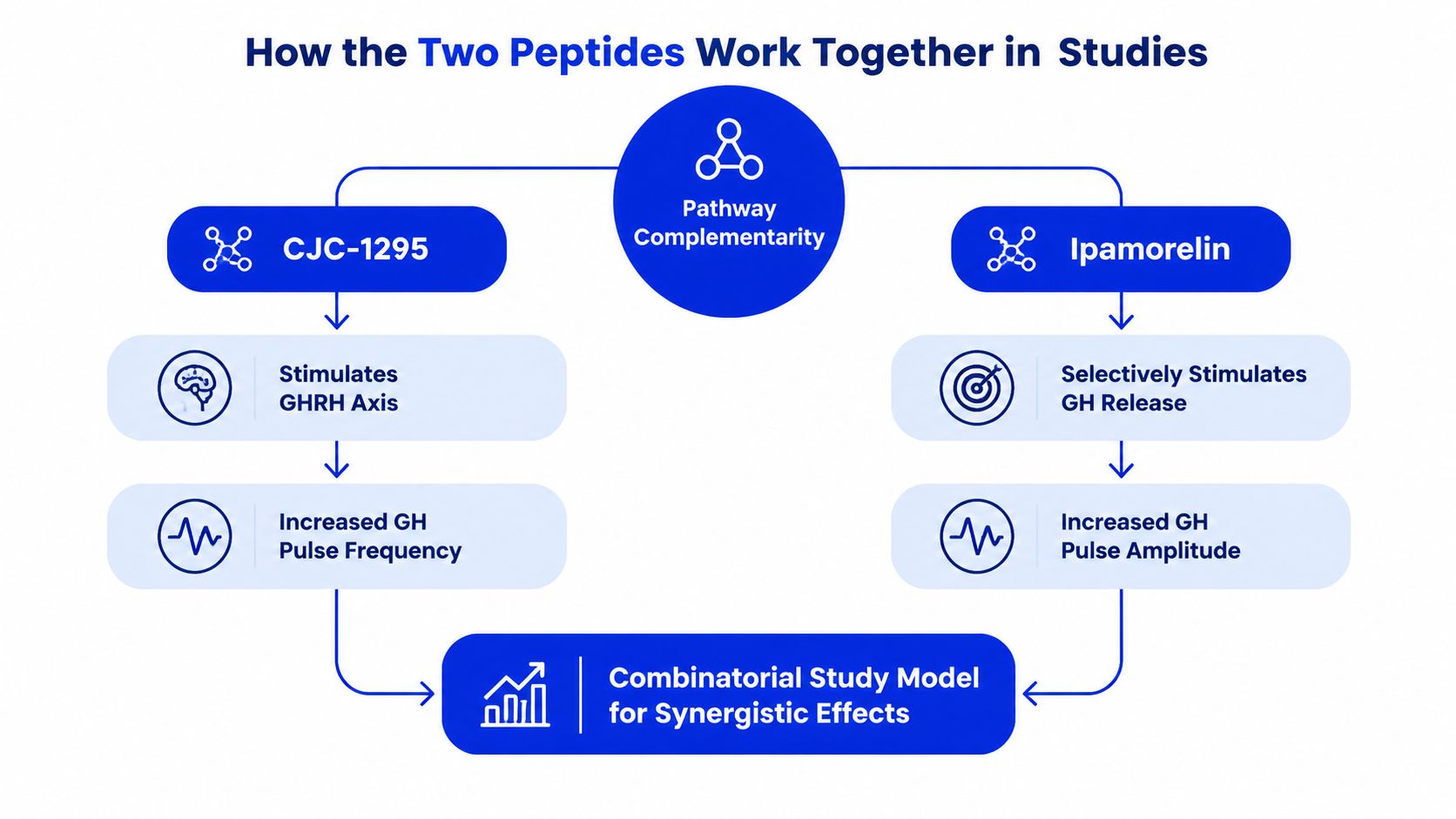
A combination study needs controls that separate the contribution of each material. Depending on the model, that may mean measuring CJC-1295 alone, ipamorelin alone, the combination, and an appropriate control condition. The endpoints, timing, and analytical methods should come from the validated study design rather than a vendor's suggested schedule.
Procurement becomes more demanding when two materials are involved:
A precombined blend can reduce packaging steps, but it also makes attribution harder if the study later shows an unexpected result. Separate vials may provide more control over experimental conditions, while a blend may simplify inventory management. Neither option removes the need to verify identity, concentration, stability, or contamination controls.
Peptides can be affected by adsorption, repeated handling, solvent selection, and storage interruptions. The laboratory should use documented procedures appropriate to its model and avoid transferring instructions casually from human-adjacent marketing pages into an unapproved research protocol.
Study-design caution: A shared administration schedule doesn't compensate for weak analytical controls.
Before submitting a purchase order, verify that each vial has an independent lot record, that the test methods are appropriate for the material, and that the institution has approved the proposed combination. The supplier's role is to document what it sold. It isn't to replace scientific review, institutional oversight, or protocol development.
U.S. buyers usually encounter two distinct channels, and confusing them creates the greatest procurement risk.
The first is the research-chemical supplier. These businesses sell materials labeled for laboratory, analytical, or preclinical research, often with research-use-only language and no prescribing step. A legitimate research channel should make the intended use clear and should provide documentation that helps a laboratory evaluate identity and batch quality. It isn't a pharmacy, and its material isn't a finished medication for human administration.
The second is compounding pharmacy access, which involves a different legal and operational framework. FDA guidance distinguishes 503A pharmacies, which compound through state-licensed pharmacies for patient-specific prescriptions, from 503B outsourcing facilities, which are FDA-registered and operate under cGMP-equivalent manufacturing standards. The FDA also states that outsourcing facilities may compound from bulk drug substances only when the substance appears on the agency's 503B bulks list or when the compounded drug is on the FDA shortage list at the relevant stages of compounding, distribution, and dispensing. See the FDA explanation of bulk-substance compounding requirements for the governing distinction.
| Channel | What They Sell | Buyer Type | Documentation Required | Key Restriction |
|---|---|---|---|---|
| Research-chemical supplier | Research-labeled peptide material | Laboratory, analytical, or preclinical buyer | COA, lot record, product identity, shipping and storage information | Not for human use |
| 503A pharmacy | Patient-specific compounded preparations | Patient with a valid prescription and clinical oversight | Prescription, pharmacy license information, formulation and dispensing records | Patient-specific compounding conditions |
| 503B outsourcing facility | Compounded preparations distributed under outsourcing-facility rules | Clinical or institutional purchaser, subject to applicable requirements | FDA registration, manufacturing records, quality documentation, applicable ordering records | Bulk-substance eligibility and compounding restrictions |
Gray-market telehealth storefronts can blur these categories by displaying research peptides beside clinical language. A page that mentions “protocols,” “cycles,” or “wellness” isn't proof that the seller is a licensed pharmacy or that the material is appropriate for human use.
A research supplier should answer questions about lot documentation, analytical testing, storage, and shipping. A pharmacy should identify its license, prescription process, compounding status, and the conditions under which it dispenses. If the seller avoids that distinction, don't treat the product page as a substitute for regulatory clarity.
The FDA has identified CJC-1295 and ipamorelin acetate as bulk drug substances that may present significant safety risks in compounding. That signal makes the channel question central, not incidental.
A Certificate of Analysis is useful only when it identifies the tested material and shows how the laboratory tested it. A polished PDF with a large purity figure isn't enough.
Start by checking whether the COA names the testing laboratory and the method used. For peptide research material, a serious buyer will typically look for HPLC data, mass-spectrometry confirmation, residual-solvent results, and endotoxin or microbial testing where those controls are relevant to the intended work.
The lot number should match across every record:
A key distinction is peptide purity versus peptide content. HPLC purity describes the proportion of detected chromatographic material attributed to the target or related components under that method. It doesn't automatically mean that the vial contains the same percentage by mass of target peptide. Water, counterions, residual solvents, excipients, and other material can affect total content.
COA question: Ask not only “What is the purity?” but also “What does this result measure, and which lot does it represent?”
Be cautious when a vendor won't provide a third-party COA, supplies a document without an analyst signature or testing date, or presents a PDF that appears edited. Sterility or endotoxin language without an assay method, sample information, or result detail also deserves clarification.
If the project requires independent confirmation, a laboratory can arrange third-party retesting through providers such as JANSÍ or Charles River. Those services don't make an unapproved product suitable for human use, but they can help a research team verify material against its internal specifications.
A supplier that publishes batch-level documents gives the buyer something auditable. A supplier that offers only a generic purity statement leaves the laboratory carrying the entire verification burden.
The phrase “where to buy” often assumes that these peptides have a normal retail pharmacy pathway. In the United States, that assumption is incorrect.
The FDA has described CJC-1295 as a bulk drug substance that may present significant safety risks in compounding, citing limited clinical data, peptide-related impurities, API-characterization concerns, potential immunogenicity for certain administration routes, and serious adverse events including increased heart rate and systemic vasodilatory reaction. The agency's bulk-substance safety information also identifies concerns involving ipamorelin acetate, including immunogenicity, peptide-related impurities, and reported serious adverse events associated with intravenous administration.
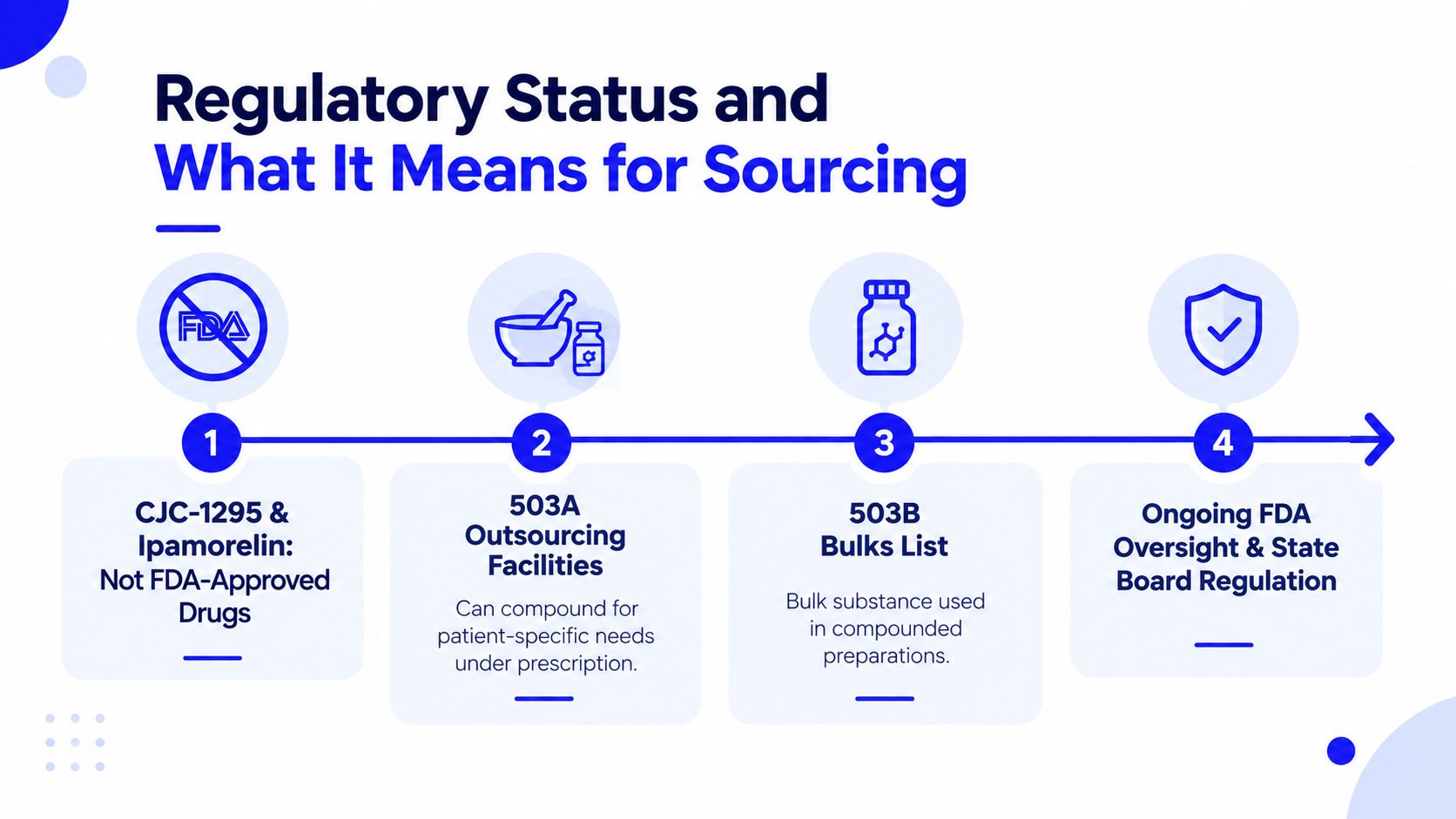
Ipamorelin has been described in FDA-related materials as having no FDA-approved drug products for human use. An FDA pharmacy-compounding meeting document from 2024 states that there are no FDA-approved products containing ipamorelin free base or ipamorelin acetate, while an FDA-linked summary records its placement in Category 2 on September 29, 2023, meaning it was treated as presenting significant safety risks in compounding policy. Those milestones are summarized in this FDA-focused ipamorelin regulatory review.
A bulk-substance category doesn't automatically authorize a finished-dose product. Pharmacy access depends on the applicable federal and state rules, the facility type, the substance's status, the prescription context, and the preparation's intended use. Research-chemical sales occupy a separate lane and should remain clearly labeled for laboratory or analytical work.
Regulatory check: Revisit current FDA notices and your state requirements before every purchase. A supplier's current stock status isn't proof of lawful clinical access.
This is why a product page can be available while a conventional medical pathway remains constrained. Availability answers whether a seller has inventory. It doesn't answer whether the material is approved, appropriately dispensed, or suitable for administration to a person.
A reliable order process starts before the quote. Use the study protocol and the institution's purchasing rules to determine which channel can supply the material for the intended work.
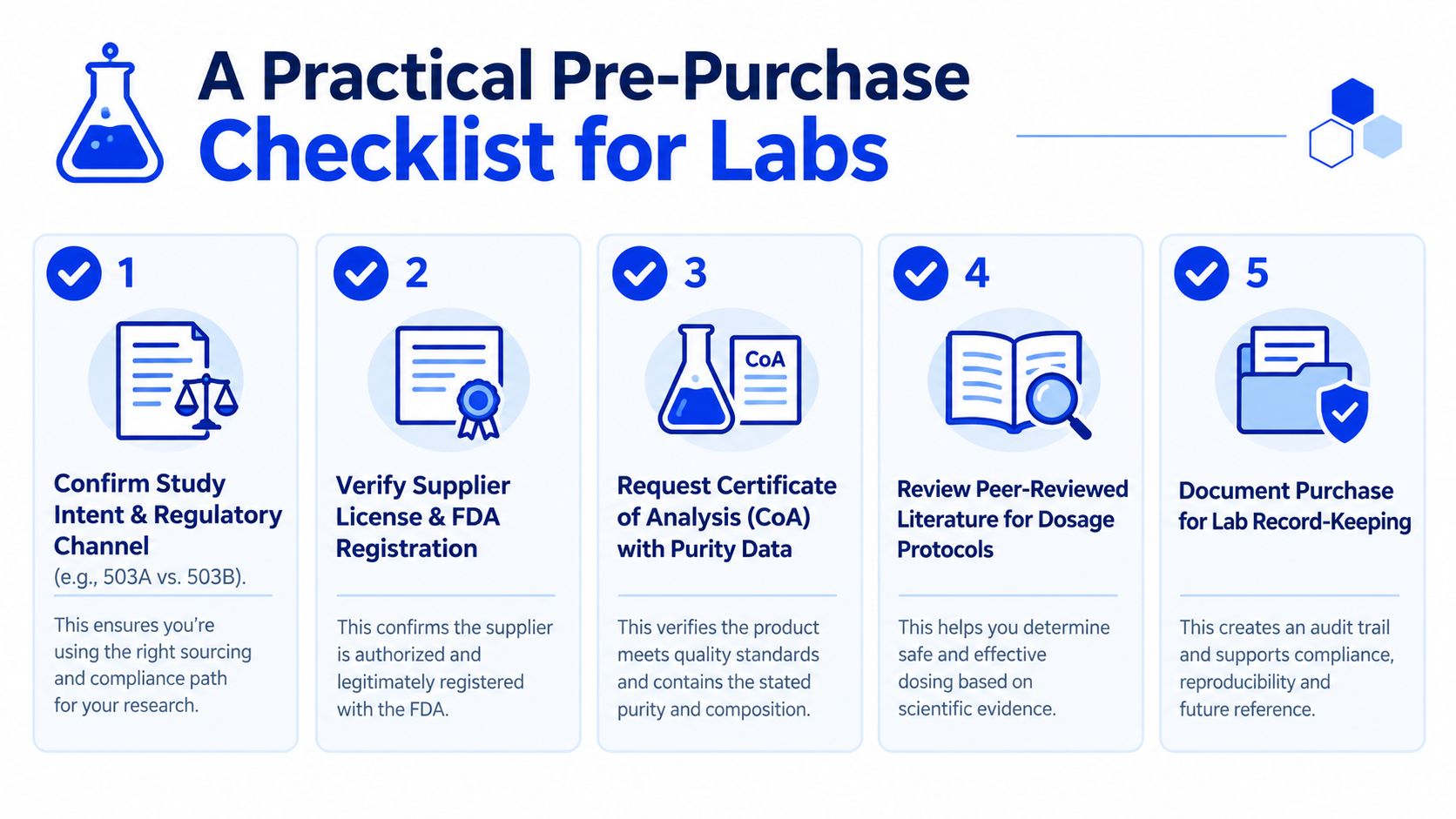
A laboratory should also review relevant peer-reviewed literature and its own approved protocol for experimental quantities, timing, reconstitution, and controls. This article isn't a dosing guide, and research documentation shouldn't be replaced by instructions copied from a commercial listing.
Even when a research supplier provides clear documents, that doesn't authorize human administration. Peptide Warehouse USA is one example of a research-chemical supplier that lists CJC-1295 without DAC plus ipamorelin and describes its products as intended for research, laboratory, or analytical use, with batch documentation presented for procurement review. Buyers should evaluate that information against their own institutional requirements rather than treating a listing as medical or regulatory approval.
A research supplier may place both products in one shipment, subject to its packaging and shipping procedures. Don't assume that one package means one quality record. Each peptide should retain its own product identity, lot number, COA, and storage requirements, and the laboratory should confirm the temperature conditions documented by the supplier.
Research buyers often look for high HPLC purity, with 98% or higher commonly used as a procurement expectation for research-grade material. That figure must be supported by a method, a named testing laboratory, and a COA tied to the shipped lot. It doesn't establish sterility, endotoxin status, peptide content, or suitability for human use.
Research-chemical suppliers sell these materials for in-vitro or animal-study work, not personal use. Possession, shipment, and use still need to comply with applicable federal, state, institutional, import, and safety requirements. Human administration outside an appropriately licensed and legally authorized medical pathway isn't converted into lawful use by a research-only label.
A blend may reduce ordering and inventory steps, while separate vials can give the laboratory more control over experimental conditions. Compare the full documentation package, lot traceability, testing scope, storage requirements, and reconstitution workflow rather than choosing on price alone.
For documented research procurement, start by confirming the intended use, then request batch-level identity and purity records before placing an order. Explore the CJC-1295 without DAC and ipamorelin research listing at Peptide Warehouse USA, and contact the supplier with your laboratory's documentation requirements before purchasing.
Leave a comment