
No products in the cart.



A new technician receives a research-grade PT-141 nasal spray kit and expects a simple label check. Instead, the package raises several questions. What exactly is in the vial? Does the actuator deliver a consistent volume? How should the formulation be stored, and can the expected exposure support the planned preclinical assay?
Those questions matter because nasal delivery isn't a cosmetic variation of injection. The vehicle, pH, peptide concentration, actuator, storage conditions, and nasal absorption process all influence what reaches systemic circulation. This guide follows those variables from molecule identification through formulation review, bioavailability limits, laboratory handling, concentration selection, study design, and research-use-only sourcing. It doesn't provide human dosing or treatment advice.
Before a technician uses a nasal formulation in an animal or analytical workflow, the product should be treated as a system rather than a bottle. The vial contains the peptide and vehicle, but the actuator determines delivery mechanics, the buffer affects chemical conditions, and the storage instructions protect the material between experimental sessions.
A practical intake review should establish:
The key distinction is between what the formulation contains and what the study can prove. A nasal spray may be easy to administer in a model, yet still produce variable exposure because mucociliary clearance, local degradation, nasal condition, and spray placement affect absorption.
Practical rule: Don't begin a preclinical run until the formulation record, storage history, actuator details, and analytical endpoint are documented together.
The discussion proceeds in a deliberate order. First comes the identity and development history of PT-141, followed by the formulation components that affect solubility and tolerability. The next sections address nasal bioavailability, storage and handling, concentration selection, integrated research design, and the regulatory limits that should govern sourcing and use.
A technician preparing a PT-141 nasal study must first separate three related terms: the peptide's identity, its receptor activity, and the product route. PT-141 is the research name commonly associated with bremelanotide, a synthetic peptide analogue related to alpha-melanocyte-stimulating hormone. It acts as a melanocortin receptor agonist, with activity discussed mainly in relation to MC3R and MC4R. This receptor profile identifies the pathway under study, but it does not establish a therapeutic use for an investigational nasal preparation.
The route has its own development history. PT-141 was initially developed as an intranasal nasal-spray product, rather than being created as an injection-only compound. A 2004 PubMed-indexed company update reported that Palatin had completed a Phase IIb erectile-dysfunction trial in September 2003 and planned Phase III trials for early 2005. The PT-141 development record summarizes that early nasal program.
Safety concerns redirected development away from nasal delivery. The FDA later approved bremelanotide as Vyleesi on June 21, 2019, under NDA 210557, for acquired, generalized hypoactive sexual desire disorder in premenopausal women. That approval applied to a 1.75 mg subcutaneous autoinjector, not a nasal spray, as described in the regulatory history of PT-141 and Vyleesi.
For laboratory work, keep the terminology precise:
Molecular size also sets a practical boundary. Reported material places PT-141 at about 1,025 Da, near the lower end of the molecular-weight range relevant to peptide nasal delivery. Its cyclic structure affects conformation and solubility. Formulation scientists therefore have to keep enough peptide dissolved for assay performance while limiting precipitation, aggregation, and local tolerability problems. Nasal delivery may simplify administration in a model, but it cannot remove those formulation and absorption constraints.
A research nasal spray should be read as a set of interacting formulation decisions. Peptide concentration and fill volume are separate variables. Increasing the concentration changes the amount available in each delivered volume, while changing fill volume affects how many actuations the container can support and how long the material remains in service.
The aqueous vehicle usually supplies the environment in which the peptide remains dissolved. A low-buffer saline or phosphate-buffer system may support ionic strength and pH control, but the exact composition must come from the product record rather than assumption.
| Component | Typical Role |
|---|---|
| Peptide concentration | Sets the amount of dissolved PT-141 available for each measured delivery |
| Fill volume | Determines the total formulation volume and supports actuator operation |
| Aqueous vehicle | Provides the liquid environment for solubility and transport |
| Buffer system | Helps maintain the specified pH during storage and use |
| EDTA | May bind trace metals that can contribute to degradation pathways |
| Antimicrobial preservative | Helps control microbial growth in a multi-dose container |
| Tonicity adjuster | Helps bring osmotic conditions closer to the intended nasal model |
| Permeation enhancer | May improve mucosal transport, but can also increase irritation or instability |
A formulation's pH is often positioned near a physiological tolerance range. The supplied plan identifies pH 4.5 to 6.5 as a typical operating window for balancing peptide solubility and nasal tolerance in animal models. That range isn't a universal acceptance criterion. The laboratory should verify the product specification and measure pH with a method suitable for the formulation.
Absorption enhancers are included for a specific reason. They can alter the mucosal surface or temporarily influence barrier properties, helping more peptide cross the epithelium. That potential benefit comes with costs, including local irritation, altered tissue response, and accelerated peptide loss in some preparations.
A preservative also deserves scrutiny. Antimicrobial protection may support a multi-dose format, but preservative compatibility with the peptide, actuator, container, and animal model must be established. The cleanest formulation isn't automatically the most useful one, because a simpler vehicle may have lower irritation but weaker delivery, while a more aggressive system may complicate interpretation.
Intranasal peptide delivery faces a mechanical ceiling before the study even begins. The nasal cavity can clear liquid through mucociliary transport, enzymes can degrade peptide at the epithelial surface, and peptide permeability across the membrane is limited by molecular size and structure.
Independent intranasal peptide research indicates that most currently marketed intranasal peptide formulations in humans have bioavailability below 5%, a constraint discussed in this review of intranasal peptide delivery. A published benchmark for a 1.5 mg/mL desmopressin nasal solution reported bioavailability of 3.3% to 4.1%, illustrating how a small peptide spray can still produce low single-digit systemic exposure compared with injection. The benchmark is summarized in this intranasal peptide development reference.
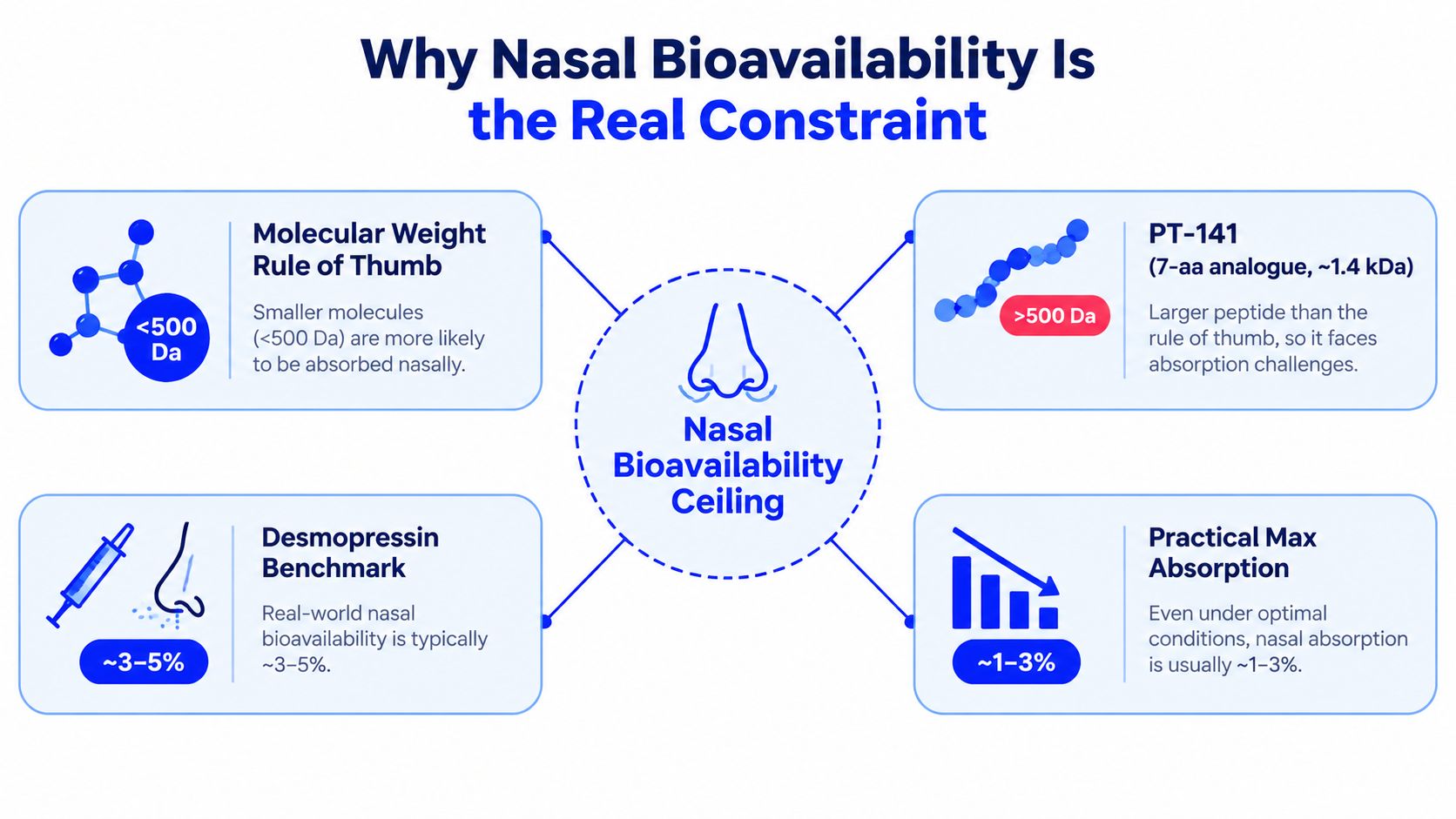
A commonly cited rule of thumb places peptides around 1,000 to 3,500 Da at approximately 3% to 5% nasal bioavailability, while larger peptides may fall below 1% to 2% without formulation enhancement. The gathered material reports PT-141 at about 1,025 Da, placing it near the lower end of that band. This molecular-weight context is described in the intranasal peptide delivery guide.
That doesn't mean a PT-141 nasal spray has a fixed absorption percentage. It means the study should be designed around low and variable exposure, not injectable-like pharmacokinetics. pH tuning and permeation enhancers may improve transport, but they don't remove mucociliary clearance, enzymatic degradation, or membrane-permeability constraints.
For PK work, that has several consequences:
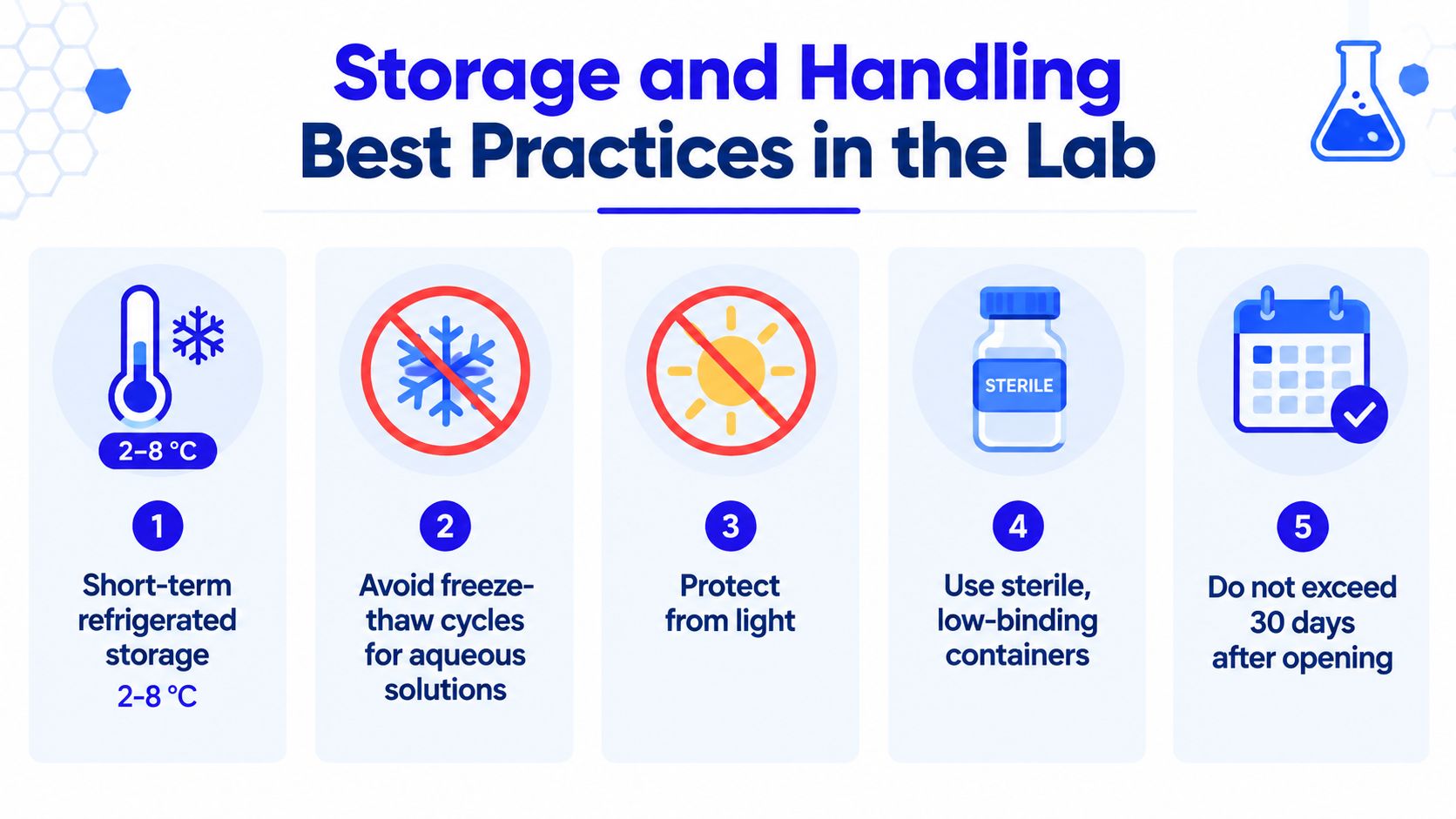
Research-grade aqueous peptide sprays need controlled handling because degradation can occur without an obvious visual change. Short-term refrigerated storage is typically identified as 2 to 8 °C, but the product's certificate, label, and technical documentation should control the final laboratory procedure.
Keep the container protected from light where the documentation calls for it. The peptide and some excipients can be photosensitive, and repeated exposure during bench work may create avoidable stability risk.
Avoid freeze-thaw cycling for aqueous peptide solutions. Freezing can alter the solution and container interface, while repeated thawing may encourage aggregation or other changes that won't be visible until an assay produces an unexpected result.
Before a run, a technician should review the chain of custody and perform a visual inspection. Look for particulates, haze, unexpected color, leaks, actuator damage, or evidence of clogging. Where the protocol requires it, verify pH after thawing or transfer using an appropriate validated method.
Opened multi-dose formats create additional risk. Preservative failure, microbial growth, and actuator contamination can affect both sample integrity and animal results. A controlled workflow should include:
Handling principle: If storage history is uncertain, treat the sample as analytically compromised until identity, concentration, and integrity are checked.
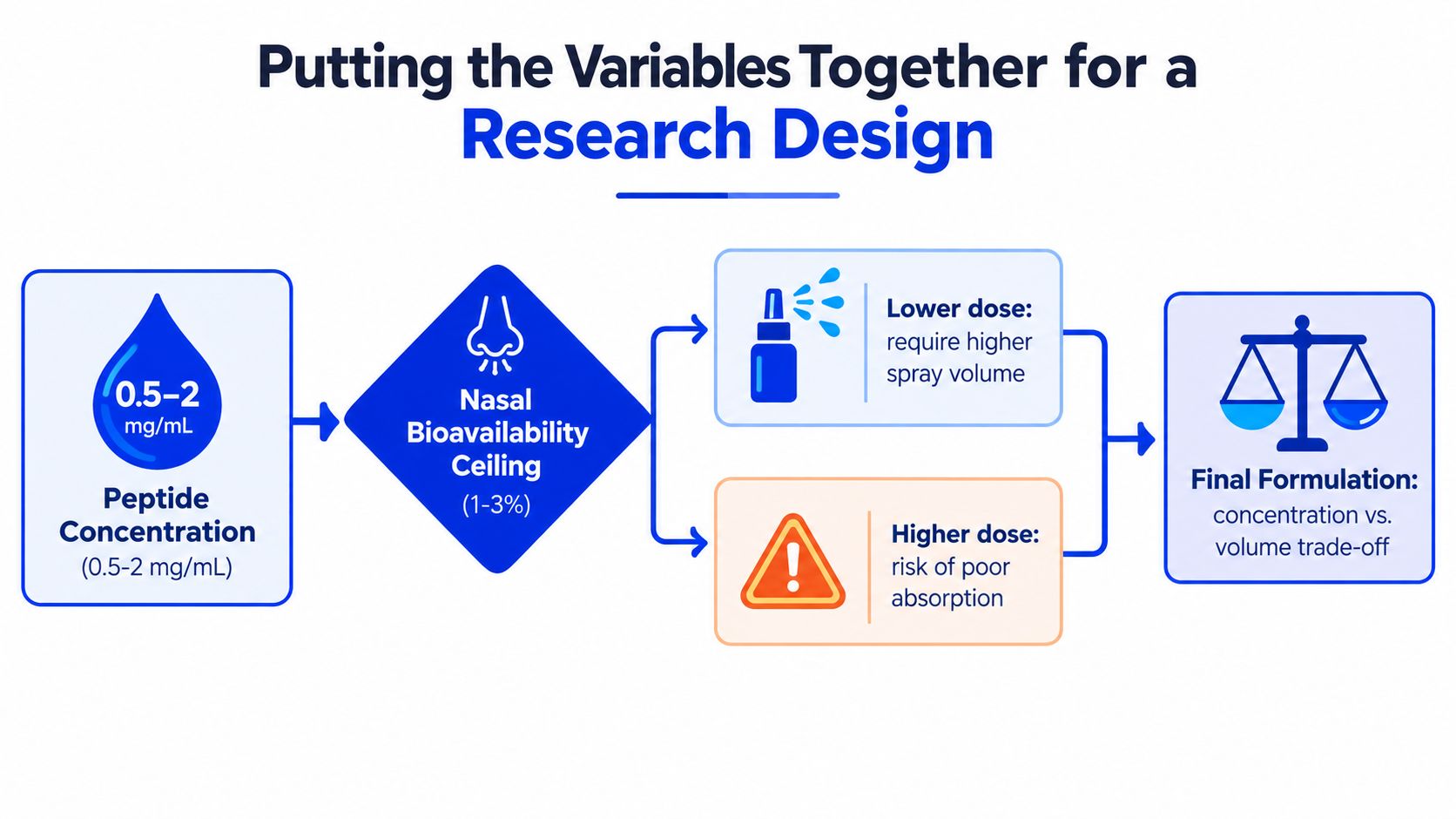
No validated PT-141 nasal concentration range exists for all preclinical models. Labs usually set a working concentration from supplier batch documentation, formulation limits, actuator output, and pilot exposure data. A concentration suitable for one spray device or animal model may be unsuitable for another, because nasal delivery can produce limited and variable systemic exposure compared with injection.
Treat concentration as a design variable, not a dosing standard. For example, a dilute preparation can support an initial check of clarity, pH, and spray function. A more concentrated preparation may reduce the liquid volume needed for the same nominal peptide amount, but can raise local concentration, viscosity, and precipitation risk.
Record the following before selecting a formulation:
| Design scenario | Example use | Decision it supports |
|---|---|---|
| Low concentration, screening preparation | Use a dilute PT-141 solution to check clarity, pH, assay response, and actuator function before exposure work | Shows whether the vehicle and delivery system are technically workable |
| Intermediate concentration, working preparation | Use a concentration selected from batch documentation and a small pilot study | Balances nominal peptide amount, spray performance, model capacity, and assay sensitivity |
| High concentration, formulation-limit preparation | Test the upper concentration the formulation can maintain without visible precipitation or poor spray behavior | Defines solubility, viscosity, and local-tolerance constraints before a larger study |
These are design scenarios, not validated numerical ranges. The team should establish acceptance criteria for identity, concentration, clarity, spray output, and analytical detectability before assigning a preparation to animal work. Batch-specific documentation remains the starting point, while pilot measurements show whether the chosen concentration delivers an interpretable signal in the intended model.
A researcher may have a clear PT-141 concentration on paper, yet still lack a usable nasal study design. The practical question is whether that nominal amount survives formulation, spraying, storage, and measurement. Treat the experiment like a chain: if one link fails, the final exposure result becomes difficult to interpret.
Start with a decision map rather than another checklist. Connect the peptide lot and concentration to the vehicle, pH, preservative, enhancer, actuator, nominal output, priming method, spray placement, and cleaning procedure. Record the storage temperature, light protection, thawing steps, opening dates, and discard criteria alongside the formulation record. These details show whether a later change came from the molecule, the delivery system, or handling.
A small pilot can then test the links that paper calculations cannot settle. Measure whether the spray produces a detectable, interpretable signal, whether the actuator delivers consistently, and whether storage or handling produces measurable degradation. Include observations that could separate vehicle-related local findings from compound-related effects. Define the analytical sampling plan and assay sensitivity before the first exposure run, so a weak signal is not mistaken for absence of exposure.
The expected nasal bioavailability ceiling should shape the design from the beginning. A high nominal concentration may fail if the peptide precipitates, the liquid becomes difficult to spray, or the assay cannot distinguish low exposure from background. A lower concentration may suit a compatibility study when it remains stable, sprays consistently, and gives a measurable analytical response.
The following video offers a general visual aid for nasal spray mechanics and research planning. It does not replace product specifications, institutional protocols, or analytical validation.
Design checkpoint: Scale up only when nominal concentration, actual delivery, expected exposure, stability history, and assay readout are connected in the study record.
PT-141 nasal spray material discussed here belongs strictly in a research-use-only framework. It is intended for laboratory, analytical, in vitro, or preclinical investigation under appropriate institutional controls. It isn't intended for human therapeutic use, compounding, personal consumption, or substitution for an approved medicine.
The regulatory distinction should remain visible in every procurement and protocol record. The FDA-approved bremelanotide product is Vyleesi, a subcutaneous product approved on June 21, 2019 for a specific indication in premenopausal women. An intranasal PT-141 format is not that approved dosage form, and the regulatory history should be checked against the documented PT-141 regulatory information.
A credible research supplier should provide documentation that lets the laboratory evaluate identity, purity, and handling conditions. Look for:
For a concise explanation of the commercial boundaries around research materials, review understanding research use only for resellers. The point isn't legal wording. Clear labeling helps prevent a research formulation from being mistaken for a clinically approved dosage form.
Peptide Warehouse USA offers research peptides and related compounds for laboratory, analytical, and preclinical applications, including a PT-141 nasal spray listing with batch documentation such as certificates of analysis and microbial and endotoxin reports. Visit Peptide Warehouse USA to review the available research materials, documentation, and sourcing information before your lab places an order.
Leave a comment