
No products in the cart.


You search “PT-141 for sale” and quickly find two very different kinds of listings. One may refer to Vyleesi, the FDA-approved prescription product, while another may describe a research-use-only peptide with a product page, a purity statement, and a downloadable Certificate of Analysis. Both listings may use the same informal name, but they don't represent the same legal category, quality system, or purchasing decision.
For research teams, the important question isn't where PT-141 is available. It's whether the material is appropriate for the intended laboratory purpose, whether the documentation matches the lot being purchased, and whether the procurement process fits applicable rules. This guide explains the identity of PT-141, the difference between prescription bremelanotide and research listings, the quality records a supplier should provide, and a practical way to review COAs before ordering.
The discussion stays focused on research procurement and compliance, not self-administration or medical treatment. By the end, you'll have a clearer framework for separating an approved medicine from a research compound, evaluating supplier transparency, and making a documented purchasing decision.
A laboratory buyer often starts with a straightforward task. A protocol calls for bremelanotide, purchasing searches for PT-141, and several vendors appear with different formats, prices, labels, and claims. The difficulty begins when the search result doesn't make clear whether the listing is a prescription medicine, a compounded preparation, or a research-use product.
PT-141 for sale is therefore a procurement phrase, not a complete product description. It tells you what someone is searching for, but it doesn't answer the questions that matter most to a lab:
Practical rule: Treat the product page as an introduction, not as proof of identity, purity, or regulatory suitability.
The regulatory history gives PT-141 an important context. PT-141 is the informal name for bremelanotide, and the U.S. Food and Drug Administration granted its initial approval on June 21, 2019, under NDA 210557 as Vyleesi for acquired, generalized hypoactive sexual desire disorder in premenopausal women. The FDA label records 2019 as the initial U.S. approval year, establishing a clear distinction between the approved medicine and later research-market listings. See the FDA Vyleesi prescribing information.
A research lab still needs to make its own purchasing assessment. The existence of an approved product doesn't automatically validate every online PT-141 listing, and a research-use disclaimer doesn't turn a product into a medicine. The safest path is to identify the material, confirm the intended use, inspect lot-level evidence, and keep procurement records that a qualified reviewer can understand.
PT-141 is bremelanotide, a synthetic peptide compound associated with melanocortin receptor signaling. A useful analogy is to think of a peptide as a small instruction card. It doesn't replace the entire biological system. Instead, it interacts with a specific signaling pathway, and researchers study the response under controlled conditions.
That signaling context helps explain why bremelanotide appears in both clinical and laboratory discussions. The approved product is Vyleesi, while research catalogs may list PT-141 as a lyophilized powder or another research format. The shared name doesn't mean the products are interchangeable. Formulation, sterility, labeling, release controls, intended use, and regulatory status can differ substantially.
The development history is also more substantial than a typical uncharacterized catalog compound. One independent clinical summary reports roughly 3,500 subjects across 43 studies, including two Phase 3 RECONNECT trials that enrolled 1,202 premenopausal women. Those trials reported response rates of about 58% for bremelanotide versus 36% for placebo, and the program supported the FDA approval in 2019. These figures are summarized in the PT-141 clinical research overview.
Researchers may examine peptide identity, receptor-related activity, analytical characteristics, formulation behavior, or interactions within a controlled model. The benefits of peptides in research often relate to their defined molecular identity and their usefulness as tools for studying biological signaling. Those research questions don't create permission for human use.
A research listing should therefore communicate its boundaries plainly. It should identify the compound, state that it is for laboratory or analytical work only, and provide documentation that allows the buyer to trace the material to a particular lot. A polished product page is helpful, but it isn't a substitute for records.
Lyophilized powder is commonly used to improve handling and support controlled laboratory preparation, but format alone doesn't establish quality. A vial described as “research grade” still requires identity confirmation, lot traceability, and appropriate storage and handling under the lab's procedures.
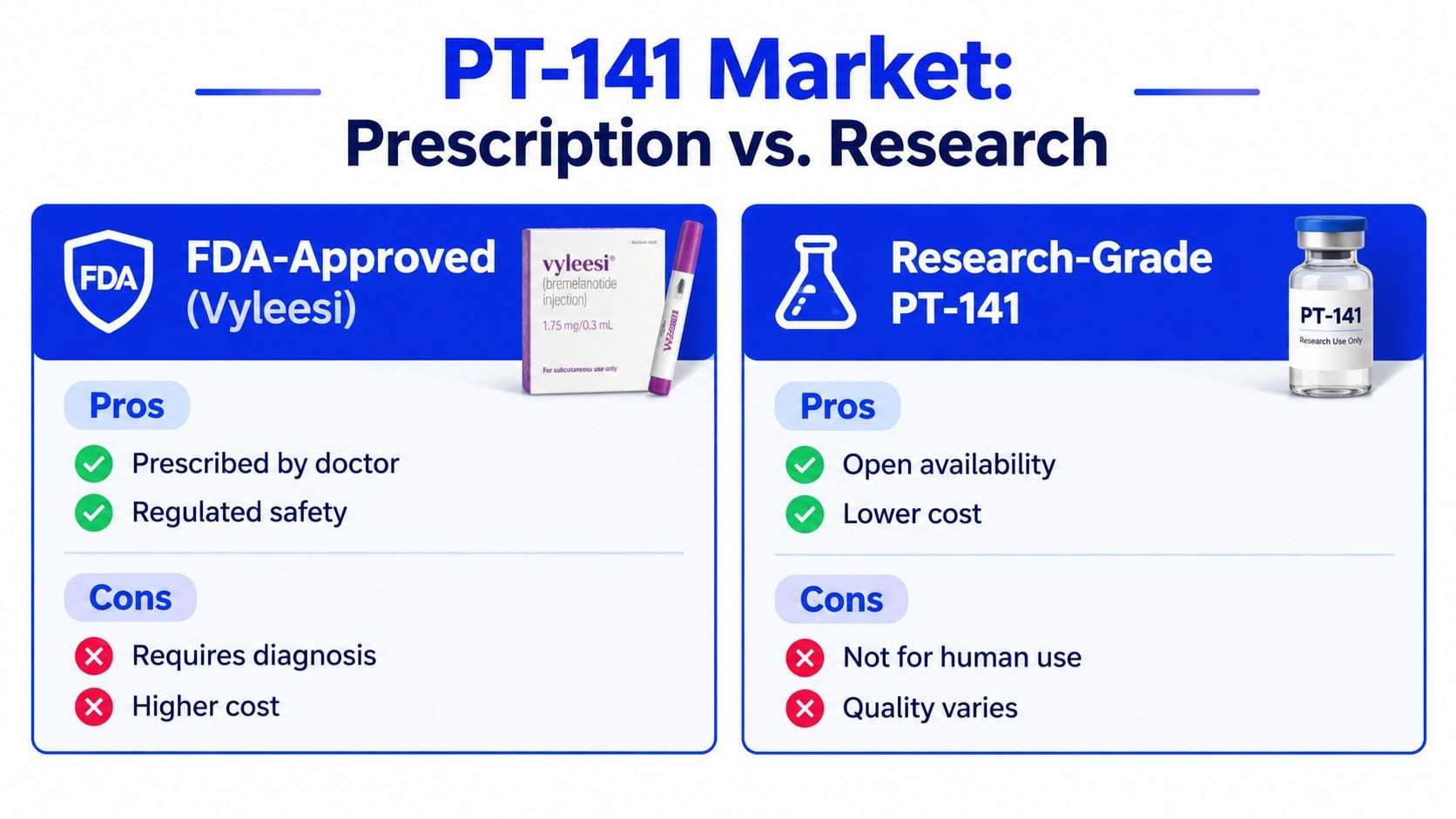
The core distinction is simple. Vyleesi is an approved prescription drug for a defined indication. Research PT-141 is a laboratory material marketed for research use only. Procurement teams should make that distinction before comparing price, vial size, shipping, or convenience.
The most important legal question is whether a listing represents FDA-approved bremelanotide or a research-use-only PT-141 product. FDA approval applies to the approved Vyleesi product and its labeled indication. It doesn't grant blanket approval for every formulation, route, population, or intended use associated with the name PT-141.
The approved indication is specific. Vyleesi is approved for acquired, generalized HSDD in premenopausal women, and no other approved uses exist under the information provided here. The approved product is also not an authorization for research listings to be sold or used as prescription medicine.
The market can be confusing because search results combine prescription products, clinical discussions, compounded preparations, and gray-market research listings. A buyer should evaluate the category first, before judging convenience or cost.

The FDA label is the most relevant reference for the approved medicine. It identifies the product, indication, administration details, warnings, and prescribing framework. A research supplier's product page can't expand that approval.
EU and UK authorization is absent according to the supplied regulatory background. That means a buyer outside the United States must assess local rules rather than assuming that U.S. approval creates authorization in another jurisdiction. Import, possession, labeling, and institutional use may involve separate requirements.
Bremelanotide isn't listed in the federal controlled-substance schedules, so it is regulated as a prescription drug rather than as a scheduled controlled substance, according to the supplied regulatory reference. The approved product is a single-use 1.75 mg/0.3 mL autoinjector. Those facts describe the approved medicine and shouldn't be used to characterize every research product or formulation. See the regulatory status overview for PT-141.
Before placing an order, a lab should ask:
A research-use disclaimer is a boundary, not a quality certificate. It tells you how the supplier positions the product, but the lab remains responsible for using material only within an appropriate and authorized research framework.
Quality assessment starts with evidence, not appearance. A professional product page may mention high purity, domestic manufacturing, or batch testing, but procurement teams should ask whether those statements are supported by documents tied to the actual material being offered.
For PT-141, the strongest supplier signals include a clearly identified manufacturing location, stated production controls, batch or lot numbers, analytical test methods, and third-party documentation. A vague phrase such as “premium purity” doesn't tell a laboratory how the result was obtained, when the test occurred, or whether it applies to the vial being considered.
| Quality Signal | What Strong Transparency Looks Like | Red Flag to Avoid |
|---|---|---|
| Identity | Compound name, lot number, and an identifiable test record | Product name without lot-level documentation |
| Purity | A stated result linked to a method and specific batch | Generic purity promise copied across products |
| Testing laboratory | Named independent laboratory or identifiable report | “Third-party tested” with no laboratory details |
| Microbial testing | A report that explains the tested lot and result | No microbial documentation for a material where the lab requires it |
| Endotoxin testing | Batch-specific endotoxin record where relevant to the protocol | Broad safety language with no endotoxin report |
| Traceability | Lot number connects the vial, COA, invoice, and shipment | Mismatched or missing lot identifiers |
| Manufacturing source | Clear statement of manufacturing location and sourcing | Ambiguous “made for” or “distributed by” wording |
A Certificate of Analysis is useful because it connects a product to a testing event. It doesn't automatically prove that every vial will perform identically in every experiment, but it gives the research team a starting point for evaluating identity, purity, and release information.
Microbial and endotoxin reports serve a different purpose from a purity assay. A purity result addresses the analytical composition reported by that method. Microbial and endotoxin records address separate quality questions, and the lab should determine which records its protocol, institution, and oversight process require.
A supplier's transparency is strongest when a reviewer can follow the material from product page to lot, report, invoice, and receiving record without filling in missing steps.
Price can be part of procurement, but it shouldn't be the first filter. A lower-cost listing may become expensive if the lab has to repeat testing, discard material, investigate unexplained results, or document an avoidable chain-of-custody gap. A transparent supplier makes those checks easier before purchase.
A COA review works best as a repeatable workflow. Researchers should not accept a document because it has a logo, a signature, or a polished layout. They should test whether the document connects the claimed result to the material in the cart.
Ask for the COA before ordering when possible. The document should identify the compound and include a lot or batch number that can be matched to the product listing, vial label, invoice, and receiving record.
If the supplier provides one generic certificate for every listing, ask whether it applies to the current batch. A report for an earlier lot may offer background information, but it isn't the same as current batch documentation.
Review the stated purity result, test date, analytical method, and laboratory identity. A complete report should make clear what was tested and how the reported result was generated. If the document shows a purity percentage without a method, sample identity, or lot number, treat the record as incomplete for procurement review.
Check the spelling of bremelanotide or PT-141 and compare it with the product description. The name should remain consistent across the COA and purchasing records. Differences in naming may be explainable, but the supplier should resolve them before shipment.
“Third-party tested” is a useful claim only when the third party is identifiable. Look for the testing laboratory's name, report number, date, and contact or verification information where available. A supplier should be able to explain whether the laboratory is independent of the manufacturer and which tests it performed.
Purity testing doesn't replace microbial or endotoxin testing. Request those records when the laboratory's protocol requires them, and confirm that they refer to the same lot rather than to a general product family.
Use a receiving checklist such as:
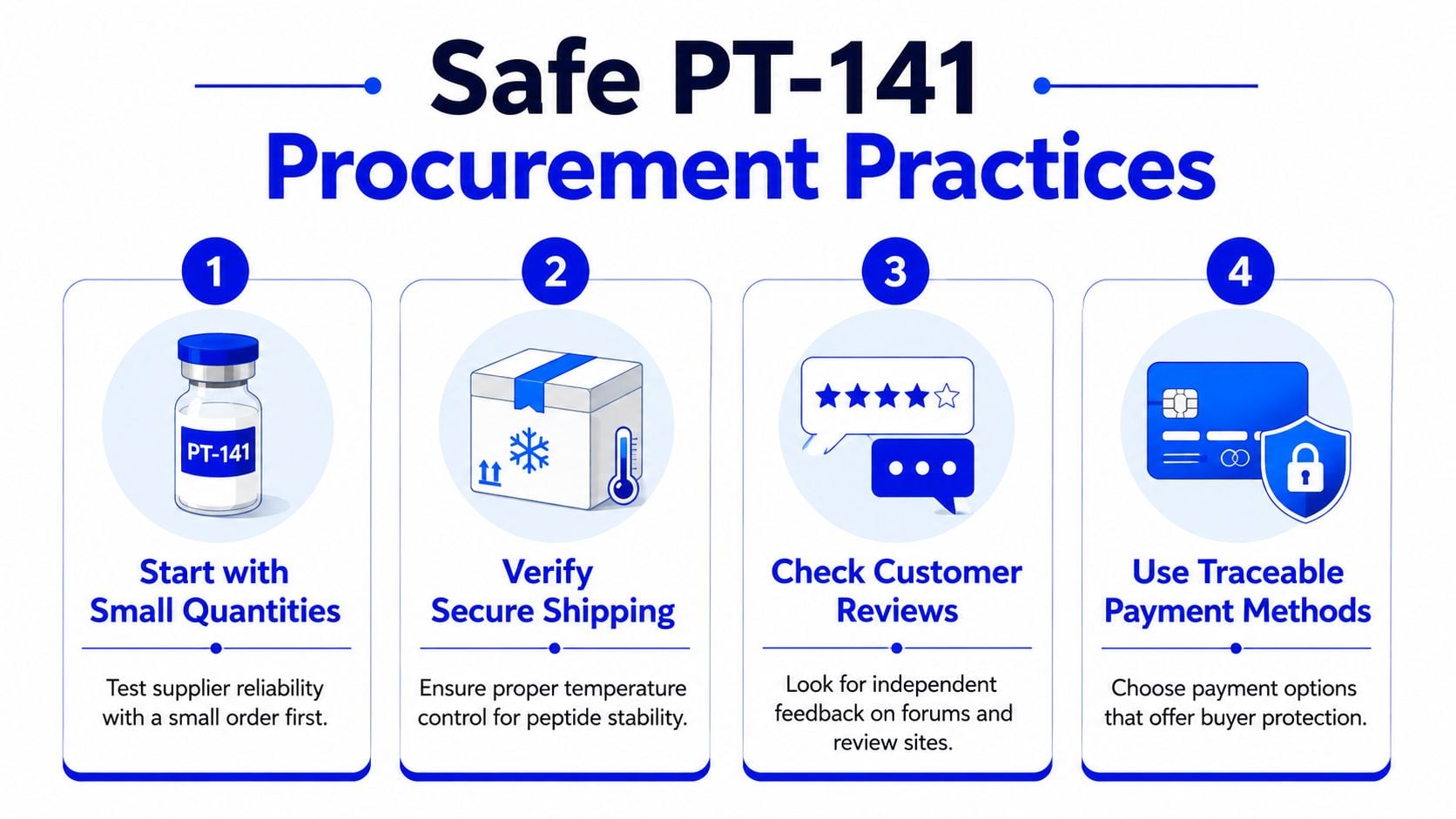
A laboratory can also use a written supplier questionnaire. Questions about lot release, storage conditions, shipping controls, returns, and documentation response time create a record of due diligence without relying on sales copy.
A strong procurement decision connects product evidence with the lab's actual workflow. Consider two hypothetical purchasing files. The first contains a low price, a product photograph, and a broad purity statement. The second contains a matching lot number, a batch-specific COA, microbial and endotoxin documentation where required, shipping information, and a clear research-use label. The second file gives a reviewer far more to evaluate.
That difference matters because research materials don't exist in isolation. A lab must receive, record, store, and use them according to approved procedures. A supplier that communicates clearly can reduce avoidable uncertainty, but it can't replace the lab's own controls.
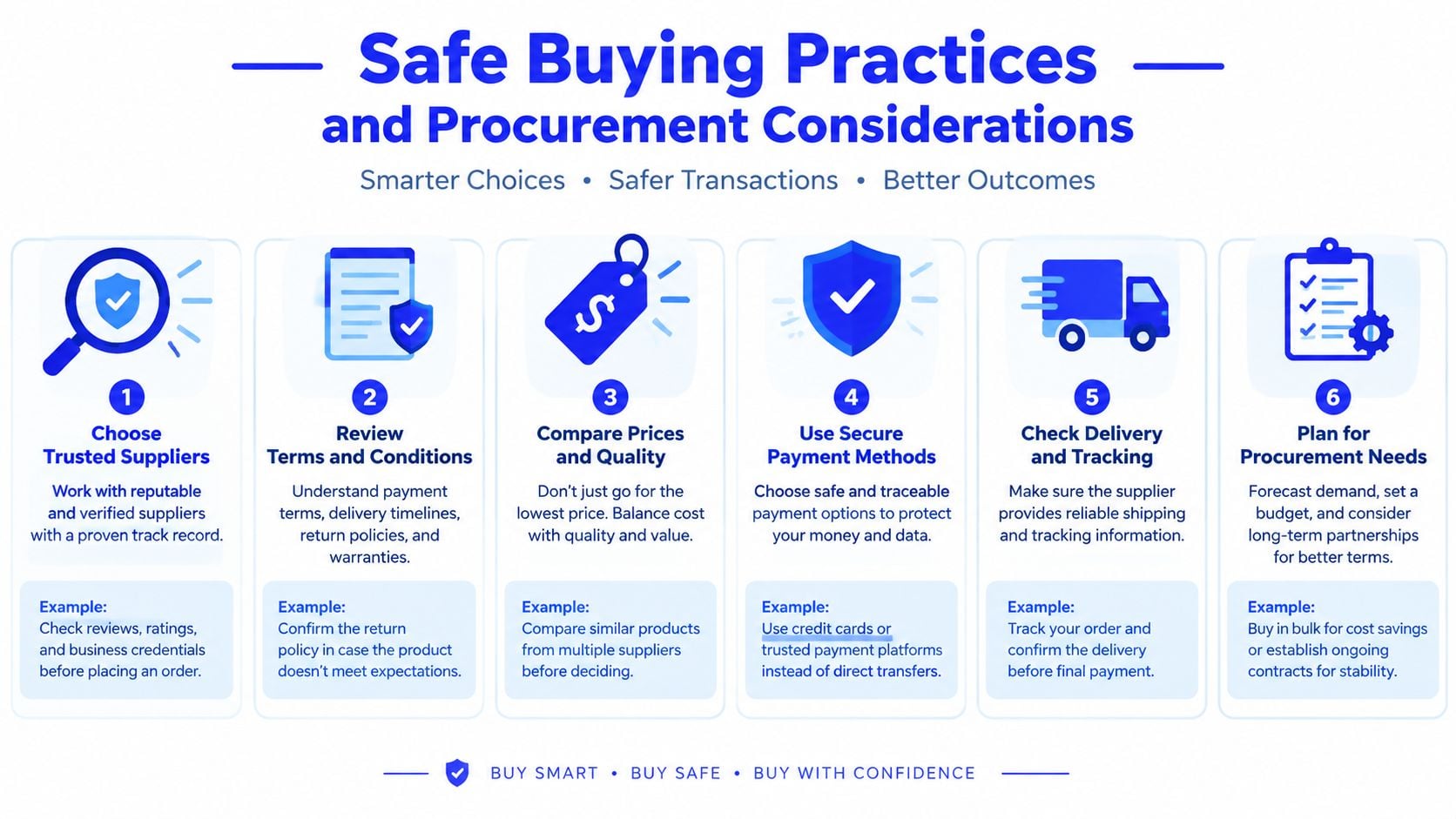
A buyer who chooses only by price may overlook missing batch records. A buyer who assumes “made in the USA” means every quality attribute has been independently verified may also miss the need to review the COA. A buyer who orders before checking jurisdictional requirements may create an avoidable customs or compliance problem.
Supplier services can support the process. Peptide Warehouse USA describes U.S. manufacturing, batch production and testing protocols, COAs, microbial and endotoxin reports, stated purity levels up to 99.5%, order tracking, and research-use-only labeling in its supplied company information. Its catalog includes research PT-141 formats, but the lab should still review the documentation for the specific lot and confirm that the material fits its approved use.
The most useful product benefit for a research team is not a persuasive promise. It's a documented supply chain that supports repeatable review.
If you're comparing listings, start with the records rather than the headline. Learn more about the available documentation, then explore options only after the product category, lot evidence, and shipping process meet your lab's requirements.
Searching for PT-141 for sale should lead to a classification decision before it leads to a checkout page. PT-141 is the informal name for bremelanotide, while Vyleesi is the FDA-approved prescription product for a specific indication. Research-grade listings occupy a different category and must remain within laboratory, analytical, or preclinical use.
A responsible review follows a clear order:
This approach turns a vague online search into a controlled purchasing process. It also helps researchers compare suppliers on evidence, not just price, packaging, or broad marketing language.
The final decision should be made by the qualified personnel responsible for the laboratory, protocol, and applicable compliance obligations. Research products aren't medicines, and no product page can determine whether a material is appropriate for a particular human or clinical use.
Peptide Warehouse USA offers research-use PT-141 products and related peptide compounds with U.S. manufacturing information, batch documentation, COAs, and supporting microbial and endotoxin records as described for its catalog. Visit Peptide Warehouse USA to review available research options and request the lot documentation your procurement process requires.
Leave a comment