
No products in the cart.


The most popular advice about peptides supplements for sale is also the most dangerous: find a product with a high purity claim, compare prices, and order the vial that looks most professional. That approach treats every peptide product as interchangeable. It isn't.
A collagen powder, an oral dietary supplement, an injectable prescription medicine, and a research-grade synthetic peptide can all appear in the same online search while belonging to very different regulatory and technical categories. For laboratories, the key buying question isn't only which peptide is available. It's whether the material is correctly classified, traceable to a specific batch, analytically verified, and suitable for research-use-only applications.
The global peptide supplements market is projected to grow from USD 4.1 billion in 2025 to USD 11.2 billion by 2035, a projected 10.4% compound annual growth rate over that decade, according to Research and Markets' peptide supplements market report. That expansion creates more purchasing options, but it also makes disciplined procurement more important. This guide separates consumer supplements from research chemicals, explains the regulatory history behind that distinction, and provides a practical framework for checking purity, identity, contamination controls, and supplier documentation.
Searching for peptides supplements for sale brings together collagen products, wellness powders, cosmetic ingredients, injectable compounds, and laboratory reagents. Their shared name does not make them interchangeable. A peptide is a chemical and biological description, not a complete purchasing specification.
A peptide is a short chain of amino acids, but procurement decisions require more detail. Sequence, formulation, intended use, administration route, manufacturing process, and marketing claims all affect evaluation. Food-derived collagen sold as a dietary supplement follows a different purchasing path from a synthetic peptide supplied as a laboratory analytical standard. Treating the two as substitutes can compromise both experimental results and regulatory compliance.
The category's commercial growth helps explain the confusion. The same market estimate projects that peptide supplements will add about USD 7.1 billion in value over ten years, identifying collagen peptides, bioactive blends, and other peptide-based nutrition products as important demand drivers. Greater distribution and more branded formulations create choice, not proof that an online purity statement is accurate or that a proposed use is permitted.
Consumer marketing commonly emphasizes skin appearance, exercise recovery, or general wellness. Those descriptions may help a consumer assess a lawful dietary supplement, but they do not establish molecular identity, lot-specific purity, or impurity controls for laboratory work.
A research buyer should document four points:
Procurement rule: If the supplier cannot connect the vial, lot number, analytical results, and intended-use statement, exclude the product from controlled laboratory purchasing.
Research-grade material supports controlled experiments, not a consumer wellness outcome. The laboratory therefore needs a defined input with a traceable chain of custody. A low purchase price can become expensive when an unverified compound interferes with an assay, forces a repeat experiment, or leaves the team unable to explain an anomalous result.
The boundary should remain explicit. Consumer supplements belong in a dietary and labeling framework. Research chemicals belong in a documented laboratory framework. Suppliers should not blur those categories through human-use language, disease claims, or promises about treatment and performance. For research-use-only applications, classification and documentation must be settled before the order is approved.
Peptides do not occupy one legal category in the United States. The term may describe a food-derived supplement ingredient, an FDA-approved medicine, an unapproved drug product, or a research compound restricted to laboratory work. A product being sold online does not establish approval for its intended use. For procurement, the intended use and marketing claims matter as much as the molecular identity.
The Dietary Supplement Health and Education Act of 1994 established the modern U.S. framework for dietary supplements. Certain food-derived peptide ingredients, such as collagen peptides, may be marketed as dietary supplements without premarket FDA approval when the labeling avoids drug claims. The FDA's guidance on the Dietary Supplement Health and Education Act should be the direct reference for that framework. Market context is summarized in the peptide supplement market overview from Future Market Insights.
That framework does not classify every peptide as a supplement. Injectable and prescription peptide products follow drug regulation and pharmaceutical controls. A synthetic sequence promoted for therapeutic, disease-related, performance, or other human-use purposes raises a different regulatory question from an orally consumed, food-derived ingredient.
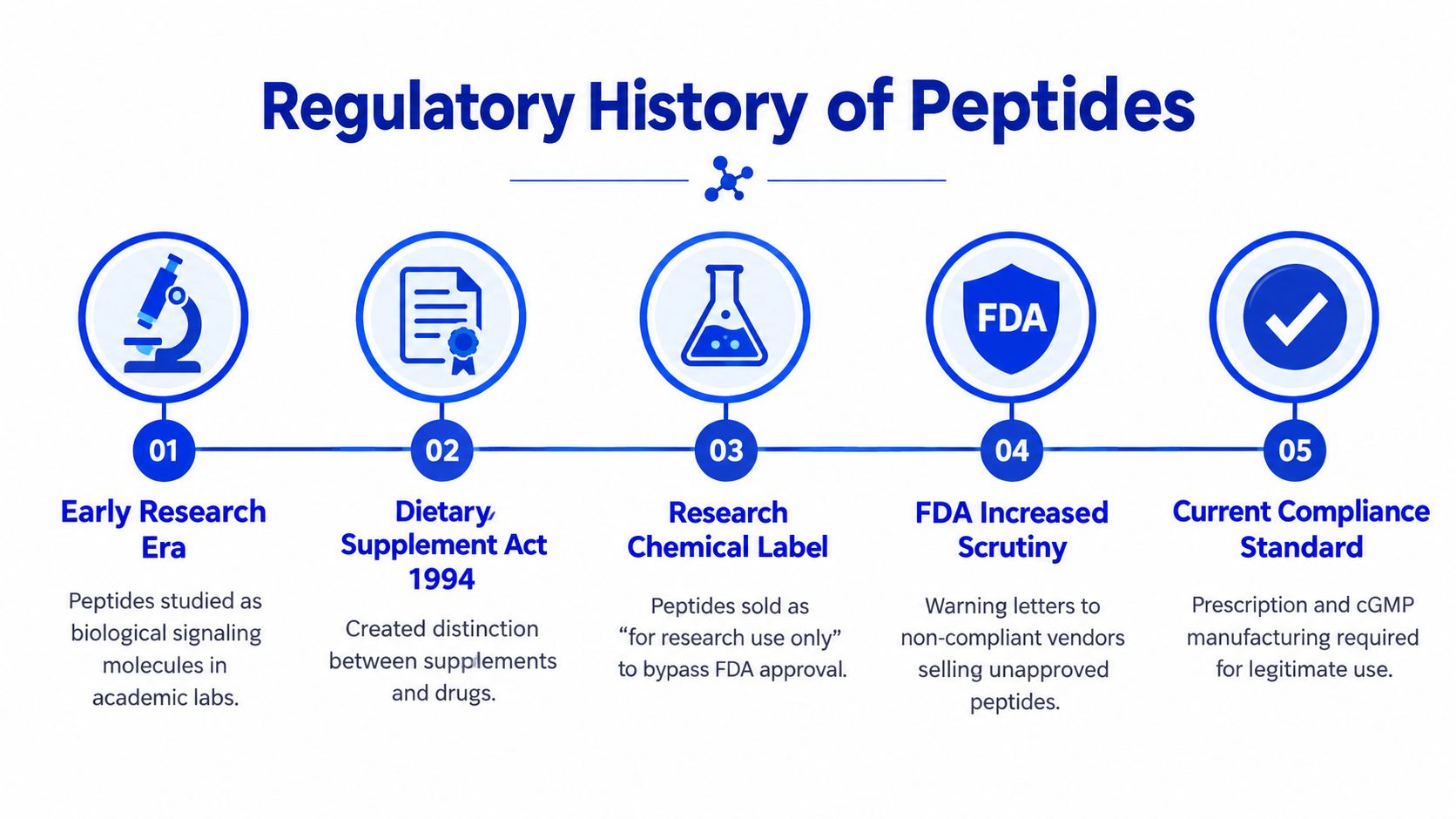
“For research use only” describes a restricted purpose. It does not erase the effect of the supplier's other conduct. A vendor that applies the research label while advertising weight loss, healing, athletic performance, anti-aging, or other human outcomes creates a mismatch between the stated classification and the actual marketing.
Independent 2026 regulatory coverage explains that unapproved peptides such as BPC-157 and TB-500 aren't lawful dietary supplement ingredients, and that reclassification does not make them over-the-counter products. Human-use marketing still requires the appropriate drug pathway, as discussed by BSCG in its 2026 peptide regulation coverage.
Cross-border purchasing adds another control point. New Zealand's Medsafe states that many unapproved peptide products are prescription medicines and that importing, supplying, possessing, or procuring prescription medicines without authorization is unlawful. Laboratories should review both the shipping and receiving jurisdictions, using Medsafe's consumer advisory on unapproved peptide products as a concrete example of why location affects procurement.
Regulators continue to establish formal pathways for peptide medicines. In 2026, the FDA published 17 revised draft product-specific guidances for certain generic peptide drug products, showing that peptide medicines are handled through structured pharmaceutical regulation rather than one universal category. The announcement is documented in the FDA announcement on revised draft product-specific guidances for generic peptide drug products.
For a laboratory buyer, the practical rule is simple: classify the product before reviewing price, confirm that its identity fits the experiment, and exclude human-use claims from research procurement. The website, label, invoice, shipping practice, and batch documentation should describe the same research-only purpose.
Consumer supplements and research chemicals can share ingredients, terminology, or online storefronts, but they serve different purposes. A dietary supplement is packaged and marketed for ingestion under supplement labeling and claim rules. A research chemical is supplied as a laboratory material with documentation that supports analytical, cell-based, preclinical, or other controlled work.
The FDA's dietary supplement labeling framework requires five label statements: statement of identity, net quantity of contents, nutrition labeling, ingredient list, and the name and place of business of the manufacturer, packer, or distributor. These requirements are set out in the FDA Dietary Supplement Labeling Guide. A generic vial page that omits mandatory packaging details shouldn't be treated as evidence of compliant supplement status.
| Feature | Dietary Supplements | Research Chemicals |
|---|---|---|
| Primary purpose | Consumer dietary use | Laboratory, analytical, or preclinical research |
| Marketing language | Must avoid drug claims | Must remain consistent with research-use-only status |
| Label focus | Identity, quantity, nutrition, ingredients, business details | Compound identity, lot traceability, storage, handling, and analytical documentation |
| Quality evidence | Supplement manufacturing and label controls | Batch-specific purity, identity, and contamination results |
| Buyer expectation | Consumer package information | Technical procurement file and certificate of analysis |
| Human-use positioning | Lawful supplement use only within applicable rules | Not for human consumption, diagnosis, treatment, or self-administration |
A laboratory should reject a product when its commercial presentation conflicts with its stated classification. Red flags include disease claims, dosing instructions for people, before-and-after promises, and a “research only” disclaimer placed next to direct instructions for injection or performance enhancement.
The same caution applies to product names that imply a medical outcome. Names such as BPC-157, GHK-Cu, and TB-500 may appear in research catalogs, but the name itself doesn't establish approval, safety, or lawful human use. Researchers should evaluate the material as a defined laboratory input, not as a consumer therapy.
A dietary supplement label can help establish basic product identity, but it usually doesn't answer the questions a laboratory needs to resolve. It may not provide sequence confirmation, molecular-weight verification, chromatographic data, or quantitative endotoxin results.
The distinction matters most in sensitive workflows. If an experiment depends on a chemically defined input, a consumer product marketed for wellness may be the wrong material even if the ingredient name appears similar. Use the category that matches the experiment, and document why you selected it.
A purity percentage printed on a product page isn't enough for professional procurement. The number may be generic, unsupported, or unrelated to the lot in your hand. A defensible purchasing decision requires batch-level documentation that connects the certificate of analysis, test methods, lot number, and vial label.
Independent discussions of peptide certificates of analysis commonly identify about 98% HPLC purity as a minimum research threshold, with higher-specification material reaching 99% or more, as outlined in Peptidepedia's guide to peptide COAs. Treat that threshold as a procurement benchmark, not as proof that a compound is suitable for every experiment.
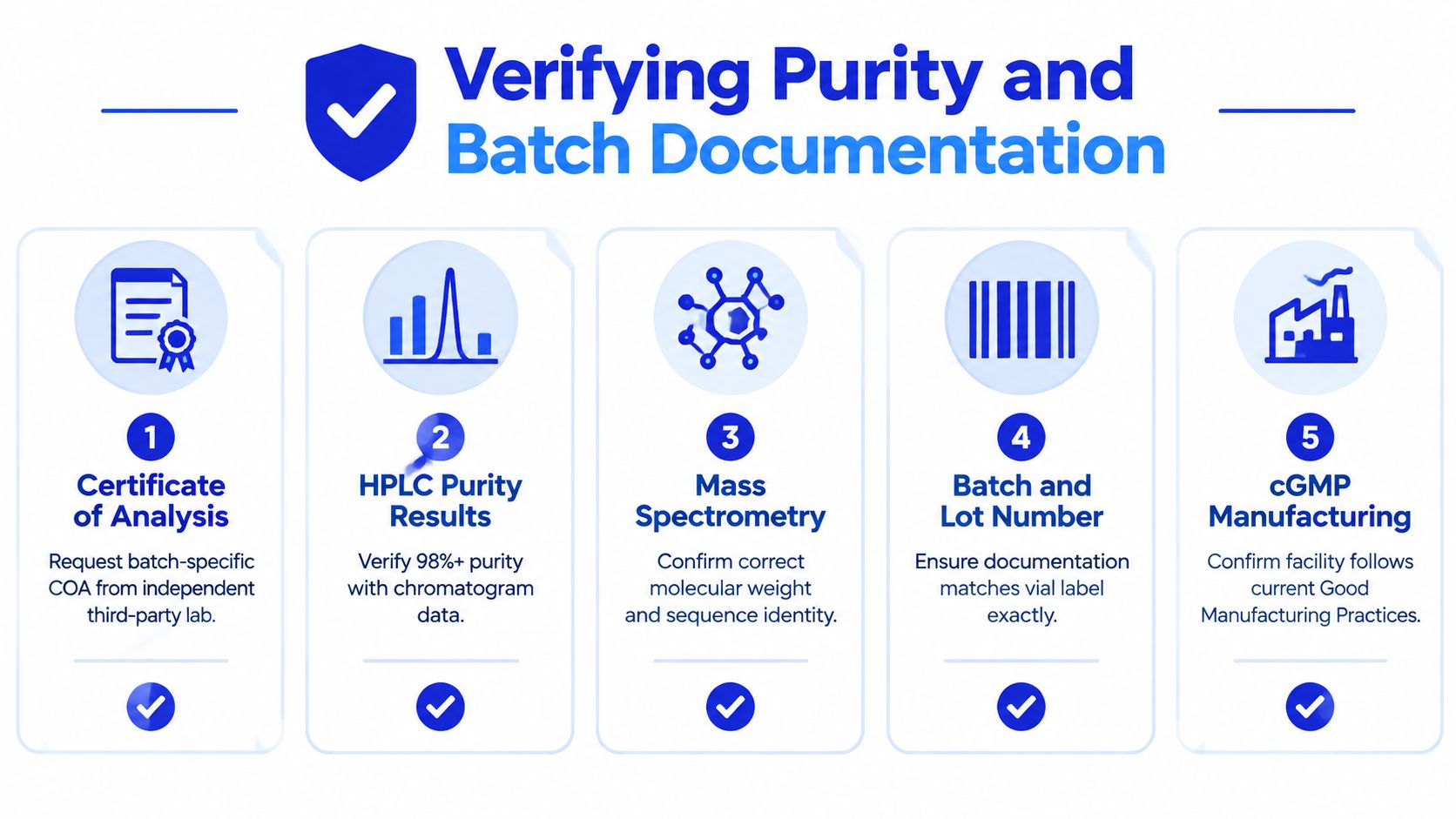
One analytical method can't answer every quality question. HPLC can show chromatographic purity, but it doesn't alone confirm that the principal peak has the intended molecular identity. Mass spectrometry can support identity and molecular-weight confirmation, while endotoxin testing addresses a separate contamination risk.
A practical review should include:
Practical standard: Purity, identity, and endotoxin are different controls. Passing one doesn't compensate for missing evidence on the others.
For cell-based, preclinical, and analytical workflows, verified purity and endotoxin control reduce the chance of assay interference, inflammatory responses, and batch-to-batch variability. The correct acceptance criteria still depend on the protocol, model, and institutional requirements, so researchers should have the principal investigator or quality unit approve the specification before ordering.
This short technical reference can help new buyers understand why a certificate must be read as a data package rather than a marketing badge.
The most serious procurement failures aren't always visible when the package arrives. An attractive label can conceal incorrect identity, severe degradation, cross-contamination, or a concentration that differs materially from the stated specification. Those failures can compromise an experiment before the researcher knows whether the biological model or the peptide caused the result.
Independent testing and safety reporting on peptides sold online has identified samples with purity as low as 5%, along with samples containing toxic metals such as arsenic and lead, according to the ConsumerMedSafety review of wellness peptides sold online. That finding makes a generic purity claim inadequate. A mislabeled batch can alter the effective concentration, introduce unexpected biological activity, and add contaminants that were never part of the study design.

In a cell-based model, an impurity can change viability, cytokine behavior, morphology, or assay signal. Endotoxin can create inflammatory effects that look like a response to the peptide itself. Metals and residual process contaminants can introduce additional variables that make a negative or positive result difficult to interpret.
The risk isn't limited to one failed plate. A poorly characterized input can force researchers to repeat work, question prior results, revise a method, or disclose a supply-chain problem during review. The cheapest vial can become the most expensive input if the lab can't defend what it contained.
Regulatory risk increases when a vendor presents an unapproved compound as a solution for human outcomes. Recent independent reporting states that the FDA issued seven warning letters in April 2026 to online peptide sellers over disease, performance, and wellness claims, while projected market growth continues to increase consumer demand, as reported by PeptideStaff's coverage of 2026 peptide marketing enforcement.
A research buyer should preserve screenshots, product specifications, COAs, invoices, and shipping records. If the supplier's public claims suggest human use while the laboratory's purchase order says research use only, that inconsistency should trigger a review before the order is approved.
A defensible peptide purchase begins before anyone opens a supplier's product page. Define the intended research use, required specifications, storage conditions, documentation, and approval authority in writing. This separates a laboratory decision from an impulse purchase driven by a product title, wellness language, or an attractive purity claim.
FDA guidance documents are nonbinding recommendations, but they explain how industry can approach compliance with applicable law under DSHEA, as described in the FDA overview of dietary supplement guidance documents. FDA dietary supplement regulation under DSHEA also addresses manufacturing, packaging, storage, and labeling under the Federal Food, Drug, and Cosmetic Act. The FDA dietary supplement regulation under DSHEA should be treated only as a reference link, not as the laboratory's regulatory authority. For procurement, package integrity and label accuracy require the same attention as the analytical result.
Use a documented review rather than relying on memory:
A missing lot number, unexplained specification change, or conflict between the label and COA should pause approval. Do not resolve those gaps by assuming the supplier used a standard process.
International shipping does not establish lawful importation or authorized possession. Customs classification, prescription rules, institutional policies, and local medicine laws can apply independently of the seller's website.
Age gates and FDA disclaimers may indicate responsible supplier conduct, but they do not verify identity, purity, or legal status. The lab must confirm that the purchase is permissible in the receiving jurisdiction and consistent with institutional biosafety and procurement rules. Keep that review with the lot records so compliance decisions remain traceable.
A laboratory can lose scientific credibility through a small procurement shortcut. Consider a common sequence of events. A researcher orders a peptide based on a polished product page, receives a vial with a high purity statement, and begins a cell experiment. The assay behaves unexpectedly, but the lab initially investigates incubation time, plate handling, and cell passage instead of questioning the material.
Only later does the team request the lot-specific COA and discover that identity confirmation or endotoxin data wasn't available. At that point, the experiment can't support a clean conclusion. The problem wasn't the use of a peptide. It was the failure to define what the laboratory had purchased.
The market is unlikely to become less crowded. The projected increase from USD 4.1 billion in 2025 to USD 11.2 billion by 2035 indicates sustained commercial expansion, according to Research and Markets' market projection. More suppliers may improve access, but access without traceability gives researchers more opportunities to acquire materials that don't meet their specifications.
Strong peptide research depends on three connected controls:
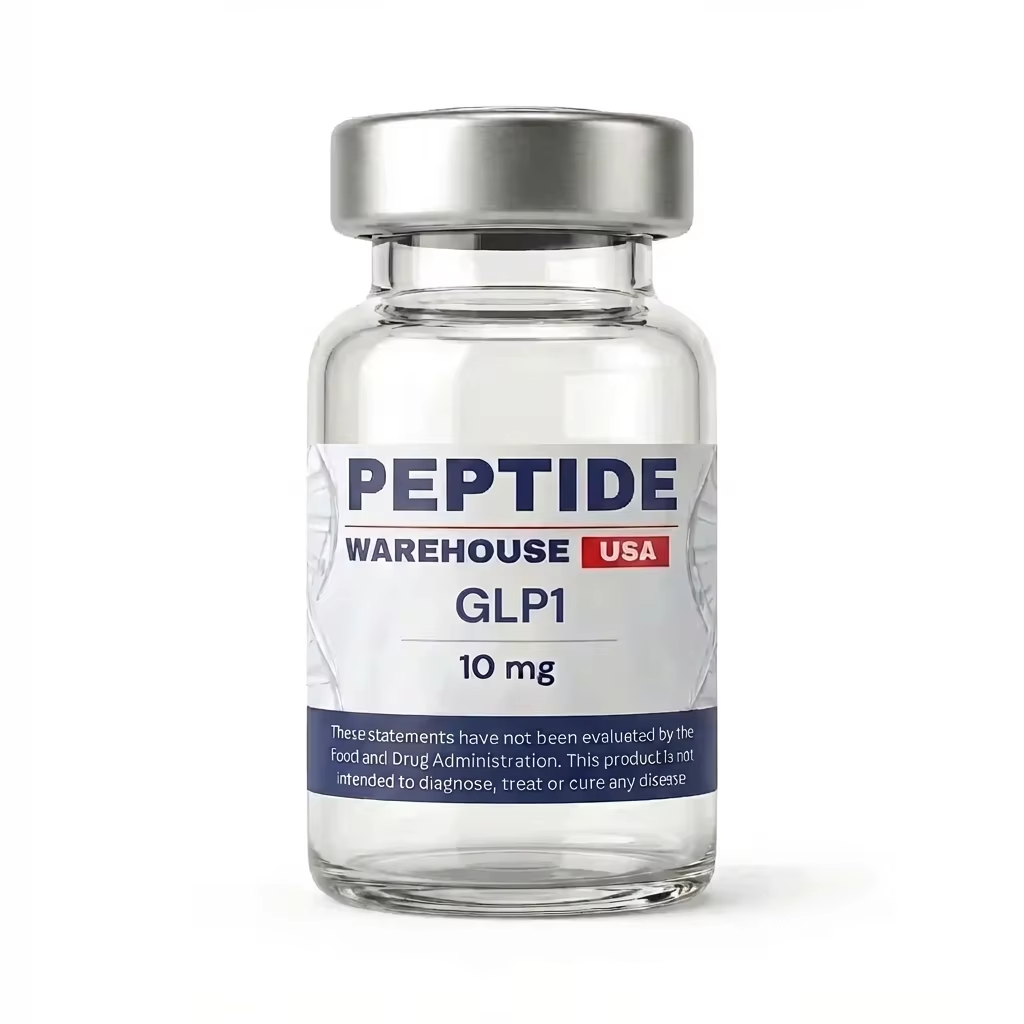
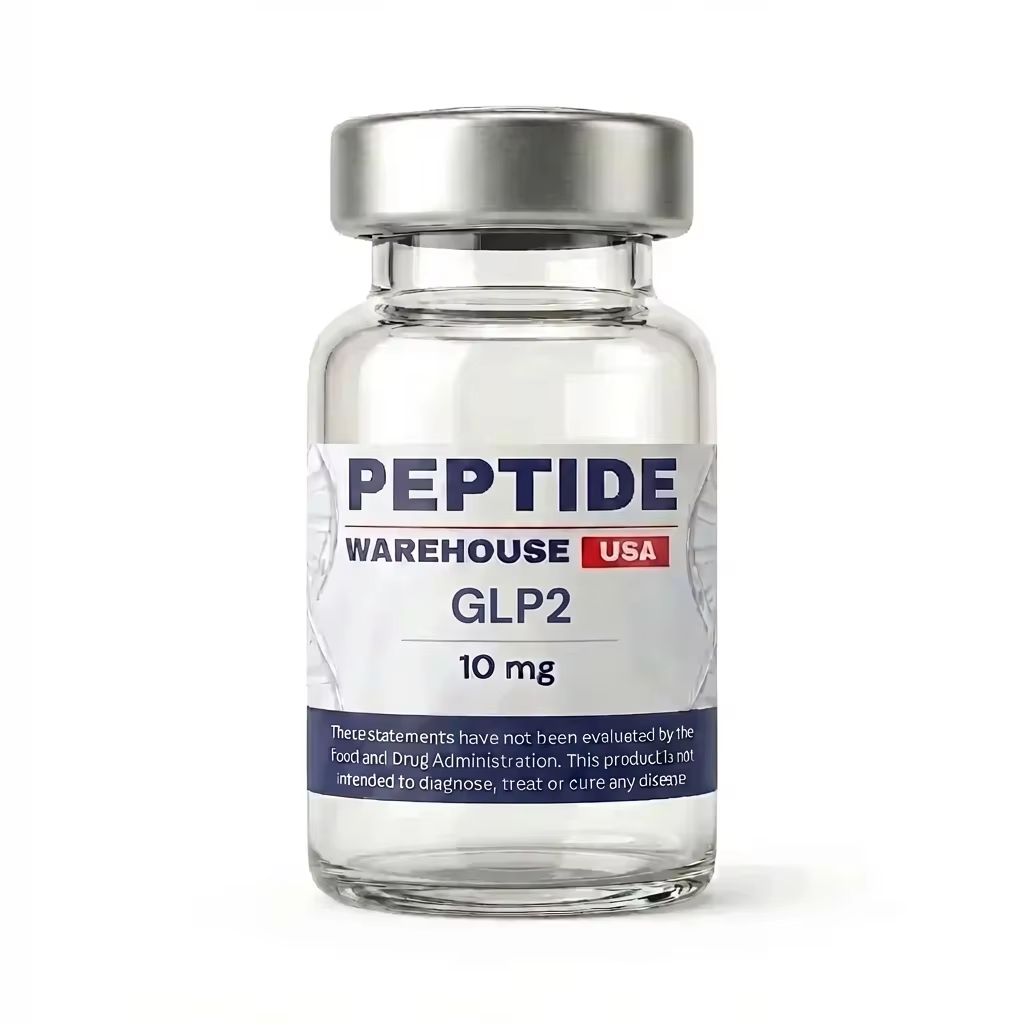
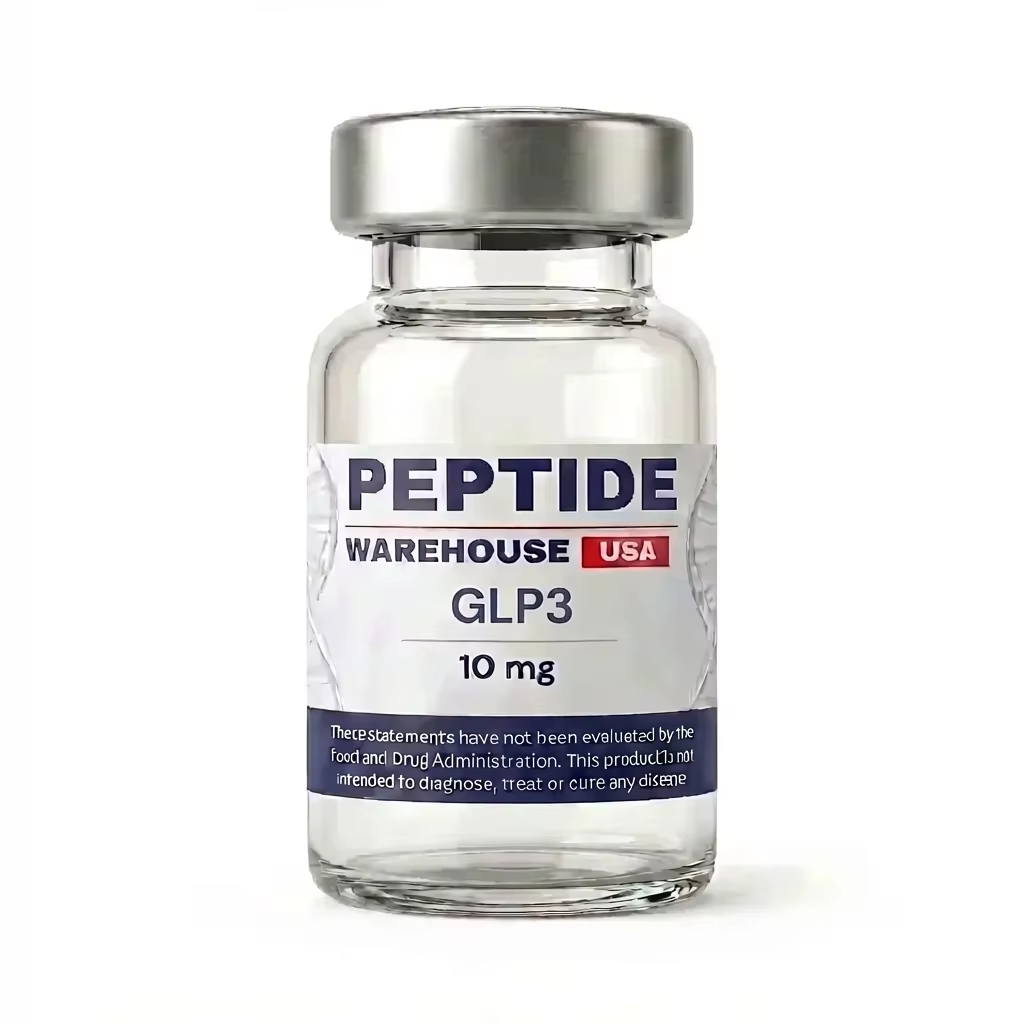
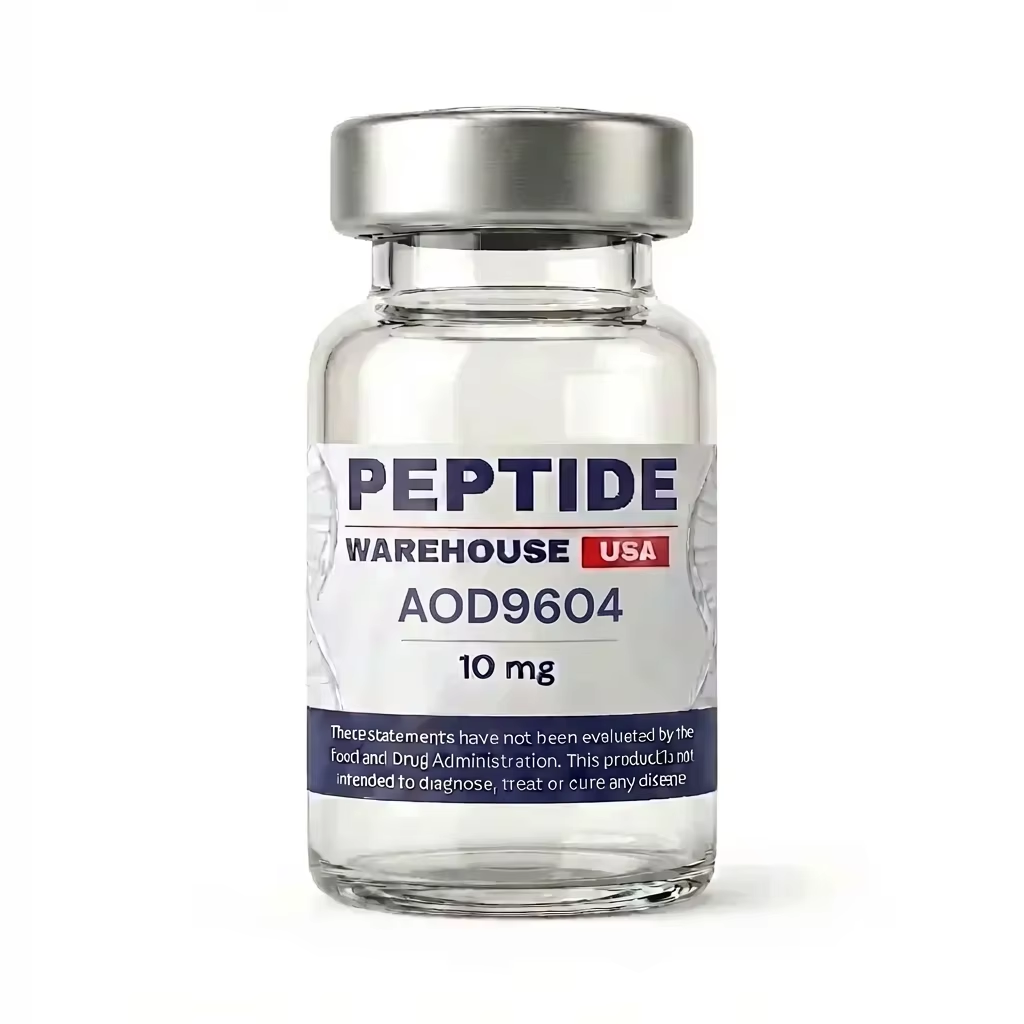
Peptide Warehouse USA presents itself as a U.S. supplier of research peptides and related compounds for laboratory, analytical, and preclinical applications. Its catalog includes compounds such as BPC-157, GHK-Cu, TB-500, Selank, and Semax, with product documentation described as including COAs, microbial reports, endotoxin reports, and stated purity levels up to 99.5%. Products are represented for research use only, not human consumption, so buyers should still review the lot documentation and institutional requirements before ordering.
The right supplier relationship is transparent, not merely convenient. Ask precise questions, retain the answers, and reject any product whose classification or analytical record doesn't withstand review. That discipline protects the experiment, the institution, and the researchers who will rely on the result.
If your lab is sourcing research peptides, start by defining the required identity, purity, endotoxin, and lot documentation before comparing products. Visit Peptide Warehouse USA to explore research-use-only peptide options and review the available batch documentation for your procurement workflow.
Leave a comment