
No products in the cart.


A lab can lose weeks to a peptide that looks acceptable on paper but behaves inconsistently in an assay. The vial may carry a familiar product name, yet the batch documentation is incomplete, the identity data is missing, or biological contamination introduces effects that have nothing to do with the target compound.
That's why US made research peptides should be evaluated as a procurement risk decision, not merely a patriotic preference. Domestic production can make it easier to examine batch records, confirm chain of custody, resolve documentation questions, and establish who is accountable when a result doesn't make sense.
A research team might begin with a straightforward plan: order a peptide, prepare the material, run the assay, and compare the results with an established control. If the first run produces an unexpected signal, the team may repeat the experiment. If the second run changes again, the problem could be the protocol, the cells, the instrument, or the peptide itself.
That uncertainty is expensive because researchers often troubleshoot the experiment before questioning the material. A mislabeled compound, an incomplete synthesis profile, residual impurities, or endotoxin contamination can create biological effects that look like meaningful findings. The result is wasted reagents, delayed decisions, and less confidence in the entire dataset.
US-made research peptides don't remove the need for scientific controls. They can, however, support a more transparent purchasing process when the supplier provides batch-specific testing, clear sourcing information, and traceability from production through fulfillment. The relevant question isn't just where a vial ships from. It's whether the supplier can show what was made, how it was tested, and which lot reached your lab.
Peptide science has a long therapeutic history. Insulin first entered clinical use in 1922, and a 2024 review reports that the FDA has authorized around 100 peptide-based products overall, with applications spanning diabetes, endocrine disorders, oncology, pain, and metabolic disease. The same review describes the broader progression from niche biochemistry to mainstream medicine over roughly a century. Read the FDA-recognized peptide history and product review
This guide focuses on the practical buyer questions behind that history:
The goal is simple: help labs treat peptide sourcing as part of experimental design.
“Made in the USA” describes geography, but geography alone isn't a quality test. For a laboratory buyer, the useful meaning comes from the systems surrounding production, including documented synthesis procedures, lot control, analytical verification, storage practices, and responsive support.
Think of a peptide batch like a manufactured microscope slide. Knowing the slide was produced domestically tells you something about where accountability may sit, but it doesn't prove that the surface is clean or that the labeling is correct. You still need inspection records. In peptide procurement, those records include the Certificate of Analysis, identity confirmation, purity results, and contamination controls.
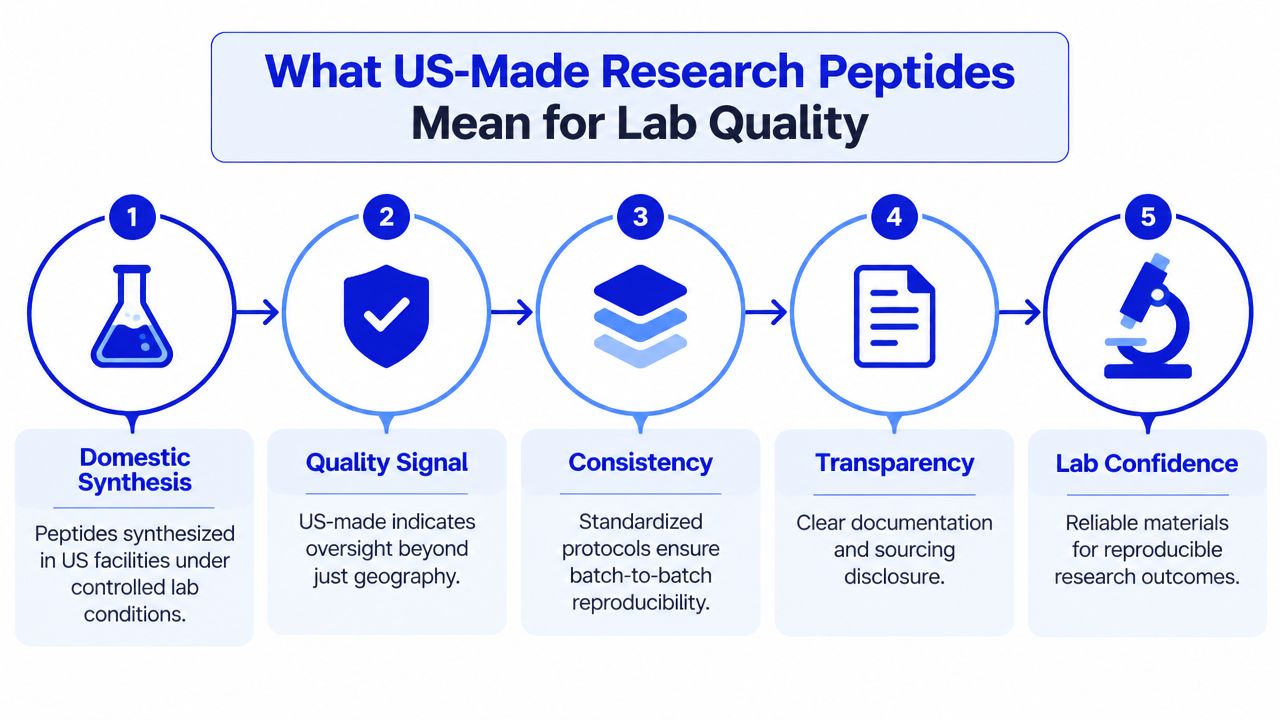
A domestic supply chain can shorten the distance between the researcher who has a question and the organization responsible for the batch. That may make it easier to request supporting records, clarify a lot number, investigate a shipping issue, or address a mismatch between the package and its documentation.
The strongest signal isn't a flag on a product page. It's a connected record:
This is why labs often care about traceability as much as nominal purity. A high-purity claim without a lot-specific document is like a balance reading without knowing which sample was weighed.
Research-use-only peptides belong in laboratory, analytical, or preclinical workflows that follow institutional policies. They aren't automatically approved medicines, pharmacy products, or materials for human use. Domestic manufacturing can improve documentation and procurement accountability, but it doesn't change a product's intended use or authorize a clinical application.
The broader peptide industry supports this need for disciplined sourcing. Market definitions differ, but multiple forecasts place the US peptide synthesis market in the multi-hundred-million-dollar range and project continued growth. One estimate reports USD 320.7 million in 2024 and USD 604.1 million by 2033, while another places the market at USD 1.02 billion in 2024 and USD 1.89 billion by 2032, with an 8.1% CAGR. A third estimates USD 219.42 million in 2024 and USD 435.49 million by 2032, at an 8.99% CAGR. These differences reflect varying market definitions, but each points to a substantial US research and manufacturing ecosystem. Compare the US peptide synthesis market estimates
Procurement principle: Treat domestic origin as a starting point for due diligence, not a substitute for batch evidence.
The phrase research use only, often shortened to RUO, describes intended use. It doesn't turn an otherwise unsuitable product into a compliant research material, and it doesn't permit a supplier to market the product for human administration.
FDA guidance for in vitro diagnostic products explains that material may be labeled “for research use only” or “for investigational use only” while it remains in laboratory research and isn't represented as an effective diagnostic. The required statement for the relevant framework is “For Research Use Only. Not for use in diagnostic procedures.” Review the FDA guidance on RUO and IUO labeling
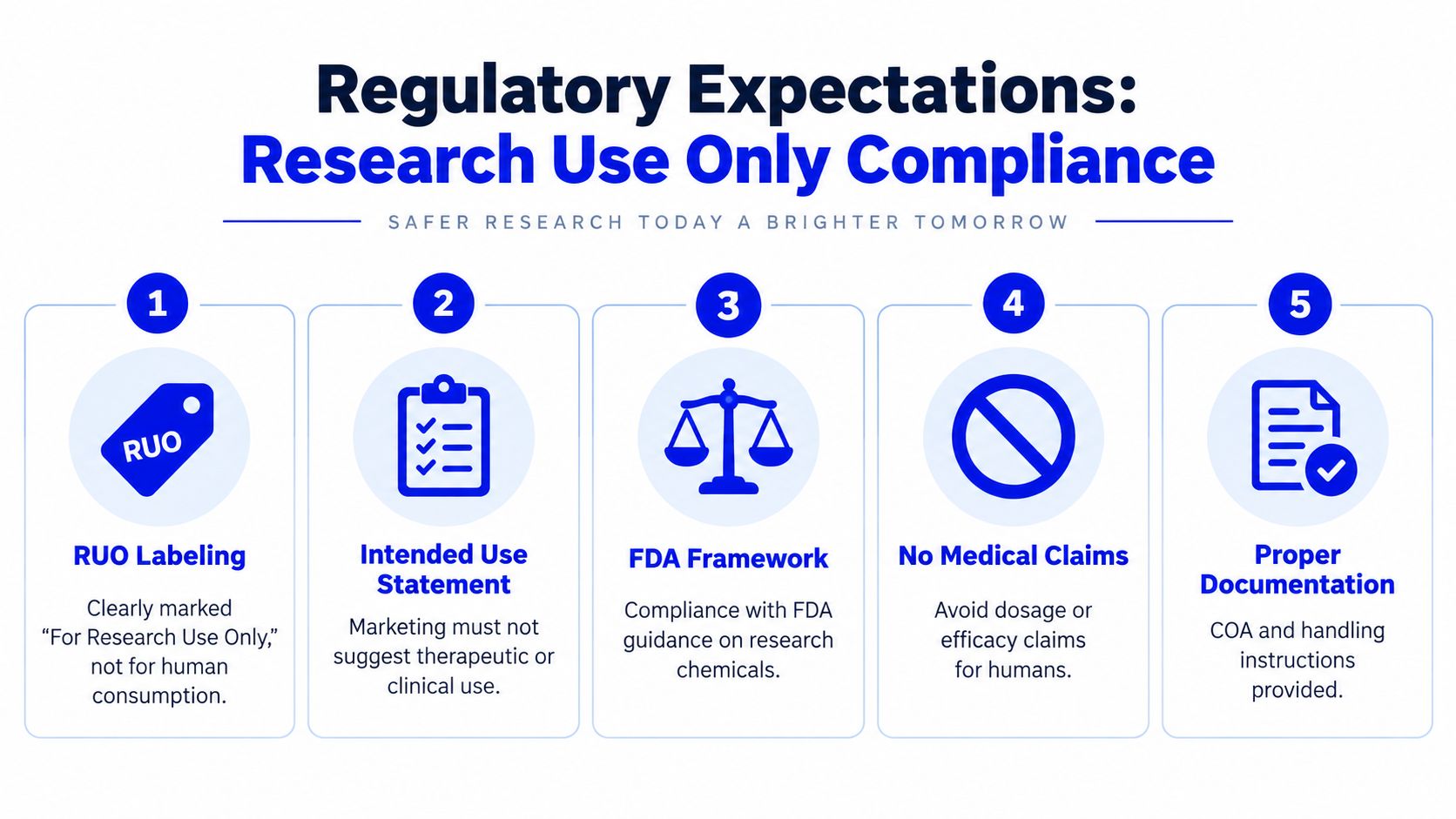
A “not for human consumption” statement may be appropriate, but the FDA's intended-use framework examines the total marketing context. That includes website language, product descriptions, promotional materials, dosage directions, treatment language, and other representations. A disclaimer doesn't override advertising that implies a therapeutic purpose. Understand how FDA intended use affects research peptide classification
For buyers, red flags include:
A compliant procurement process should preserve the boundary between laboratory material and clinical or pharmacy supply. That means using institutional review procedures, following handling requirements, and ensuring that product records match the intended research application.
The 2026 compounding and pharmacy discussion has created confusion because reclassification language can sound like broad permission. Independent coverage reports that about 14 peptides were announced for movement back from Category 2 to Category 1 on February 27, 2026, and that BPC-157 was later removed from the restricted bulk-substances list on April 23, 2026, with a July 23, 2026 advisory review scheduled. Review the reported 2026 regulatory updates and their research implications
Those developments don't erase the distinction between research and human use. The same coverage emphasizes that distribution for human use remains illegal despite the reclassification discussion. A supplier's product page should therefore communicate laboratory use clearly, avoid medical claims, and provide documentation appropriate for research procurement.
FDA-related enforcement reporting in 2026 described seven warning letters in April 2026 directed at peptide sellers that used RUO language while also implying human use. Read the enforcement analysis of GLP-1 and peptide advertising
Purity and identity are related, but they aren't interchangeable. Purity asks how much of the measured sample appears to be the desired material. Identity asks whether that material is the compound named on the label.
Reversed-phase HPLC and LC-MS work well together because they answer those questions from different angles.
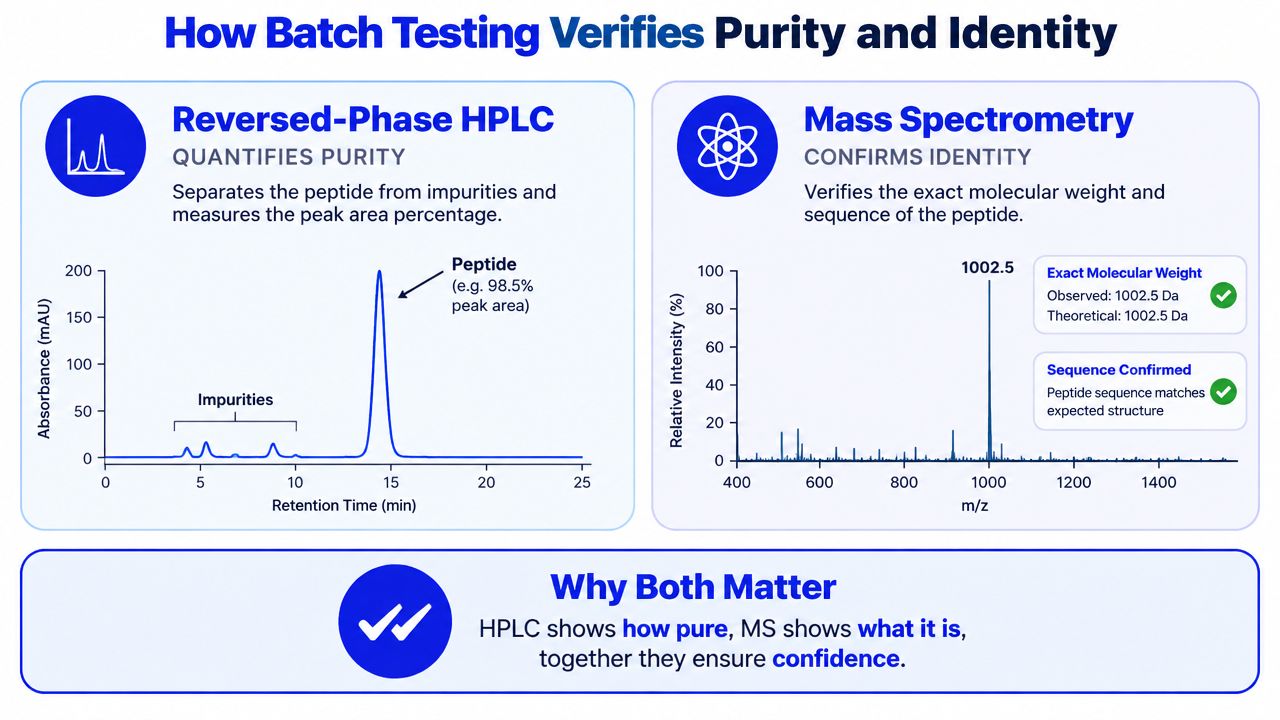
In reversed-phase HPLC, the sample moves through a column under controlled conditions. Components separate at different times, producing peaks on a chromatogram. The laboratory calculates chemical purity by integrating the main peak as a percentage of the total measured peak area.
The analogy is a sorting line. HPLC helps separate the parcels and shows how much of the shipment belongs to the dominant category. It can reveal residual synthesis products, truncated sequences, and other components that separate differently from the target.
Industry quality guidance commonly treats greater than 95% as a minimum pharma-grade benchmark, with greater than 99% increasingly used for higher-confidence research material. Review high-purity peptide production and QC guidance
Mass spectrometry measures molecular weight and helps confirm structural identity. A chromatographic peak can look dominant while still representing a wrong sequence, a truncation product, or an adduct that behaves similarly under the separation conditions.
A second analogy helps. HPLC sorts the parcels. LC-MS weighs the parcel and checks whether its weight matches the expected item. Neither method replaces the other:
| Method | Primary question | Failure mode it helps expose |
|---|---|---|
| Reversed-phase HPLC | How much of the measured sample is the main peak? | Residual impurities and synthesis byproducts |
| LC-MS | Does the measured molecular weight support the stated identity? | Wrong sequence, truncation, or adduct |
| Both methods | Do purity and identity support each other? | False acceptance based on a single test |
Higher purity can reduce the chance that residual components interfere with an assay or contribute to variability between preparations. In vitro and preclinical work still requires appropriate controls, but orthogonal testing gives researchers a stronger material baseline.
A COA is useful only when it belongs to the exact lot you received. A polished template with no lot connection is weak evidence, even if it lists an impressive purity value.
Start with the identifier on the vial, then match it to the COA. Check the product name, lot number, test date, analytical method, reported result, and approving laboratory or quality representative. If those fields don't connect, ask the supplier for clarification before placing the material into a critical experiment.
Chemical purity doesn't answer whether a peptide is biologically clean. Endotoxin, microbial, and handling records address different risks.
For biologically used research materials, endotoxin control can be as important as chemical purity because pyrogenic contamination may invalidate cell-culture or animal results. Industry references citing FDA-linked limits place injectable non-intrathecal products at 5 EU/kg product, while research peptide programs may specify much lower limits depending on the intended laboratory application. Review endotoxin control during peptide manufacturing
The practical distinction is easy to remember:
| Document or Data Point | What to Look For | Why It Matters |
|---|---|---|
| Product identity | Peptide name, form, and specification | Confirms that the document applies to the material ordered |
| Lot number | Exact match between vial, packaging, and COA | Connects the test result to the physical batch |
| HPLC result | Chromatogram or clearly reported purity method | Shows how chemical purity was assessed |
| LC-MS result | Molecular-weight or identity confirmation | Supports the stated compound identity |
| Endotoxin report | Test method and result, such as LAL testing where applicable | Helps identify biological contamination risk |
| Microbial report | Bioburden or related testing information | Separates chemical quality from biological cleanliness |
| Production details | Manufacturing or release information | Supports investigation and supplier accountability |
| Storage and handling | Conditions, reconstitution notes, and cautions | Helps preserve material integrity in the lab |
Commonly cited guidance for sterile injectable or parenteral products uses 5 EU/kg body weight as an endotoxin limit, while research-grade guidance may target under 5 EU/mg, with stricter thresholds below 1 EU/mg or 0.5 EU/mg for cell-culture or in vivo work. These thresholds should be interpreted against the actual protocol and institutional requirements. Review peptide endotoxin thresholds and USP-related guidance
Document rule: If the supplier can't connect the COA, endotoxin result, and lot number to your vial, treat the package as incomplete.
A rushed assay can expose weak procurement planning. If a shipment arrives late, the vial label conflicts with the COA, or the lot cannot be traced, the cost includes more than the purchase. Time is lost repeating checks, adjusting schedules, or investigating an unexplained result. US-made research peptides therefore represent a procurement risk decision, not just a preference for domestic origin. Domestic batch testing, endotoxin controls, and traceability can reduce uncertainty when compared with an opaque import chain.
A reliable purchasing chain connects synthesis, testing, inventory, packaging, shipment, and customer support. For a lab manager, that connection works like a chain of custody. Each handoff should leave a record showing what happened to the material and who can answer questions.
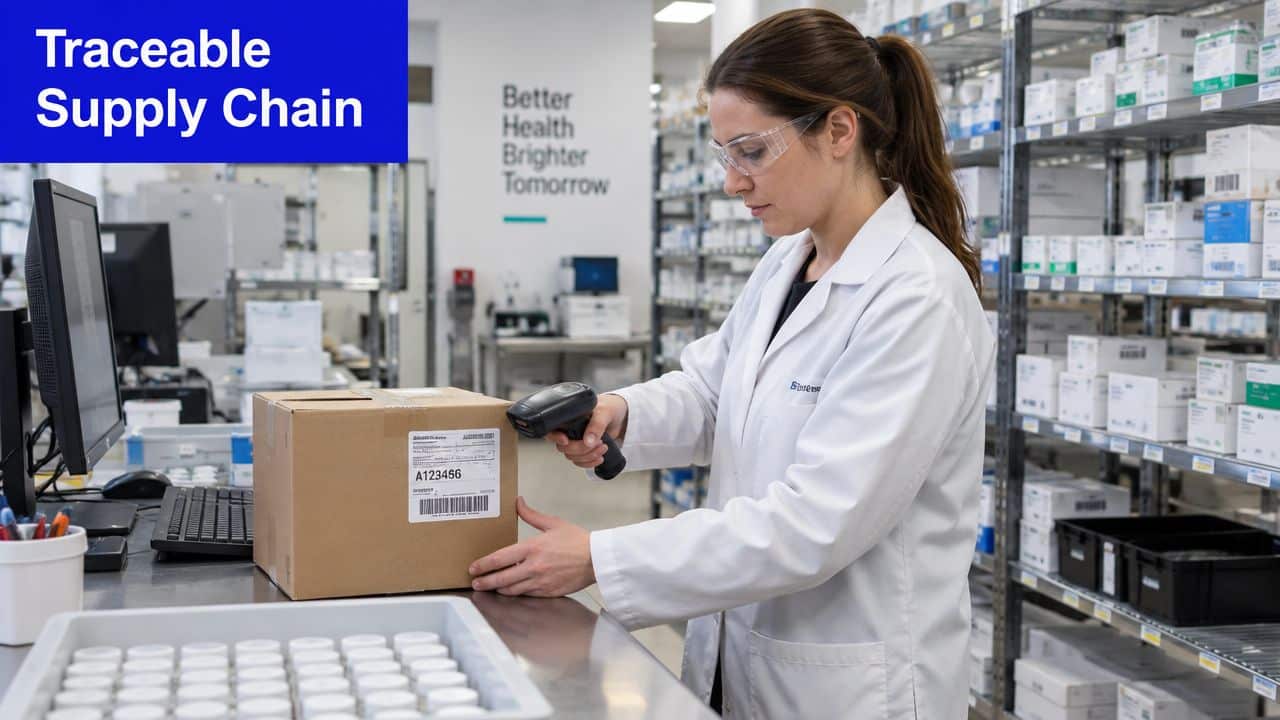
Price matters, but missing records can make a low-cost order expensive. A replacement shipment, delayed assay, or unresolved lot mismatch may cost more time than the initial saving.
Ask prospective suppliers:
A US-based chain may reduce customs uncertainty and make communication easier. It does not, by itself, prove that synthesis occurred domestically. Verify the production location, batch records, testing, and fulfillment process.
Check availability, documentation access, storage requirements, and shipping policies during protocol planning. Keep the lot number and COA with the project records so another researcher can identify the same material later.
A practical workflow is:
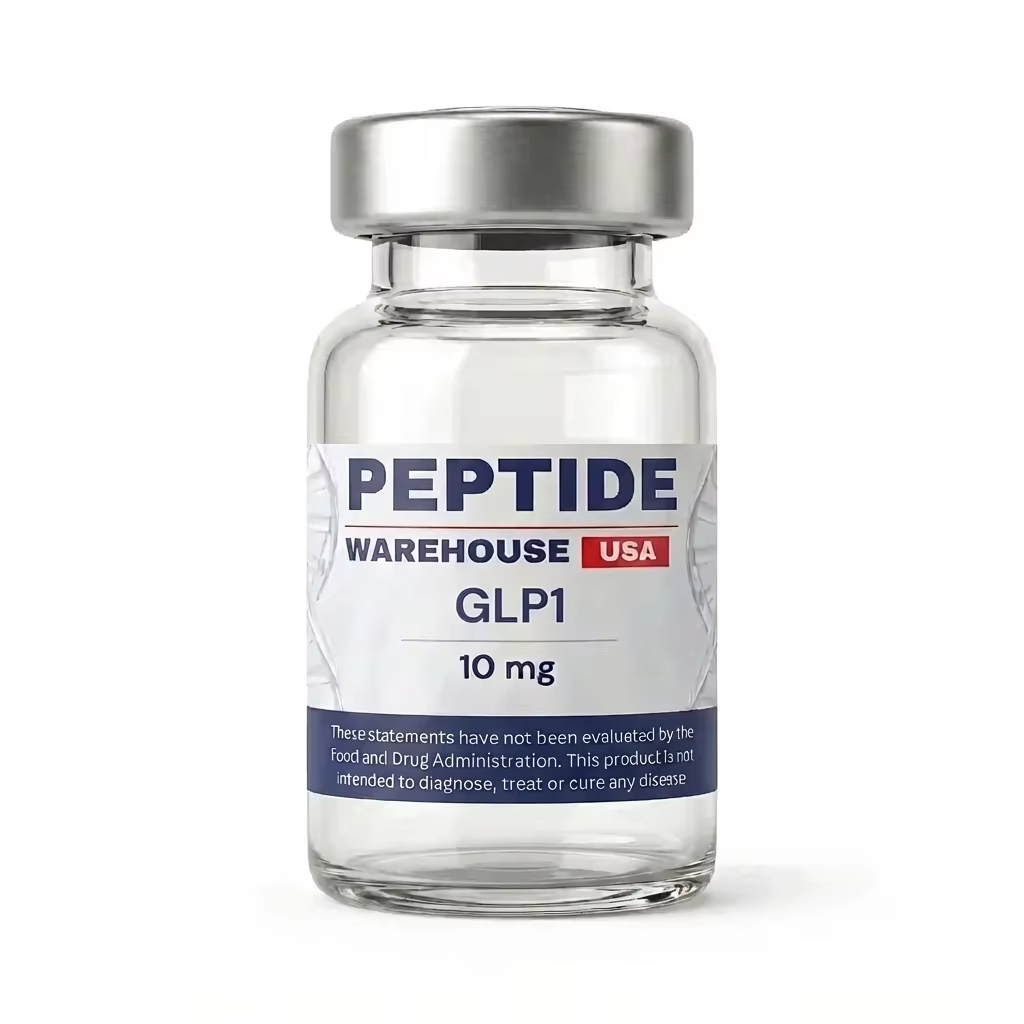
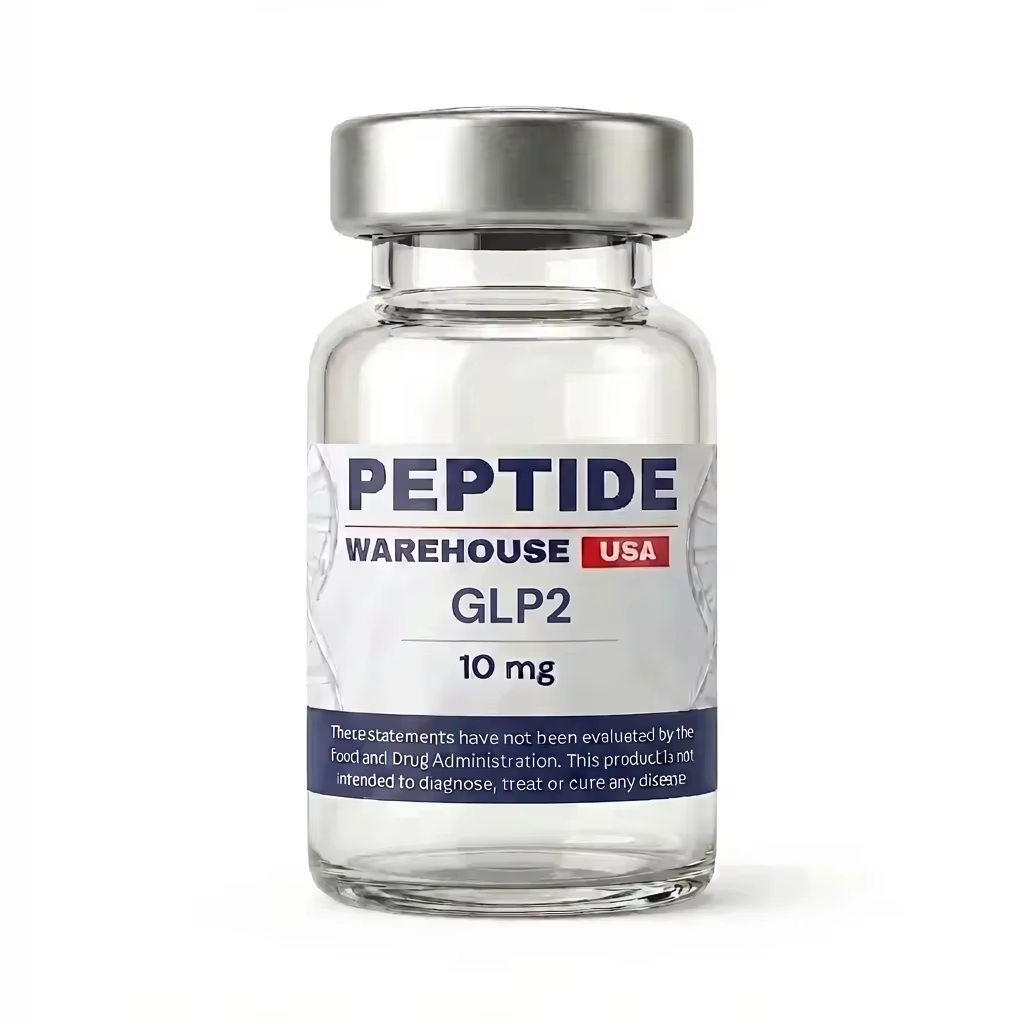
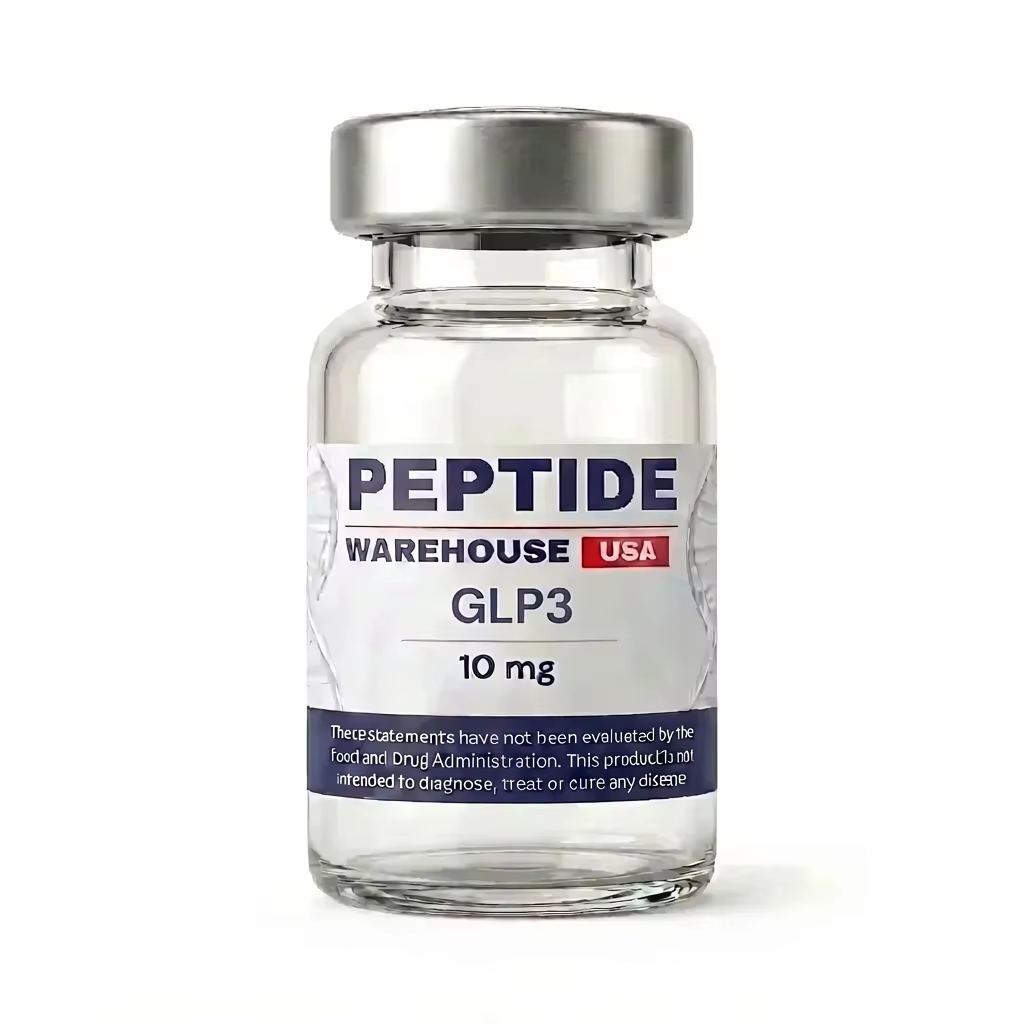
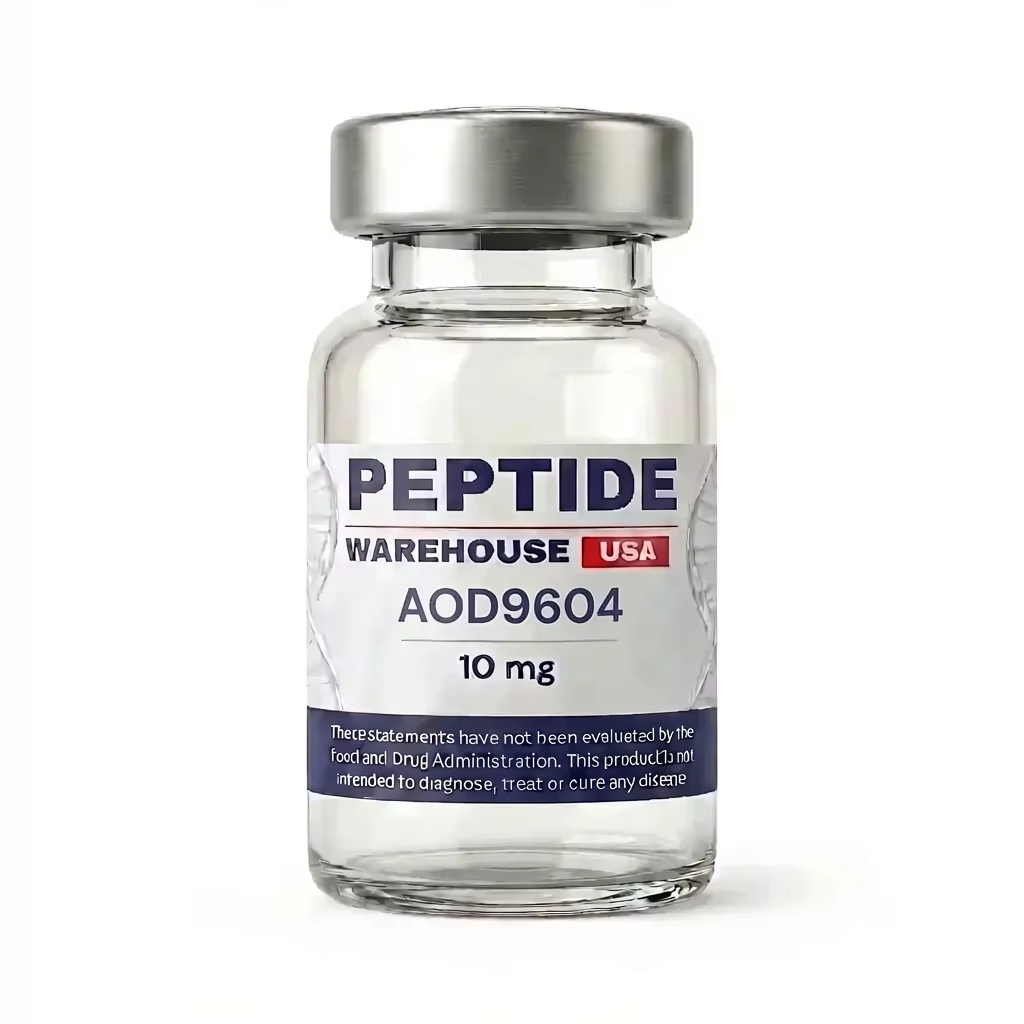
Peptide Warehouse USA presents USA-manufactured research material for laboratory and analytical use. Its catalog describes COAs, microbial reports, endotoxin reports, and stated purity levels up to 99.5%, with products including PT-141, BPC-157, GHK-Cu, TB-500, Selank, and Semax. The products are presented for research, laboratory, or analytical use only, not for human consumption. Explore the Peptide Warehouse USA research peptide catalog
The strongest case for US made research peptides is a procurement decision grounded in evidence. Domestic sourcing can make accountability easier to establish, but it does not replace batch-specific verification. Each material should have a connected record covering synthesis, identity, purity, endotoxin or microbial status where relevant, storage, and fulfillment.
Use these checks before approving a purchase:
A useful analogy is a chain of custody. If one link is missing, a lab may struggle to determine whether an assay failure came from the peptide, contamination, storage, or handling. Make documentation review part of purchasing, save the COA with the experiment record, document receipt conditions, and resolve unclear identity or contamination status before acceptance.
Peptide Warehouse USA offers USA-manufactured research peptides and related compounds for laboratory, analytical, and preclinical applications, with batch documentation that includes COAs, microbial reports, and endotoxin reports. Researchers can review its available materials as noted earlier and select options with clearer sourcing and traceability.
Leave a comment