
No products in the cart.


You're staring at two vials with the same peptide name. One is cheaper, both claim high purity, and both say they're for research use only. On paper, they look interchangeable.
Then the questions start. Which lot has real identity confirmation? Which supplier can trace that vial back to a specific batch? Which one has endotoxin data instead of a generic purity promise? That's where premium research peptides stop being a marketing phrase and start becoming a practical buying standard.
Labs don't usually pay more because a label sounds better. They pay more when better documentation reduces avoidable uncertainty. If a peptide is going into analytical work, cell culture, or preclinical research, the hidden cost isn't just the purchase price. It's the time lost chasing inconsistent results, replacing questionable material, or trying to interpret a thin COA after something already went wrong.
Many buyers get tripped up. They focus on the headline purity number first, even though purity alone doesn't answer every quality question. A stronger approach is to treat the paperwork like part of the product.
A common buying mistake starts with a shortcut. A purchaser compares two listings, sees similar names, similar purity claims, and a clear price gap. The lower-cost option feels efficient. The problem is that identical labels don't mean identical quality systems.
In peptide procurement, the difference often sits behind the listing. One supplier may provide a batch-specific COA, mass spectrometry identity confirmation, endotoxin reporting, and traceable release data. Another may provide a single-page summary with a purity line and little else. Those are not the same product experience, even if the vial name matches.
That distinction matters more today because peptide science sits inside a larger, expanding technical supply chain. The global peptide synthesis market was estimated at USD 961.5 million in 2024 and is projected to reach USD 1.8406 billion by 2033, implying a 7.71% CAGR from 2025 to 2033. The same market snapshot notes the market is expected to be about USD 1.02 billion in 2025 according to Grand View Research on the peptide synthesis market. For buyers, that growth points to more supply options, but also more need to separate transparent manufacturers from low-visibility sellers.
If you're buying for research, you're not really buying a peptide name alone. You're buying:
Premium starts where the percentage claim stops.
That's why smart buyers don't ask only, “What purity is it?” They also ask, “What proves this specific lot is consistent enough for my work?”
The questions tend to be practical:
Those questions are worth asking before checkout, not after a failed run.
A buyer compares two vials with the same peptide name. Both list 99% purity. One comes with a lot number, method details, and results tied to that batch. The other shows a single percentage on a product page. They are not equal purchases, even if the headline number matches.
That is the clearest way to understand premium quality in research peptides. Premium refers to proof, not just polish. It means the supplier can show what was made, how it was checked, and which specific batch the vial came from.
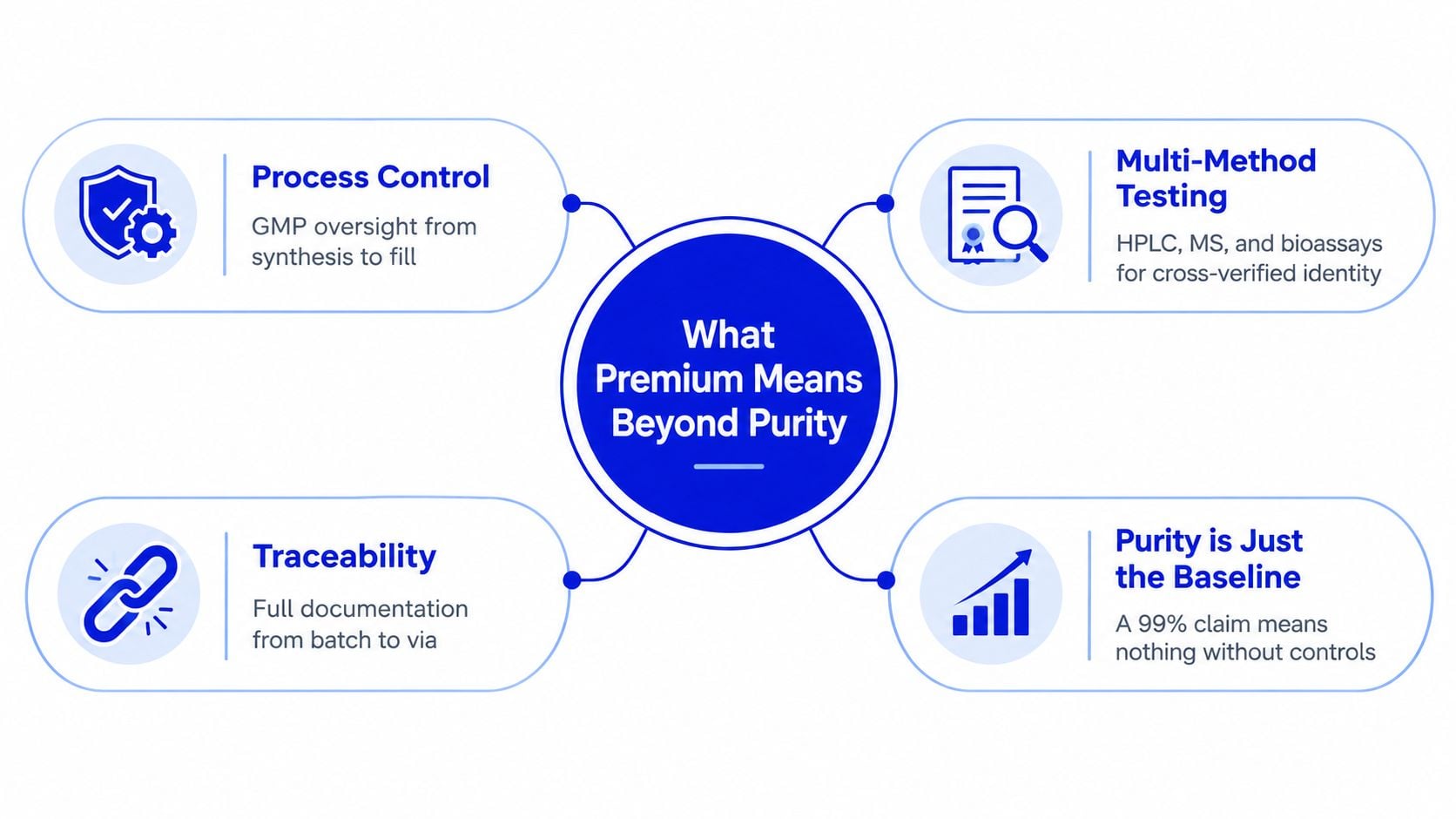
A purity percentage is only one line in the quality story. Buyers often treat it like a final grade because it is easy to compare. In practice, it works more like one instrument on a lab bench. Useful, but limited.
As noted earlier, a strong verification package separates three different questions:
That separation matters. HPLC can indicate relative purity of the measured components, but it does not confirm identity by itself. Mass spectrometry can support identity, but it does not rule out every contaminant. Endotoxin screening addresses a different risk altogether.
A COA with only one of these data points leaves blind spots.
Purity is often treated like the product. It is better treated like one diagnostic readout.
Here is the practical issue. HPLC area percent describes how the chromatogram was measured, not whether every meaningful impurity has been ruled out. A 99% result may still leave unanswered questions about trace contaminants, handling conditions, or whether the result belongs to the exact lot in your hand.
A premium product closes more of those gaps. The value is not a higher number. The value is fewer assumptions.
Practical rule: Treat purity as the opening checkpoint, not the verdict.
Premium quality works like a chain of custody in a lab notebook. Each step should connect to the next without guesswork.
That usually includes:
This is also where price differences start to make more sense. A low price can reflect lean documentation, limited testing, or weak batch tracking rather than a simple efficiency advantage. A higher price does not guarantee quality either. The better question is what evidence comes with the vial, and whether that evidence is specific to that lot.
Premium, in other words, is a documentation standard. If you can trace the batch, read the methods, and connect each result to a clear quality question, you are looking at something more meaningful than a marketing percentage.
You receive a vial that looks fine at first glance. The label is clean, the purity number looks high, and the COA arrives as a polished PDF. The question is simpler and more useful. Can that document prove the vial in your hand matches the batch that was tested?
That is how a researcher reads a COA. The certificate works like an ID card paired with a lab record. It should confirm what the material is, which lot it came from, how it was tested, and what the reported numbers do and do not cover.
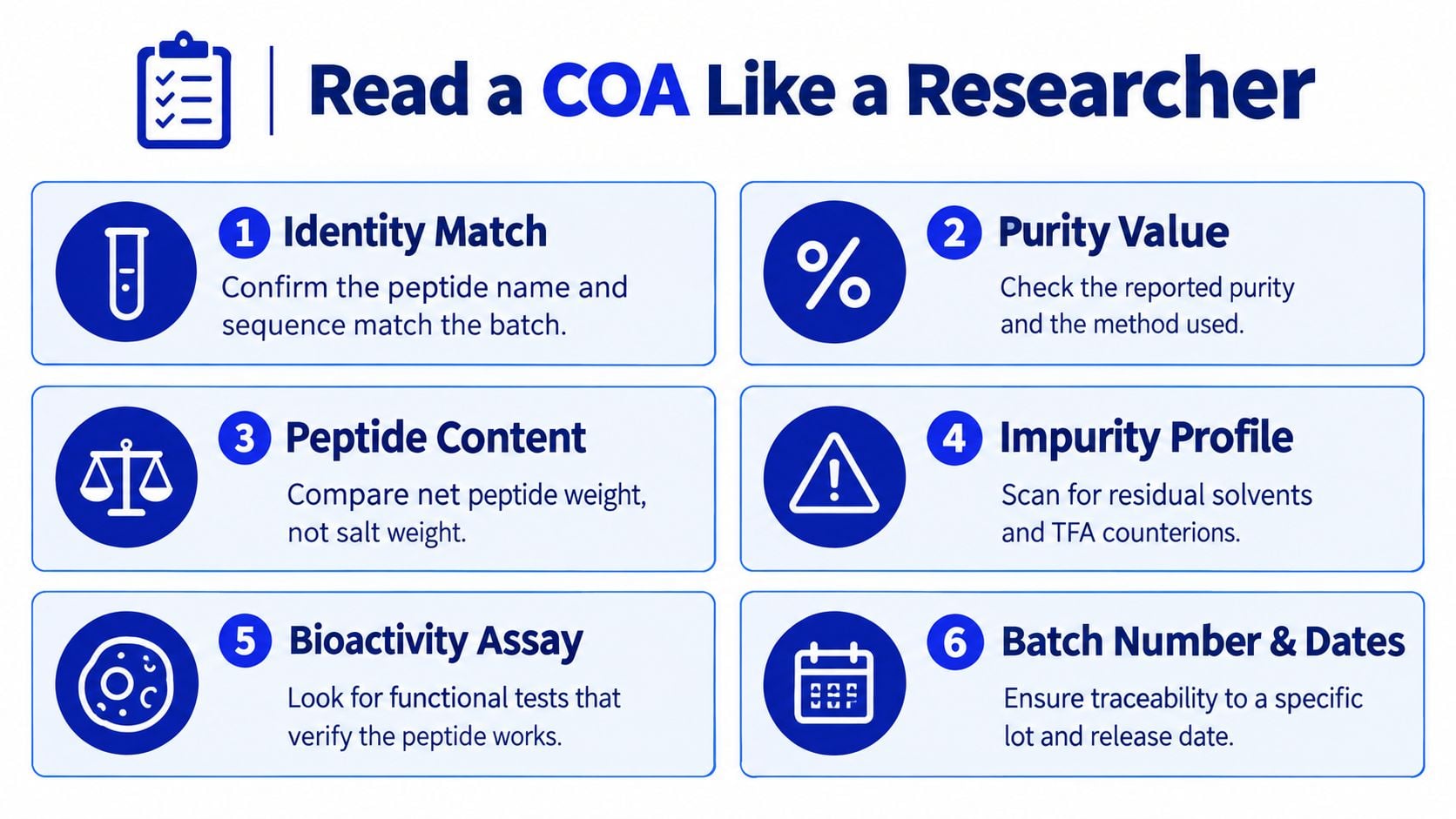
Start with the identity block. Check the peptide name, sequence, catalog reference if shown, lot number, and test date. These fields should agree with the vial label and any packing slip. If the lot number on the certificate does not match the lot number on the product, the rest of the document loses much of its value.
Next, read the methods section before the results table. A purity claim means little without a named test method. HPLC is commonly used for purity. Mass spectrometry is commonly used to support identity. Those two lines answer different questions, so they should not be treated as interchangeable.
Then look at the actual result lines and ask one question for each: what does this line prove?
A useful habit is to read a COA the way you would read a shipping label. You do not stop at the brand name. You verify the address, the tracking number, and whether the package is yours. Batch documentation works the same way.
A high purity percentage can be real and still leave open questions. Purity usually describes how clean the main peak appears under the reported method. It does not automatically answer whether the batch was screened for endotoxin, microbial contamination, long-term stability, or handling risks.
That distinction matters because buyers often treat a purity line as a summary of total quality. It is not. The COA is stronger when each quality question has its own document trail instead of being implied by one headline number.
For a practical explanation of purity verification methods, see the FDA discussion of peptide drug substance characterization and impurity control in its guidance documents: https://www.fda.gov/drugs/guidance-compliance-regulatory-information/guidances-drugs
Some COAs are specific and useful. Others are polished templates with very little batch evidence. A quick review can help separate the two.
Ask these questions:
One more practical check helps with price comparisons. If two suppliers claim similar purity, but one provides a lot-specific COA with clear methods, dates, and traceable batch identifiers, while the other provides a generic certificate, you are not comparing equal quality evidence. You are comparing documentation depth.
That is the premium difference at the document level. The better COA does not just present a number. It gives you a way to verify where that number came from and whether it belongs to the exact batch you are evaluating.
Once you can read a COA, the next question is bigger. Can the supplier deliver the same level of documentation and process discipline over time?
A premium supplier isn't defined by one clean PDF. It's defined by repeatable behavior. That includes how batches are produced, how testing is handled, how exceptions are documented, and how clearly the company separates research supply from implied human-use marketing.
The strongest suppliers make it easy to answer practical procurement questions before an order is placed.
Some signals are operational:
Others are structural. A supplier with stable synthesis access, purification controls, and analytical quality capacity is generally easier to work with than one that seems to broker product from unclear origins.
| Evaluation Criteria | What Premium Looks Like | Red Flag to Avoid |
|---|---|---|
| Documentation | Batch-specific COA with supporting test records | Generic certificate reused across products |
| Identity testing | Mass spectrometry included or available | Identity claim with no visible method |
| Endotoxin reporting | Separate endotoxin result provided for the lot | Purity report presented as full quality proof |
| Traceability | Clear lot number, release date, and reorder consistency | No batch history or vague numbering |
| Storage guidance | Handling and storage details stated clearly | No storage notes or stability guidance |
| Support quality | Direct answers to technical document questions | Evasive replies or sales-only language |
The gap often shows up in small details.
A low-transparency seller may emphasize product names and prices while keeping batch data hard to access. A premium supplier usually treats documentation as part of the product itself. For example, Peptide Warehouse USA states that it supplies USA-manufactured research peptides with strict batch production and batch testing protocols, along with third-party documentation including COAs, microbial reports, and endotoxin reports.
Documentation should lower your workload, not create a scavenger hunt.
That's especially important when labs need repeat purchases. Consistency isn't just about one successful order. It's about whether the second and third lots arrive with the same clarity.
Low price gets attention fast. In research purchasing, though, a lower listed cost can shift expense somewhere less visible. The missing cost usually appears later in the form of retesting, replacement orders, added review time, or results you can't trust enough to build on.
That doesn't mean every lower-priced peptide is automatically poor quality. It means price should be interpreted together with the depth of testing and traceability behind the vial.
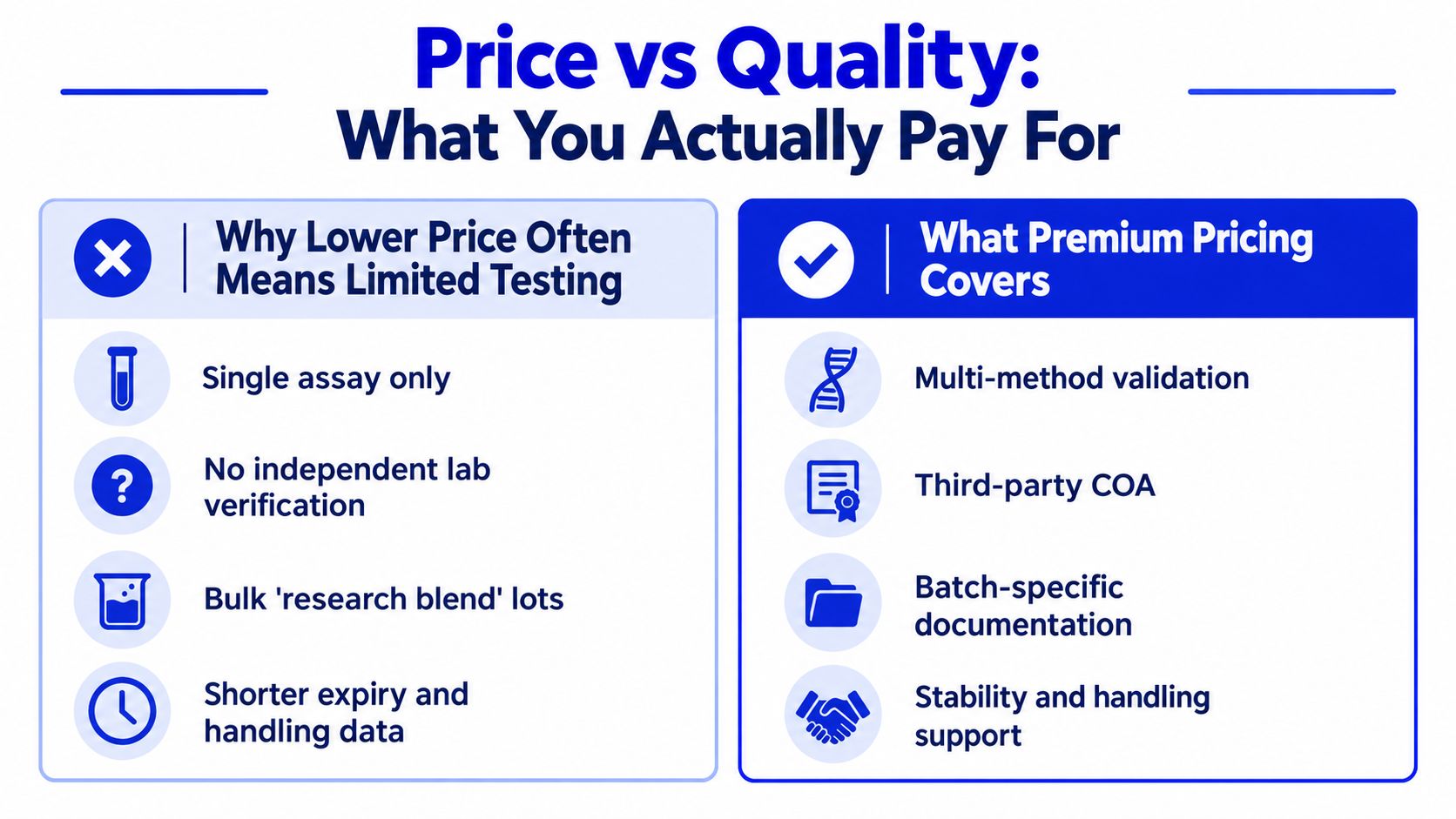
A premium price often reflects work the buyer doesn't see directly:
By contrast, lower prices can reflect thinner documentation, inconsistent purification, or less transparency around source and release procedures.
Not every application carries the same risk tolerance. For simple analytical reference work, a basic document package may be enough. For cell culture or preclinical work, documentation gaps matter more because contamination or instability can interfere with interpretation.
For laboratory and preclinical use, endotoxin control is a critical benchmark. Accepted parenteral limits are expressed in EU/kg body weight, and research-grade peptide materials are commonly screened to keep endotoxin below thresholds such as 5 EU/mg, with tighter targets often used for cell-culture or in vivo work according to this testing reference on peptide laboratory benchmarks. That's why a lot can pass a strong HPLC assay and still be a poor fit for sensitive biological experiments.
The broader peptide field has grown well beyond a niche research category. The peptide therapeutics market reached USD 43.80 billion in 2025 and is forecast to rise to USD 83.80 billion by 2035, with a reported 6.7% CAGR over that period. Another report places the 2025 market at USD 140.9 billion, with North America holding 61.9% of global revenue and recombinant DNA technology accounting for 80.2% of market share in that same year according to Market Research Future on peptide therapeutics. As that commercial backdrop expands, buyers increasingly expect research suppliers to offer stronger documentation and cleaner traceability.
A buyer pulls up two peptide listings. Both say “research use only.” One has a clear batch record, a dated COA, and a traceable lot number. The other has a short disclaimer and little else. The label is the same, but the documentation standard is not.

That distinction causes a lot of confusion. According to this regulatory overview of research peptides, “research use only” and “not for human consumption” describe intended laboratory or in vitro use. They do not indicate FDA approval, safety clearance, or a verified quality tier. The same source explains that RUO chemicals are not reviewed by the FDA for purity, sterility, or potency before sale.
A practical way to read the label is to treat it like a shipping category, not a quality grade. It tells you how the product is being marketed and how it is supposed to be used. It does not confirm how well the batch was characterized.
The safest reading is a narrow one:
That last point matters in categories often discussed alongside wellness or body-composition claims. If the sales language points one way and the compliance label points another, buyers should slow down and examine the paperwork more closely.
A compliance label cannot replace batch documentation.
Recent regulatory summaries describe warning letters, import scrutiny, and enforcement actions when RUO products are marketed in ways that suggest human use. Broader commentary on manufacturing compliance, customs review, and distributor enforcement appears in this FDA regulatory overview for peptides.
For research buyers, the useful takeaway is simple. Compliance is not just the text on the vial. It includes the full chain around the vial: product page wording, support responses, order records, lot tracking, and the COA tied to that lot. If one part says “research use only” while the rest of the sales process hints at something else, that mismatch is a warning sign.
This is also where the idea of premium gets clearer. Premium does not come from a disclaimer. It comes from records you can verify.
For a quick visual overview of how labs often think about this boundary, this video is a useful reference point before procurement discussions move too far into assumption.
A common buying problem looks simple at first. Two vials appear similar, both list a high purity figure, and one costs less. The difference usually shows up in the paperwork. One batch has records you can trace from the label to the test results. The other gives you a number without much context.
That is the practical meaning of premium in peptide sourcing. Premium means documentation you can verify, batch by batch, so your team can check what was tested, how it was tested, and whether the records match the material in hand.
A good final screen is to treat the COA and lot record like a chain of custody. If one link is weak, the whole chain deserves a closer look.
Before purchasing, use a short review standard:
This process works like inspecting a shipping label before signing for a package. The label, tracking number, and contents all need to agree. If several details are vague, a low price may mean you are accepting more uncertainty.
Price still matters. So does the cost of delays, re-ordering, and explaining weak records later. Buyers who compare documentation first usually get a clearer picture of value than buyers who compare purity claims alone.
The goal is not to find a perfect sheet of paper. The goal is to choose material you can evaluate, defend, and reorder with confidence if the same lot quality is needed again.
Peptide Warehouse USA offers USA-manufactured research peptides and related compounds for laboratory, analytical, and preclinical work, supported by batch-specific COAs, microbial reports, and endotoxin documentation. If you want a supplier that treats traceability as part of the product, visit Peptide Warehouse USA to learn more and explore options.
Leave a comment