No products in the cart.



You've found a peptide vendor that promises high purity, fast fulfillment, and compounds associated with muscle growth. The product page looks polished, but the questions that matter are harder to answer: Can the supplier connect the vial to a specific lot? Does the Certificate of Analysis identify the testing laboratory? Is the material clearly labeled for research use only? And does the evidence support a muscle-growth claim, or only a short-term hormone change?
If you're looking to buy peptides for muscle growth, treat the purchase as a research procurement decision, not a supplement transaction. The useful workflow starts with evidence and regulatory status, then moves through vendor verification, COA review, shipping inspection, storage, and records. This guide is written for laboratories, analysts, and researchers evaluating peptides marketed in muscle-growth and body-composition contexts. It isn't medical advice, and it doesn't provide dosing or self-administration instructions.
A typical procurement request begins with a compound name copied from a forum, a social post, or a product listing. The requester may ask for CJC-1295, ipamorelin, MK-677, GHRP-2, BPC-157, or another peptide associated with muscle, recovery, or body composition. The purchasing problem appears simple until the lab asks for documentation and discovers that the listing doesn't identify the lot, testing method, storage requirements, or intended use.
A responsible buyer changes the order of operations. First, define the research question. Then determine what material and documentation the study requires. Only after that should you compare suppliers, review batch records, and place an order.
Practical rule: A clean product page is not quality evidence. Traceable documentation is.
This distinction matters because the phrase “for muscle growth” describes a marketed use case, not an established regulatory indication. As of 2026, no peptide is FDA-approved for muscle growth or athletic performance enhancement in healthy adults. The related FDA-recognized approvals cited in the field apply to specific medical conditions, including tesamorelin for HIV-associated lipodystrophy and elamipretide, marketed as Forzinity, for improving muscle strength in adults and pediatric patients with Barth syndrome who weigh at least 30 kg. The regulatory background is summarized in this overview of peptides and muscle growth in 2026.
By the end of the procurement process, you should be able to:
The right outcome isn't automatically a purchase. Sometimes the documentation is insufficient, the endpoint doesn't match the research question, or the regulatory status makes the material unsuitable. A compliant workflow gives you enough information to make that decision before money, samples, and laboratory time are committed.
Marketing often compresses several different ideas into one promise: higher growth hormone, improved recovery, more lean mass, and greater strength. Those outcomes aren't interchangeable. A peptide can affect a signaling pathway or endocrine biomarker without demonstrating hypertrophy in healthy, resistance-trained adults.
The strongest caution concerns CJC-1295 and ipamorelin. A recent evidence review found no randomized controlled trial measuring muscle mass, cross-sectional area, or strength for CJC-1295 or ipamorelin, either alone or in combination. Short studies may show changes in growth hormone or IGF-1, but those findings don't establish added muscle. The review's recommended endpoint hierarchy is sensible: hormone response first, then lean-mass imaging, then standardized strength testing. Read the evidence review on peptides for muscle growth for the methodological distinction.
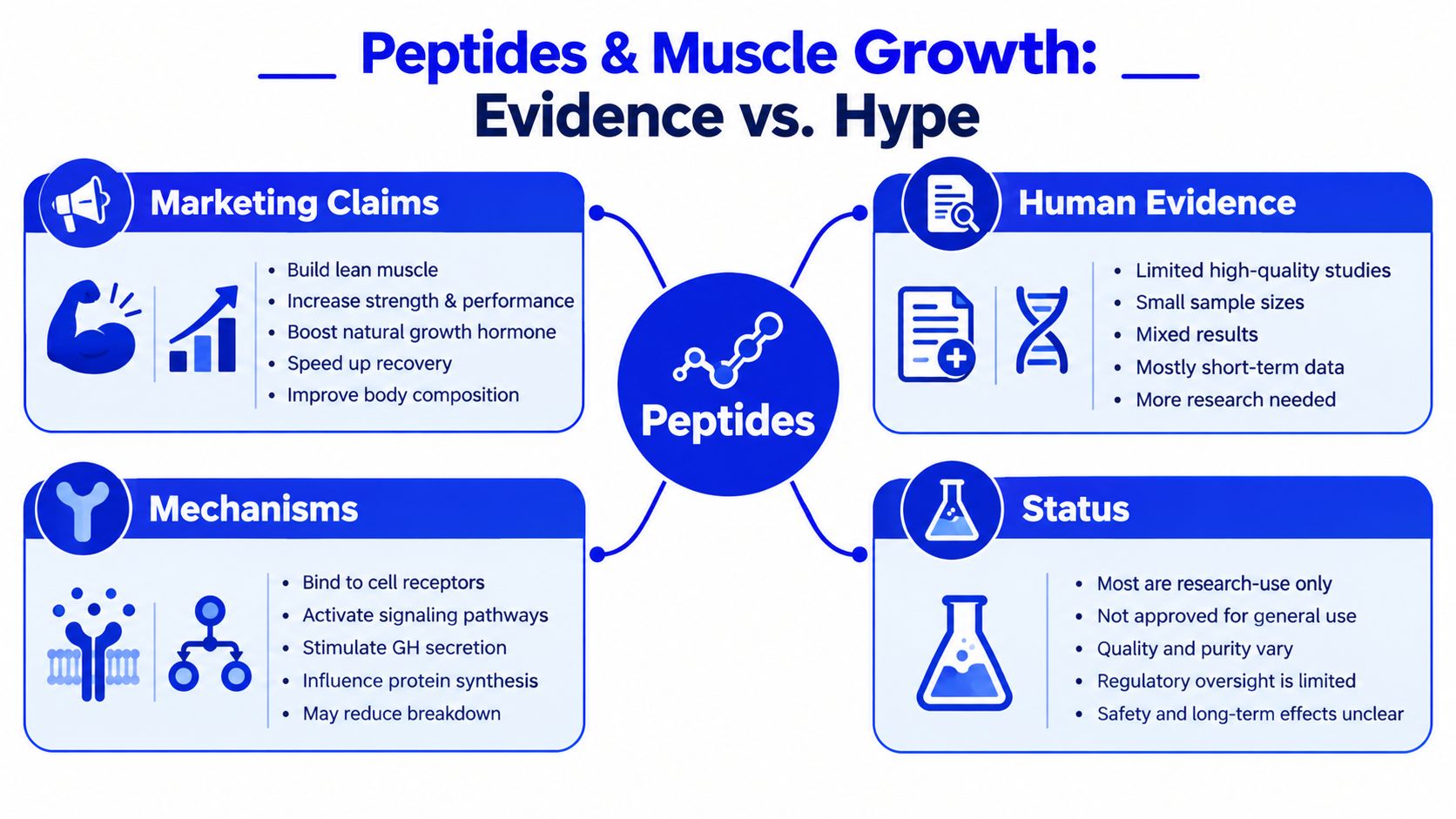
The MK-677 trial often appears in discussions of muscle-growth peptides. In a study of 65 adults aged 60–81, participants receiving MK-677 gained 1.6 kg of lean mass over 12 months compared with placebo, but the increase may have included fluid retention rather than true hypertrophy. The population was older adults, not healthy lifters, so the result can't be converted into a reliable bodybuilding expectation. The trial and related discussion are summarized in this review of peptide evidence for muscle growth.
A broader 2025 scoping review of peptides in skeletal muscle wasting found that 54.0% of assessed peptides were associated with beneficial muscle-related outcomes, 17.2% with detrimental effects, and 9.2% with muscle-neutral effects. Those figures describe a mixed, condition-specific field. They don't show that a retail peptide reliably builds muscle in a healthy adult.
Growth-hormone-axis interventions illustrate the same problem. A summary of 11 placebo-controlled trials involving 254 healthy young subjects reported increased lean body mass and reduced fat mass, but no significant improvement in muscle strength, with p = 0.36, or maximal oxygen uptake, with p = 0.89. The summary of growth hormone and body-composition evidence supports using imaging and performance tests rather than scale weight alone.
The category is scientifically active, but the intended consumer use remains outside approved indications. A review notes that peptides received 34 FDA approvals between 2016 and 2024 across all therapeutic uses, but those approvals don't create a muscle-growth indication for healthy users. That's why a lab should ask, “What endpoint is this material appropriate for?” rather than, “Which peptide is best?”
Collagen peptides belong in a separate conversation. They're commonly placed in the same search category, but available findings are mixed and population-specific. Some trials report small strength improvements, while others find no difference in muscle-fiber cross-sectional area or strength, making collagen more relevant to nutrition and recovery research than to an injectable anabolic claim. This analysis of peptides for muscle growth provides useful context on that distinction.
Vendor evaluation starts with the supplier, not the compound. A researcher should be able to identify where the material is manufactured, how batches are tested, which lot the documentation covers, and how the company handles questions about deviations or damaged shipments.
A USA manufacturing claim is useful only when the supplier states what it means. Look for a clear manufacturing location, named production practices, batch identification, and testing procedures. “High purity” is not enough by itself. If a vendor advertises purity up to 99.5%, compare that statement with the actual lot-specific COA rather than treating it as a blanket guarantee.
Your initial checklist should include:
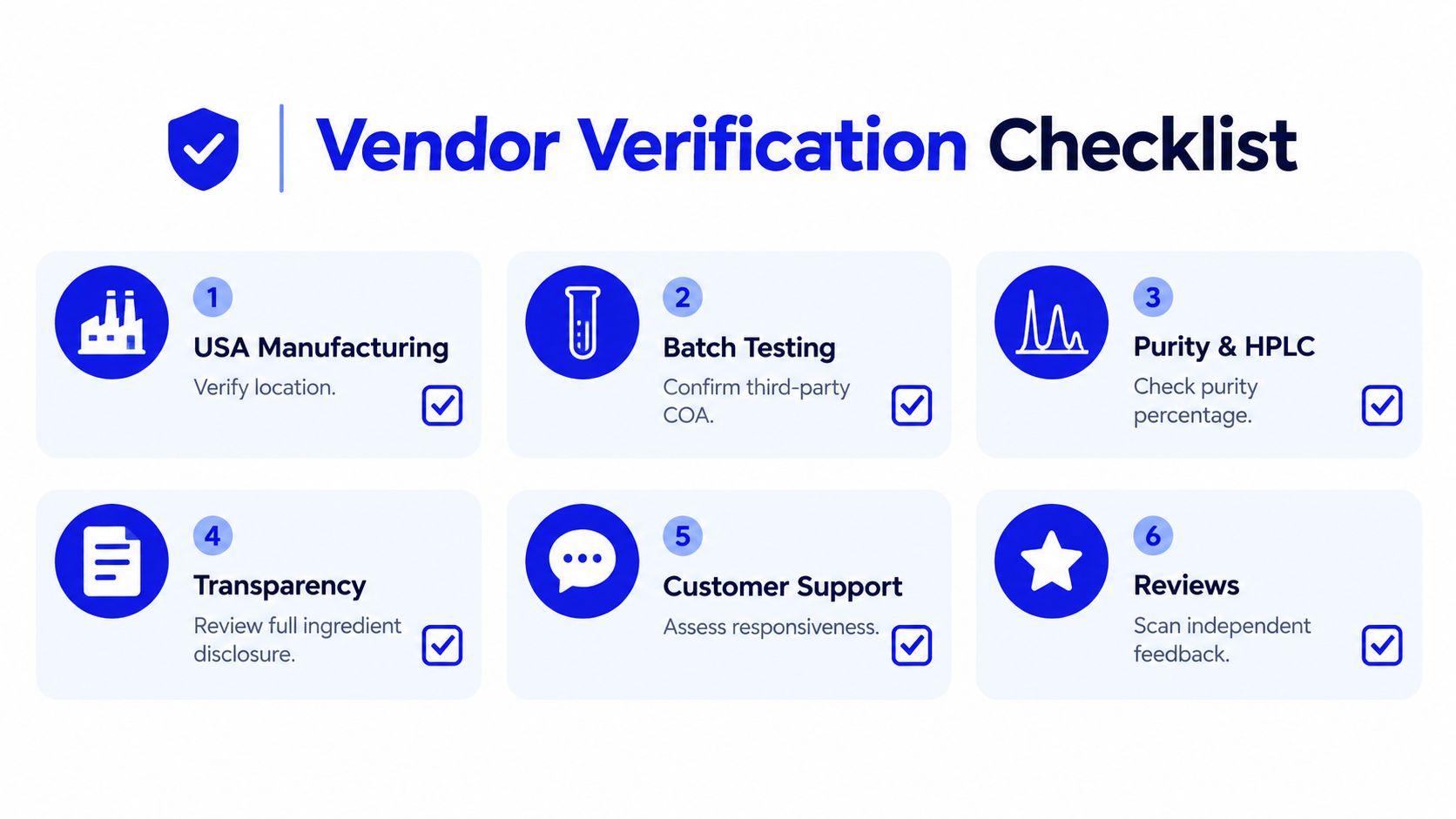
A useful COA should connect product name, lot number, test date, laboratory identity, methods, and results. If the PDF has no lot number, uses a template unrelated to the shipment, or omits the testing laboratory, treat the gap as a procurement issue. Don't fill missing information with assumptions.
Customer support is part of quality control. Send specific questions before ordering and assess whether the response includes documents, definitions, and clear limitations. A vendor that answers a technical question with a sales slogan hasn't resolved the underlying risk.
For a broader framework on maintaining supplier relationships, documentation, and accountability, review the Cartwright Fitness vendor management overview. The principles apply beyond fitness products. Procurement teams need an auditable record of who supplied the material, what was promised, and what arrived.
Independent feedback can provide context, but it shouldn't replace analytical records. Reviews may reveal shipping problems or poor support, while only appropriate testing can address identity, purity, microbial status, or endotoxin concerns.
A short visual explanation can help new buyers understand why quality claims need verification:
Documentation standard: If you can't connect the product, lot, test, and result, you don't have a complete quality record.
A vendor can pass an initial review and still be unsuitable for a particular study. Procurement works best as a sequence, with a decision point at every stage.
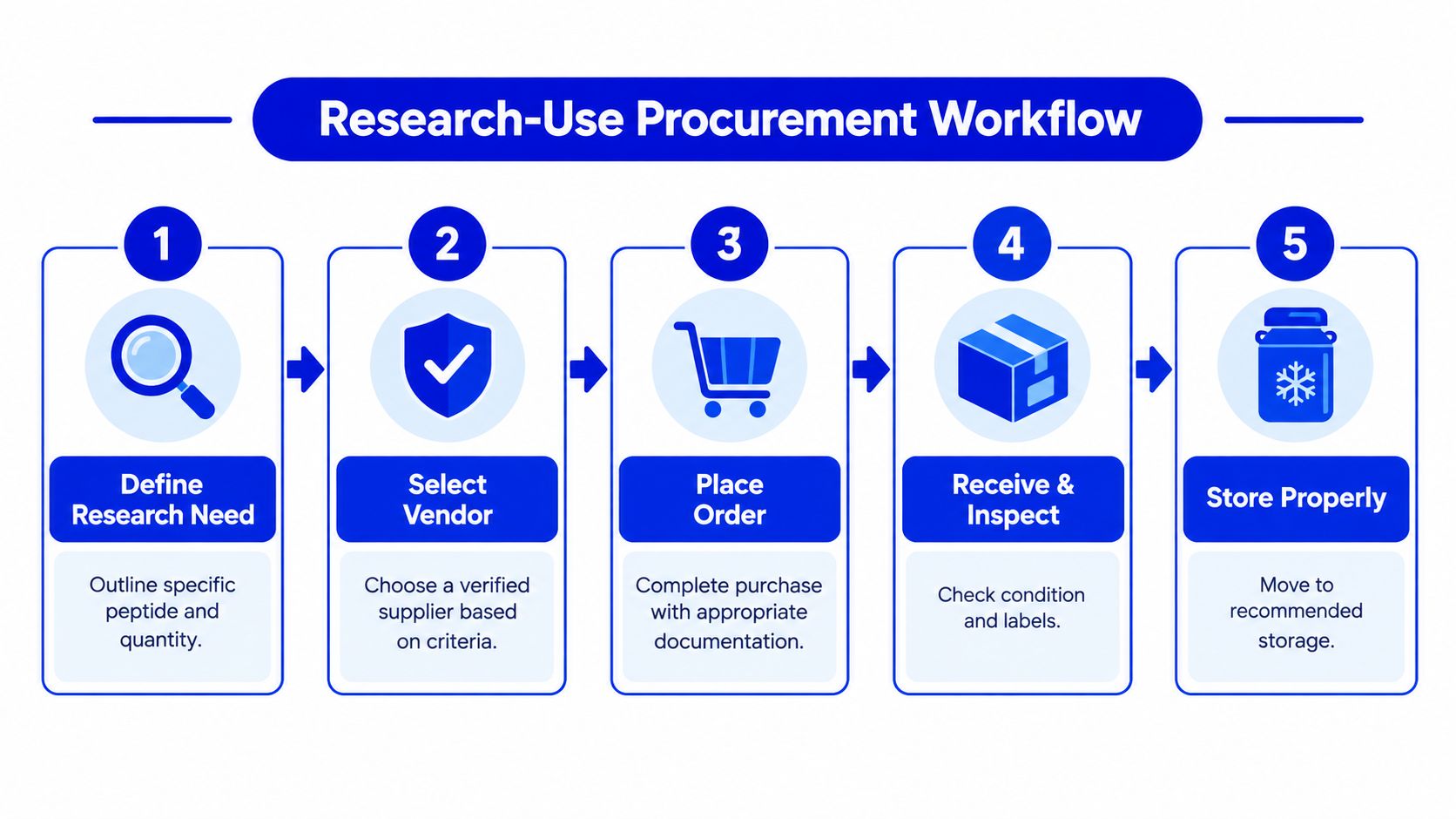
Write down the target compound, intended assay, required form, approximate quantity, acceptable purity documentation, and storage conditions before browsing products. A study examining receptor signaling has different documentation needs from one examining an analytical standard or a preclinical tissue model.
Don't select a stack because a product page groups compounds together. Define whether the work concerns GH secretion, IGF-1 signaling, tissue repair, lean mass, or another endpoint. If the endpoint is muscle size or force, document the measurement method before ordering. A biomarker-only study shouldn't be presented as proof of hypertrophy.
Compare suppliers against the criteria above. Confirm that the catalog clearly identifies research-use-only status and that the website uses an age gate and FDA disclaimer consistent with that positioning. For USA-based work, verify whether the supplier ships within the required territory and whether the material is available from stock.
Account management and order tracking are practical controls, not cosmetic features. They help the lab preserve invoices, lot information, shipping records, and correspondence in one place. If the supplier states one to two business day fulfillment for in-stock products, record that as a stated fulfillment expectation, not as a guaranteed delivery date.
Before payment, save the product page, COA, and written responses from support. On arrival, inspect the outer packaging, product label, lot number, seal, container condition, and temperature or moisture concerns relevant to the material. Photograph discrepancies before opening the package.
Use this checklist during receiving:
| Checkpoint | What to Verify | Pass Criteria |
|---|---|---|
| Product identity | Compound, form, and label | Matches the approved purchase request |
| Lot traceability | Lot number across vial, invoice, and COA | All records match |
| Analytical documentation | Method, result, laboratory, and date | COA is complete and lot-specific |
| Contamination records | Microbial and endotoxin reports where required | Reports meet the study's acceptance criteria |
| Shipment condition | Seal, container, label, and packaging | No unexplained damage or discrepancy |
| Compliance status | Research-use-only language and restrictions | Intended use remains within laboratory policy |
| Record retention | Invoice, COA, correspondence, and receiving note | Files are stored with the project record |
Complete the record before the sample enters storage. Returns and shipping procedures should be reviewed before ordering, because a damaged or mismatched shipment is easier to resolve when the lab already knows the supplier's process.
A correctly documented sample can still become unusable through poor handling. Storage decisions should follow the supplier's product-specific guidance and the requirements of the assay. Don't improvise a temperature range, reconstitution method, or stability period when the documentation doesn't provide one.
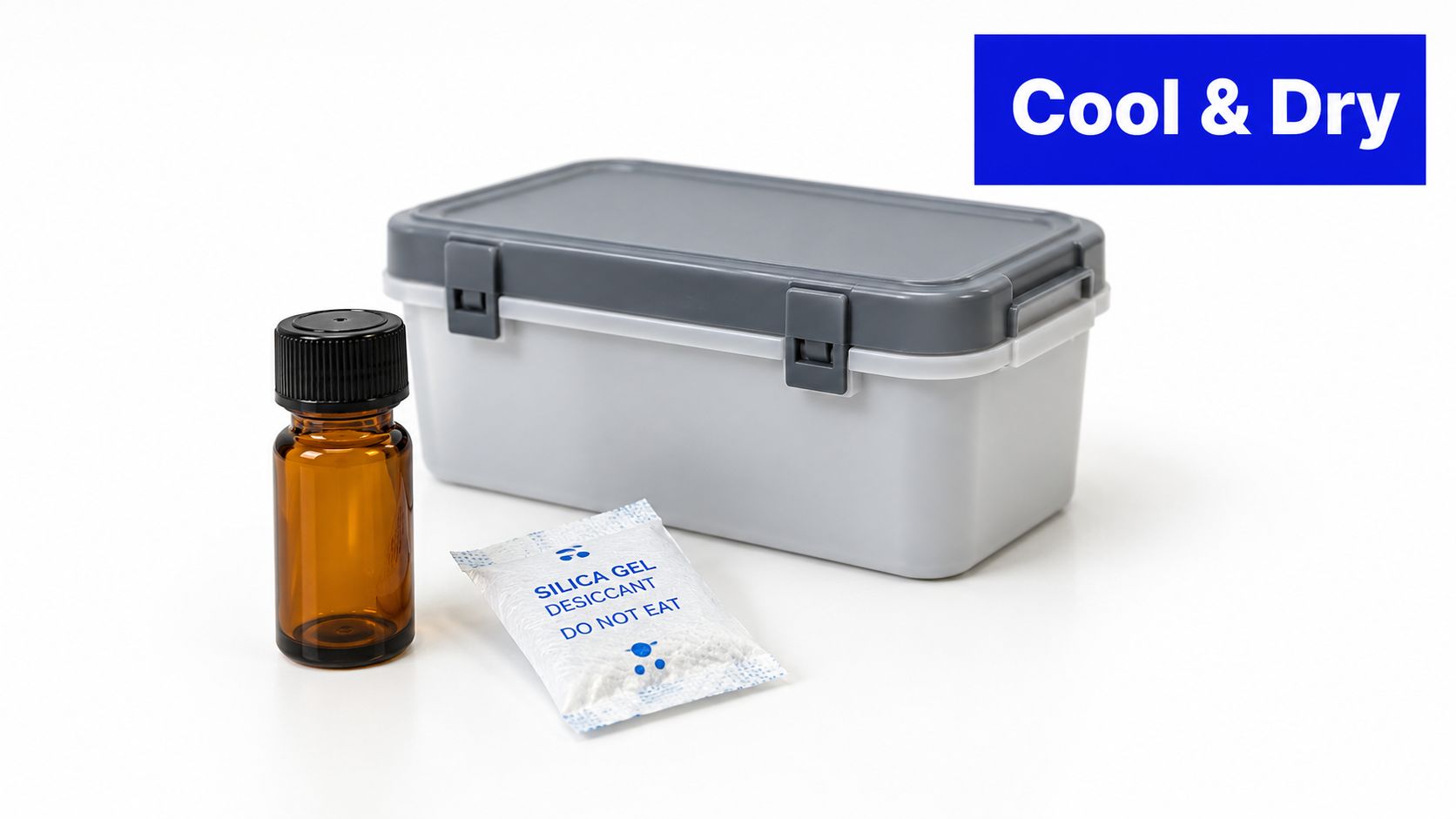
Lyophilized powders generally need protection from moisture, heat, and light, but the correct conditions depend on the compound and packaging. Keep containers closed, use clean handling practices, avoid repeated unnecessary exposure, and document any movement between storage areas.
A basic integrity record should include:
Chain of custody matters: A sample's history supports the interpretation of every result generated from it.
Research-use-only labeling isn't a decorative disclaimer. It defines the supplier's stated purpose for the material and helps prevent laboratory products from being represented as approved medicines or consumer performance products. The FDA determined that 19 peptides posed significant safety risks in 2023 and moved them to a de facto do-not-compound list, a regulatory fact discussed in this compliance-focused explainer on injectable peptides.
The risk stack also includes contamination, legality, and anti-doping exposure. Recent reporting describes concerns about toxic contaminants in non-FDA-approved peptides purchased outside normal pharmacy channels, while the FDA has tightened access by restricting compounding of peptides that lack USP monographs. The reporting on peptide science, muscle growth, and wellness also discusses increasing scrutiny, including an Australian TGA warning about unapproved peptides and public-health and law-enforcement risks.
Athletes and teams need a separate compliance review because many peptides marketed for physique enhancement are prohibited under the World Anti-Doping Code, and detection and enforcement methods continue to evolve. A laboratory should never assume that research-use-only status removes anti-doping consequences for an athlete, or that an undetected compound is permitted.
For additional background on the uncertain short- and long-term safety of growth-hormone-secretagogue peptides, compare the discussion in this overview of peptides for bodybuilding. Use the information to strengthen documentation and risk review, not to create a self-administration protocol.
The most defensible decision combines five filters. First, ask whether the evidence matches the endpoint. A hormone increase is not a muscle-growth result, and lean mass is not automatically functional strength. Second, verify the supplier's identity, manufacturing claims, testing practices, and support process.
Third, inspect the COA for lot-level traceability. The document should connect the product to a test, method, laboratory, and result. Fourth, confirm research-use-only status and make sure the proposed work fits your institution's legal, ethical, and safety requirements.
Finally, protect the sample after purchase. Record receipt, preserve the chain of custody, follow product-specific storage guidance, and quarantine discrepancies instead of moving them into inventory.
This approach won't produce a flashy “best peptide” ranking, but it answers the more useful buyer question: Can this material be responsibly evaluated for the stated research purpose? If the answer is no, the correct action is to pause, request documentation, or choose a supplier with a clearer record.
If you're comparing catalog options, review the documentation first and contact the supplier's help desk with precise questions about lot records, testing, shipping, returns, and storage. Peptide Warehouse USA offers USA-manufactured research peptides and related compounds, with product documentation that can include COAs, microbial and endotoxin reports, and stated purity levels up to 99.5%, while maintaining research, laboratory, and analytical use restrictions. Explore the Peptide Warehouse USA catalog to review available options and request the records your lab needs before ordering.