No products in the cart.



You're probably comparing Semax notes on one tab, COA screenshots on another, and a supplier page in a third, trying to figure out whether the peptide is worth sourcing for research. That confusion is normal. Semax sits in a strange space, with a long Russian clinical history, limited Western familiarity, and a lot of online noise that blurs research use with marketing.
Semax is a synthetic heptapeptide that keeps showing up in conversations about neuroprotection, cognitive research, and peptide quality control. The key question isn't whether it sounds interesting, it's whether the structure, evidence, handling, and documentation support careful lab work. That's where most broad nootropic guides stay shallow, and where a practical supplier mindset helps.
A lot of peptide discussions start with bodybuilding, recovery, or general wellness. Semax doesn't fit cleanly into that lane, which is exactly why people get turned around when they first encounter it in Russian literature or in modern research catalogs.
Semax was developed in the late 1980s at the Institute of Molecular Genetics of the Russian Academy of Sciences, then moved into clinical use after early 1990s trials, including human testing in military hospitals and later broader Russian medical-center work Semax technical history. That history matters because it shows Semax didn't emerge from Western supplement culture. It came from a clinical research pipeline tied to post-Soviet medical development and later regional use Semax human studies overview.
For researchers, that creates a very specific problem. You can find material on Semax, but much of it is geographically concentrated, and the evidence story doesn't read like a mainstream U.S. or EU peptide program. The result is a compound that looks familiar to peptide buyers, yet behaves more like a niche neuropeptide with a local clinical legacy than a globally standardized research tool.
Practical rule: if a compound's history is concentrated in one region, treat every claim about broad applicability as unproven until the documentation supports it.

People often compare Semax to other neuroactive peptides, but that comparison can hide more than it reveals. The important distinction is that Semax is discussed as a CNS-active peptide with neurobehavioral relevance, not as a steroid, not as a classic hormone replacement, and not as a simple single-target compound FDA briefing material.
That makes Semax useful in a different kind of question. Instead of asking whether it is a performance enhancer, the more precise question is whether it can support research on neurotrophic signaling, recovery, or cognition in populations that resemble the studied groups. That's a much narrower and more defensible frame.
Semax is a synthetic heptapeptide with the sequence Met-Glu-His-Phe-Pro-Gly-Pro peer-reviewed sequence description. The structure matters because the amino-acid order isn't decorative, it shapes how the molecule behaves in biological systems.
Semax is described as a peptide derived from an ACTH fragment, with one source calling it a fragment of ACTH(4–7) extended by the C-terminal tripeptide Pro-Gly-Pro peer-reviewed sequence description. In FDA material, it's also characterized as a synthetic analog of the ACTH(4-10) fragment that lacks the full hormonal corticotropic and melanotropic effects of intact ACTH while retaining neurobehavioral activity FDA briefing material.
That distinction is easy to miss. A peptide can be related to a hormone fragment without functioning like the full hormone. For lab planning, that means you're evaluating a compound with a distinct pharmacology profile, not a generic endocrine agent.
The research literature consistently points to multi-target activity. Semax has been associated with BDNF/TrkB signaling, serotonergic and dopaminergic modulation, and gene-network effects tied to inflammation, oxidative stress, and neuronal survival PubMed context on multi-target activity. Those are different layers of biology, which is part of why the peptide attracts interest in neuroprotection research.
A useful way to think about it is this. Single-pathway compounds often give you one primary readout. Semax invites broader observation because its reported activity touches trophic signaling, neurotransmission, and stress-related biology at once.
For readers who like mechanistic diagrams, a good companion resource on pathway thinking is understanding disease mechanisms. It's helpful when you're trying to separate a molecule's theoretical role from what can be measured in a study.
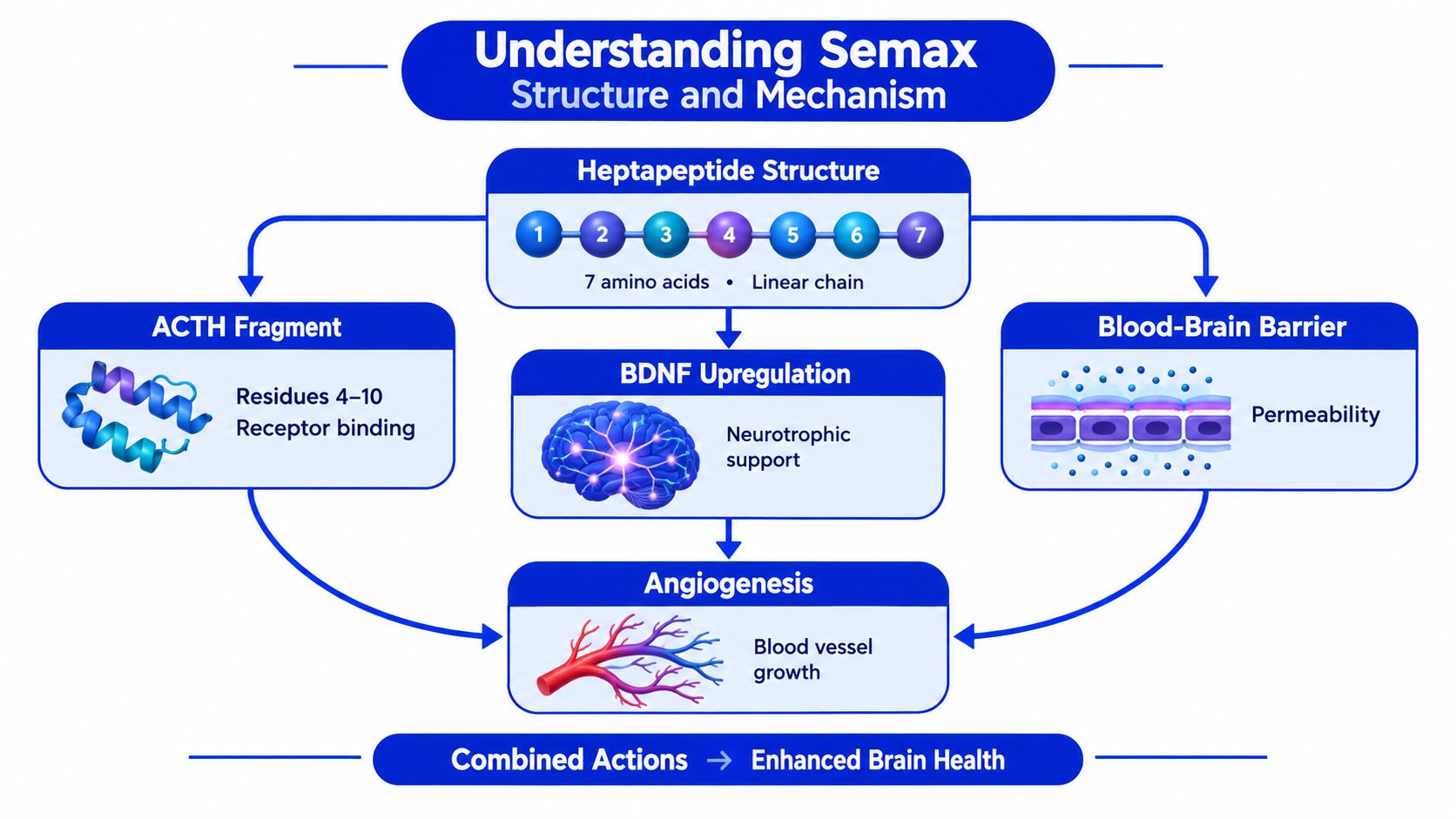
The structure explains why Semax is discussed as a neuropeptide first, and as a general-purpose “nootropic” only second.
The strongest way to read Semax research is to separate human evidence, preclinical mechanism, and marketed claims. If you blur those together, the peptide looks broader than it really is.
A PubMed-indexed study on 110 people recovering from ischemic stroke reported that intranasal Semax raised plasma BDNF levels, and higher BDNF was associated with faster recovery of motor function and everyday functional capacity stroke recovery study summary. That doesn't prove broad cognitive enhancement, but it does show why Semax keeps appearing in recovery-focused discussions.
There's also a human report involving a 1% Semax solution in motor neuron disease patients, where quality-of-life measures improved by day 10 even though the underlying disease course did not change PubMed context on symptom-level effects. That's a useful reminder that symptom-level changes and disease modification are not the same thing.
The most cautious Alzheimer's-focused review in the verified material says there's little evidence that Semax improves cognition in healthy patients, no evidence for Alzheimer's disease, and little human safety data. It also notes the broader evidence base remains thin outside Russia, with no large-scale Western placebo-controlled replication Alzheimer's-focused review.
That's where buyers and researchers often talk past each other. Marketing language pushes Semax as a nootropic. The actual evidence base is more restrained, and it supports stronger confidence in niche, studied contexts than in general wellness use.
For a plain-language companion on cognition research framing, the Orange Neurosciences cognitive guide is a useful contrast point. It helps readers separate broad cognitive-support concepts from compound-specific evidence.
A recent evidence audit cited in the verified material found no eligible recent Semax randomized controlled trial, systematic review, meta-analysis, or Cochrane review with at least 100 human participants Alzheimer's-focused review. That doesn't make Semax irrelevant. It does mean the strongest case is still tied to the populations already represented in the evidence.
Peptides don't stay useful if the handling is careless. With Semax, the practical issue is preserving the molecule long enough to keep your batch-to-batch comparisons meaningful.
The verified material here doesn't give a full stability dossier, so the smart move is to stay conservative. Keep lyophilized Semax protected from heat, moisture, and unnecessary light exposure. Once it's reconstituted, treat it as a working solution, not something to leave sitting on a bench.
Repeated freeze-thaw cycles are a common way to create avoidable variability. If you're planning more than one run, aliquot the material into working volumes so you don't keep reopening the same container.
Use sterile handling practices and the diluent specified by the vendor or study protocol. Avoid improvising with unverified reagents, because the peptide's behavior depends on pH, contamination risk, and the container surface it contacts.
A few practical habits help keep the sample cleaner:
Practical rule: if you can't explain how a sample was stored, you can't confidently explain a result that came from it.
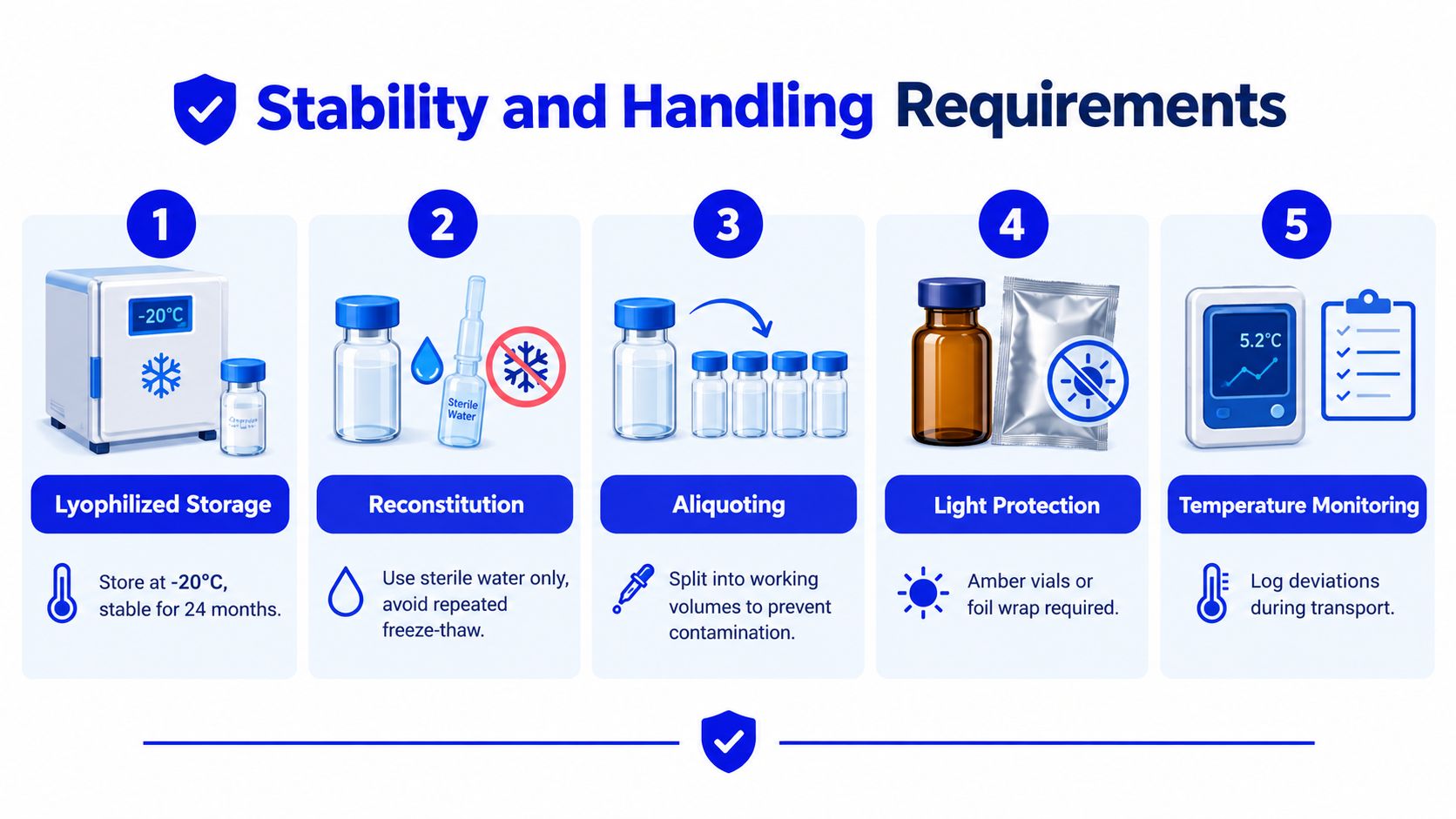
Semax is a peptide where small handling errors can look like biological inconsistency. In reality, the problem may be sample degradation, contamination, or device incompatibility rather than the compound itself.
A Certificate of Analysis should help you answer one question fast, is this batch what the supplier says it is. If it can't do that, the paperwork is decorative, not useful.
For Semax, documentation quality matters as much as the compound name on the label. A useful COA should be batch-specific, tied to a real lot number, and supported by testing that identifies purity and obvious contamination risks.
That means looking for:
A COA that only says “high purity” without method details is weak. So is a document that isn't linked to a batch, or a page that looks copied across multiple products with the same formatting and no substance-specific traceability.
If a supplier won't provide the underlying documentation package, that's a procurement problem, not a paperwork nuisance. Researchers need traceability to defend their methods and reproduce results later.
Peptide Warehouse USA is one option in this space, since its Semax Spray listing is presented as research use only and the company states that it provides COA verification, USA manufacturing, and endotoxin and microbial testing. That kind of documentation framework is the right starting point for lab comparison, even when a researcher is evaluating multiple suppliers.
A clean comparison helps separate a basic sales page from a procurement-ready file. The table below is a practical way to judge documentation before you place an order.
| Documentation Level | Purity Testing | Impurity Profile | Batch Specific | Microbial Testing |
|---|---|---|---|---|
| Basic | Listed, but method may be missing | Not provided | Sometimes unclear | Not shown |
| Intermediate | Method named, result stated | Limited detail | Usually shown | May be included |
| Comprehensive | Method named with batch result | Clear impurity notes or profile | Clearly tied to lot | Included with supporting record |
A basic COA can tell you the vendor wants to make a sale. A detailed one tells you the vendor expects the material to stand up in a lab file.
Don't assume all documentation gaps mean the product is unusable. Sometimes a supplier is just under-documenting. But if the project depends on reproducibility, weak documentation should push you toward another batch or another vendor.
Price can matter, but it shouldn't outrank traceability. The cheapest vial is often the most expensive one once you factor in failed runs, unrepeatable results, and time lost trying to interpret bad inputs.
If the documentation can't survive a lab audit, it won't survive a serious discussion of method quality.
Semax makes sense when the question is narrow and the sourcing is disciplined. It's a better fit for neuroprotection, recovery, and mechanistic work than for broad claims about healthy-adult cognition.
If your research is built around stroke recovery, neurotrophic signaling, or route-specific peptide handling, Semax is a rational candidate. If the project is trying to prove a general “brain boost,” the current evidence doesn't support that level of confidence.
The earlier sections point to the same conclusion from different angles. Semax has a real clinical history, but its strongest evidence remains concentrated in Russia, and the Western replication gap is still a real limitation Semax human studies overview.

The practical decision is simple. Choose Semax when the evidence fits the question, and choose a supplier only when the documentation fits the standard you'd want in a real lab file.
If you're sourcing Semax for research, look for a supplier that treats documentation, traceability, and handling as part of the product, not an afterthought. Peptide Warehouse USA offers a research-focused Semax option with batch documentation and testing details aligned to laboratory use, and you can visit Peptide Warehouse USA to review current product information and procurement details.