No products in the cart.



You're staring at a vial of lyophilized BPC-157, a vial of bacteriostatic water, and a syringe marked in units. The label gives you a mass in milligrams, but the syringe measures volume. The question is immediate: how many micrograms does each mark represent?
A BPC-157 dosage calculator can solve that conversion, but it can't turn an unapproved research compound into a clinically validated treatment. The useful role of the tool is narrower and more practical: it can make concentration math transparent, reduce avoidable arithmetic errors, and show the assumptions behind every output. This guide walks through mg, mcg, IU, mg/mL, vial calculations, worked examples, calculator design, and the evidence limits that must remain visible.
A calculator matters because the same vial can produce very different concentrations depending on the volume used for reconstitution. If you dissolve 5 mg of peptide in 2 mL, the resulting concentration isn't the same as dissolving that vial in 3 mL. The amount of peptide hasn't changed, but the amount contained in each syringe mark has.
That distinction is easy to miss when someone moves between a vial label, a calculator, and an insulin syringe. A reliable tool should show the entire chain:
Practical rule: A calculator should expose its assumptions, not simply display a number.
The calculation supports laboratory, analytical, and preclinical work. It doesn't establish a human prescription, a safe cycle, or a medically appropriate route. Independent regulatory sources classify BPC-157 as unapproved for human use. USADA explains its unapproved status, and the Office of Dietary Supplements' sport supplement guidance also describes it as an unapproved drug that can't legally be prescribed or sold over the counter.
By the end, you should be able to check an online BPC-157 dosage calculator by hand. You'll also know when an output is mathematically correct but scientifically weak because the underlying dose assumption comes from limited or non-human evidence.
Start with the units. A milligram, or mg, is larger than a microgram, or mcg. One milligram equals 1,000 micrograms. International units, or IU, are different. IU measure biological activity for substances with an established activity standard, while mg and mcg measure mass. You can't convert BPC-157 mass into IU without a valid, recognized activity standard.
The basic concentration formula is:
Concentration = total peptide mass ÷ reconstitution volume
For a 10 mg vial mixed with 2 mL of liquid:
10 mg ÷ 2 mL = 5 mg/mL
To express that concentration in micrograms:
5 mg/mL × 1,000 = 5,000 mcg/mL
A target of 250 mcg would therefore require:
250 mcg ÷ 5,000 mcg/mL = 0.05 mL
That is the mass-to-volume conversion. Syringe markings are a separate step, and the syringe type must be identified before converting volume into units.
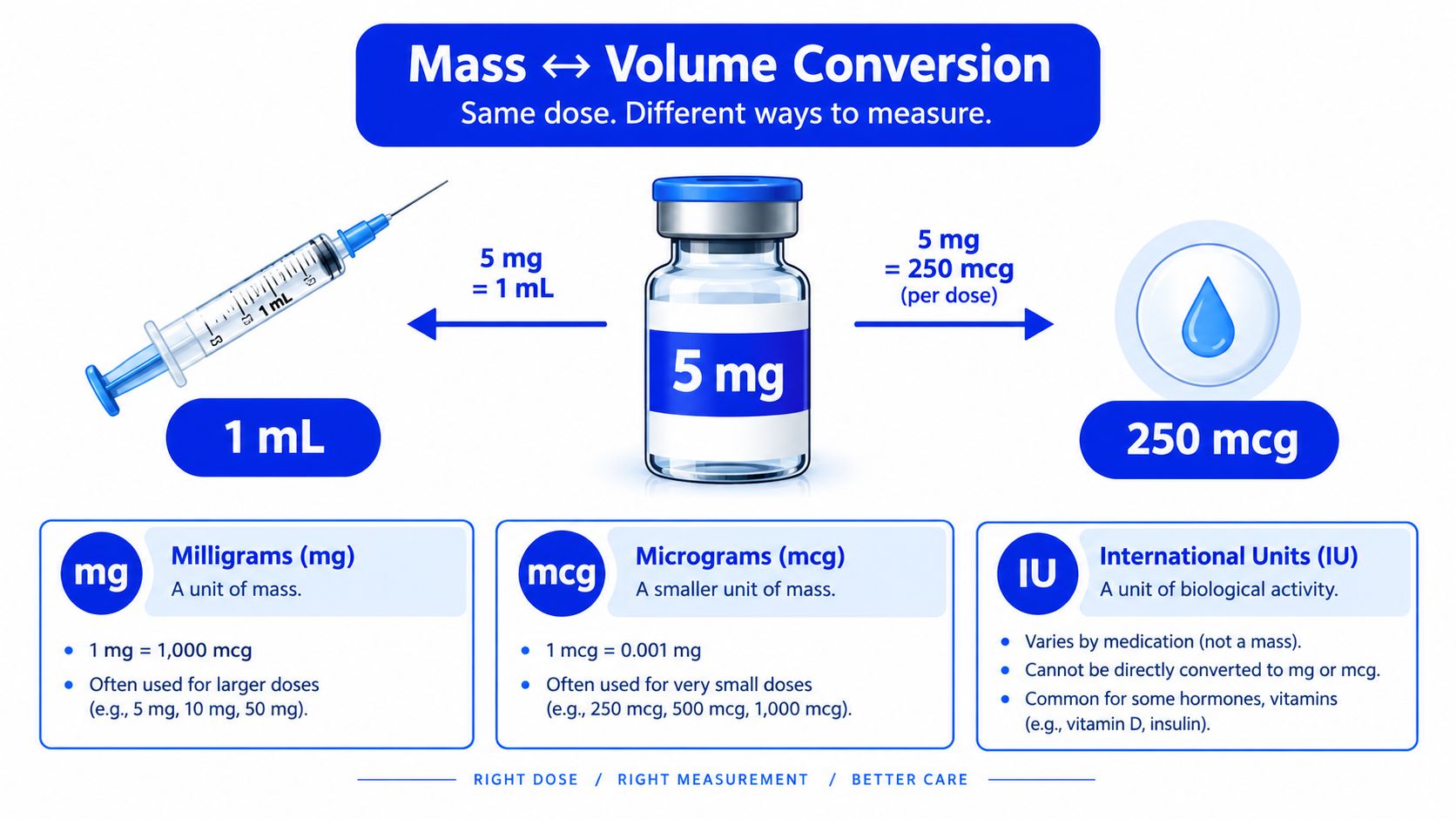
On a standard U-100 insulin syringe, 1 mL corresponds to 100 units, so 0.05 mL corresponds to 5 units. That conversion depends on the syringe scale. A calculator should never assume that “units” means a universal volume without showing the syringe convention it uses.
A major pharmacokinetic review reported preclinical effective doses of about 6 to 50 mcg/kg across mice, rats, and rabbits. The same review proposed 200 mcg per person per day, with comparisons using body-surface-area conversion rather than simple mg/kg arithmetic. The pharmacokinetic review explains the preclinical range and BSA issue.
That distinction matters. A direct body-weight multiplication can produce a misleading result when moving from an animal model to a human research context. A serious calculator should identify the species, route, model assumptions, and conversion method instead of presenting one universal number.
Check the unit before checking the answer. Most serious errors begin with confusing mg, mcg, mL, or syringe units.
The fastest way to test a calculator is to reproduce its arithmetic on paper.
Suppose a 5 mg vial is reconstituted with 2 mL of bacteriostatic water.
Step one: Calculate concentration.
5 mg ÷ 2 mL = 2.5 mg/mL
Step two: Convert concentration to mcg/mL.
2.5 mg/mL × 1,000 = 2,500 mcg/mL
Step three: Calculate the volume for a 250 mcg target.
250 mcg ÷ 2,500 mcg/mL = 0.1 mL
Step four: Convert volume to syringe units using a U-100 scale.
0.1 mL × 100 = 10 units
So, under these stated assumptions, the result is 0.1 mL, or the 10-unit mark on a U-100 insulin syringe. This is a mathematical example, not a recommendation for human administration.
Now use a 10 mg vial with 4 mL of liquid:
10 mg ÷ 4 mL = 2.5 mg/mL
The concentration is identical to the first example. A 250 mcg target still corresponds to 0.1 mL, or 10 U-100 units. The vial contains more total peptide and more total liquid, but each milliliter has the same concentration.
| Vial Concentration Quick Reference | Vial Size | Bacteriostatic Water | Concentration (mg/mL) | Volume per 250mcg Dose |
|---|---|---|---|---|
| 5 mg | 2 mL | 2.5 mg/mL | 0.1 mL | |
| 5 mg | 3 mL | 1.67 mg/mL | 0.15 mL | |
| 10 mg | 2 mL | 5 mg/mL | 0.05 mL | |
| 10 mg | 3 mL | 3.33 mg/mL | 0.075 mL |
The table gives volume only. Converting volume into syringe units requires the syringe scale, such as U-100. Before accepting any output, compare the entered vial mass and liquid volume with the physical label and the Certificate of Analysis, or COA. A calculator can't detect a mislabeled vial, an incorrect reconstitution volume, degradation, or a concentration error created during preparation.
A useful interface doesn't need many controls. It needs the right controls, visible units, and warnings that stop users from treating a neat output as a validated regimen.
The core input panel could contain:
The output panel should show:
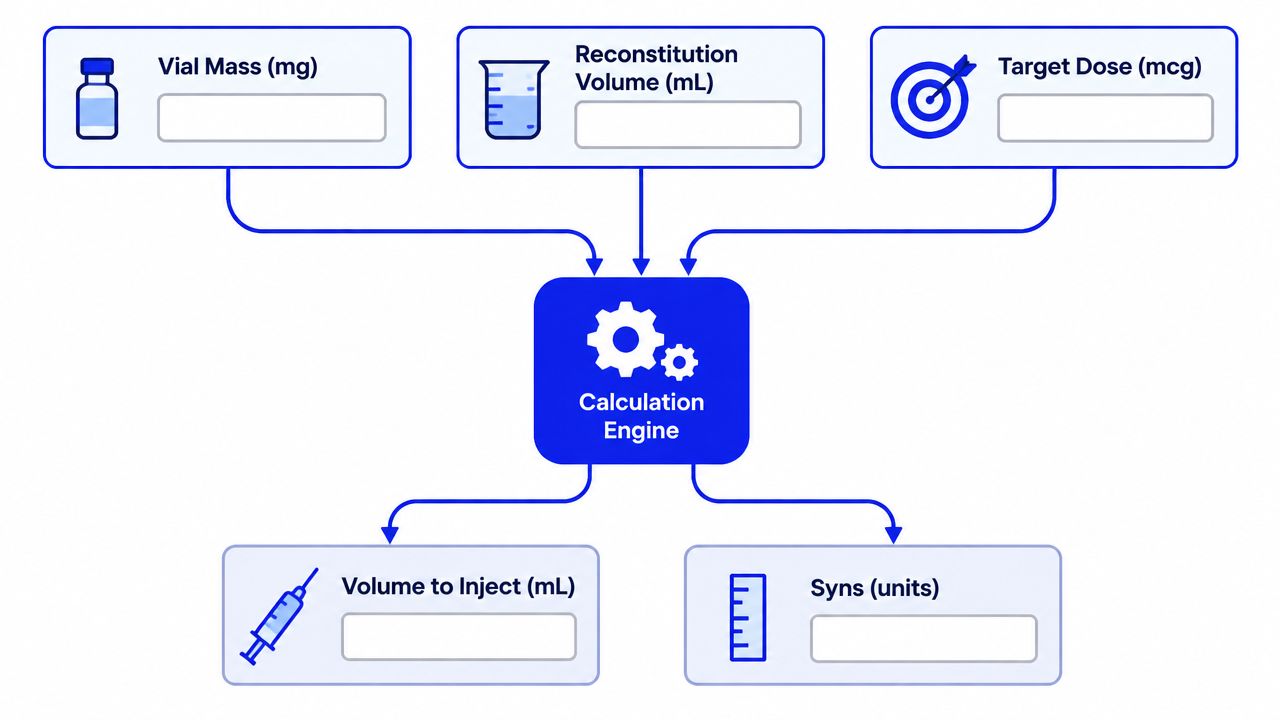
The logic is straightforward:
A stronger interface would flag volumes that are too small to measure reliably with the selected syringe. It could also warn when a target falls outside the 6 to 50 mcg/kg preclinical range reported in the pharmacokinetic review, while clearly stating that this range is model-specific and isn't a human dosing recommendation. That preclinical range and its route-specific context are discussed in the cited review.
The interface should also ask whether the user is describing oral, subcutaneous, intramuscular, or intravenous research conditions. Route matters because absorption and exposure assumptions differ. The review reports rapid peak timing after intramuscular dosing in rats and beagles, which means route and timing can materially alter interpretation.
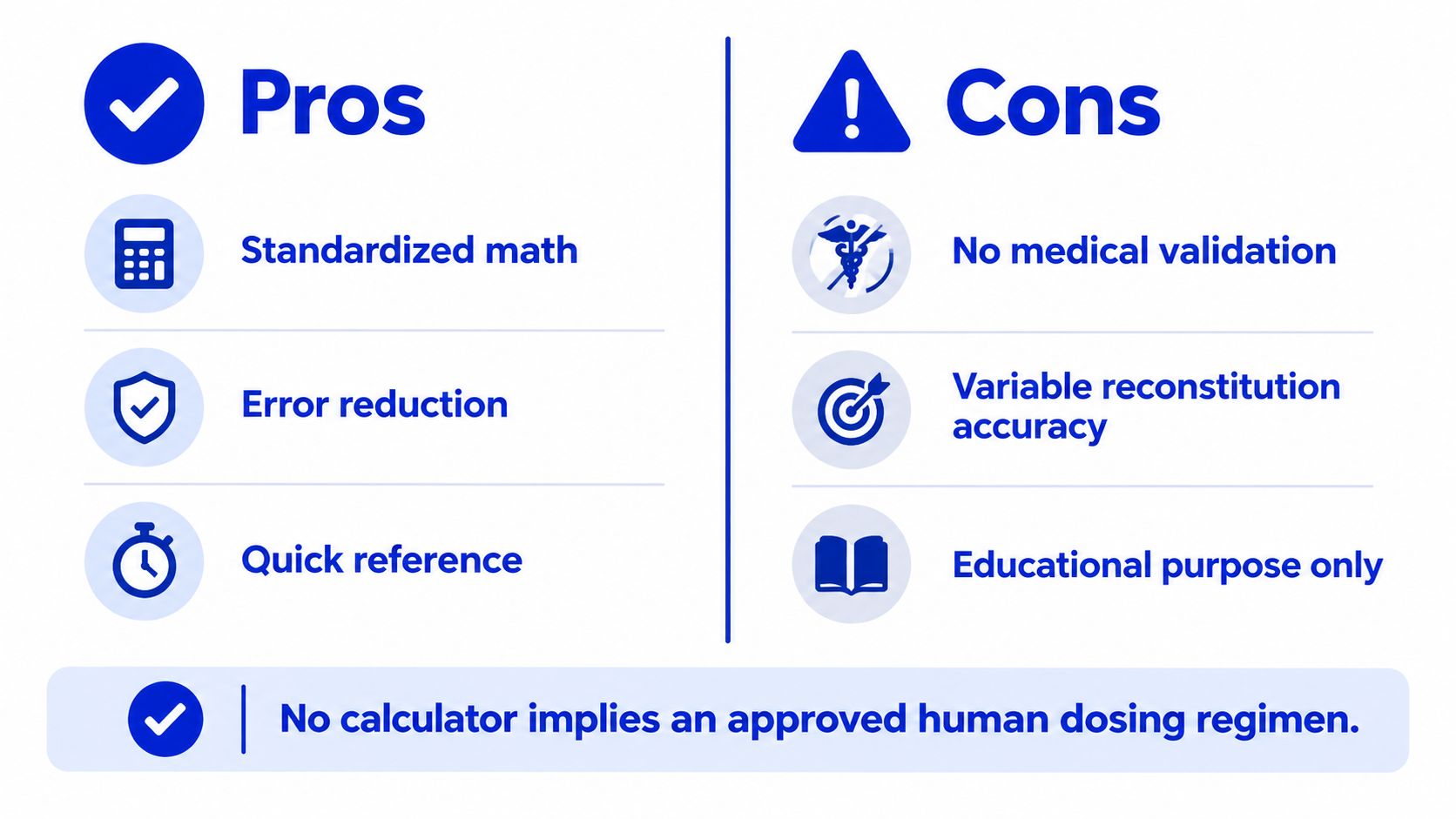
A mathematically correct result can still rest on an unsupported biological assumption. That's the central limitation of every BPC-157 dosage calculator.
In 2026, the FDA's Pharmacy Compounding Advisory Committee reviewed BPC-157 as a bulk drug substance. The agency's briefing materials stated that there was no applicable USP or NF monograph for BPC-157 free base or BPC-157 acetate, neither form was in an FDA-approved drug, and the agency proposed not adding either form to the 503A Bulks List because of a lack of evidence supporting effectiveness for ulcerative colitis. The same materials cited limited safety information for proposed routes and said the agency couldn't determine whether the drug would cause harm in humans. FDA's 2026 advisory committee materials provide the regulatory context.
That means a calculator can convert units, but it can't supply an FDA-established clinical dosing framework. Any online tool presenting a universal human dose is adding an assumption that the regulatory record doesn't establish.
An FDA briefing document cites an intramuscular no-observed-adverse-effect level of 4.0 mg/kg in pregnant rats. Reviews also describe negative-limit toxicology findings up to 2 g/kg by intravenous or intragastric dosing in mice, with no LD1 reached in some summaries. These are animal toxicity-screen observations, not controlled human efficacy results. The FDA briefing document contains the cited toxicology context.
A 2025 peer-reviewed review reported only one registered clinical trial, a phase I study whose status had been unknown since 2016. Another 2025 review stated that only three published human studies existed, and noted that no included human study assessed safety or adverse events. The review of the human evidence explains why a standardized clinical dose isn't available.
Responsible output: “This is the calculated volume under stated assumptions,” not “this is a safe human dose.”
For general medication education, readers can also consult fever medication safety tips from MEDISTIK. That resource addresses a different topic, but it reinforces a useful habit: medication decisions should account for the substance, context, and safety information rather than relying on arithmetic alone.
Accuracy starts before the calculator opens. Read the vial label, confirm the stated mass, and check the COA for lot-specific identity and purity information. Record the lot number, preparation date, reconstitution volume, and syringe type in a lab log so another researcher can reproduce the calculation.
Use the same syringe convention that the calculator assumes. If the display reports U-100 units but the physical syringe uses a different scale, the numerical result won't transfer safely. During preparation, work slowly and consistently, and avoid treating a rounded display value as more precise than the measuring device allows.
A short verification checklist helps:
If a calculated volume looks unexpectedly large or small, recheck the reconstitution volume first. That input changes concentration directly and is one of the easiest values to mistype.
Concentration: vial mass in mg ÷ liquid volume in mL = mg/mL.
Target volume: target mass in mcg ÷ concentration in mcg/mL = mL.
Syringe units: volume in mL × syringe units per mL = displayed units.
BPC-157 remains unapproved for human use, as outlined by USADA's regulatory and sport guidance. For laboratory work, researchers can explore third-party-tested, COA-verified research peptides from a US-based supplier, while keeping all calculations within the stated research-use framework.
Peptide Warehouse USA offers BPC-157 and other research peptides for laboratory, analytical, and preclinical applications, with lot documentation that can include COAs, microbial and endotoxin reports, and stated purity information. Visit Peptide Warehouse USA to explore research compounds and review sourcing and documentation options before planning your next lab workflow.