No products in the cart.

You're at your desk, refining the search “5 amino 1MQ where to buy”, and the same handful of supplier pages keeps appearing. One lists a low price, another highlights purity, and a third offers capsules or a bundle. The difficult question isn't finding a checkout page. It's deciding whether the material, documentation, labeling, and intended use are appropriate for legitimate research.
This guide doesn't provide a ranked vendor list. Instead, it gives you a practical way to evaluate any listing, including US-based research suppliers, by starting with batch-specific analytical evidence rather than testimonials, promises, or attractive packaging. 5-Amino-1MQ is for laboratory and research use only, not human or animal consumption.
You'll learn what the compound is, where its research stands, how US regulatory status affects purchasing, what current retail listings reveal, and how to read a Certificate of Analysis, or COA. You'll also get a supplier comparison framework, handling expectations, and a final pre-order checklist.
You find several pages for 5 amino 1mq where to buy, each making a different promise. One emphasizes purity, another price, and another packaging. Before comparing checkout options, ask what evidence supports the vial in front of you:
These questions matter because 5-Amino-1MQ appears in a research-supply market rather than standardized pharmaceutical retail. Listings commonly show small vial sizes such as 5 mg, 10 mg, and 50 mg, as well as bulk gram quantities. They also often use research-use-only language and mention third-party testing or COA records, as shown by Pepta Labs' 5-Amino-1MQ listing.
Practical rule: Treat a product page as an invitation to investigate, not as proof of identity, purity, or suitability.
A “high purity” label is only a claim until the supporting record connects it to a defined lot. Look for the lot number, test date, analytical method, identity result, and purity measurement. A supplier that cannot provide meaningful documentation before purchase gives you less basis for comparison.
The research-use boundary also matters. A responsible supplier should state that the material is not intended for human consumption, diagnosis, prevention, or treatment. Dosing instructions, body-composition testimonials, or therapeutic promises sit poorly beside that disclaimer and create a compliance concern.
Use a fixed sequence before ordering: understand the compound, check the US regulatory context, compare market listings, examine the COA, evaluate the supplier, and confirm storage and shipping conditions. This turns “where to buy” into a documentation check rather than a search for the most persuasive sales page.
5-Amino-1MQ is a small-molecule inhibitor of nicotinamide N-methyltransferase, or NNMT. It isn't a peptide, even though peptide suppliers and peptide-focused communities often discuss it alongside research compounds. Its chemical identity is commonly described as 5-amino-1-methylquinolinium iodide, with CAS 42464-96-0, molecular formula C11H11N3, and a methylquinolinium core.
A plain-language analogy helps. Think of NNMT as a cellular accountant that manages part of the bookkeeping around nicotinamide and methyl-group metabolism. 5-Amino-1MQ is being investigated as a compound that blocks that accounting step, potentially changing how cells preserve or use metabolic resources. That analogy describes a research mechanism, not a guaranteed outcome in people.
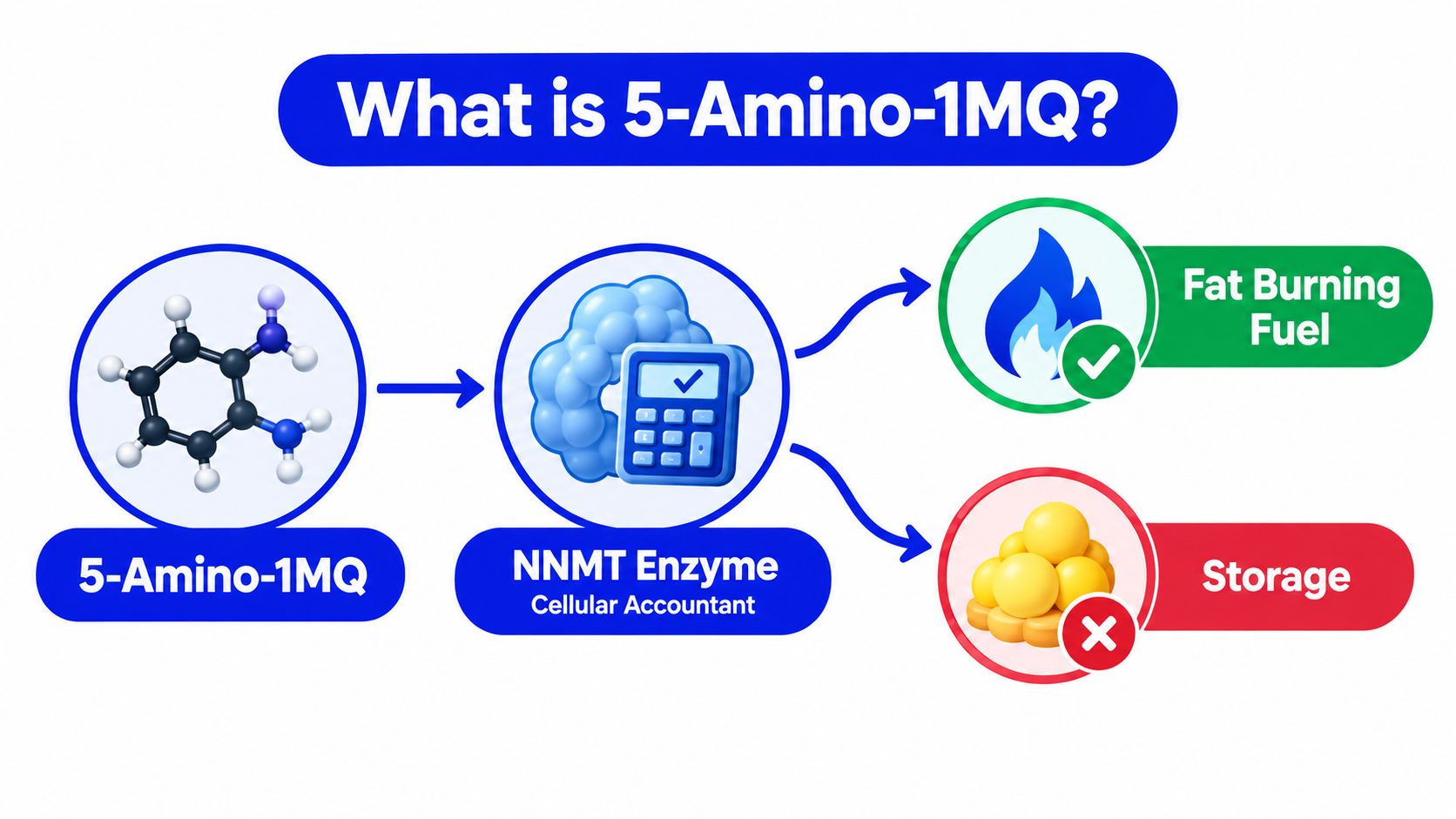
Researchers have examined NNMT in relation to adipose tissue, skeletal muscle metabolism, NAD-related pathways, and selected cancer cell lines. These areas are scientifically relevant because enzyme activity can affect cellular fuel handling and the availability of metabolic intermediates.
The current evidence should still be described carefully. Preclinical findings have generated interest, but that interest doesn't establish a therapeutic benefit, a safe human dose, or a clinically useful product. The commercial presence of a compound can move faster than the research record, especially when online discussions turn laboratory observations into personal-use claims.
The research distinction is essential:
There's no established human clinical use for 5-Amino-1MQ, and buyers shouldn't treat forum anecdotes as a substitute for peer-reviewed research. If your project requires the compound, define the assay, model, controls, and acceptance criteria before comparing suppliers.
A short educational video can help orient new researchers to the basic concept, but it shouldn't be treated as a purchasing or dosing guide.
5-Amino-1MQ is described as an investigational small-molecule research reagent, not an FDA-approved product for diagnostic, preventive, or clinical use. A current supplier statement says that no FDA-approved 5-Amino-1MQ product exists in the USA as of April 2026 (research-use listing and regulatory statement).
That status changes how a buyer should interpret a listing. There's no ordinary prescription pathway, no approved human-use label, and no basis for treating a research vial as a pharmacy product. A legitimate research purchase should remain separate from compounding, clinical administration, and consumer health marketing.
The FDA's broader enforcement activity provides useful context. In a 2026 warning-letter example, the agency classified peptide products such as Prostamax and Gonadorelin as unapproved new drugs under section 505(a) of the FD&C Act (FDA warning letter concerning wholesale peptide products). The example concerns other products, but it illustrates the regulatory risk created when research-style products are marketed outside approved pathways.
| Status Item | Current State | Buyer Implication |
|---|---|---|
| FDA approval | No FDA-approved product exists in the USA as of April 2026 | Don't treat the material as an approved medicine |
| Intended use | Laboratory and research use | Confirm the project is non-human research |
| Product labeling | Research-use-only language is expected | Reject pages that promote self-administration |
| Prescription access | No established approved prescription pathway | A research supplier isn't a pharmacy |
| Clinical marketing | Outside the research-only boundary | Avoid dosing, treatment, or disease claims |
| Enforcement context | FDA warning letters show risk for unapproved products marketed outside approved channels | Review the seller's wording, not just the disclaimer |
For a US researcher, the practical checks are straightforward. Confirm that the page says “not for human consumption,” verify that it doesn't advertise personal dosing, and keep the purchase tied to a legitimate laboratory purpose. The molecule's research status doesn't make every marketing practice acceptable.
A buyer comparing 5-Amino-1MQ listings may see similar labels, different vial sizes, and wide price gaps. That variation reflects a fragmented market rather than one standardized supply chain. Current examples include approximately $25 for a 5 mg vial and approximately $195.68 for a 50 mg vial, with implied unit costs ranging from roughly $3.91 to $6.40 per mg, depending on package size and discounting.
A separate snapshot of US-based research suppliers lists 10 mg products around $44.98 to $49.99, 50 mg products around $49.99 to $195.68, and a bundle priced at $19.00 per vial in one listing (US research-supplier market examples). These figures are historical market markers, not quality rankings.
| Pack Size | Low Listing (USD) | High Listing (USD) | Implied Per-mg Spread | Typical SKU Format |
|---|---|---|---|---|
| 5 mg | About $25 | Not specified in the verified listing | About $5 per mg at the listed price | Small research vial |
| 10 mg | About $44.98 | About $49.99 | Approximately $4.50 to $5.00 per mg | Small research vial |
| 50 mg | About $49.99 | About $195.68 | Approximately $1.00 to $3.91 per mg | Larger research vial |
| Bundle | Not specified | Not specified | $19.00 per vial in one listing | Multi-vial offer |
Price differences may result from vial size, discounts, shipping policies, repackaging, or differences in documentation. Price alone cannot establish material quality. The lowest listing may have strong records, while an expensive listing may provide little evidence.
Use per-milligram cost as an initial comparison only. A notably low price warrants closer review when the seller offers no lot-specific COA, no chromatogram, or only a generic purity statement. Higher pricing also requires support. A higher price without stronger batch data is still an unsupported claim.
The useful comparison is therefore between documentation packages, not just checkout totals. Check whether the material has a clearly identified compound, sealed packaging, lot traceability, and analytical records that can be matched to the batch you would receive.
Capsules and liquid formats need extra scrutiny because their presentation can blur the boundary between a laboratory reagent and a consumer product. For research purchasing, a format that emphasizes convenience should not replace verifiable identity and batch evidence.
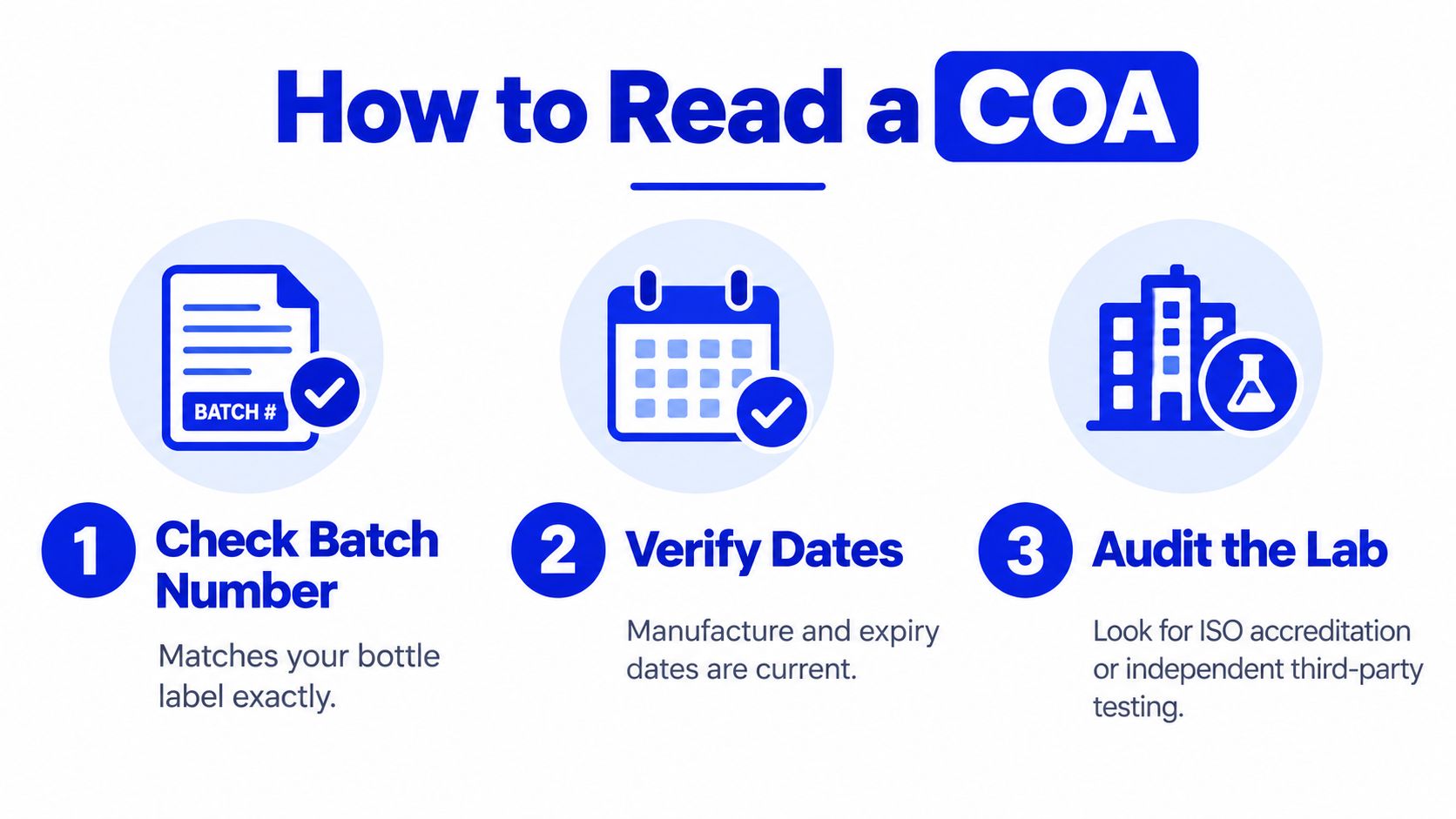
A COA is useful only when it identifies the material you're receiving. Start at the top of the document, not at the large purity number.
Check whether the COA includes:
A seller-generated summary can be helpful, but it carries less weight than a complete report from an independent laboratory. You should be able to ask for the underlying pages rather than relying on a cropped image or a typed result.
Identity testing answers a different question from purity testing. Mass spectrometry should support the expected molecular identity, while 1H-NMR can provide additional structural confirmation. For 5-Amino-1MQ, the expected molecular ion is commonly referenced at m/z 165.07 in the requested analytical framework.
A clear MS trace matters more than a sentence saying “identity confirmed.” If the report provides no spectrum, no instrument information, or no traceable sample reference, the identity claim is difficult to evaluate.
HPLC then addresses the relative composition of the tested sample. A stated purity near or above 99% can be useful, but the chromatogram should be attached so you can review the peaks, integration, sample identification, and test conditions. The result applies to the tested lot only, not automatically to every vial the supplier sells.
Residual-solvent testing can identify solvents such as acetone or methanol and should be interpreted against the applicable analytical limits used by the laboratory. Heavy-metal testing is also useful where the supplier claims it has been performed, but the report should name the analytes and show results rather than just displaying a quality badge.
Reconcile the stated assay with the net amount. A vendor may present an assay percentage and a total powder mass as separate values. Those figures describe different characteristics, so don't multiply them together unless the report clearly defines the basis of calculation.
For a broader explanation of how analysts use documentation to evaluate complex mixtures, see this practical resource on decoding terpene profiles with COAs. The same habit applies here, inspect the underlying data instead of accepting a headline result.
COA warning signs: Missing pages, absent chromatograms, mismatched lot numbers, unexplained signatures, and templates reused across unrelated compounds should all slow the purchase.
A supplier comparison works best when every seller receives the same questions. Brand familiarity can help you find a starting point, but batch evidence should decide whether a listing moves forward.
Documentation depth comes first. A strong supplier provides an independent COA with HPLC, identity confirmation, and readable supporting traces. An acceptable supplier may provide a complete report from an in-house quality group, but you should ask whether raw data or independent confirmation is available. A weak supplier supplies only a purity badge or a generic PDF.
Manufacturing transparency concerns traceability. A strong response identifies the synthesis or manufacturing facility and explains how lots are tracked. An acceptable response gives a lot number and basic production information. A weak response avoids questions about origin or sends a document that doesn't identify the tested batch.
Shipping norms should fit the material and the intended work. Ask how the seller protects sealed vials from heat, light, moisture, and tampering. Research packaging should be plain and clearly labeled, while any supplier that frames shipping around personal use deserves a no-go decision.
Technical communication is revealing. A credible seller should answer specific COA questions without redirecting you to marketing copy. If staff can't explain which test supports identity or purity, slow down.
Dispute handling matters when independent testing fails. Look for written terms covering damaged packages, missing documentation, or a material that doesn't match its stated identity. Don't assume a refund or replacement exists unless the policy says so.
For a broader approach to comparing suppliers through evidence and process, consult this PlotStudio AI vendor evaluation guide. Its general evaluation principles can complement a compound-specific review.
| Evaluation Dimension | Strong Signal | Acceptable Signal | Weak Signal | Decision Impact |
|---|---|---|---|---|
| Documentation | Independent COA with chromatograms and identity data | Complete in-house report with lot number | Generic certificate or purity badge | Strong evidence supports go |
| Manufacturing | Named facility and clear lot traceability | Basic origin and batch records | No meaningful sourcing information | Missing traceability suggests slow or no-go |
| Shipping | Sealed, tamper-evident research packaging with suitable protection | Basic sealed packaging and documented terms | Consumer-style or unclear packaging | Packaging mismatch is a no-go |
| Communication | Specific, prompt answers with raw-data access | General answers that require follow-up | Evasive or purely promotional replies | Technical clarity supports go |
| Dispute handling | Written refund or replacement process tied to testing | Basic damage or delivery policy | No usable policy | Poor recourse increases purchasing risk |
The framework is supplier-agnostic. It doesn't crown a winner. It gives you a reusable scorecard for any listing page, quotation, or sales conversation.
A research order should arrive as a sealed, clearly identified material with documentation that matches the lot. Depending on the supplier and shipping route, researchers may expect lyophilized powder in sealed vials, insulated or cold-chain shipping, tamper-evident packaging, and accompanying batch records.
Before ordering, ask the supplier to state its recommended storage conditions. In general, protect the vial from unnecessary light, moisture, and temperature changes, and follow the storage instructions provided with the tested material. Don't transfer the powder into an unlabeled container, because doing so breaks the link between the sample and its lot documentation.
Record the condition of the package when it arrives:
A shipment labeled for human or veterinary use falls outside normal research-supply expectations and should be rejected or escalated to the supplier. 5-Amino-1MQ must remain a laboratory research material, not a personal-use product.
The strongest answer to 5 amino 1mq where to buy is not a store name. It's a repeatable decision process that leaves you with enough evidence to explain why a particular lot is suitable for your experiment.
Use this checklist before payment:
Confirm the intended-use boundary. The page and packaging should identify the material as research use only and not for human or animal consumption. Avoid listings that combine that disclaimer with personal dosing or treatment claims.
Match the lot. The COA's batch number should correspond exactly to the vial or package label. A document for a different lot doesn't validate the material in your order.
Check identity evidence. Look for mass spectrometry and, where supplied, 1H-NMR data that support the expected compound. A purity percentage without identity confirmation is incomplete.
Inspect the HPLC record. Review the chromatogram, not only the reported percentage. Confirm that the test identifies the sample and that the stated purity applies to the tested lot.
Compare price with evidence. Calculate the per-milligram cost, then ask what documentation supports it. A discount can reflect package size or volume pricing, but it can't replace analytical proof.
Evaluate the supplier's answers. Ask who performed the testing, how the lot is traced, how the material is shipped, and what happens if independent testing contradicts the COA.
Review receipt and storage terms. Make sure the packaging, temperature guidance, and documentation fit your laboratory workflow before you place the order.
Keep copies of the product page, COA, invoice, shipping terms, and correspondence. That record supports internal purchasing controls and makes later analytical discrepancies easier to investigate. For additional guidance, explore resources focused on COA interpretation and supplier due diligence rather than pages that promise personal outcomes.
Peptide Warehouse USA offers research peptides and related compounds, including 5-AMINO-1MQ, with product information, research-use labeling, and batch documentation intended for laboratory, analytical, and preclinical work. Review the available details and contact the supplier with your lot-specific COA questions through Peptide Warehouse USA before deciding whether a product fits your research protocol.