No products in the cart.


What should a researcher verify before typing “Follistatin 344 buy” into a search box? The difficult part isn't finding a vial. It's determining whether the material is suitable for your protocol, whether the documentation belongs to the exact batch, and whether the seller's marketing keeps a clear boundary between laboratory research and human use.
Follistatin-344 is a complex recombinant protein with activity across important signaling pathways. A responsible purchase therefore requires more than comparing prices or reading a purity badge. This guide explains the molecule's origins, what the strongest preclinical evidence does and doesn't show, how to evaluate a Certificate of Analysis, and how to avoid regulatory problems during procurement.
A low price can look attractive until a reagent produces inconsistent results, fails a binding assay, arrives with incomplete documentation, or has been exposed to unsuitable conditions during transport. At that point, the apparent saving disappears into repeated experiments, delayed decisions, and uncertainty about whether the biology or the material caused the problem.
For Follistatin-344, procurement should be treated as a due diligence process, not a simple retail transaction. The protein's activity depends on more than its label. Researchers need confidence in identity, purity, folding, aggregation status, storage history, and functional performance.
A practical purchasing review starts with three questions:
A research reagent can be chemically pure and still be unsuitable for a particular assay. Conversely, a polished product page can describe a protein attractively without proving that the listed lot has the expected structure or biological activity.
Practical rule: If a supplier can't provide documentation for the exact batch, treat the product as unverified until the gap is resolved.
Price still has a place in a purchasing decision, but it should come after quality and traceability. A useful comparison may also include the HGH and regenerative medicine guide when a team is reviewing how research compounds differ from regulated clinical or medical contexts. The important distinction is that a research listing isn't automatically a therapeutic product, regardless of how confidently the page describes potential benefits of peptides.
Follistatin wasn't first identified as a muscle-building compound. Researchers isolated and characterized it in 1987 from porcine ovarian follicular fluid, where it was recognized as a protein that suppressed follicle-stimulating hormone, or FSH, secretion. In the same year, researchers described it as a single-chain monomeric protein of roughly 35 kDa, establishing an early structural description of the molecule. These historical details are summarized in the documented history of Follistatin-344.
The story developed further in 1988, when researchers published the human follistatin precursor and its genomic organization. That work provided the structural basis for later discussion of the FS-344 isoform and its alternative splicing patterns. It also explains why researchers should avoid treating every product called “follistatin” as interchangeable. Isoform, sequence, expression system, formulation, and test method all matter.
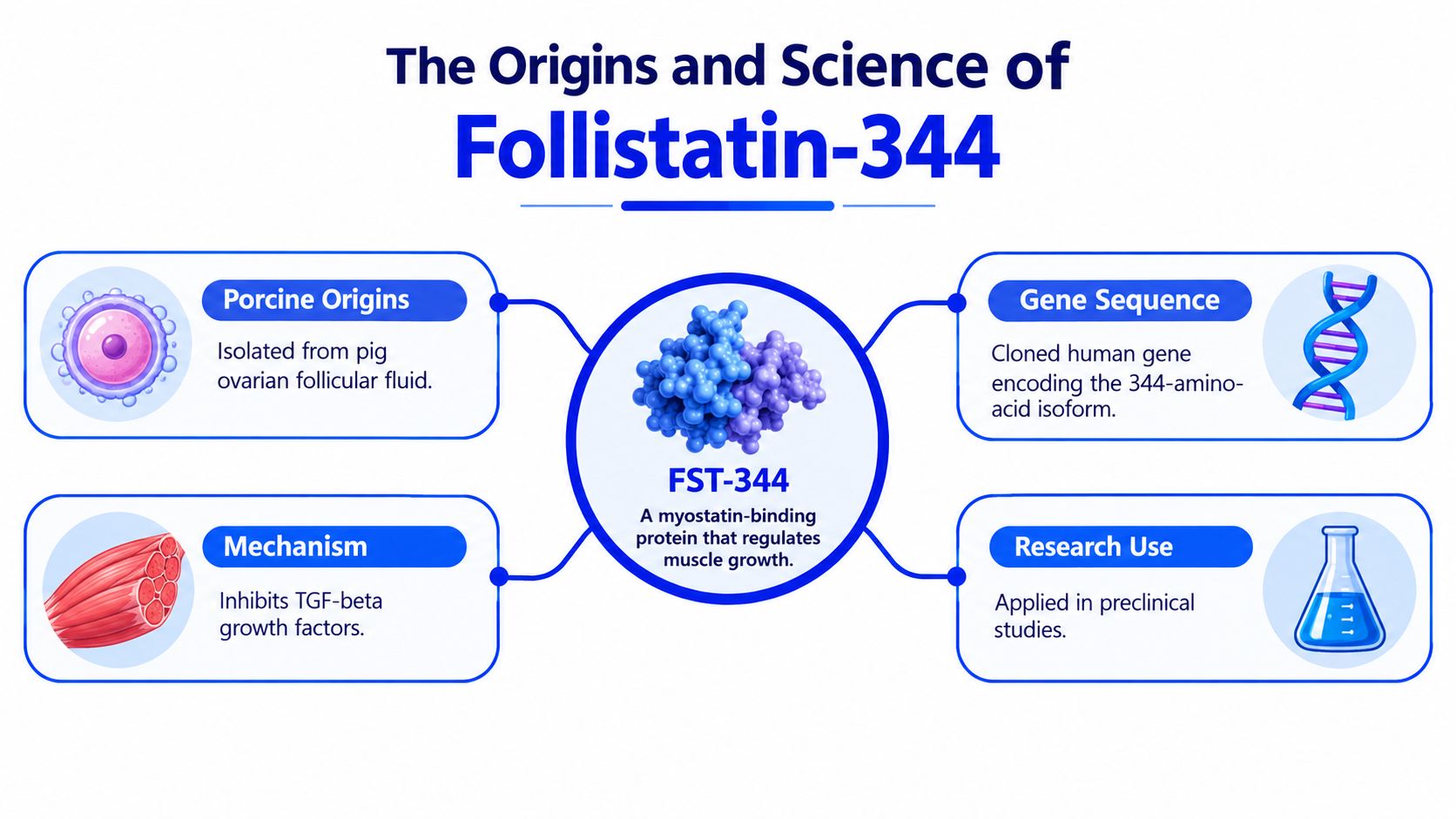
Follistatin binds signaling proteins including activins and myostatin. That interaction is the biological basis for studying it in muscle models, because myostatin and related pathways influence muscle growth and remodeling. The compound is therefore better understood as a signaling protein with broad biological relevance, not as a generic amino acid blend.
This breadth creates both opportunity and uncertainty. A molecule that interacts with more than one ligand or pathway may help researchers investigate how muscle cells, satellite cells, and related tissues respond. It can also make interpretation harder, because a measured change may not result from a single pathway.
The FS-344 label refers to a defined isoform and precursor context, not a guarantee that every commercial preparation behaves identically. A lab manager should record the exact product name, sequence or construct information when available, host or expression system, formulation, lot number, and analytical evidence before comparing results across suppliers.
For a visual overview of the molecule's history and research context, the following video provides an additional introduction:
The strongest preclinical evidence described for FS-344 involves AAV1-delivered follistatin-344 in a nonhuman primate model. That study reported durable skeletal muscle hypertrophy and strength gains, with effects lasting more than two years. The evidence is important, but its meaning depends on understanding the delivery system.
AAV1 delivery is a form of gene therapy. The vector delivers genetic instructions so that muscle tissue produces the follistatin construct. That is quite different from purchasing a vial of purified recombinant protein. A research powder and an AAV-mediated expression system can differ in distribution, exposure duration, tissue handling, immune recognition, and biological effect.
The authors described the transgene as encoding a soluble circulating isoform with low affinity for heparan-sulfate binding sites, a property that helps explain why activity remained largely muscle-focused rather than broadly retained across tissues. The study and its interpretation are summarized in the FS-344 preclinical research overview.
That finding doesn't establish that a separately manufactured protein will reproduce the same tissue distribution. It does, however, give researchers a useful mechanistic question: does the construct or preparation being tested have comparable solubility, binding behavior, stability, and exposure characteristics?
A strong experimental plan should separate the following comparisons:
| Question | Gene therapy study | Purified research protein |
|---|---|---|
| What is delivered? | A vector carrying genetic instructions | A manufactured protein preparation |
| How is exposure created? | Cells produce the encoded construct | The preparation is handled within a defined assay or model |
| What must be compared? | Vector, construct, expression, and tissue response | Identity, purity, folding, aggregation, stability, and assay activity |
| What can the result prove? | Findings about that vector-based intervention | Findings only about the tested protein, model, and protocol |
Human evidence requires even more caution. The published human program involved six Becker muscular dystrophy patients and six sporadic inclusion body myositis patients, and the studies were very small and open-label. The human evidence concerns AAV1-FS344 gene therapy, not an over-the-counter or injectable peptide sold for muscle growth, as shown in the published clinical report.
A searcher asking “Follistatin 344 buy” may therefore be looking for a product while assuming that gene-therapy findings apply directly to that product. They don't. The evidence supports continued research into delivery, signaling, and muscle biology. It doesn't establish a general human efficacy claim for a retail research reagent.
A Certificate of Analysis, or COA, is the central document in a research purchase. It should help you answer a practical question: what exactly was tested, by which method, for which lot, and with what result?
Start with identity and batch matching. The lot number on the vial, invoice, and COA should agree. If the document describes a product but doesn't identify the lot, the result may not apply to the material in your freezer.
A useful COA review includes more than one purity line:
Independent documentation also lists Follistatin-344 products with purity claims around 99% or higher, including batch-dependent values such as 99.4%, greater than 99.50%, and 99.48%. Those figures come from different listings, laboratories, and methods, so they shouldn't be ranked as though they were generated under one standardized comparison. The independent COA testing collection illustrates why method and lot context belong beside the number.
A high HPLC result doesn't prove correct folding, preserved binding, low aggregation, or performance in your specific assay. A protein can meet a chromatographic purity criterion and still behave differently after storage, transport, freeze-thaw exposure, or reconstitution.
Another research listing describes Follistatin-344 as a recombinant 344-amino-acid activin-binding glycoprotein studied in myostatin and activin antagonism, satellite cell biology, and musculoskeletal research. It also identifies HPLC, SDS-PAGE, binding ELISA, and endotoxin testing as relevant quality checks in its research-grade documentation.
Before ordering, ask the supplier for:
A purity percentage answers one question. It doesn't answer every question your assay will ask.
Supplier evaluation should resemble a short qualification audit. You're not only choosing a product. You're choosing the documentation, packaging, support, and traceability that will follow the product into your laboratory records.
Product definition comes first. The listing should identify Follistatin-344 as a recombinant research protein and distinguish it from gene therapy, a dietary supplement, a finished medicine, or a clinical formulation. Independent COA documentation describes the material as a 344-amino-acid recombinant protein intended for laboratory research, in-vitro study, and analytical use, not for human or animal consumption.
Batch records should be accessible. A supplier that can provide a matching lot number and analytical report gives your team something concrete to review. A page that only displays a general purity statement leaves you unable to confirm whether the claim applies to the vial you received.
Testing should be relevant to the experiment. HPLC may be useful for purity assessment, while SDS-PAGE, binding ELISA, endotoxin, and microbial tests answer different questions. A supplier doesn't need to publish every possible assay, but it should clearly state what was tested and what wasn't.
Shipping information should be specific. Protein stability can be affected by temperature, light, handling, and transit time. Look for clear packaging and storage information, then document the condition of the shipment when it arrives.
Be cautious if a seller combines “research use only” language with body-building promises, dosing calculators, reconstitution supplies, or instructions aimed at personal injection. A vague origin story, missing lot number, inconsistent product naming, or refusal to share a COA should also pause the purchase.
A compliant supplier treats Follistatin-344 as a specialized research tool. That tone matters because it aligns the product description with the actual use permitted by the documentation, rather than encouraging buyers to infer medical or performance applications.
The most common mistake in the Follistatin-344 market is assuming that a product sold as a peptide is equivalent to the intervention tested in a clinical research program. It isn't. An AAV1-FS344 gene-therapy study and a research-grade protein vial are different interventions, with different manufacturing controls, delivery mechanisms, exposure patterns, and regulatory questions.
A product labeled for laboratory research must remain within that boundary. It shouldn't be represented as a medicine, dietary supplement, or approved treatment, and buyers shouldn't interpret retail marketing as medical advice. Human use of a research reagent can introduce risks that the available evidence doesn't adequately define.

FDA enforcement guidance states that “research use only” and “not for human consumption” disclaimers don't protect peptide sellers by themselves when surrounding marketing and sales behavior indicates intended human use. The agency has relied on objective evidence such as marketing claims, bacteriostatic water and reconstitution supplies, and dosing calculators or guides to infer intended use under 21 CFR § 201.128, as described in this FDA enforcement analysis for unlawful peptide sellers.
For a laboratory, responsible handling means maintaining records from purchase through disposal:
Researchers should also recognize the biological uncertainty. Follistatin interacts with activin and myostatin signaling, so broad pathway effects may be difficult to predict outside the tested model. That uncertainty is a reason to use qualified personnel, validated methods, appropriate controls, and institutional oversight, not a reason to improvise a personal-use protocol.
Peptide Warehouse USA offers USA-manufactured research peptides and related compounds with batch documentation, including Certificates of Analysis and microbial or endotoxin reports, for laboratory, analytical, and preclinical applications. Visit Peptide Warehouse USA to review its research-only catalog, documentation, shipping information, and support options before selecting a supplier for your Follistatin-344 procurement process.