No products in the cart.


Peptide amino acids are easy to misunderstand because the word peptide sounds like one thing and amino acids sound like another. In lab work, they're really the same story at different stages, first as a defined chemical alphabet, then as ordered residues, then as a material whose identity depends on sequence, termini, and purity. If you read peptide catalogs, COAs, or sequence files, you're already dealing with that full system, whether the label says so or not.
Peptide amino acids matter because every sequence starts with a residue choice, every bond changes the molecule, and every analytical method answers a different part of the identity question. A peptide can look simple on paper and still raise hard questions in the lab: Is the sequence oriented correctly, are the termini defined, are the residues canonical, and does the batch match the documentation? Those are the questions researchers need to answer, and they're the ones this guide keeps returning to.
Peptide amino acids aren't a vague nutrition term here, they're the chemical vocabulary that makes peptides possible. A peptide is a chain built from amino-acid residues joined by peptide bonds, and once those residues are linked, the molecule is no longer a free amino acid mixture. It becomes an ordered structure with a sequence, direction, and analytical identity.
That distinction matters in research because the same residue set appears across biology, synthesis, and quality control. In other words, the amino-acid alphabet isn't just what living systems use, it's also what chemists rely on when they design, order, test, and document research peptides. The practical job is to track which residue is where, what changes at the termini, and whether the material you received matches the sequence you expected.
One useful way to think about peptide amino acids is as building blocks that only become meaningful when they're arranged in order. A pile of residues is not a peptide sequence, and a peptide sequence is not just a name on a vial. The name has to map to a defined structure if you want the material to be reproducible.
Practical rule: if the sequence, orientation, termini, and modifications aren't documented, the material is only partially identified.
That's why peptide chemistry keeps coming back to residue identity, side chains, and analytical confirmation. Once those pieces are clear, the rest of the article becomes much easier to read.
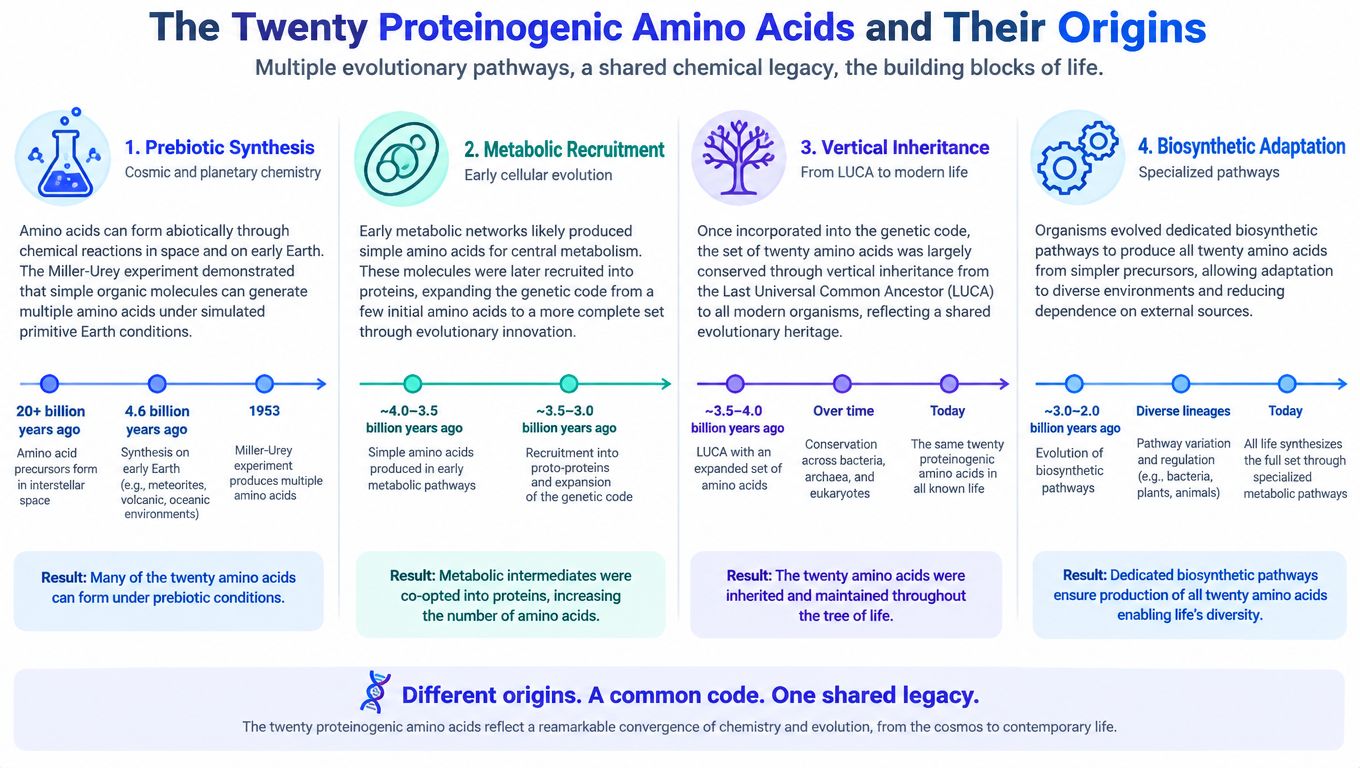
The standard biological set contains 20 proteinogenic amino acids, and that set is not arbitrary. Their carbon frameworks are recruited largely from metabolic pathways connected to glycolysis and the tricarboxylic-acid cycle, which is one reason biology settled on this particular library of residues rather than another. That same 20-member set underpins virtually all naturally occurring proteins and, by extension, most peptide research.
The history is older than many readers expect. Asparagine was first isolated from asparagus juice in 1806 by Louis-Nicolas Vauquelin and Pierre Robiquet, and the systematic discovery and confirmation of the 20 proteinogenic amino acids continued until approximately 1935. Later, in 1953, Stanley Miller showed that amino acids could form under simulated prebiotic conditions when an electrical spark passed through methane, ammonia, hydrogen, and water.
Those milestones point to two complementary facts. First, the amino-acid alphabet is biologically standardized and shaped by metabolism. Second, the basic chemistries behind these building blocks can arise through relatively simple reactions under plausible early-Earth conditions. That combination helps explain why peptide researchers care so much about identity, sequence, stereochemistry, purity, and traceability when they evaluate synthetic peptides or amino-acid-based compounds.
Analytical takeaway: a peptide supplier isn't just selling a name, it's selling a specific residue set in a specific structural context.
That's also why documentation has to be precise. If a batch record doesn't tell you what the residues are, how they're arranged, and what chemistry was used to make them, you still don't really know what you have. The alphabet is fixed, but the message can still be wrong.
Every amino acid shares the same backbone architecture, but the R group, or side chain, is what gives each residue its personality. That side chain controls polarity, charge, steric bulk, and reactivity, which is why two peptides with similar lengths can behave very differently in solution or in a binding assay. The chemistry of the side chain often matters more than the number of residues.
Charged residues drive ionic interactions and can strongly influence solubility. Hydrophobic residues contribute to membrane association, packing, and aggregation behavior. Aromatic residues can affect UV detectability and stacking interactions, while sulfur-containing residues bring their own stability questions.
A few edge cases help anchor the concept. Glycine is unusually small, so it gives the backbone more flexibility than most residues. Proline is different again because its ring structure restricts backbone movement, which can change local shape in ways that matter for folding and synthesis.
When a peptide changes from one residue to another, you're not just swapping a letter. You can change:
That's why peptide amino acids are best understood as a chemical coding system, not a nutrition chart. If you know the side chain class, you can often predict whether a sequence will be more hydrophilic, more hydrophobic, more flexible, or more sensitive to oxidation and structural distortion.
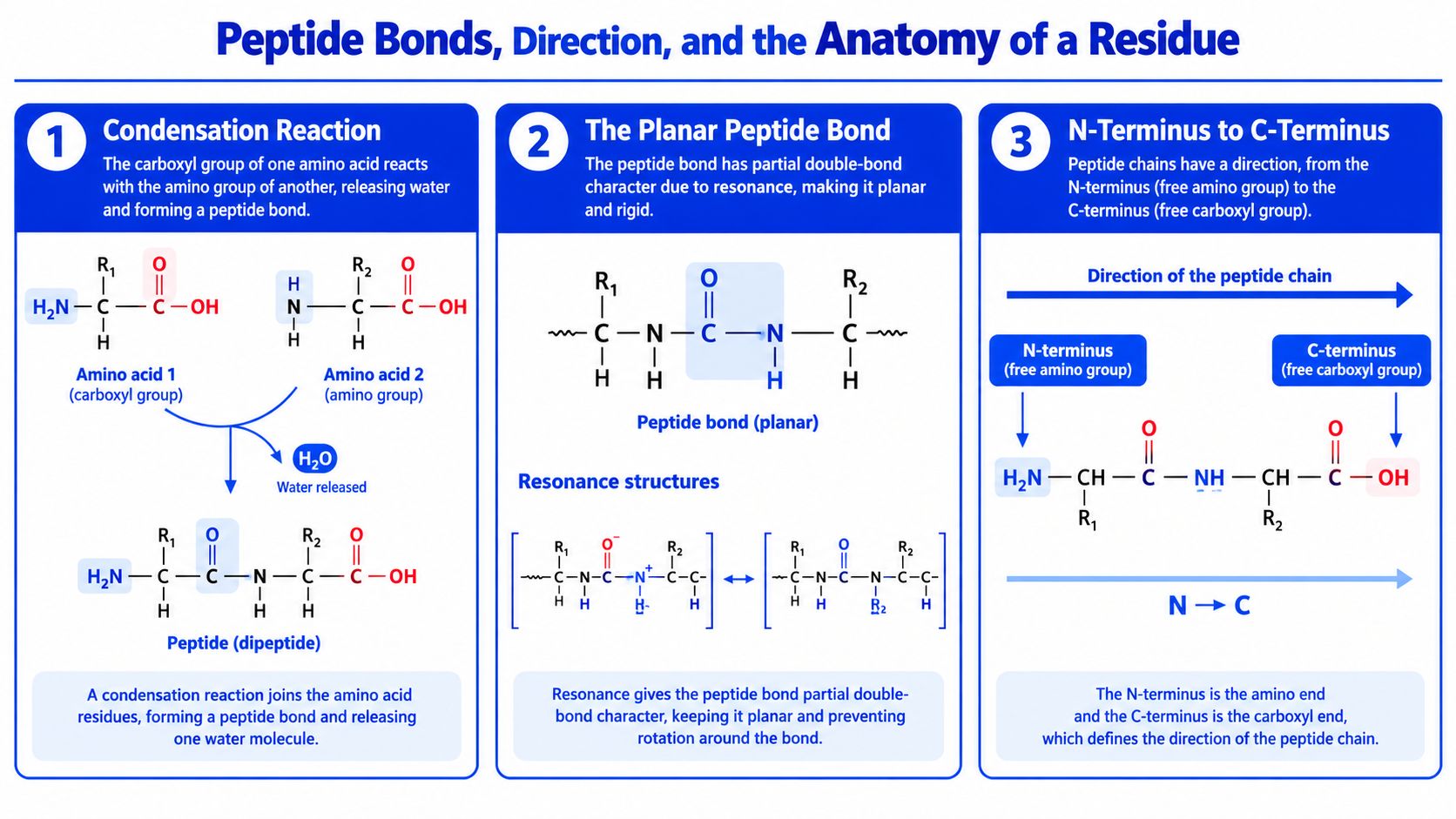
A peptide bond forms when the carboxyl group of one amino acid reacts with the amino group of another in a condensation reaction, releasing water. What's left behind is an amide linkage, and once that happens, each incorporated amino acid is described as a residue rather than a free amino acid. That wording isn't cosmetic, it reflects the chemistry of what was lost during bond formation.
The peptide bond also has partial double-bond character, which restricts rotation and makes the local backbone relatively planar. That structural constraint is one reason peptides have defined shapes instead of behaving like loose chains in space. The chain is conventionally written from the N-terminus on the left to the C-terminus on the right.
A reversed sequence is a different molecule. A duplicated residue changes the composition. A missing terminal group changes the analytical identity. Those aren't small notational differences, they're structural changes that can alter mass, charge, and behavior.
Solid-phase peptide synthesis uses this same logic, because residues are added in a defined order that matches the N-to-C reading convention. That means sequence notation, synthesis planning, and analytical reporting all depend on the same directional standard. If the direction is unclear, the interpretation gets shaky fast.
A peptide sequence is not fully identified until the residue order, termini, and modifications all line up.
For graduate-level work, that's the key habit to build early. Read the chain as a directed structure, not as a set of ingredients.
IUPAC naming gives researchers a practical way to describe residues without ambiguity. Standard one-letter and three-letter symbols are used for amino-acid notation, and internal residues are conventionally written in acyl form, ending in -yl, while the C-terminal residue keeps the amino-acid name. That convention helps distinguish the internal sequence from the terminal chemistry.
Many product labels become too thin to be useful. A peptide name alone rarely tells you the full structure, especially if there are terminal modifications, noncanonical residues, or metal complexes. A complete record should identify the sequence, orientation, termini, and any modifications that affect identity.
A usable peptide description should cover:
That is the level of detail you need when reading a COA, a synthesis sheet, or a procurement record. It's also why some peptide names can be misleading if the documentation stops at a marketing label.
The practical lesson is simple. If the sequence isn't clear on paper, it isn't clear in the lab.
Many peptide sequences are defined not just by their canonical residues, but by what happens to them during synthesis, handling, or storage. Terminal amidation and acetylation change end-group chemistry, and disulfide bonds between cysteines can lock parts of a molecule into a specific shape. Those changes often influence stability, solubility, and analytical readouts.
Some residues are chemically fragile. Cysteine can undergo oxidation, carbamidomethylation, and cyclization under certain conditions. Methionine is vulnerable to oxidation. N-terminal glutamine can convert to pyroglutamic acid, and certain sequence motifs involving asparagine, glutamine, aspartic acid, glycine, or proline are associated with deamidation or cleavage-prone behavior.
A peptide can carry the right nominal sequence and still contain a chemically altered subset of molecules. That's why quality assessment can't stop at the intended order of residues. Storage, light exposure, oxidation risk, and sequence context all shape the final material.
For researchers comparing batches, the key question is not only “What sequence was made?” but also “What fraction of the batch still matches that sequence in the expected chemical state?” That's a much more useful question than relying on a label alone.
Good lab habit: check whether the sequence contains residues or motifs that are known to shift during synthesis or storage before you interpret any downstream assay.
When modification status is documented clearly, it becomes easier to explain differences between batches and avoid false conclusions about the peptide itself.
A purity percentage by itself doesn't tell you whether a peptide batch is fit for a specific experiment. Quality needs orthogonal evidence, meaning different tests that answer different questions. Identity, assay or content, impurity profiling, sequence verification, stereochemical assessment, residual-solvent testing, and, where relevant, aggregation, endotoxin, microbial, and stability data all belong in the conversation.
A recent regulatory review separates impurity sources into three broad origins, starting materials, manufacturing reactions, and degradation during production or storage. That matters because two batches with the same nominal purity can have very different impurity profiles and therefore very different practical usefulness.
Amino-acid analysis is a composition check, not a full structural proof. Published reference-standard work describes hydrolysis in 6 N hydrochloric acid with 4% phenol at approximately 110 °C for 18 hours, followed by acid removal, resolubilization, filtration, and chromatographic analysis, with pre-column OPA/FMOC or post-column ninhydrin derivatization (published amino-acid hydrolysis method). It can support amino-acid content, but it can't by itself establish sequence order, terminal chemistry, disulfide connectivity, or many post-translational modifications.
That's why reversed-phase HPLC and mass spectrometry belong beside it. HPLC helps evaluate purity and homogeneity, while mass spectrometry confirms molecular mass and can reveal mismatches that a single chromatogram won't catch.
For teams that want a supplier with this kind of documentation, Peptide Warehouse USA is one option for research peptides supplied with batch records and third-party testing. The point isn't the label, it's whether the evidence is complete enough for your experiment.
Research-use language does a narrow job, and it doesn't replace evidence. Materials labeled for laboratory, in-vitro, or analytical use have not received FDA approval for human administration or treatment, and marketing them for therapeutic use can change how they're viewed. That distinction matters because a research chemical is not the same thing as a medicine just because it appears in the same category of online discussion.
The broader issue is evidence quality. Research-use designation doesn't stand in for clinical data, sterility assurance, validated dosing, or medical supervision. It also doesn't solve the impurity question, since there isn't a single universal threshold for every peptide-related impurity, limits are often justified case by case using manufacturing, stability, toxicology, and batch data.
A peptide can be the same sequence and still raise different quality concerns depending on the format. Nasal, injectable, and oral presentations introduce different exposure and control issues, so the documentation has to match the intended route and use case. That's why the same named compound can be discussed very differently across research, consumer, and regulated settings.
For common research peptides such as BPC-157, TB-500, PT-141, GHK-Cu, and Semax, the label alone doesn't resolve the core question. The core question is whether the product is chemically characterized, appropriately documented, and matched to the use you're evaluating.
| One-Letter | Three-Letter | Side-Chain Class | Peptide Research Note |
|---|---|---|---|
| A | Ala | Nonpolar | Common backbone-friendly residue, often used in conservative substitutions. |
| R | Arg | Positively charged | Strongly influences binding, salt formation, and solubility. |
| N | Asn | Polar uncharged | Can be sensitive to deamidation in certain sequence contexts. |
| D | Asp | Negatively charged | Adds acidity and can shift local electrostatics sharply. |
| C | Cys | Sulfur-containing | Important for disulfides, oxidation state, and cyclization risk. |
| E | Glu | Negatively charged | Longer side chain than aspartate, often changes spacing in charge patterns. |
| Q | Gln | Polar uncharged | N-terminal conversion to pyroglutamic acid can matter in stability work. |
| G | Gly | Nonpolar | Smallest residue, increases backbone flexibility. |
| H | His | Positively charged | pH-sensitive and often useful in binding or catalytic contexts. |
| I | Ile | Nonpolar | Hydrophobic residue, often contributes to packing. |
| L | Leu | Nonpolar | Hydrophobic and common in core or binding regions. |
| K | Lys | Positively charged | Frequently used to tune charge and solubility. |
| M | Met | Sulfur-containing | Oxidation-sensitive, so storage and handling matter. |
| F | Phe | Aromatic | Useful in hydrophobic and stacking interactions. |
| P | Pro | Nonpolar | Restricts backbone flexibility and can reshape local geometry. |
| S | Ser | Polar uncharged | Common site for phosphorylation in modified sequences. |
| T | Thr | Polar uncharged | Often discussed alongside phosphorylation and polarity. |
| W | Trp | Aromatic | Strongly influences UV behavior and hydrophobic interactions. |
| Y | Tyr | Aromatic | Can participate in phosphorylation and aromatic stacking. |
| V | Val | Nonpolar | Compact hydrophobic residue, often found in core regions. |
The table above gives you a fast way to translate sequence notation into chemistry. If a sequence contains several charged residues, expect different behavior than one dominated by hydrophobic or aromatic residues. If it contains cysteine, methionine, or glutamine at sensitive positions, read the batch documentation more carefully.
Peptide amino acids become much easier to work with once you connect the residue, the bond, the notation, and the quality data into one mental model. If you're sourcing research-grade materials and want a supplier that documents sequences with batch-level testing, visit Peptide Warehouse USA to review its catalog and supporting documentation.