No products in the cart.

BPC-157 is still an experimental research peptide, and the published human evidence is limited to three small pilot lines of evidence with fewer than 30 total subjects across uncontrolled reports, plus one intravenous safety pilot with only 2 healthy adults. In the Swiss Chems context, that means you're not evaluating a proven therapy. You're evaluating a research-use-only peptide material, commonly encountered in lyophilized form, where COAs and third-party documentation matter far more than outcome claims.
Most buyers search for BPC 157 Swiss Chems because they want answers about healing, recovery, weight loss, or muscle growth. That's the wrong first question. The better question is simpler: can the lot in front of you be verified well enough for legitimate lab work?
That shift changes everything. Instead of asking whether a supplier page sounds convincing, you start asking whether the product identity is documented, whether the batch data is complete, and whether the label tells you anything clinically useful at all.
For BPC-157, the evidence gap is the central fact. A recent review found that published research is overwhelmingly preclinical, with no peer-reviewed, published randomized controlled human trial showing efficacy or safety for any medical indication, and even the human reports that do exist lacked key controls such as placebo comparison, blinding, standardized outcomes, and long-term follow-up (review summary). That's why due diligence matters more than marketing.
Why do researchers search for BPC 157 Swiss Chems in the first place? Usually because they are trying to answer two separate questions that suppliers often blur together: what BPC-157 is as a compound, and whether a specific seller presents enough documentation to justify buying a lot for lab work.
BPC-157 is generally described in the literature as a 15-amino-acid synthetic peptide investigated in preclinical settings, while human evidence remains sparse and methodologically weak. A clinical review in the Medical Journal of Australia concluded that published human research is limited, uncontrolled, and insufficient to establish safety or efficacy for therapeutic use (clinical evidence review).
That context matters more than any product headline. A vial label or capsule count can describe a unit of sale, but it does not establish that the peptide has a clinically validated use, a settled dosing framework, or an approved medical role.
Practical rule: Treat BPC-157 first as a material that requires identity and quality verification, not as a shortcut to any promised outcome.
Swiss Chems shows up in peptide searches because it is part of the research-chemical market, where buyers compare vendors on stock status, format, documentation, and handling convenience. The relevant question is not whether the brand name appears often. The relevant question is whether the listing gives enough information to examine the lot like a research input.
The product language associated with Swiss Chems BPC-157 classifies the material as research-use-only and not for human consumption, which places it in the category of laboratory supply rather than approved drug product, as noted in the Swiss Chems product information.
A credible evaluation starts with the parts of the listing that can be checked against records, not the parts written to suggest outcomes.
The buyer advantage comes from this screening process. Supplier pages can market possibilities. Reproducible lab work depends on whether the lot can be verified.
A supplier can sell the same peptide in multiple formats, but the format changes what a researcher can verify. For BPC-157 listings associated with Swiss Chems, that distinction matters more than the headline purity number.
Swiss Chems-related BPC-157 searches commonly surface two retail-facing formats: lyophilized powder and capsule products. Those formats create different quality-control questions from the start.
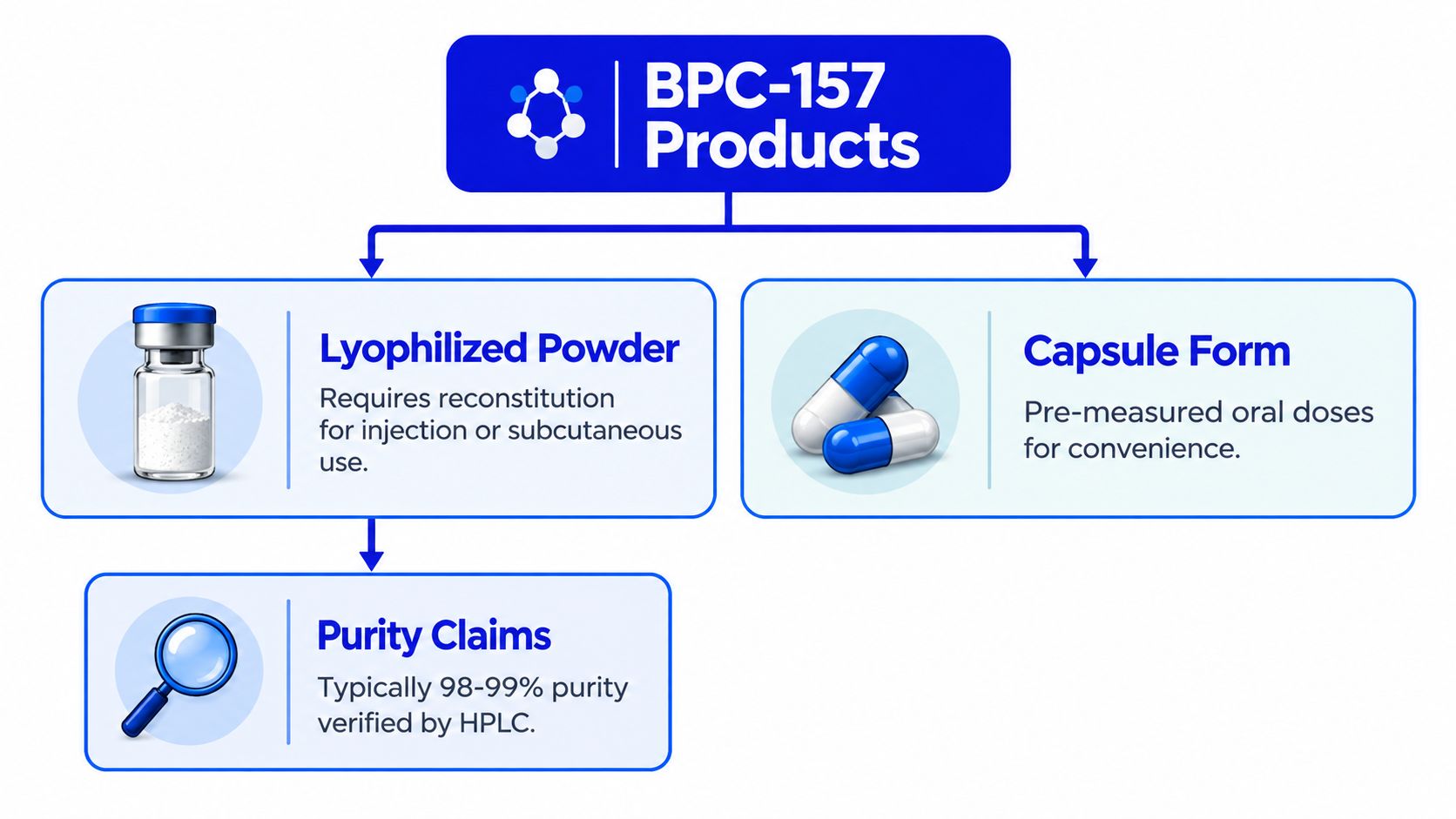
A lyophilized powder is easier to evaluate as a discrete batch material. A lab can request batch-specific chromatograms, identity testing, and fill information tied to one lot. A capsule product adds more variables, including excipients, blend uniformity, capsule fill variance, and stability of the finished preparation rather than the peptide alone.
That difference is often overlooked on supplier pages. Marketing language treats both formats as if they represent the same research input. They do not.
The gap is even wider for route-related claims. A peer-reviewed review of the human evidence concluded that current studies do not answer many of the safety and efficacy questions raised around nonstandard routes such as subcutaneous, intranasal, or topical use, and the authors argued that BPC-157 should remain investigational (review on available human evidence).
A posted purity percentage can be useful, but it is only one analytical result. Researchers still need to know what method produced that number, what impurities were separated, and whether the result applies to the finished product or only to the starting peptide material.
A high purity claim does not establish:
This is the due-diligence problem with peptide shopping. The most visible number on the page is rarely the one that determines whether the lot is fit for a controlled research workflow.
Purity is one property of a lot, not a complete quality judgment.
Researchers should also separate labeled quantity from interpretable exposure. As noted earlier, the available literature does not provide a validated basis for converting a vendor's stated amount into a reliable human dosing inference. Pharmacokinetic uncertainty, route-dependent absorption, and formulation differences all limit that kind of extrapolation.
For a buyer evaluating a peptide lot, the practical conclusion is straightforward. The stated milligram amount helps with inventory planning and experiment setup. It does not confirm therapeutic relevance, route suitability, or reproducible biological effect.
A supplier page can look polished and still leave out the details that matter. Researchers need a simple screening process that separates documented quality from presentation quality.
The first rule is to evaluate the specific batch you may receive. Vendor reputation matters, but lot-level variation matters more. Independent reporting summarized in FDA briefing materials described a testing project across peptide samples in which ten samples across three peptides were reportedly examined, with four passing and six failing, and the reported failures were largely related to vial fill quantity, even when the expected compound was detected (FDA briefing materials).
That doesn't prove every Swiss Chems lot is deficient. It does prove a broader point that applies to peptide procurement in general: identity alone is not enough.
The strongest review process compares multiple quality attributes side by side.
| Verification Element | Why It Matters |
|---|---|
| Identity confirmation | Confirms the material is actually BPC-157 rather than a mislabeled peptide or degraded sample |
| Purity result | Helps estimate the proportion of target peptide relative to impurities, but doesn't answer every quality question |
| Fill quantity | Affects reproducibility. A correct identity with inconsistent quantity still creates unreliable research inputs |
| Residual solvent data | Shows whether manufacturing or cleanup residues were assessed |
| Microbial or sterility data | Relevant when a supplier presents the material as a controlled research product rather than just a chemical label |
| Endotoxin reporting | Important for labs that need a cleaner picture of contamination risk |
| Storage stability | Helps determine whether the tested condition remains meaningful over time |
| Batch number matching | Confirms the COA actually corresponds to the lot offered for sale |
Not all paperwork carries the same weight. A manufacturer summary may still be useful, but independent lot-specific testing often gives buyers a clearer basis for trust because it reduces the chance that a site is recycling one generic report across multiple batches.
A practical side-by-side comparison helps:
Watch for common gaps:
A research buyer doesn't need perfect certainty. But they do need enough verified detail to know what they're buying.
A lot of confusion around Swiss Chems BPC-157 starts with the phrase research use only. Buyers often read that label as a safety signal. It isn't one.
A research-use-only label tells you how the seller is positioning the product. It does not tell you that the product is safe for people, clinically studied, or approved for treatment.
FDA briefing documentation states that neither BPC-157 free base nor BPC-157 acetate has a United States Pharmacopeia or National Formulary drug-substance monograph, and neither form is an ingredient in an FDA-approved drug. The same document records FDA's proposal not to add either form to the 503A Bulks List (FDA briefing document).
That's a clean regulatory line. BPC-157 remains an investigational compound rather than an approved medicine.
Swiss Chems entered a significant U.S. regulatory moment on December 10, 2024, when the FDA issued a warning letter concerning the marketing of semaglutide and retatrutide as unapproved new drugs and misbranded products. The FDA record identifies the action under MARCS-CMS 695663, and the agency stated that it had reviewed the company's website in October 2024 as well as its Facebook and Instagram pages (Swiss Chems regulatory summary).
That warning letter did not establish a BPC-157-specific violation. What it does show is more important at a policy level: regulators don't decide intended use based only on a “research use only” label. They also look at website presentation, promotional language, and surrounding claims.
If a product page pushes treatment-style outcomes, the label alone won't carry the compliance burden.
The practical takeaway isn't legal panic. It's better skepticism. If a peptide page leans heavily on healing, antiaging, fat loss, or muscle growth narratives while keeping the documentation thin, the buyer should read the page as a marketing object first and a scientific record second.
That's especially true for BPC-157, where the evidence base remains narrow and the clinically relevant questions haven't been answered.
A COA can help, but only if you know how to read it. Many buyers stop at the purity line and never examine whether the rest of the document supports reliable procurement.
Start with the basic identifiers. The lot number, test date, and product description should line up with the listing and the item offered for sale. If they don't, the document may still be real, but it isn't proving much about the actual batch.
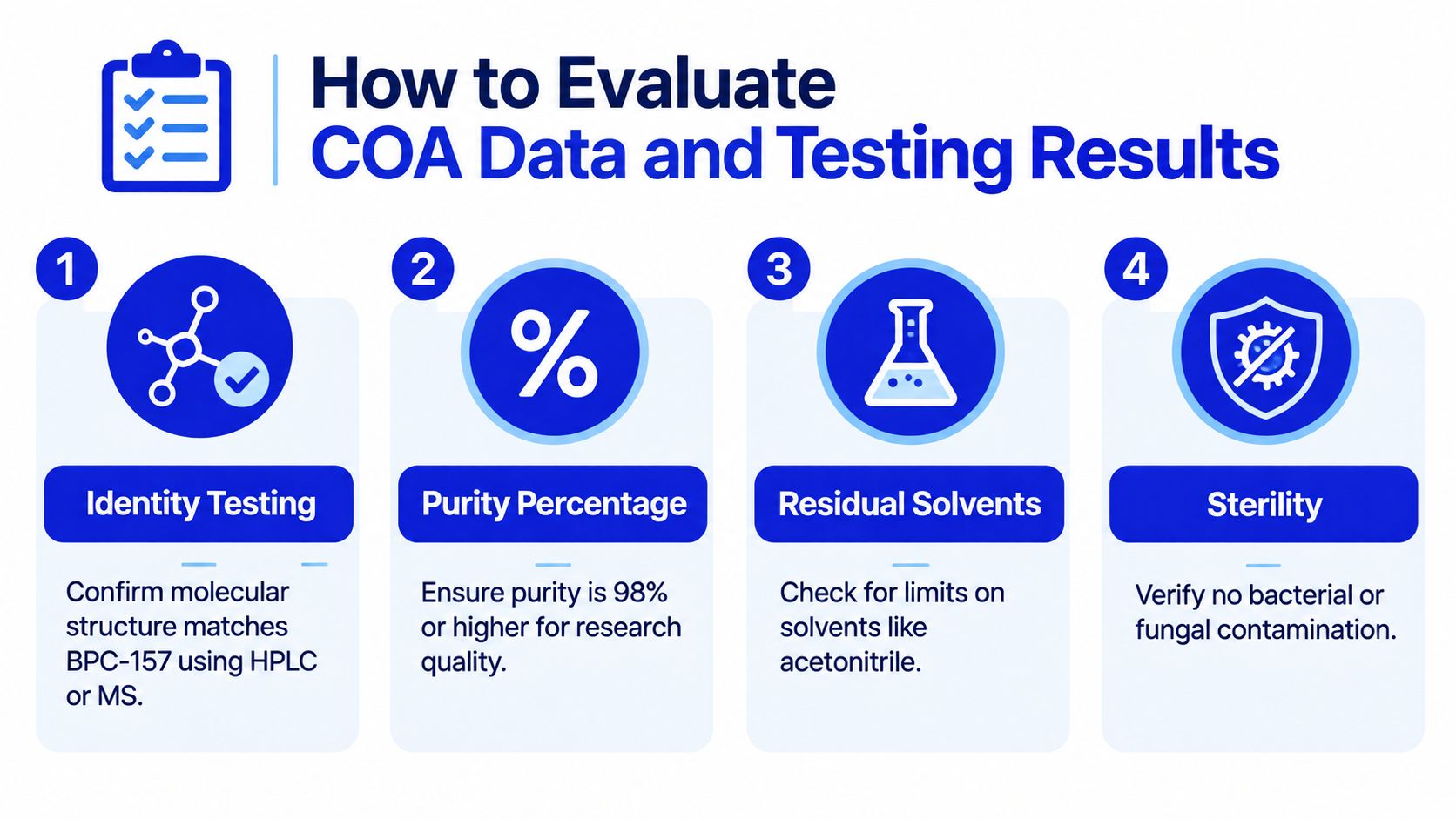
Then read the analytical content in this order:
Identity first
If the document doesn't establish that the sample matches BPC-157, a purity figure is far less useful.
Purity second
Purity helps characterize the sample, but it doesn't tell you whether the vial is filled correctly or whether contamination risks were assessed.
Contaminant-related data next
Residual solvents, microbial reporting, endotoxin findings, and related checks help you understand what else may be present or what wasn't checked.
Quantity and consistency last
Fill quantity affects experimental repeatability. This is one of the easiest things for buyers to overlook.
That matters because independent testing attention has already highlighted fill-weight variability as a real procurement issue in this category. A peptide can be the expected compound and still be underfilled, which leaves the buyer with a material that looks legitimate on paper but performs inconsistently in practice.
For researchers who want a plain-language framework for decoding your test numbers, that guide is useful as a general reminder that lab results need context, not just a pass-fail glance.
A vendor option in this broader market is Peptide Warehouse USA, which states that its research-peptide lots are supported by third-party COAs along with microbial and endotoxin reports. That doesn't remove the need to read the batch documents, but it does show the kind of multi-attribute packet buyers should look for.
Later in the review process, it also helps to watch this explainer before comparing one supplier packet against another:
The human safety literature is easy to overread. One PubMed-indexed pilot involved only 2 adults who received intravenous infusions of 10 mg on day 1 and 20 mg on day 2, each diluted in 250 cc of normal saline and administered over one hour. The report found no measurable changes in tested cardiac, hepatic, renal, thyroid, or blood-glucose biomarkers and no reported side effects during that observation period, while also stating that additional studies are needed (pilot safety study).
That's interesting. It is not broad validation.
A small IV tolerability pilot does not validate oral, subcutaneous, intramuscular, topical, capsule, or nasal retail formats.
What should a careful buyer value more. outcome language, or documentation that can survive laboratory scrutiny?
For BPC 157 Swiss Chems, the second standard is the only one that reduces procurement risk. Human evidence remains limited, as noted earlier, so the decision should turn on whether a supplier provides enough batch-level information to treat the material as a defined research input rather than a branded idea.
A useful purchasing framework starts with three checks. First, separate supplier claims from evidence. Second, confirm that any certificate of analysis is tied to the exact lot offered for sale. Third, ask whether the testing packet answers more than one question. Purity alone does not address identity, net content, microbial burden, endotoxin exposure, or storage handling.
That distinction matters because peptide marketing often compresses uncertainty into a simple promise. For an investigational compound with a thin human record, that shortcut increases risk. The practical advantage comes from verifying the lot, not from accepting broad claims about recovery, repair, or performance.
A disciplined screening process usually looks like this:
Some cases justify walking away.
That is true when the seller relies on vague purity language, cannot produce batch-matched records, or leaves basic questions unresolved about fill quantity and contamination screening. A poorly documented lot does more than create uncertainty at checkout. It can weaken the entire downstream workflow by making failed replication harder to interpret.
The central buying principle is straightforward. With research peptides, procurement discipline is part of research quality. If Swiss Chems BPC 157 meets your documentation standard, that is useful. If it does not, marketing language should not close the gap.
For researchers comparing suppliers through that due-diligence lens, Peptide Warehouse USA presents another packet to examine. The company states that its research-use peptide lots are supported by batch-specific COAs, microbial reports, and endotoxin testing. Reviewing that documentation is a practical way to apply the same verification standard used throughout this guide.