No products in the cart.


Peptide therapy research looks modern, but its most important lesson is old. The field didn't begin with social media, it began with insulin in 1922, which showed that a peptide could be isolated, manufactured, and used as a medicine at scale (MDPI review). That single milestone still shapes how researchers think about benefits of peptides, receptor biology, formulation, and the gap between approved medicine and research-only material.
Peptide therapy research has advanced by solving one hard problem after another. Insulin established that a peptide could be isolated and used as medicine. Later synthetic hormone products such as oxytocin and vasopressin, then recombinant human insulin in 1982, and peptide medicines like leuprolide, octreotide, and glatiramer acetate in the 1980s and 1990s showed how the field moved from purification to stability to receptor selectivity (MDPI review).
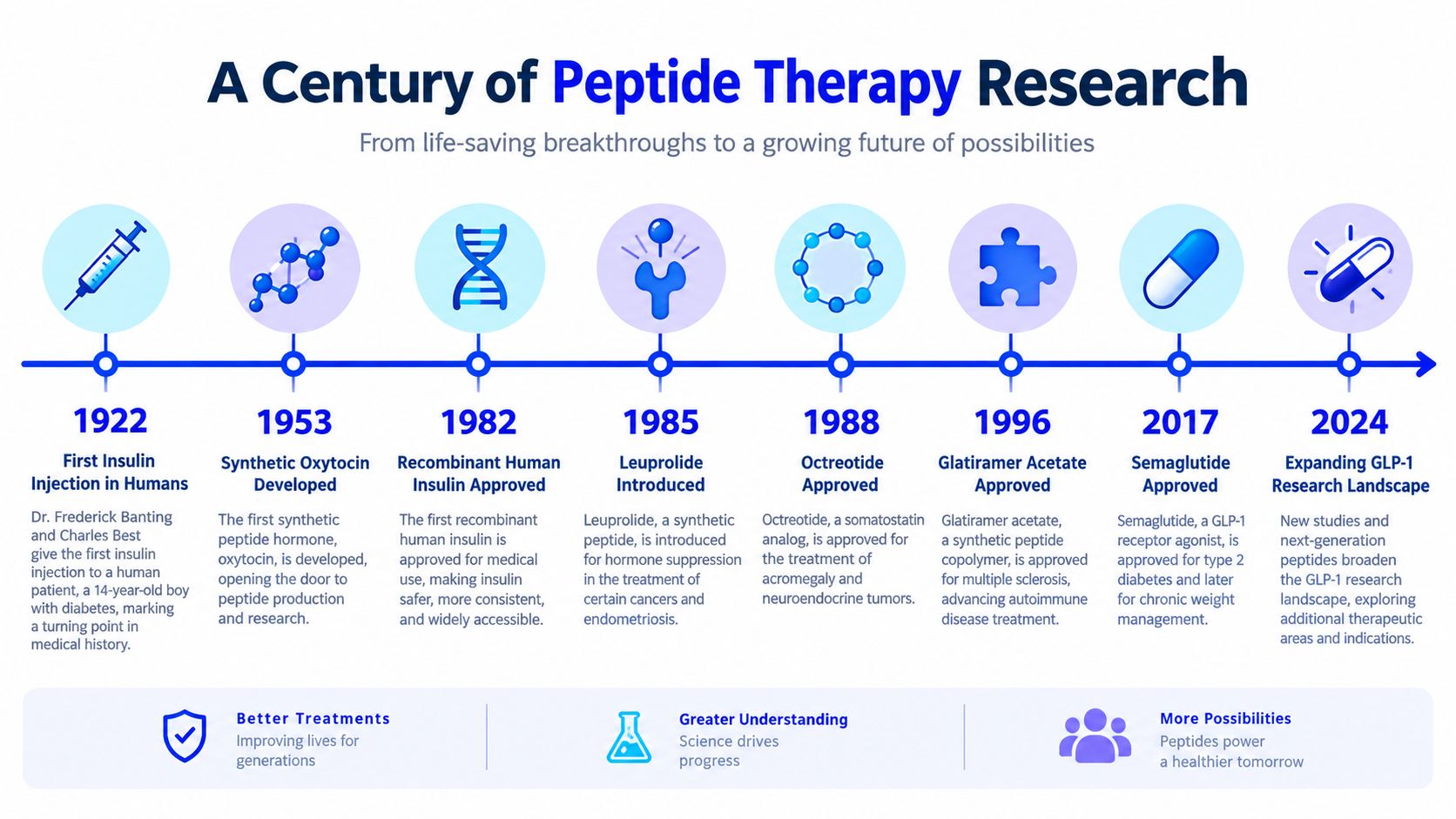
Early peptide medicine proved the concept. Mid-century products showed that scientists could make peptide hormones more consistently, which mattered because each batch had to behave the same way in patients. Later work added chemical modification, long-acting formulations, and receptor-selective analogues, helping peptides survive normal breakdown pathways and act with more precision (MDPI review).
That history matters because it explains why peptides are not a passing wellness category. A peer-reviewed review reported that the FDA approved five peptide drugs and one peptidomimetic in 2017, and those products made up 13% of all drugs accepted that year (MDPI review). Another review places the field at roughly 100 FDA-approved therapeutic peptides overall, with about 31 approvals in the seven years preceding 2024.
Practical rule: if a peptide project ignores the century of formulation work behind this class, it is probably missing the reason one candidate succeeds while another stalls.
For a structured way to read the historical literature before you design a project, a literature review process guide can help you separate landmark findings from isolated enthusiasm.
The important takeaway is simple. Peptide research is mature enough to produce clinically established treatments in endocrinology, oncology, reproductive medicine, hematology, neurology, and rare disease, but uneven enough that many newer compounds still live only in research pipelines. That tension, mature platform and uneven evidence, is where good experimental design starts.
A peptide is a short chain of amino acids, and amino acids are the building blocks of proteins. The length alone doesn't make a peptide useful, the shape does, because folding turns a simple chain into a structure that can fit a specific receptor. That's why peptide biology feels a lot like a key finding the right lock.
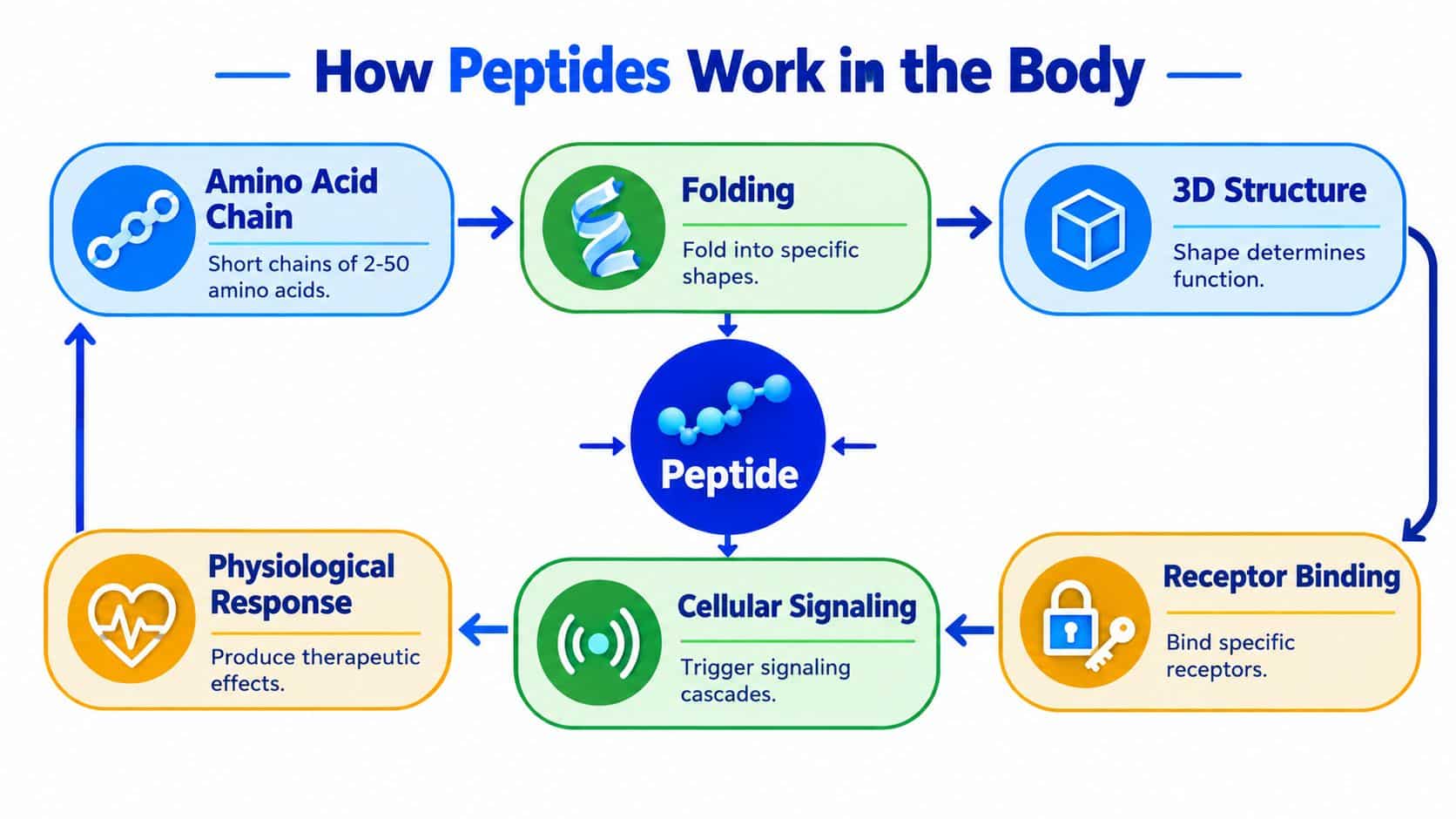
When a peptide binds a receptor, it can act as an agonist, which turns signaling on, or an antagonist, which blocks signaling. In plain language, the peptide either presses a biological button or prevents someone else from pressing it. That's why two peptides with similar-looking sequences can produce very different outcomes.
Researchers improve peptide candidates by changing the sequence, cyclizing the chain, or adding lipid groups to extend half-life and improve stability. Those changes can slow enzymatic breakdown and help the molecule stay active long enough to matter in the body. Without that step, a promising binding event can disappear before it becomes a measurable physiological response.
A peptide that binds well but disappears too fast usually teaches you more about pharmacokinetics than pharmacology.
The educational trap for new lab members is assuming receptor binding equals therapeutic success. It doesn't. A candidate still has to survive the route of administration, reach the target tissue, stay intact long enough, and produce a response that's meaningful rather than merely measurable.
The Harvard overview on peptides summarizes the basic biology well, including the idea that peptides are short amino-acid chains with highly specific functions, but the lab lesson is more precise: sequence, folding, receptor selectivity, and exposure time all matter together. If one of those pieces fails, the whole mechanism can fail with it.
Modern peptide research clusters in a few therapeutic areas because peptides act with high receptor selectivity. Metabolic medicine is the clearest example, especially GLP-1-based peptide therapies and related incretin analogues. These compounds show how a sequence of amino acids can move from receptor biology into large clinical programs and everyday prescribing (GLP-1 clinical review).
Peptide medicines also appear in cancer, osteoporosis, acromegaly, immune disorders, thrombocytopenia, and rare neurological diseases (FDA peptide-drug overview). That spread matters. It shows peptides are not tied to one organ system or one commercial niche. They function as a platform, not a single use case.
| Therapeutic area | Example mechanisms | Research maturity |
|---|---|---|
| Metabolic disease | GLP-1 and incretin signaling | Highly developed |
| Oncology | Receptor-selective signaling and targeting | Established and expanding |
| Reproductive medicine | Hormone pathway modulation | Established |
| Hematology | Thrombopoietin-related activity | Established |
| Neurology | Calcitonin gene-related peptide, or CGRP, antagonism | Growing |
| Rare disease | Pathway-specific replacement or modulation | Variable |
The FDA overview also notes that more than 130 approved peptide drug products are designated as reference listed drugs (FDA peptide-drug overview). That figure does not mean every research peptide is approved or fit for human use. It does show a large regulatory and manufacturing base that new projects can build on instead of starting from zero.
For researchers, the practical distinction is simple. An indication with approved peptide medicines usually has enough biological rationale, dosing logic, and regulatory history to support serious planning. A field without approved products is usually more speculative, and the line between research-grade material and FDA-reviewed science becomes much more important.
The clearest way to read peptide therapy research is to treat a trial like a lab protocol, not a headline. In the 68-week STEP 1 trial, 1,961 adults with obesity or overweight plus at least one weight-related comorbidity received once-weekly subcutaneous semaglutide 2.4 mg with lifestyle counseling. The semaglutide group lost 14.9% of mean body weight, while placebo lost 2.4%, for a placebo-adjusted difference of 12.4 percentage points with a 95% CI of 11.5 to 13.4 and P<0.001 (NEJM STEP 1 trial).
Start with the comparator and the size of the effect. Then ask whether the exposure window matches the biology, because a peptide used as weekly maintenance therapy is a very different test from a short-acting dose. Tolerability matters for the same reason. A molecule can have clean receptor biology and still fail in practice if patients cannot stay on it.
Responder data make the picture easier to read. In STEP 1, 86.4% of semaglutide-treated participants achieved at least 5% weight loss, compared with 31.5% on placebo (NEJM STEP 1 trial). Mean change tells you the average shift, but responder analysis shows how many people crossed a threshold that matters clinically.
A second peptide study shows why this approach matters. In a phase 3 tirzepatide trial, participants with obesity again lost substantially more weight than those on placebo, and the trial design helped separate drug effect from background lifestyle advice (SURMOUNT-1 trial). Reading both trials side by side shows the same lesson, the molecule matters, but so do comparator choice, dosing schedule, and how the endpoints are framed.
Practical rule: read the abstract for placebo-adjusted change, durability, and responder rates before you focus on the mechanism diagram.
For peptide candidates, use the same checklist, and also check whether the trial specified formulation and route, since half-life and exposure can differ sharply between analogues. Ask whether the trial measured the right population, used a relevant comparator, ran long enough, and reported clinical response rather than only biochemical activation. If those pieces are missing, the result may be interesting, but it is not yet decision-grade.
The hardest question in peptide research is often what happens after the injection stops. Headline coverage of semaglutide trials centers on the 14.9% mean weight loss, while the regain-after-stopping data get far less attention. That gap matters, because the post-treatment phase is where the evidence becomes harder to read. A JAMA review estimated real-world discontinuation of GLP-1 receptor agonists at 50 to 75% within 12 months, and nearly 30% of participants discontinued semaglutide in the SELECT trial (SELECT trial).
A joint advisory reported that up to two-thirds of lost weight may return within one year after discontinuation, even when conventional nutritional counseling or behavioral therapy accompanies the stop (JAMA review). That makes maintenance design a scientific question, not just an adherence problem.
The open questions are practical. Researchers still need to know whether structured nutrition, resistance training, behavioral support, dose tapering, or re-treatment can preserve benefits after therapy ends (JAMA review). They also need to separate true biological relapse from interruption caused by cost, access, supply, tolerability, or poor follow-up.
The most useful maintenance study may be the one that measures lean mass, cardiometabolic health, and durability, not just scale weight.
A peptide can look excellent during active treatment and still leave clinicians with no clear post-treatment strategy. If you are reading or designing a study, ask whether the protocol ends at the last dose or tells you what happens next. For many compounds, that second part is the missing evidence.
A stated purity percentage does not tell you enough. Peptides can still behave differently because of aggregation, deamidation, oxidation, residual synthesis impurities, excipients, storage excursions, and container interactions, all of which can change stability and immune risk. FDA guidance treats those factors as linked variables, not separate footnotes.
A peptide sample should be evaluated as a package:
A lot can pass identity testing and still fail on behavior. A batch that shows a new aggregation peak on SEC-HPLC may produce different immune responses even at the same stated purity, because the immune system responds to the material it sees, not the label on the vial. That is why a clean Certificate of Analysis helps, but does not prove biological sameness across batches.
Use LC-MS for identity, chromatographic assays for impurities, and aggregation-focused methods before you blame pharmacology for a result that may be a material problem. Orthogonal testing is the point, and compendial guidance such as USP chapter methods helps keep those checks consistent. If two lots behave differently, the first question should be quality, not chemistry theory.
Peptide research gets messy fast when regulatory terms are used as if they were interchangeable. A research peptide, a compounded medication, a 503B outsourcing-facility product, and an FDA-approved drug belong to different categories and answer different questions. For health-related claims, the FTC requires competent and reliable scientific evidence, and randomized controlled human clinical trials are generally the most reliable form of evidence for health-benefit claims (FTC health products guidance).
FDA compounding rules separate patient-specific compounding under section 503A from outsourcing facilities regulated under section 503B (FDA compounding guidance, FDA outsourcing-facility Q&A). Under 503A, a drug product is compounded after receipt of a valid prescription order for an identified patient. A 503B outsourcing facility, by contrast, must comply with current good manufacturing practice requirements and sterile human drug compounding rules to fit the statutory framework.
Supplier language matters here. A company calling something a “research peptide” does not make it a compounded medication, and a certificate of analysis does not make it FDA-approved. The legal category follows from the product, its intended use, and the manufacturing framework, regardless of the marketing copy.
The FTC evidence standard adds another layer. If a claim says a peptide improves healing, burns fat, increases muscle, or supports anti-aging, the claim needs evidence that fits the claim. A single favorable study is not enough, especially when the broader body of evidence does not support the same conclusion (FTC enforcement policy statement). That is the right lens for reading product pages and papers alike.
A good peptide project starts with a narrow question and the right category. If the indication has approved medicines, you can benchmark against known clinical behavior. If it doesn't, you need to be much stricter about evidence quality, quality control, and what the compound is intended to do.
If you want a clean framework for separating academic evidence from promotional language, Captapi's take on academic research is a useful reminder that method, evidence, and interpretation matter more than slogans. That same discipline belongs in peptide work.
For sourcing, Peptide Warehouse USA is one option for research-grade peptides and related compounds sold for laboratory, analytical, and preclinical use only. The point isn't to blur the line between research material and medicine, it's to keep the line visible while you plan, document, and compare batches.
Peptide Warehouse USA supplies research peptides, liquids, aminos, and related compounds for laboratory and analytical work, with documentation such as COAs and batch testing that help researchers compare lots with more confidence. If you're building a study plan or reviewing research-grade materials, visit Peptide Warehouse USA to explore the catalog and see what fits your laboratory workflow.