No products in the cart.


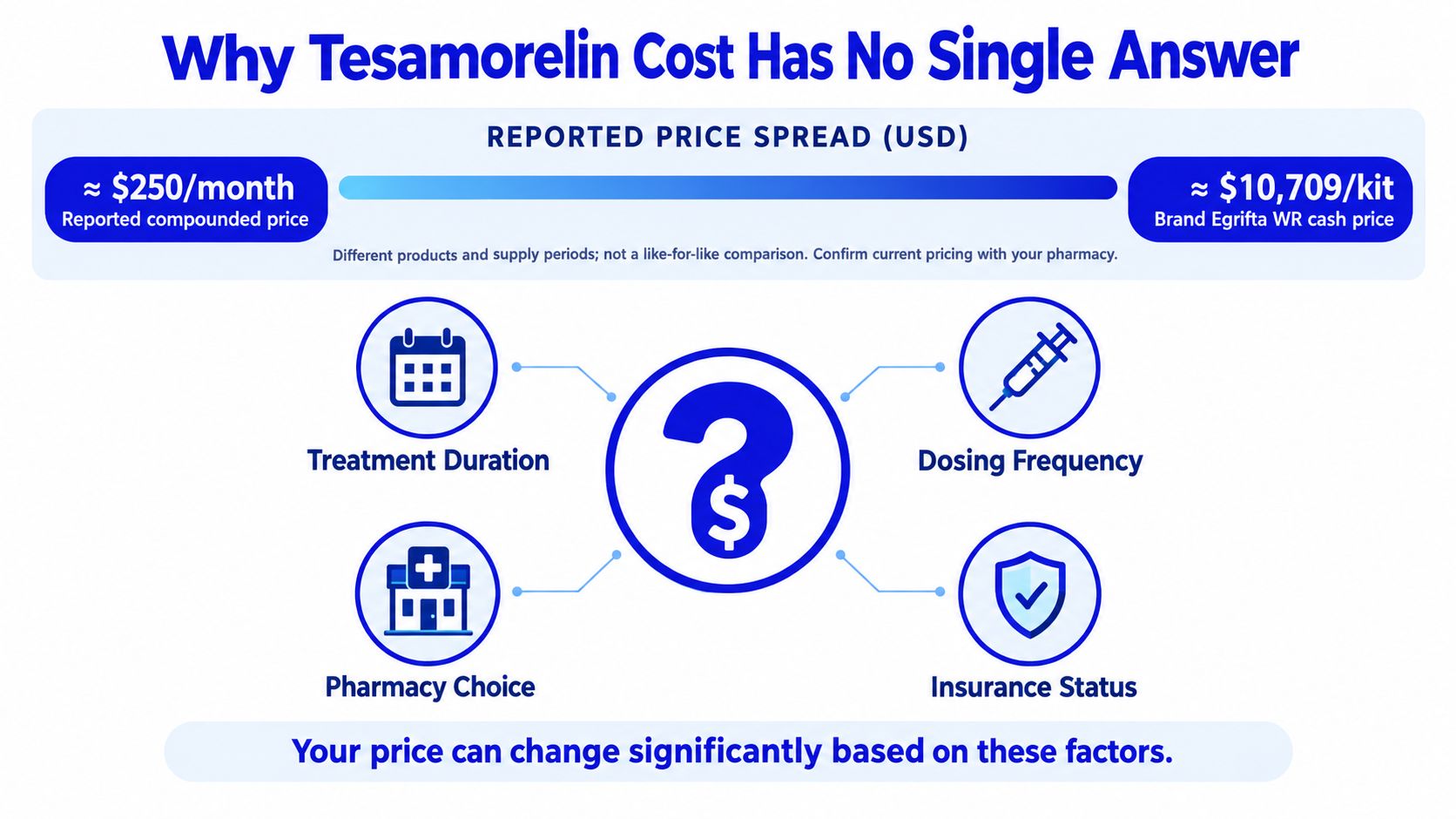
Publicly reported 2026 estimates put tesamorelin cost without insurance at roughly $2,400 to over $10,700 per month for branded products. That variation is the point, not noise: the figures can reflect different formulations, dispensing quantities, pharmacy channels, and services rather than different prices for an identical purchase.
A useful budget starts with identifying what a quote buys. The medication's identity, the treatment period it covers, and the services excluded from the advertised price matter more than an isolated monthly average.
The reported price spread needs to be separated into meaningful categories before anyone can judge whether a quote is competitive. An advertised estimate, a pharmacy retail listing, and a clinic package aren't necessarily measurements of the same expense.
The following comparison summarizes the published U.S. cash-price estimates for tesamorelin. These are reported estimates, not guaranteed pharmacy offers.
| Reported pricing category | Cash-price estimate | What needs checking |
|---|---|---|
| Commonly reported branded monthly estimates | Approximately $2,400–$2,800 | Exact formulation, quantity, and eligibility assumptions |
| Other retail cash-price estimates | Near $3,500 per month | Whether this is an actual dispensing quote or a general estimate |
| Some reported high-end listings | Over $10,700 per month per kit | Kit contents, refill period, pharmacy channel, and included services |
The upper listing shouldn't automatically become a worst-case budget, just as the lowest estimate shouldn't become an expected bill. Without package details, neither tells you what an equivalent treatment cycle would cost.
Start with product identity. Egrifta SV and Egrifta WR need to be identified separately, while compounded prescriptions belong in a different comparison category altogether.
Then check the pharmacy channel, geographic location, and dispensing quantity. A specialty-pharmacy quote may cover medication alone, while a clinical program may combine the prescription with management services. A price described as monthly may also cover a different refill period from another pharmacy's monthly quote.
Comparison principle: “Without insurance” describes how someone pays. It doesn't establish that every product or procurement route being compared is clinically equivalent.
For another treatment-budgeting perspective, the Cost Plus TRT cost overview is a related resource to explore. Its treatment category is different, so its prices shouldn't be used as tesamorelin benchmarks.
The analytical conclusion is straightforward: a wide spread isn't enough evidence of overcharging or savings. First establish that the quotes describe the same product, usable quantity, and service package. Only then does comparing their totals become meaningful.
Tesamorelin is a growth-hormone-releasing-factor analog used in the FDA-approved branded prescription pathway for excess abdominal fat in adults with HIV-associated lipodystrophy. Its medication cost needs a dosing anchor, not just a product name.
For Egrifta SV, the labeled regimen is 1.4 mg, equivalent to 0.35 mL of reconstituted solution, injected subcutaneously once daily. The product comes in a 2 mg single-dose vial with diluent, and the prepared dose is administered immediately after reconstitution, as described in the Egrifta SV prescribing information.

A vial's labeled strength describes its presentation. It doesn't mean the patient receives the entire contents as the prescribed dose, and a single-dose presentation shouldn't be treated as a reusable container when calculating affordability.
That distinction changes the economics. Dividing the total milligrams in a package by an assumed dose can produce a misleading days-of-supply estimate if the calculation ignores the product's administration instructions and unused material.
The label also directs users to rotate injection sites across different abdominal areas. Administration decisions belong with a qualified healthcare professional, not a seller's price calculator.
A useful comparison follows this sequence:
The consequence is easy to miss: a larger amount of material isn't necessarily a longer usable prescription supply. Product presentation matters alongside ingredient quantity.
There's also no FDA-approved generic equivalent in the pricing information discussed earlier. That limits the relevance of the familiar brand-versus-generic shopping strategy. Buyers should verify the prescribed formulation rather than assume a product carrying the same ingredient name is an interchangeable lower-cost medicine.
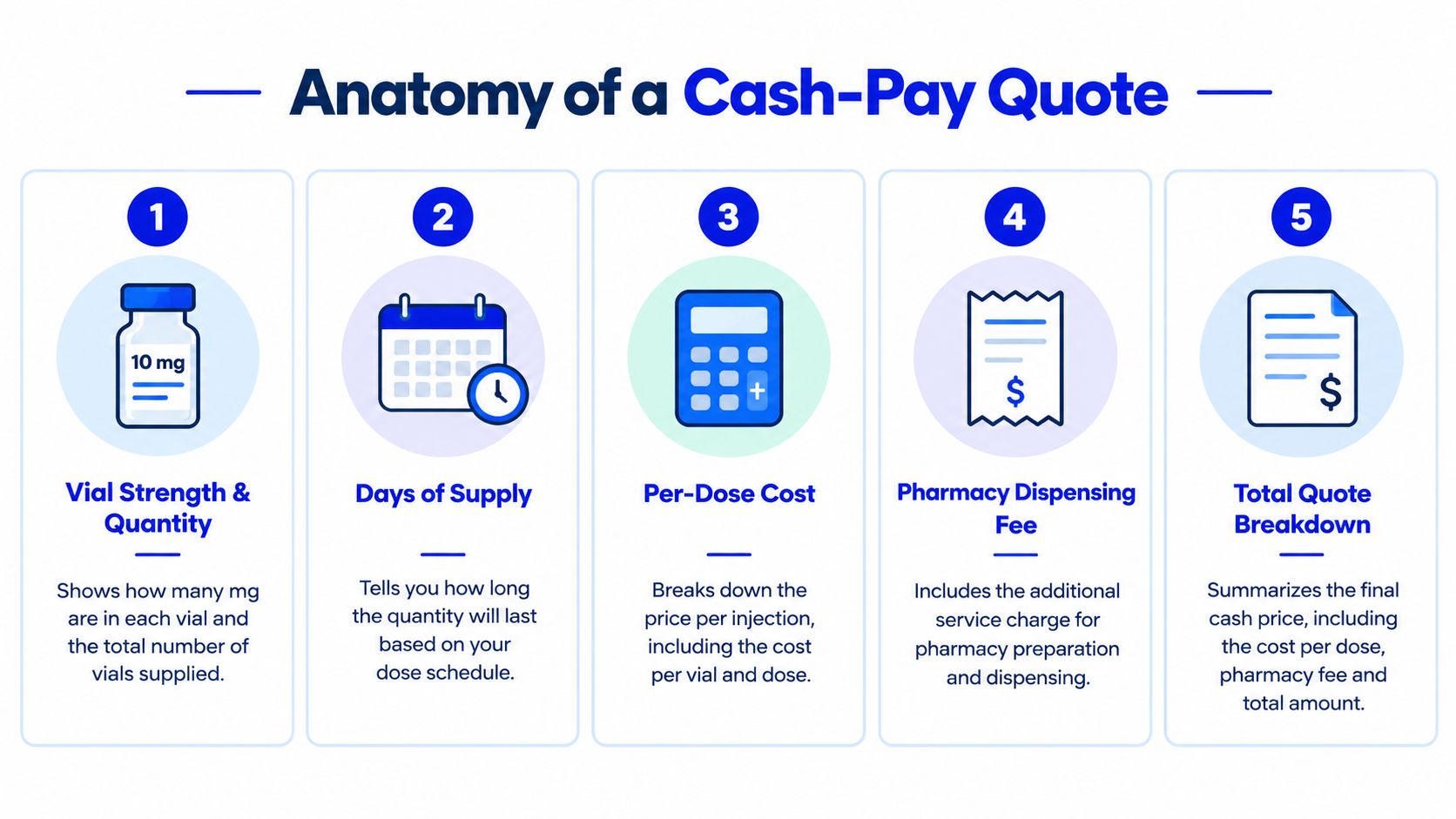
A cash-pay quote should function like an itemized purchase document. If it only states a monthly total, you can't determine whether it covers the medication, dispensing services, shipping, or clinical care.
The Medfinder guide to saving on tesamorelin identifies the central comparison problem: advertised prices can reflect different products, package sizes, dosing assumptions, and included services. My interpretation is that the most useful shopping tool isn't an average price. It's a standardized written quote request.
Ask the pharmacy or prescribing service to separate the following:
Don't assume every quote contains each fee. The purpose is to identify applicable charges and exclusions, not to add hypothetical costs to an already expensive purchase.
Consider a comparison without assigning invented prices: a pharmacy quote includes medication and delivery, while a clinic quote includes medication and a consultation but excludes supplies. Even if the advertised totals match, the buyer's remaining expenses don't.
The solution is to compare included services and outstanding obligations, not just the amount due at checkout. Ask which expenses recur at each refill and which occur only when a clinical service is performed.
A low advertised estimate deserves clarification rather than immediate rejection or acceptance. It may depend on assistance eligibility, a different dose, or an assumption that a vial lasts longer than the labeled presentation permits.
If the provider can't explain the product and days of supply in writing, the quote isn't ready for a reliable comparison. Price transparency means knowing what the amount covers, not merely seeing an amount displayed.
Procurement category should be established before comparing price. An FDA-approved prescription product, a compounded preparation, and research material serve different purposes and shouldn't be placed on a single cheapest-option ranking.
The Egrifta SV dosage reference provides the prescription-regimen anchor for comparing supply over a 28- or 30-day treatment cycle. The accompanying distinction is critical: compounded and research-grade products aren't interchangeable with FDA-approved Egrifta.
| Route | Regulatory Status | Typical Price Range | Documentation | Intended Use |
|---|---|---|---|---|
| Branded Egrifta prescription | FDA-approved prescription product | Branded estimates mapped in the opening comparison | Prescription, labeled formulation, dispensing quantity, and pharmacy instructions | Treatment within a clinician-directed prescription pathway |
| Compounded prescription | Not an FDA-approved equivalent for this use; availability requires verification | Lower prices are reported, but no reliable equivalent range is established here | Prescriber and pharmacy details, formulation, applicable quality information, and dispensing instructions | Patient-specific clinical use only where legally available and appropriately prescribed |
| Research-grade supply | Not an FDA-approved human-use medication | Supplier-specific catalog pricing, not a treatment-cost benchmark | Intended-use classification and available batch documentation | Laboratory and analytical work, not human consumption |
No numerical compounded or research-supply range belongs in this comparison unless it can be tied to an adequately documented product. Filling those cells with attractive figures would recreate the very problem the table is intended to solve.
For a branded prescription, the relevant purchasing question is whether the pharmacy is supplying the prescribed product through the appropriate dispensing pathway. The quote can then be evaluated against other equivalent pharmacy offers.
A compounded prescription requires a different inquiry. The patient and clinician need to establish whether the preparation is appropriate and legally available, then verify the dispensing pharmacy, formulation, and requirements. A lower price alone can't answer those questions.
Research supply belongs outside patient treatment budgeting. Laboratory purchasers can evaluate the material against their experimental requirements and available documentation, but that assessment doesn't establish suitability for administration to people.
Compounded preparations aren't FDA-approved substitutes for Egrifta. Research-grade supply must not be represented as human-use medication.
The phrase benefits of peptides can blur these distinctions when used in marketing. Interest in a peptide's research applications doesn't convert a research chemical into a prescription medicine or establish a clinical benefit for an individual buyer.
The practical decision is therefore role-based. Patients evaluate clinical prescription options with qualified professionals; researchers evaluate laboratory materials within their institution's requirements. Neither group should use the other's purchasing category as proof that an equivalent product is available more cheaply.
Having insurance and having coverage for a particular prescription are different conditions. Someone can hold a health plan yet still face the full cash price because the intended use doesn't meet the plan's criteria.
The FDA Egrifta SV labeling identifies the approved indication as reducing excess abdominal fat in HIV-infected adults with lipodystrophy. It also states that the product isn't indicated for weight-loss management.
That distinction matters financially before a pharmacy quote is requested. General weight loss, cosmetic fat reduction, and anti-aging shouldn't be assumed to share the coverage pathway for the approved indication.
A clinician's prescription establishes what has been prescribed. An insurer separately determines whether it will reimburse the product under the patient's benefits and applicable criteria.
Coverage may involve prior authorization and diagnosis documentation. Patients should ask their insurer and prescribing clinician what information is required rather than treating an online statement about coverage as a decision for their own plan.
Useful questions include:
These questions separate an administrative delay from a coverage exclusion. They also prevent a tentative estimate from being mistaken for a final out-of-pocket amount.
A prescription can make a medication available through a pharmacy without making its intended use eligible for reimbursement.
Off-label use is generally a cash-pay scenario in the coverage information associated with these products. Buyers pursuing general fat loss should therefore avoid budgeting around a hoped-for reimbursement decision.
The less obvious conclusion is that indication mismatch can create the uninsured price experience even for insured people. Their financial problem isn't necessarily a missing health plan. It may be a medication request outside the covered clinical pathway.
That's why checking eligibility before comparing pharmacies can be more useful than seeking discounts first. It establishes whether the relevant benchmark is a covered prescription expense, an assistance pathway, or an undiscounted cash purchase.
Medication cost and total treatment cost need separate budget lines. Combining them too early makes it difficult to tell whether a quoted package is affordable because the medication is less expensive or because other expenses have been left out.
The FDA product record for Egrifta establishes the branded prescription product's regulatory identity. Published cash-price estimates discussed above imply roughly $28,800–$42,000 annually across the common monthly and retail estimates, before physician visits, laboratory monitoring, supplies, or other treatment expenses.
That annual range isn't derived from the unusually high listing in the opening table. It's also not a guaranteed annual pharmacy offer: recurring prices and dispensing arrangements still need confirmation.
Keep medication spending distinct from clinical services and practical purchasing expenses. This makes it easier to see what a bundled program covers and what remains payable elsewhere.
| Budget category | Information to obtain |
|---|---|
| Medication | Written refill price and actual days of supply |
| Physician services | Initial evaluation and anticipated follow-up charges |
| Laboratory monitoring | Tests the clinician requests, timing, and cash-pay charges |
| Injection supplies | Included items and separately purchased supplies |
| Delivery and handling | Recurring shipping charges and product-specific storage instructions |
| Access costs | Personal travel expenses if collection or appointments require travel |
There's no verified standard allowance here for visits, tests, supplies, refrigeration, or travel. Use actual quotes and the clinician's proposed monitoring plan rather than assigning generic amounts.
For storage, ask the dispensing pharmacy for the instructions specific to the prescribed formulation. Don't transfer storage assumptions from another peptide or product presentation.
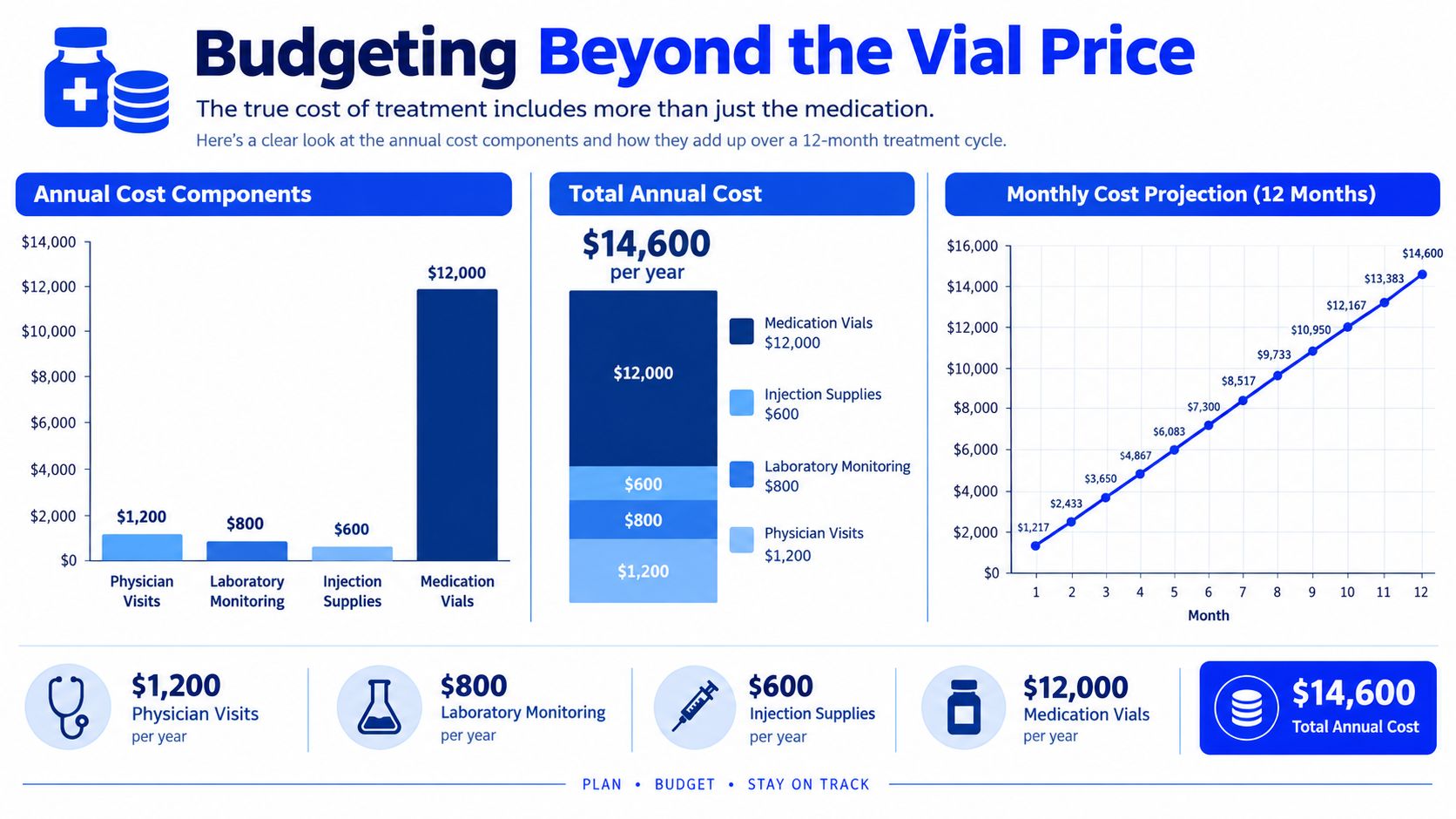
Treat the visual as an illustration of expense categories, not a verified tesamorelin budget. Any example amounts displayed in it shouldn't replace pharmacy and clinical-service quotes.
Ask what happens if a promotional price ends, assistance eligibility changes, or a pharmacy supplies a different refill quantity. A manageable initial invoice doesn't establish a manageable ongoing expense.
For broader budgeting context, you can compare peptide therapy out-of-pocket costs through Weight Method. Keep the product categories separate instead of importing another therapy's monthly estimate into this budget.
Market boundary: U.S. cash prices can't be transferred directly to other countries. Reimbursement systems, regulatory status, and pharmacy supply differ.
A realistic budget reflects the buyer's actual location, prescription pathway, and recurring obligations. It doesn't depend on an average assembled from unlike purchases.
Eligible uninsured or underinsured patients may have an alternative to paying retail cash prices. The manufacturer's THERA Patient Assistance Program states that qualifying patients can receive THERA medications at no cost, subject to eligibility and enrollment.
The THERA patient-support information identifies needs-based eligibility requirements and limits the program to eligible residents of the United States and Puerto Rico. It provides patient support at 1-833-23-THERA for current application instructions.
Program details generally identify these conditions:
These conditions make assistance a distinct pathway, not a discount available to every cash-pay buyer. Off-label use and research products shouldn't be treated as eligible purchases under this prescription assistance framework.
Ask patient support which documents are currently required and whether the prescribing office must submit part of the application. Also confirm whether medication is supplied directly or through a participating pharmacy.
Get clarity about when enrollment is effective before making a purchase based on anticipated assistance. An application in progress isn't the same as approved access to medication.
The financial conclusion differs from ordinary pharmacy shopping: for an eligible applicant, checking assistance can change the purchasing pathway, rather than merely reduce a retail quote. For an ineligible buyer, the program shouldn't be included as an assumed saving in the budget.
Current program terms control the decision. A pricing article can identify the opportunity, but only the program can confirm eligibility and supply arrangements.
Choose the procurement category that matches your role before choosing a seller. Patients seeking the FDA-approved product should work through a qualified clinician and prescription pharmacy; any compounded option requires separate clinical and legal assessment.
Laboratory purchasers should evaluate research-grade supply for laboratory requirements only. It isn't a workaround for an unaffordable prescription.
Readers comparing other prescription categories can explore the GLP-1 online without insurance guide from Empire Medical Wellness. It's a separate treatment category, not evidence that GLP-1 products and tesamorelin are interchangeable.
The strongest next step is a written, itemized quote paired with an eligibility check. That turns a confusing advertised price into a purchase you can evaluate.
For laboratory buyers, Peptide Warehouse USA offers research peptides and related compounds for laboratory, analytical, and preclinical applications, with batch documentation available to support procurement review. Visit its catalog to explore research-only options and review intended-use information; the supplier isn't a prescription pharmacy, and its products aren't for human consumption.