No products in the cart.


You've got a protocol draft open, two supplier tabs side by side, and both claim high purity. One shows a lot number you can trace. The other shows a discount banner and vague healing language. If you're going to buy BPC 157 and TB 500 for laboratory work, that difference in documentation is the whole decision.
This guide is written for researchers who need a clean procurement record, not therapeutic promises. You'll get a direct way to judge compliance, read a COA, vet a supplier, and handle what arrives.
A principal investigator is planning preclinical tissue-recovery work and asks the lab manager to source both peptides for parallel experiments. The analytical chemist wants sequence confirmation before anything enters an assay. The graduate researcher wants enough material from one lot to avoid restarting a time course halfway through.
That's a common buying pattern. BPC-157 and TB-500 get ordered together because labs often study related questions around cell migration, tissue models, and recovery pathways in controlled settings. Ordering them as a pair simplifies vendor qualification, shipping, and lot tracking, provided each compound keeps its own identity record.
Pre-blended stacks add convenience, but they don't reduce your paperwork. A blend needs documentation for each component, the stated ratio, total content, and the lot that was mixed. If a seller can't separate blend marketing from batch evidence, buy the individual peptides instead and keep control of your experiment.
This approach fits academic labs, principal investigators, analytical chemists, and lab managers who answer to institutional review, grant audits, or internal quality systems. It also fits independent research teams that need repeatable materials across reorders.
It doesn't fit anyone looking for a proven treatment. The human record is too thin to support that framing, and a supplier who blurs that line is telling you something important about their standards.
Buy the documentation first and the peptide second. If the lot record wouldn't survive an audit, the vial shouldn't enter your lab.
Your outcome from a disciplined purchase is simple. You know what molecule you received, which lot it came from, how it was tested, and where it's stored. You also know what the paperwork doesn't prove, which protects your lab from overstating results later.
Ask three questions before you read any product page. What's the exact chemical identity? Which lot will ship? What test results belong to that lot? Suppliers who answer cleanly move forward. Suppliers who pivot to benefits of peptides, recovery stories, or dosing talk should be removed from your shortlist.
Research use only isn't decorative labeling. It means the material is sold for laboratory, analytical, or preclinical research, not for human consumption, diagnosis, or treatment. Your purchase order, invoice, storage location, and lab notebook should all reflect that same purpose.
Don't treat a research chemical order like a pharmacy transaction. A compounding pharmacy operates under a different regulatory structure, with patient-specific dispensing and professional oversight. A research supplier shouldn't present BPC-157 or TB-500 as a compounded medicine or an approved drug.
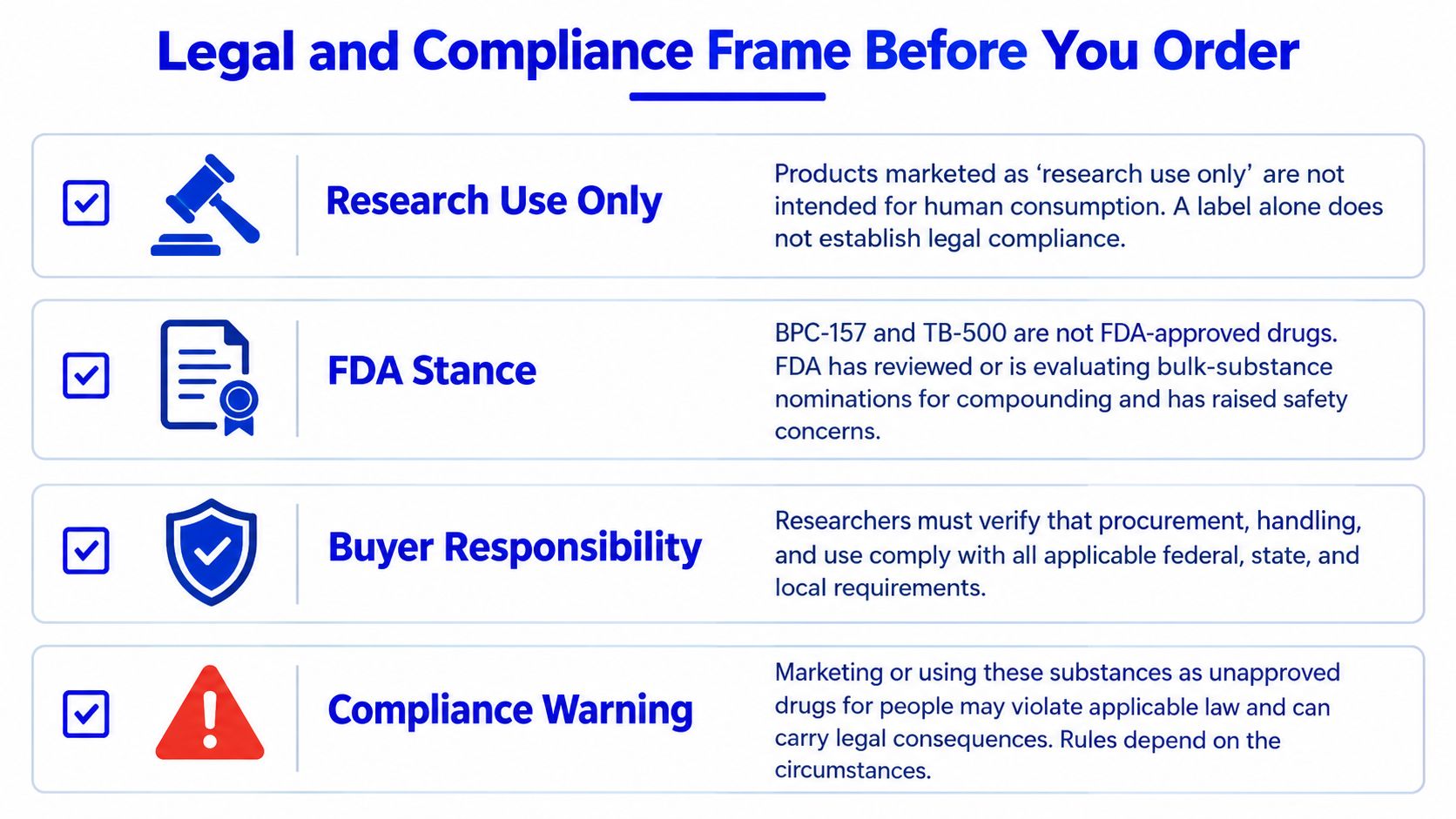
The FDA pharmacy compounding advisory materials on BPC-157 and TB-500 state that the agency proposed that BPC-157 free base, BPC-157 acetate, and TB-500 free base should not be included on the federal 503A bulk-drug-substances list. That proposal highlights the gap between research chemicals and compounded medicines.
Athlete-adjacent labs need a separate warning. BPC-157 is prohibited under WADA's S0 category for non-approved substances, and TB-500 also carries anti-doping risk. Research-only labeling doesn't eliminate eligibility, testing, or inadvertent exposure problems for anyone competing under WADA rules.
Keep these records from day one:
If your institution can't clearly classify the purchase, pause. Ask your compliance office before you order, not after a package reaches receiving. A clean paper trail is cheaper than explaining a mislabeled chemical inventory during review.
Expect packaging and invoices to match. If the website says research use only but sales support discusses personal use, that's a compliance failure and a credibility failure. Walk away.
A real testing package answers narrow analytical questions. It identifies the material in a specific lot and reports what a lab measured with stated methods. It doesn't establish human safety, dosing, sterility for injection, long-term toxicity, or clinical effectiveness.
That distinction matters because the clinical record remains limited. A 2025 systematic review of 544 BPC-157 publications found 544 publications from 1993 through 2024, but only 36 studies met inclusion criteria, including 35 preclinical studies and 1 clinical study. A COA can't fill that evidence gap.
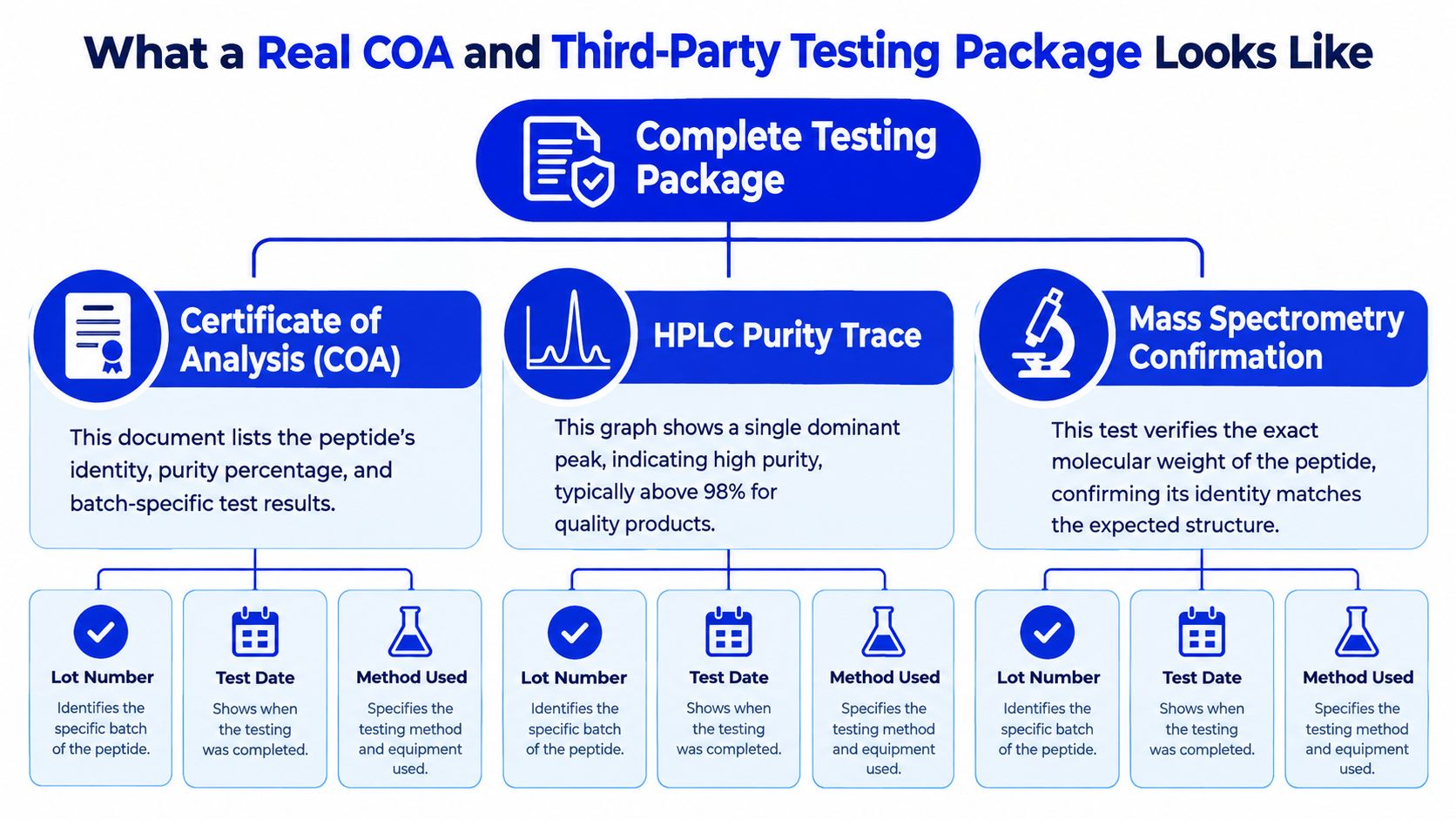
Start with the Certificate of Analysis. It should list product name, sequence or chemical identity, lot number, test date, methods, specifications, results, and the testing laboratory. A generic COA reused across lots is not acceptable.
An HPLC purity trace shows chromatographic separation and the relative area of the main peak. Read the method and impurity reporting, not just the headline purity. A high percentage without a trace, column details, or lot match gives you little to verify.
Mass spectrometry supports identity by comparing measured molecular mass with the expected molecule. It helps catch wrong-sequence or wrong-fragment material, which matters especially for TB-500 because sellers sometimes blur it with full-length thymosin beta-4.
For cell-based or in vivo preclinical work, ask about endotoxin and microbial testing where relevant to your assay. Endotoxin can distort biological readouts even when peptide purity looks acceptable. Match testing depth to your experiment's tolerance for contaminants, and don't assume a purity result covers those risks.
If you want a practical primer before comparing reports, the PepFlow peptide purity guide is useful background for separating identity, purity, and quantity claims. Use it to sharpen questions, then judge the actual lot documents in front of you.
Practical rule: If the lot number on the vial, COA, HPLC trace, and invoice don't match, treat the package as undocumented.
Store the full package in your quality file, not in a purchasing inbox. Link it to the protocol, inventory entry, freezer location, and every experiment that uses the lot. When results look odd months later, that chain of records lets you investigate material quality instead of guessing.
Product pages are easy to polish. Supplier behavior under specific questions is harder to fake. Ask for a sample COA for the lot that will ship, the name of the third-party lab, and an explanation of how reorders handle lot changes.
A serious US peptide supplier should explain where material is manufactured, how batches are produced, and how finished lots are released. Vague claims about premium quality mean little without batch testing, impurity reporting, and traceability from synthesis through packaging.
| Evaluation Criterion | What Strong Documentation Looks Like | What to Avoid |
|---|---|---|
| Identity | Sequence, molecular mass, salt form, and mass spectrometry result for the lot | Product name only, with TB-500 and thymosin beta-4 used interchangeably |
| Purity | HPLC trace, method, lot number, test date, and impurity information | A single purity percentage with no trace or date |
| Contamination controls | Endotoxin or microbial reports matched to intended lab application | Claims that purity alone proves biological suitability |
| Traceability | Lot numbers align across vial, invoice, COA, and shipping record | Generic documents or lot numbers added after purchase |
| Support | Direct answers about storage, documentation gaps, and replacements | Dosing advice, treatment claims, or pressure to order quickly |
| Pricing transparency | Clear vial content, quantity, shipping terms, and return conditions | Discounts that hide content, concentration, or lot differences |
Compare two suppliers with the same email. Ask what molecule they're selling, which lot ships today, what tests were performed, and whether endotoxin data exists. Time the response, but judge precision more than speed.
Green lights include age-gated ordering, clear research-use restrictions, transparent limits, and support staff who refuse to give medical advice. Red flags include guaranteed healing, muscle growth promises, before and after stories, and blends with undisclosed ratios.
Don't reward a supplier for saying what you want to hear. Reward the one who says, in effect, here's the lot, here's what we measured, and here's what we didn't measure. That candor protects your data.
Price belongs last in the comparison. A cheaper vial that forces you to repeat an assay, discard a time course, or defend weak documentation isn't cheaper in any meaningful lab sense.
Set up the account with accurate institutional or business details before you select products. Complete any age verification the supplier requires, and use an email address that preserves order and lot correspondence for your records. Don't route critical documentation to a personal inbox that disappears when staff changes.
Choose BPC-157, TB-500, or a blend based on experimental design, not bundle pricing. Confirm vial content, quantity, salt form, and whether the displayed COA belongs to the shipping lot. For blends, confirm each component and the stated ratio before checkout.
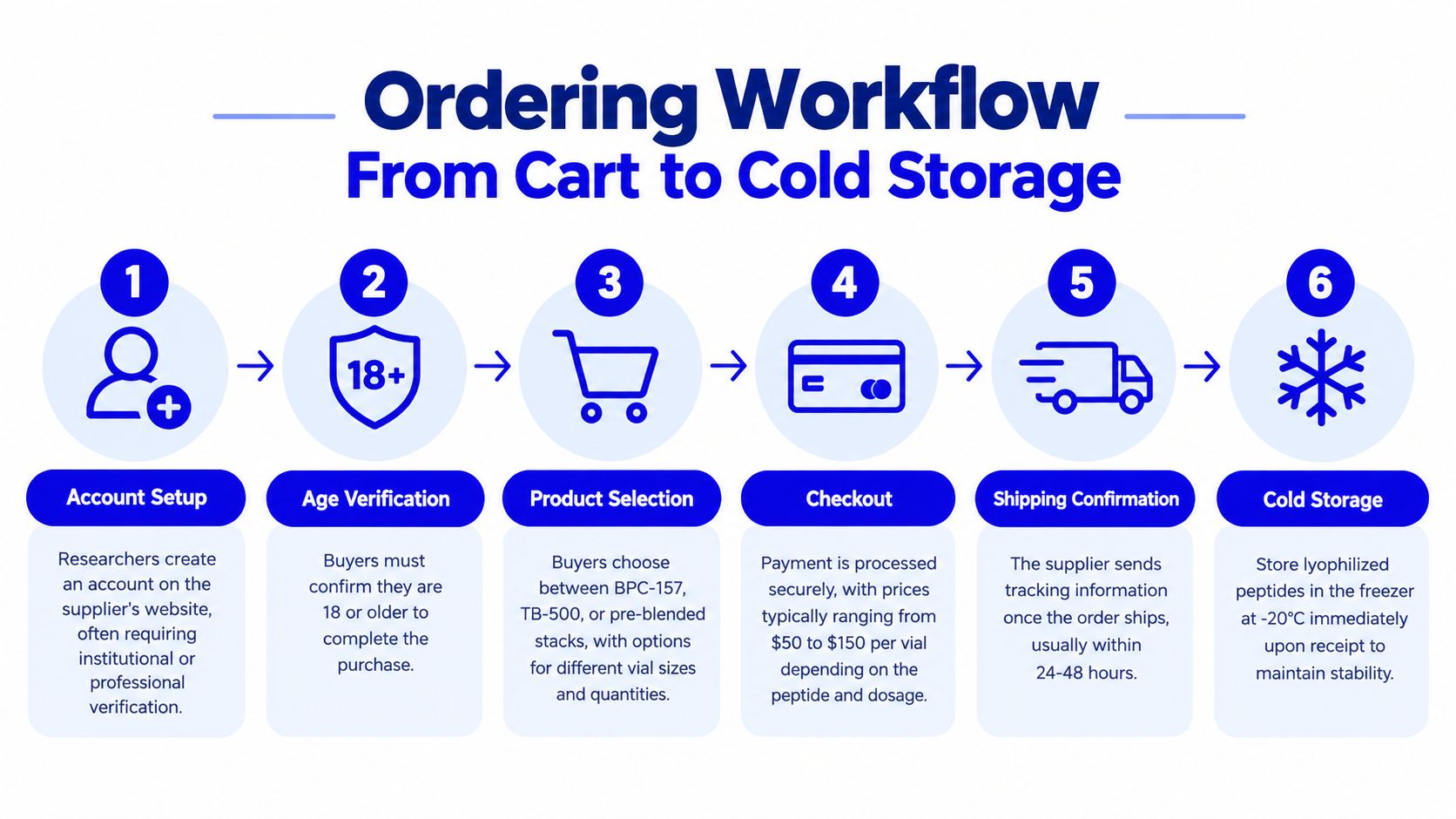
Receive the shipment like a controlled material, not office mail. Photograph the outer package, labels, seals, and any temperature indicator before you open the vials. Log the date, receiver, condition, and storage location in your inventory system.
Check these points immediately:
Move accepted vials into the storage conditions specified for the product and your protocol. If anything doesn't match, quarantine the material and contact support with photos, lot numbers, and order details. Don't use a compromised vial to keep a schedule.
Plan reorder cadence around lot continuity. If a long experiment depends on one lot, ask about remaining inventory before you begin. Switching lots midstream may be unavoidable, but it should be a documented decision, not a surprise discovered after analysis.
Store lyophilized BPC-157 and TB-500 according to the supplier's lot guidance and your laboratory's validated procedures. Protect vials from moisture, light, and unnecessary temperature swings. Keep them sealed until use, and record freezer location down to box and position when your inventory volume justifies it.
Analytical reference material, in vitro assay stock, and preclinical in vivo material may need different controls. Don't move vials between those categories casually. Label each vial with lot, receipt date, opening date, responsible researcher, and intended application.
Reconstitute only under your approved laboratory protocol, using the solvent, concentration, filtration, and aseptic controls appropriate to the experiment. This is laboratory handling guidance, not medical dosing advice. If your protocol hasn't defined those variables, stop and define them before opening the vial.
Prepare working aliquots sized for planned experiments so you don't repeatedly warm and refreeze the same stock. Label aliquots with compound, lot, concentration, solvent, preparation date, preparer, and storage condition. Link every aliquot back to the parent vial in the notebook.
Limit freeze-thaw cycles because repeated cycling can complicate stability and concentration assumptions. Track each cycle for sensitive assays. If an aliquot has an unclear history, discard it through your chemical waste process and prepare a traceable replacement.
An unlabeled aliquot is not a shortcut. It's future uncertainty inserted into your experiment.
Review retained vials during routine inventory. Look for damaged seals, illegible labels, expired internal use dates, and material stored outside its assigned location. Correct the record while the responsible researcher still remembers what happened.
When stability is central to the claim you're testing, verify it with an appropriate analytical method rather than relying on appearance. A clear solution doesn't prove identity, potency, or absence of degradation products.
Use one checklist for every order, even when you reorder from a familiar supplier. Familiarity is where documentation habits slip. Lots change, support staff change, and product pages change without an announcement landing in your lab notebook.
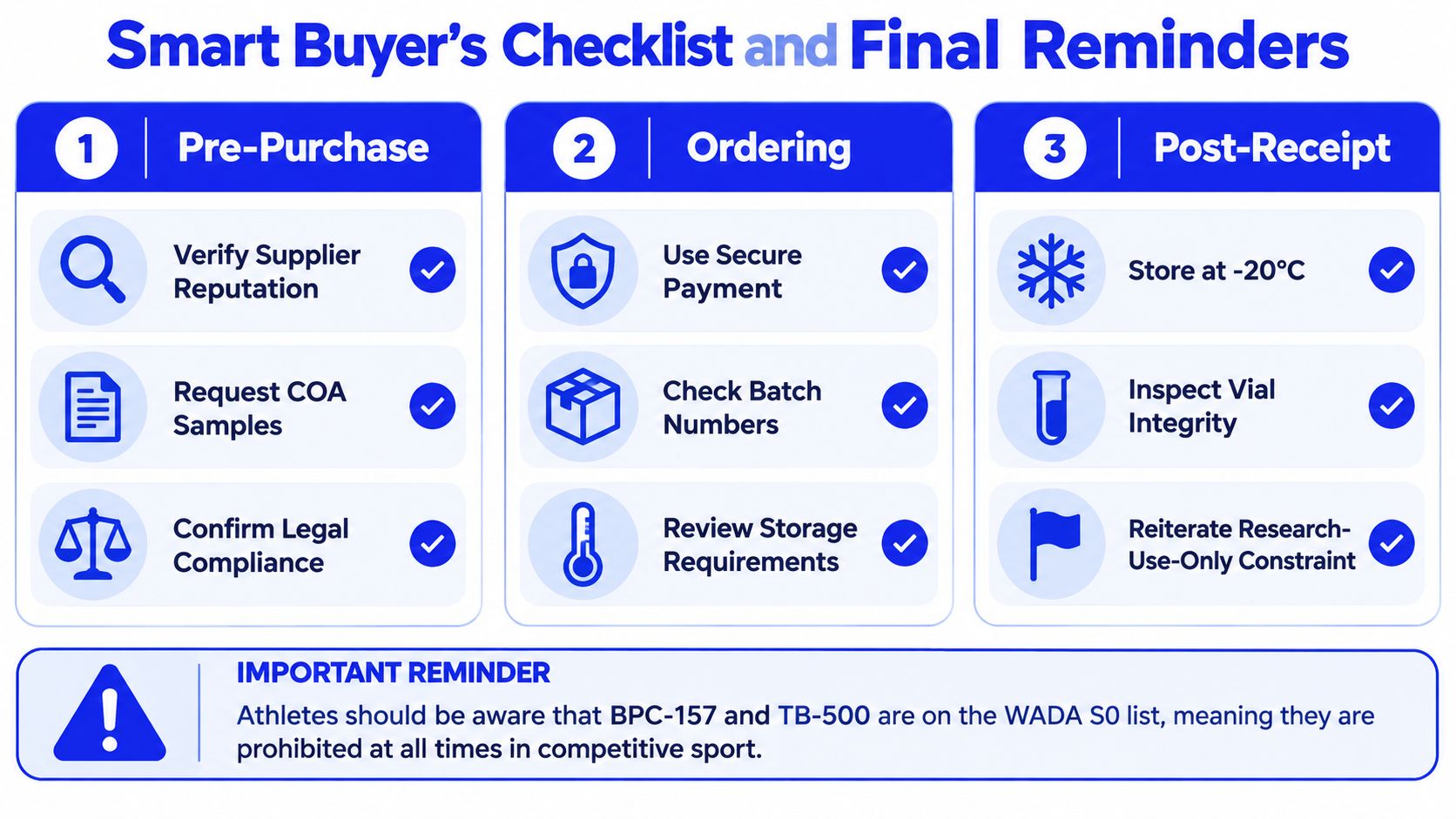
Keep the evidence boundary visible in manuscripts, reports, and internal presentations. Analytical documentation can support material identity and measured purity for a lot. It can't create a clinical success rate, validate a combination protocol, or turn preclinical findings into human outcomes.
My recommendation is direct. Shortlist suppliers by documentation, remove anyone making therapeutic promises, and buy only when the shipping lot is fully traceable. Explore options patiently, learn more from the actual test package than from marketing copy, and make the supplier earn repeat orders lot by lot.
Peptide Warehouse USA offers US-made research peptides, including BPC-157, TB-500, and combination blends, with lot-level COAs and third-party testing documentation for laboratory and preclinical applications. Review the published documentation for each product, confirm the lot details against your protocol, and visit Peptide Warehouse USA to explore options for your next research order.