No products in the cart.


The most common advice about buying peptide injections online is to check the purity percentage. That's an incomplete starting point. A polished certificate can describe a chemical sample without establishing that the vial is sterile, appropriately stored, legally marketed for its intended use, or suitable for human administration.
For a research buyer, the better question is whether the supplier can support a complete verification chain. That means examining the product's regulatory category, lot identity, testing records, shipping conditions, and institutional handling requirements, without confusing laboratory documentation with evidence of human safety.
A professional-looking website can make very different products appear interchangeable. A research vial, a compounded preparation, and an approved prescription medicine may share an ingredient name, but the name alone doesn't tell you what evidence supports the finished product.
The practical risks extend beyond chemistry. In a 2026 study of consumers attempting to prepare and self-inject an online semaglutide product, participants completed fewer than half of the required steps correctly on average; the study involved 20 participants, divided between 10 college-aged adults and 10 adults in their 60s, recruited in the northeastern United States.
Researchers identified errors that could increase infection, bleeding, accidental needle-stick, and incorrect-dose risks. The authors cautioned that the small, geographically limited sample and focus on a single product prevent generalization to every purchaser or injection setting.
For procurement purposes, treat the evidence like separate aircraft inspections. Confirming the identity of a component doesn't confirm that someone installed it correctly or maintained it under appropriate conditions.
A useful review separates:
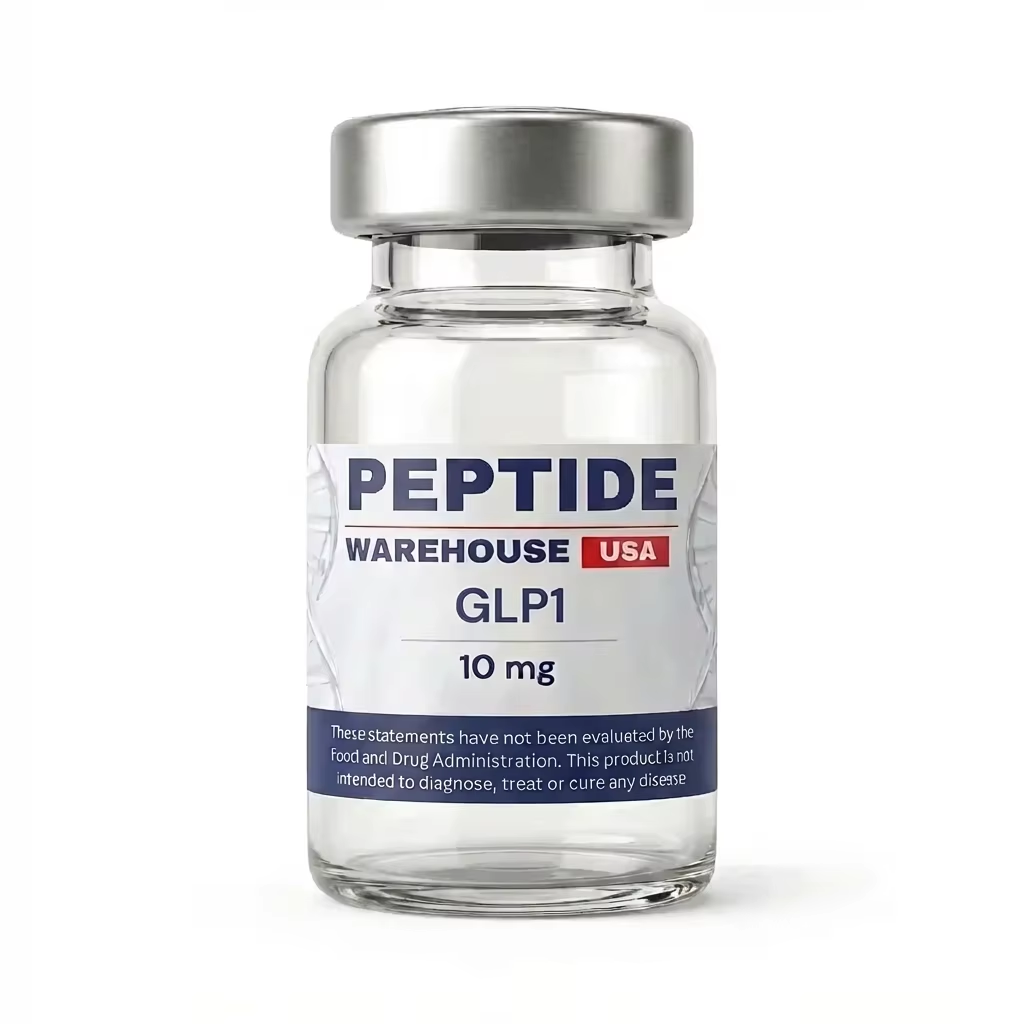
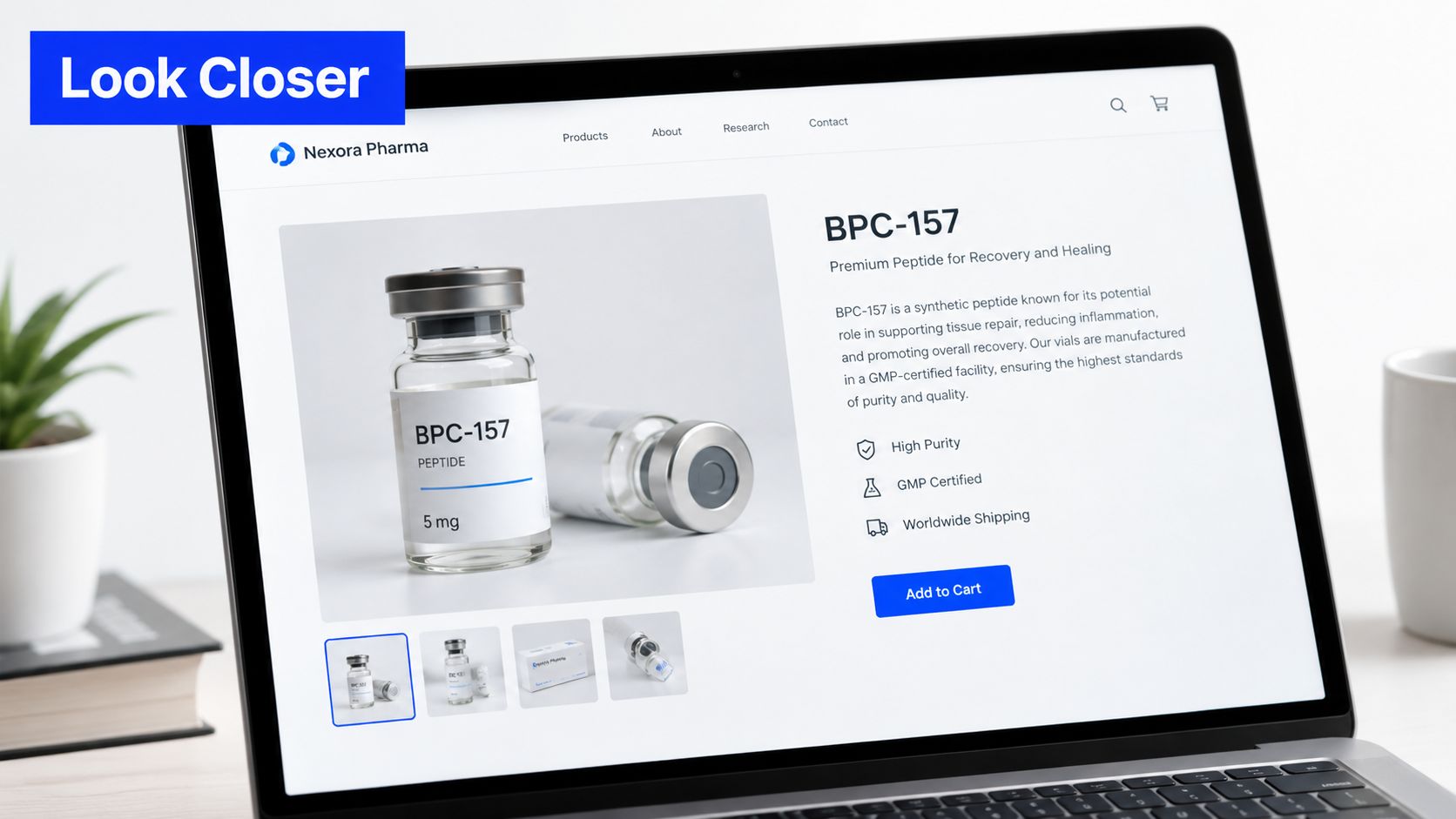
The image below illustrates the kind of therapeutic marketing a buyer should distinguish from research-supply documentation. Its wording isn't evidence of a treatment benefit.
Practical rule: Evaluate a research material against the laboratory's requirements. Don't use a procurement review to decide whether someone should inject it.
That boundary allows a buyer to ask rigorous questions without suggesting that a well-documented research chemical becomes a human medicine.
A receiving coordinator opens a shipment and finds a vial whose label resembles the catalog listing. The purchase order identifies the supplier, but the accompanying report uses a different product description. Before accepting the material, the coordinator needs to resolve whether the order, vial, and documentation refer to the same item.
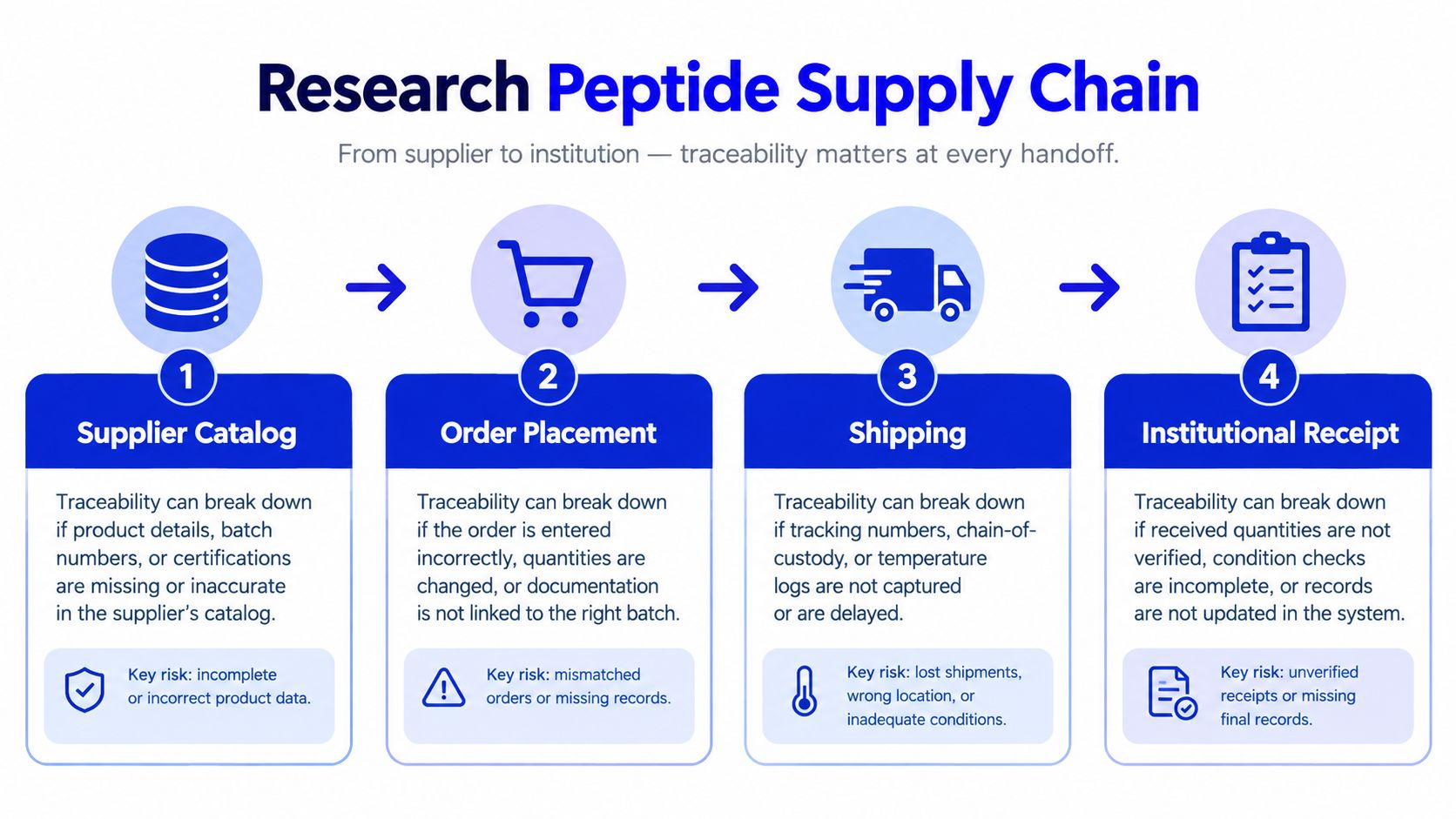
This is an illustrative procurement scenario, not a reported case. It shows why traceability depends on matching records across handoffs rather than recognizing a familiar peptide name.
The supply-chain diagram highlights where those handoffs deserve attention.
A research institution should establish the intended application before comparing suppliers. An analytical project may require a particular identity method or formulation description; another project may require additional quality records under its approved protocol.
Human treatment belongs in a different purchasing pathway. The FDA's warning about compounded semaglutide dosing errors describes adverse events, including hospitalization, involving confusion between milligrams, milliliters, and syringe units or nonstandard instructions.
For anyone considering treatment, the relevant checks include a licensed prescriber, a licensed pharmacy, and clear labeling covering concentration, prescribed dose, storage, expiration, and administration instructions. Buying a research product doesn't replace those safeguards.
For laboratory purchases, a practical procurement file should connect:
The accompanying video is an additional viewing resource, not a substitute for institutional purchasing procedures.
The useful procurement outcome is a record another qualified employee can review without reconstructing the purchase from emails. If that person can't connect the catalog item to the received lot, the documentation needs clarification before release into laboratory work.
Regulatory classification, lot quality, and clinical evidence are separate questions. A favorable answer to one doesn't resolve the others.
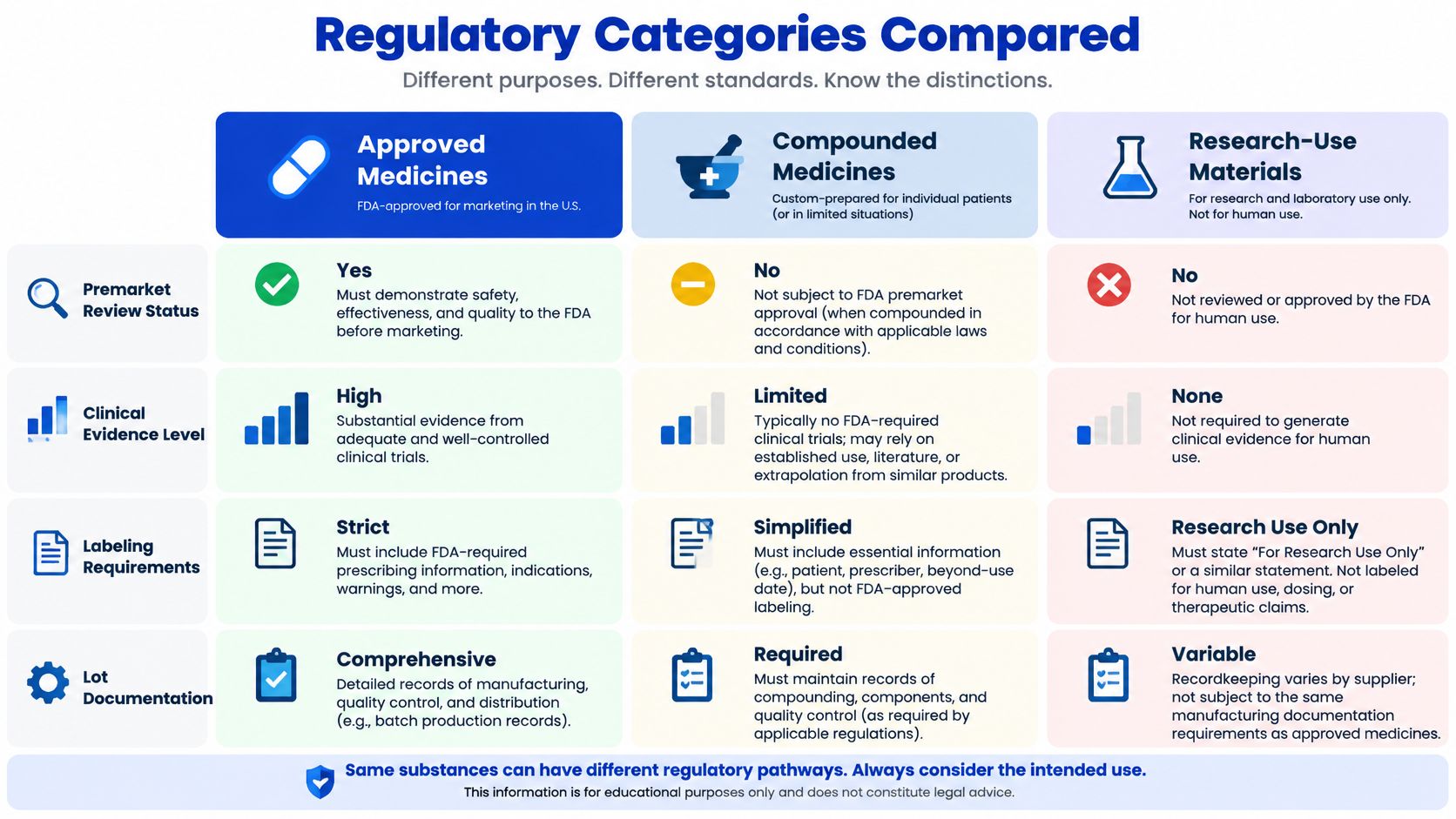
The FDA's guidance for telehealth companies promoting compounded drugs explains that compounded drugs aren't FDA-approved and aren't reviewed before marketing for safety, effectiveness, or quality. They shouldn't be presented as FDA-approved or as the same as an approved medicine.
The comparison below helps keep these categories distinct.
| Category | What the buyer should distinguish |
|---|---|
| FDA-approved medicine | Approval applies to a particular finished medicine and its evaluated conditions of use, not every online product sharing its ingredient name. |
| Compounded medicine | Pharmacy preparation is a distinct category, not an alternative name for an approved product. |
| Research-use material | Laboratory documentation must be evaluated for the authorized research application, not treated as treatment authorization. |
For readers also considering clinical questions, Longevity Medical Institute's peptide guide offers an additional resource to discuss with a licensed healthcare professional. Keep that clinical discussion separate from the institution's supplier qualification process.
On February 26, 2025, the FDA warned USApeptide.com about semaglutide and tirzepatide listings, identifying them as unapproved and misbranded drugs and requesting that the company stop offering them to U.S. consumers. The agency explained that research-use disclaimers don't necessarily determine classification when other website evidence indicates intended human use.
Website design deserves scrutiny, too. An analysis of FDA enforcement involving peptide sellers describes regulators considering dosing guides, peptide calculators, reconstitution supplies, and marketing claims when assessing intended use.
Availability can also reflect a changing policy environment. The FDA's compounded GLP-1 policy timeline records that the semaglutide injection shortage was resolved on February 21, 2025, with enforcement discretion for relevant 503B semaglutide compounding scheduled to end on May 22, 2025; the comparable tirzepatide transition ended on March 19, 2025.
Those historical dates aren't a current authorization check. Before purchasing, ask what the product is legally offered as, what supports the specific lot, and what evidence supports any claimed human use.
Start with the organization taking responsibility for the sale. Request its business identity, contact route for technical questions, and a clear explanation of whether it supplies research materials, dispenses medicines, or performs another role.
That distinction matters because counterfeit-looking paperwork isn't the only concern. The FDA's discussion of fraudulent online semaglutide and tirzepatide products warns that products may contain incorrect, harmful, insufficient, excessive, or absent active ingredients; some labels identify pharmacies that don't exist.
Ask for a lot-specific Certificate of Analysis, not a representative certificate posted beside a catalog photograph. Check that the vial's lot identifier matches the document and that the report identifies the sample, laboratory, analytical method, and test date.
Then examine what each result measures. Identity testing addresses whether the tested sample corresponds to the claimed compound; a purity result addresses a different analytical question. Don't treat a percentage as interchangeable with identification.
| Document or detail | What to verify | What it does not establish |
|---|---|---|
| Supplier information | Business identity, technical contact, product category, and research-use boundaries | Independent confirmation of lot quality |
| Lot-specific COA | Matching lot identifier, sample description, testing laboratory, methods, and dates | Every attribute needed for the proposed application |
| Identity result | Whether the reported method addresses the claimed compound | Sterility or human efficacy |
| Purity result | What the method measures and how the result is expressed | Correct identity by itself or injection suitability |
| Microbial or sterility report | Test type, sample reference, result, and applicable acceptance criteria | Endotoxin status unless separately addressed |
| Endotoxin report | Method, units, limits, result, and lot connection | A substitute for microbial or sterility testing |
| Storage and retest information | Conditions, dates, and supporting supplier explanation | Proof that transit followed those conditions |
Treat this table as a request list, not a claim that every research material requires identical testing. Qualified personnel should decide which documents and acceptance criteria fit the authorized work.
A complete-looking document packet still needs a reviewer who understands what was tested, which sample was tested, and what remains unknown.
Ask about expiration or retest information and whether the packaging should include tamper-evident features. If a supplier replaces a missing report with a general assurance, record the unresolved question rather than translating that assurance into acceptance.
The strongest supplier response is specific: it identifies the relevant lot, supplies the requested evidence, and explains limitations without making unsupported human-use claims.
A correctly labeled vial can arrive with an unresolved shipping history. For procurement purposes, that creates a gap between the supplier's release records and the condition of the material received.
Don't assume every peptide requires the same cold chain. Ask for product-specific shipping and storage specifications, including the formulation covered by those instructions, and have qualified personnel determine what evidence the institution needs.
The following checklist organizes the physical conditions worth reviewing.
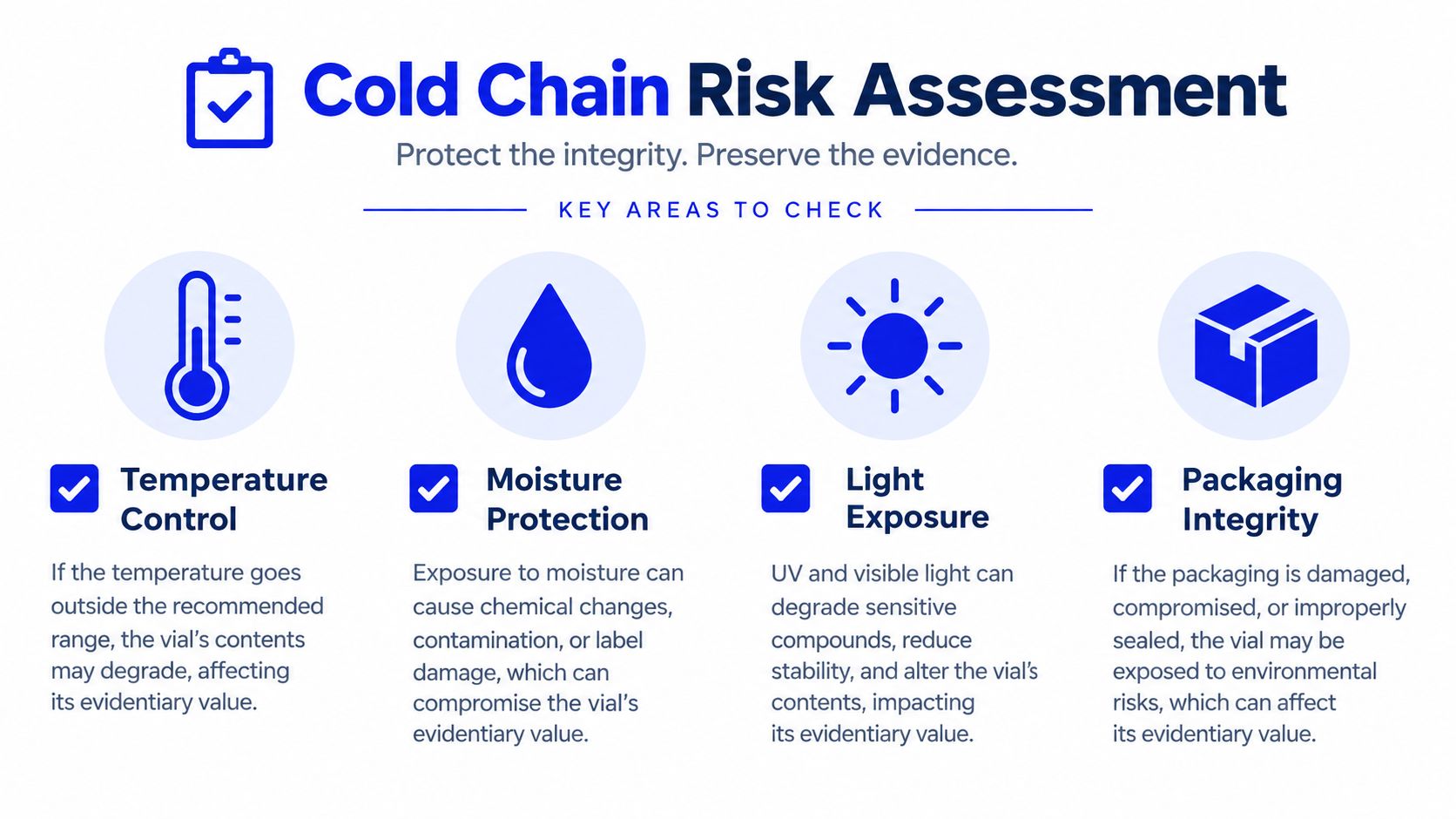
Before ordering, clarify the shipping method and what happens if delivery is delayed. If temperature monitoring is required by the institution's acceptance plan, establish who supplies the record and how it connects to the shipment.
Useful questions include:
A cold pack isn't a substitute for a documented acceptance decision. Likewise, a visually intact package doesn't answer every question about its transit history.
Consider a hypothetical delivery with a matching lot label but a damaged outer carton and a missing temperature record required by the purchase agreement. The receiving coordinator should document the condition, segregate the shipment under the institution's procedure, and request qualified review.
That response doesn't declare the material unusable. It prevents an unsupported release while someone evaluates the missing evidence and any supplier explanation.
Receiving decision: An unresolved condition calls for a documented hold, not a guess based on how the vial looks.
For facility-level storage planning, see Labs USA planning guide. Use such planning resources alongside product-specific requirements; a storage layout cannot establish the quality of an individual lot.
Keep the microbiological and endotoxin records distinct during this review. Their respective results should remain tied to the tested sample and shouldn't be stretched into claims about every subsequent shipping or handling event.
The following hypothetical examples show how the same purchasing standard can lead to different decisions. They focus on authorization and records, not preparation or administration.
A laboratory is sourcing lyophilized BPC-157 for an authorized analytical project. One seller displays a prominent purity claim, while another provides a lot-specific documentation packet and answers the laboratory's questions about formulation and shipping.
The procurement specialist shouldn't select solely on the headline percentage. A useful comparison records:
The second seller may be easier to evaluate, but documentation availability alone isn't automatic approval. The laboratory still applies its acceptance criteria.
An analyst reviewing a liquid GHK-Cu product finds that the report doesn't clearly identify the formulation. Instead of assuming the document covers the ordered item, the analyst requests a matching sample description and clarification of the reported concentration and composition.
A catalog category such as “aminos” deserves the same precision. The purchasing record should identify the actual material, not rely on a broad merchandising label.
A Selank nasal spray product arrives with shipping paperwork that conflicts with the supplier's storage statement. The coordinator records the discrepancy and refers it to the designated reviewer before releasing the shipment.
A consumer-style container shouldn't change the institutional review standard. The reviewer still needs the product identity, formulation, intended research application, and applicable handling documentation.
Across these examples, the buyer's task is to identify a defensible next action: accept under established criteria, request clarification, or hold for review. Explore supplier options after defining those criteria, so the comparison reflects the laboratory's needs rather than the most persuasive product page.
Once a research material is accepted, staff need a controlled record of where it goes and who may handle it. Supplier documents should remain accessible to the personnel responsible for the work, not buried in a purchasing inbox.
The workflow below is a procurement-oriented recommendation. Institution-specific preparation decisions belong to qualified personnel working under approved standard operating procedures.
Maintain a laboratory record containing:
Keep identifying information attached when material moves between authorized locations. If the institution uses secondary containers, its labeling procedure should preserve the connection to the original lot and current status.
Use the supplier's documented storage instructions and the institution's approved controls. Apply light or moisture protection when specified, restrict access appropriately, and refer conflicting instructions to the responsible reviewer.
For a general example of how labels communicate warnings and storage information, the Bandana Rx guide to pet label basics is a supplementary resource. Its veterinary context does not make it an authority for research-peptide handling or human use.
If a label becomes unreadable, a storage excursion occurs, or the documentation no longer matches the material, record the issue and use the institution's hold procedure. Don't replace missing information with an assumption.
Boundary for personnel: Laboratory handling authorization isn't permission to administer a research product to a person.
This workflow intentionally excludes reconstitution, syringe selection, dosage calculations, and injection technique. Anyone investigating the benefits of peptides for weight loss, healing, anti-aging, or muscle growth should take those treatment questions to a licensed healthcare professional rather than adapting laboratory procedures.
A defensible purchase ends with a documented decision, not just an order confirmation. The reviewer should be able to explain why the material meets the institution's defined needs and identify any limitations that remain.
Use a go-or-hold review before releasing a shipment into the laboratory workflow.
This isn't a universal certification checklist. A project's protocol, quality system, and qualified reviewers determine which evidence is necessary and what counts as acceptable.
Pause when the supplier can't reconcile an identifier, explain a conflicting report, or address a required shipping record. Request clarification in writing and assign the decision to the appropriate institutional reviewer rather than asking receiving staff to improvise.
Keep unresolved clinical claims outside the procurement decision. Neither attractive pricing nor a research-use disclaimer converts a chemical supply into an approved human medicine, and a research buyer shouldn't interpret a complete file as treatment clearance.
A careful purchasing process creates a clear distinction between what the evidence supports and what the seller merely suggests. That distinction is the most useful protection against overreading an online listing.
Before your next order, define the application, assemble the acceptance requirements, and ask prospective suppliers to respond to that specific list. Compare the resulting evidence and support options before choosing a research source.
Peptide Warehouse USA offers research peptides and related compounds for laboratory, analytical, and preclinical applications, with lot documentation available to support procurement review. Visit Peptide Warehouse USA to explore research-use options and contact its help desk about the records and shipping information your institution needs before ordering. Products are for research use only, not human consumption.