No products in the cart.


The popular advice to copy an online Bronchogen schedule skips the most important question: what evidence makes that schedule appropriate? Bronchogen peptide dosage is better understood as an unresolved research problem than as a settled instruction. A precise number can look authoritative even when nobody has established what it means for a particular formulation, route, or endpoint.
For a researcher, the useful distinction isn't between competing forum recommendations. It's between a historical product label, a controlled experimental exposure, and a human dose supported by clinical evidence. Those categories aren't interchangeable.
A dosage recommendation should tell you more than how much material to measure. It should connect an identified substance to a defined formulation, administration route, exposure period, and measurable outcome. Without that context, a schedule is closer to an incomplete laboratory note than a reproducible protocol.
Bronchogen's documentation doesn't provide an internationally validated human dosing standard. Historical oral labeling and secondary summaries describe schedules, but they don't establish a clinically validated treatment protocol. The distinction matters because a label can document what someone recommended without demonstrating that the recommendation works.
Before comparing amounts, decide what question you're asking. Characterizing a peptide in a cell assay isn't the same task as investigating tissue changes in an animal model, and neither establishes a personal treatment dose.
A useful screening process asks:
These questions prevent a familiar mistake: treating every page containing a dosage number as though it reports the same kind of evidence.
Planning exposure for an unvalidated peptide is closer to developing an analytical method than following a recipe. You define assumptions, check the material, establish controls, and determine whether the measurement answers your question.
Practical rule: A schedule without its formulation, route, and endpoint isn't a complete research protocol.
That approach also sets an appropriate boundary. Research planning can address units, concentration ranges, handling, and documentation without claiming that a particular human dose is safe or effective. Uncertainty belongs in the protocol, not hidden behind a confident-looking number.
Bronchogen is generally identified as the tetrapeptide Ala-Glu-Asp-Leu, with a reported molecular weight of approximately 432.43 Da; the same research summary describes rat lung-explant activity at 0.05 ng/mL and bronchial epithelial-cell investigations involving differentiation-related factors including CXCL12 and HOXA3 (Bronchogen identity and preclinical exposure summary).
Those details define a research starting point, not a treatment claim. Sequence identifies the intended molecule, molecular weight supports concentration calculations, and the experimental model defines what investigators exposed.
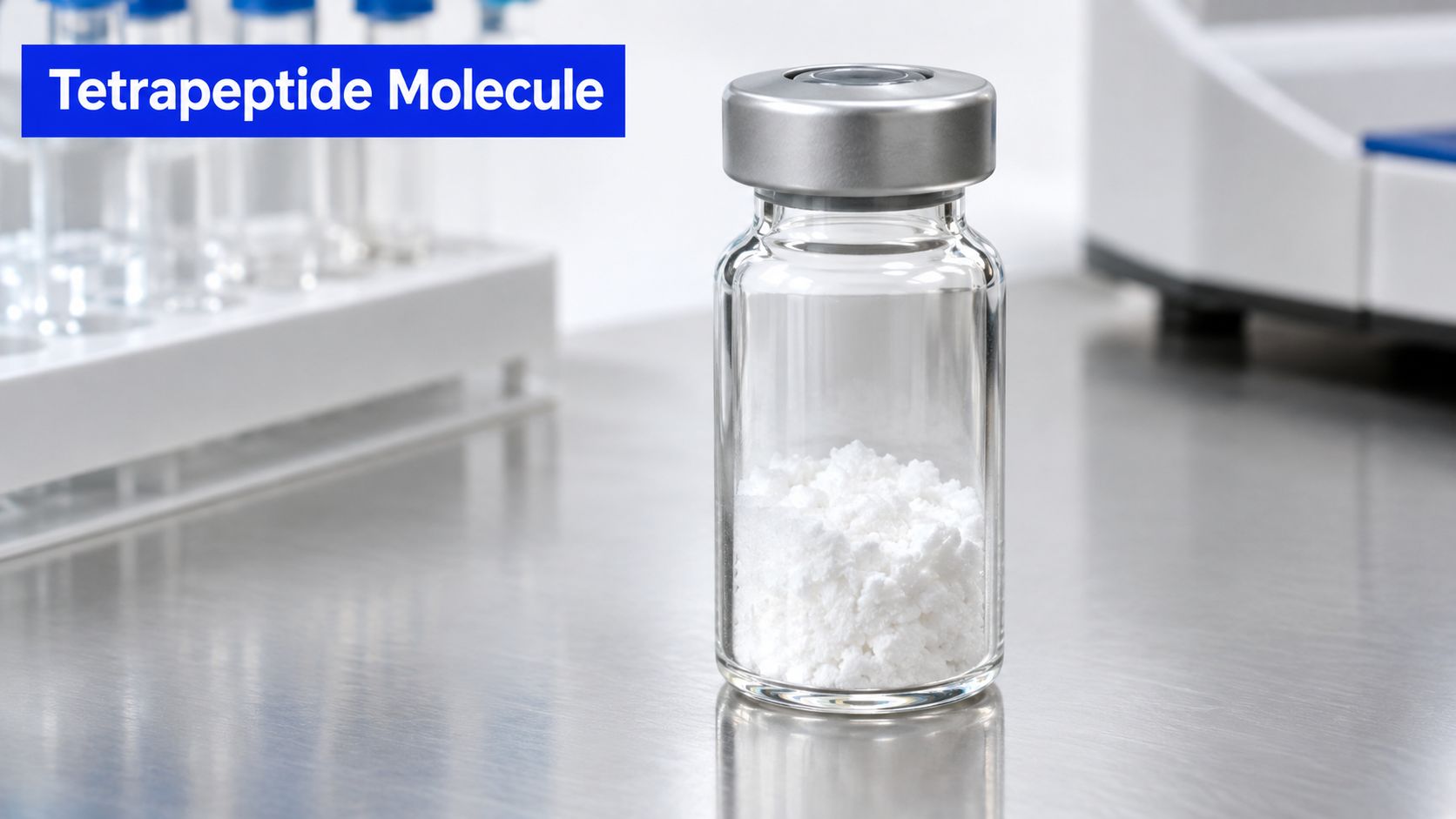
A vial's gross contents and its active peptide content are different reporting concepts. When preparing an experiment, distinguish the stated peptide quantity from the formulation, counterion, and other material that may accompany it.
The short sequence doesn't justify assuming predictable absorption or persistence. Nor should a researcher borrow the handling assumptions used for a larger protein because both materials belong to the broad category of peptides.
For procurement, request documentation that separates:
Bronchogen is discussed as a lung bioregulator in preclinical work. That description doesn't establish rapid airway-opening activity, and it shouldn't be interpreted as an alternative name for an asthma rescue medicine.
The dosing documentation discussed below specifically cautions against treating it as emergency asthma treatment. An exploratory epithelial-cell endpoint and immediate relief of breathing difficulty are fundamentally different claims.
When assessing the potential benefits of peptides, keep the endpoint attached to the claim. Activity in a laboratory model can justify further investigation without demonstrating a respiratory benefit in people.
Unit conversion answers a mathematical question. Dose translation answers a biological question. Confusing the two is how a correct calculation becomes an unsupported recommendation.
The relationships below are useful for organizing a calculation, but they don't establish human exposure.
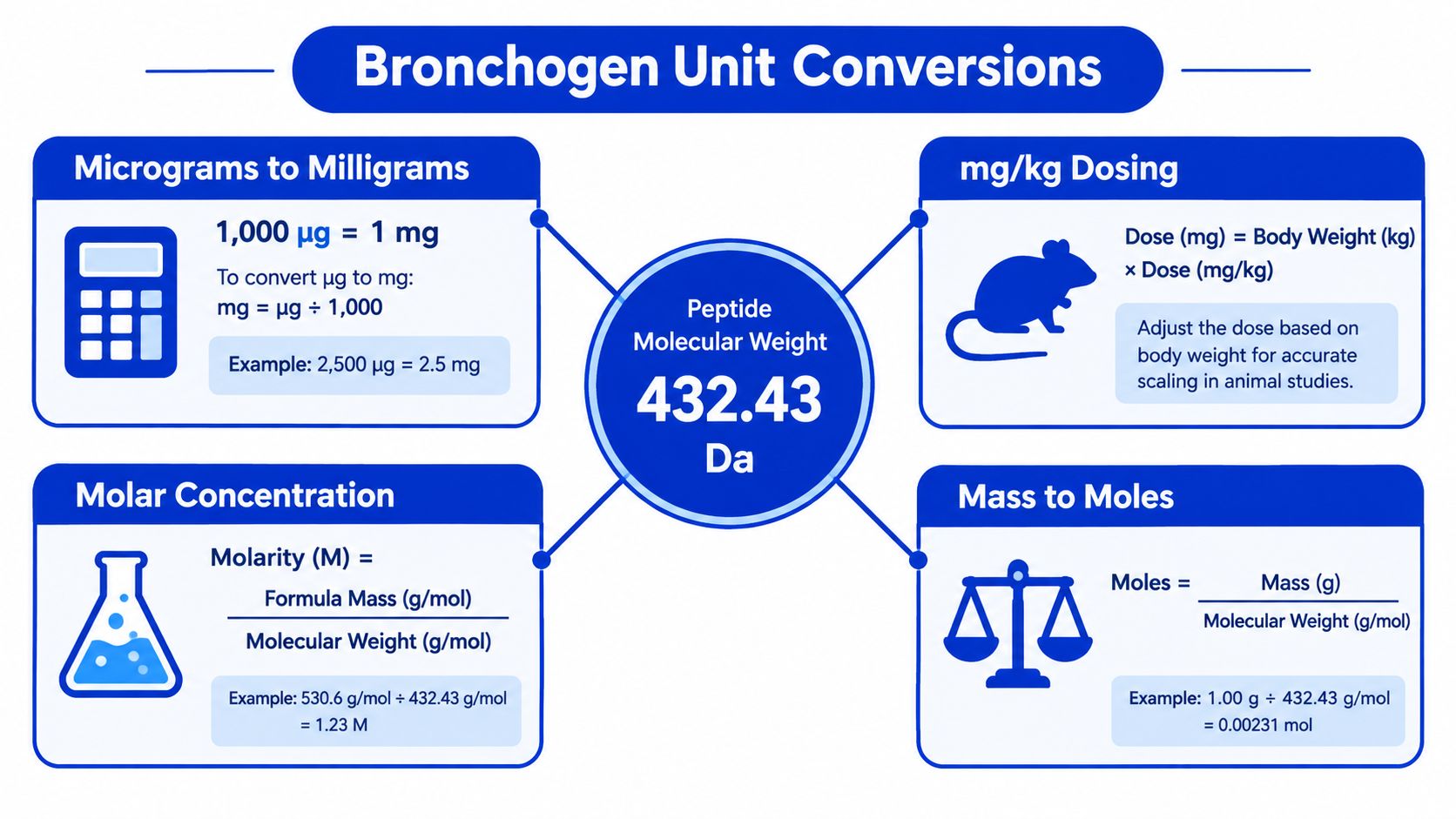
Micrograms and milligrams express mass. Milligrams per kilogram express an administered mass normalized to body weight. Molar concentration expresses the amount of substance within a defined volume.
These quantities describe different aspects of an experiment. A concentration in culture medium doesn't specify how much material an organism absorbs, and a body-weight-normalized amount doesn't identify the concentration reaching lung tissue.
For a symbolic worked example, let the verified peptide mass be m, its molecular weight be M, and the final solution volume be V:
This calculation describes a prepared solution. It doesn't describe an absorbed dose, tissue concentration, or therapeutic exposure.
Bronchogen's available evidence hasn't established human absorption, proteolytic stability, tissue distribution, or route-specific bioavailability. The experimental summaries cited elsewhere therefore can't supply the missing bridge between an animal exposure and a human regimen.
Even a carefully calculated translated value would remain a hypothesis requiring validation. It shouldn't be promoted as a clinical recommendation or used to justify self-administration.
Correct arithmetic can preserve an assumption. It can't prove that assumption is biologically valid.
The accompanying video is supplemental viewing, not a source of validated Bronchogen dosing instructions.
For laboratory reporting, retain both the calculation and its assumptions. That lets a colleague check the preparation without mistaking mathematical precision for pharmacological certainty.
The schedules below belong to different evidence categories. Their differences shouldn't be resolved by choosing an average, selecting the most frequently repeated amount, or assuming that an injectable preparation is equivalent to a capsule.
| Regimen | Source category | Key caveat |
|---|---|---|
| Capsules containing 100 micrograms, with 1–2 capsules taken 1–2 times daily for approximately 30 days, followed by a repeat course after 4–6 months. The stated daily exposure is 100–400 micrograms (historical oral-label documentation). | Historical oral label | This documents a reported schedule, not an approved medical dose or demonstrated treatment for respiratory disease. Published human injectable dosing evidence wasn't identified in the cited review. |
| Oral or capsule schedules of approximately 10–20 mg daily for 10–30 days; product-oriented injectable schedules including 10 mg intramuscularly daily for 10 days; rodent protocols around 0.2 micrograms/kg; and cell-culture exposure near 20 ng/mL (secondary protocol and preclinical exposure summary). | Secondary summaries, market conventions, and preclinical benchmarks | These aren't standardized clinical regimens. Animal and culture exposures don't validate the consumer schedules listed alongside them. |
The historical oral account also cautions that Bronchogen hasn't been demonstrated to function as a rapid bronchodilator or emergency treatment for an asthma attack. The secondary protocol summary identifies the absence of controlled human dose-ranging evidence as a central limitation.
A historical label answers what a product's documentation reportedly instructed. A preclinical benchmark answers what investigators exposed a particular model to. An internet convention answers what people repeat.
None answers the clinical question merely by providing a number.
When extracting a schedule into a literature spreadsheet, preserve its provenance:
The contrast between the reported schedules is a reason to investigate their origins, not evidence that the amounts are interchangeable. A properly designed preclinical study needs a model-specific rationale rather than a consumer schedule copied into its methods.
Start with the endpoint, not the vial size. A study investigating epithelial differentiation needs an exposure design that can answer that question, rather than an amount chosen because it's convenient to purchase.
The following workflow is a planning framework, not a ready-to-run Bronchogen protocol.
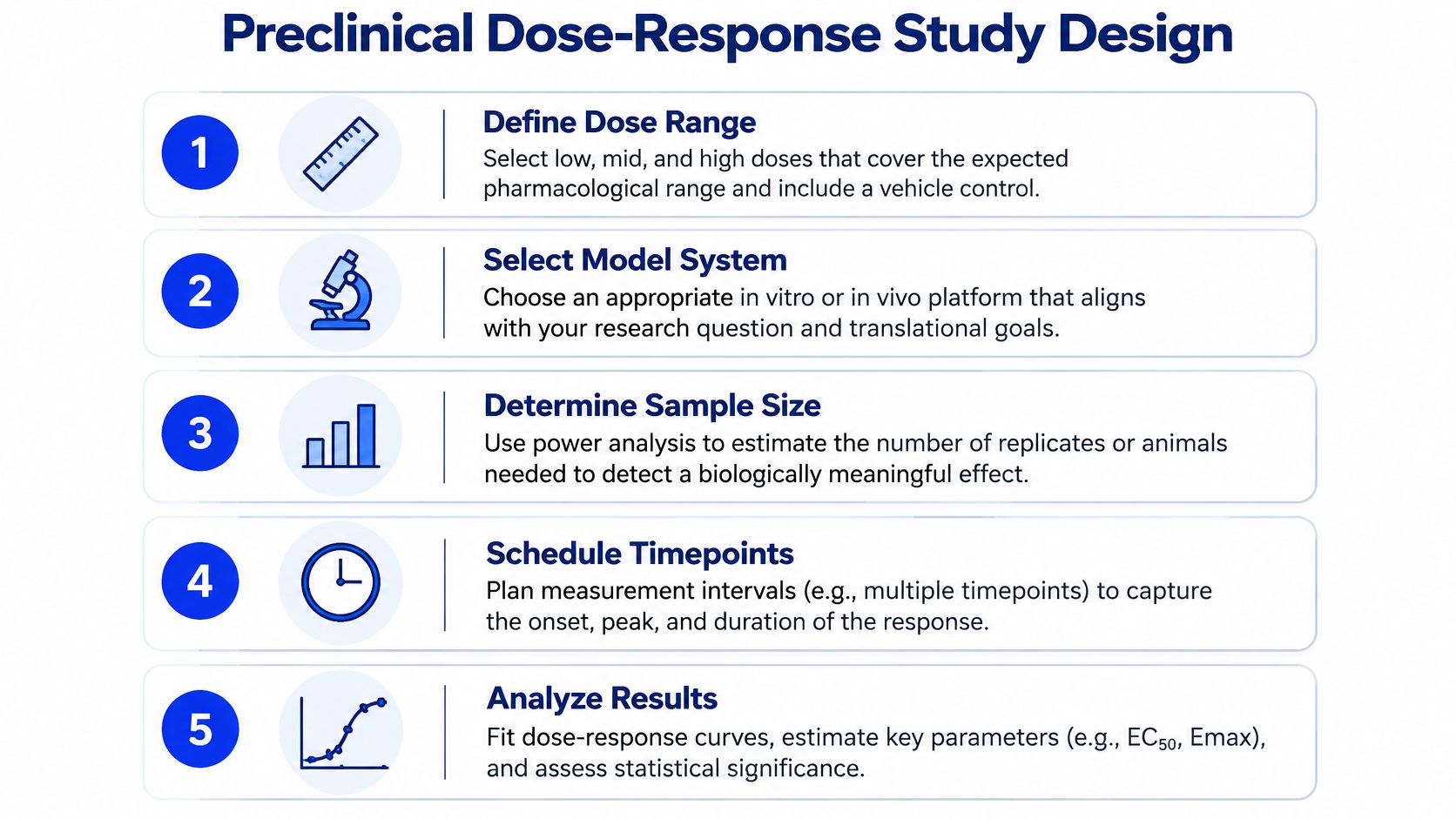
Define a low-to-high concentration series appropriate to the selected model. Explain the basis for its boundaries, and keep exploratory range selection separate from the experiment intended to test the hypothesis.
Include untreated controls and vehicle controls so the comparison addresses both baseline behavior and the preparation conditions. Verify peptide identity and stability rather than assuming that a supplier's product name establishes what the assay receives.
Plan sampling and analysis before collecting results. Choose sample size with an appropriate statistical justification, identify measurement intervals, and specify how you'll interpret a response that doesn't follow the expected pattern.
A structural or inflammatory readout in lung tissue remains a preclinical endpoint. It doesn't become a patient benefit because the response appears concentration-dependent.
Adapt this record to the model rather than treating it as a universal operating procedure.
| Field | What to record |
|---|---|
| Material identity | Sequence, supplier, lot identifier, and identity-testing documentation |
| Composition | Salt or formulation, peptide-content basis, purity, and endotoxin status |
| Preparation | Vehicle, stock concentration, dilution calculation, and preparation date |
| Exposure | Model, route, final molar concentration or justified animal-dose expression, frequency, and duration |
| Comparators | Untreated condition, vehicle condition, and other justified controls |
| Measurement | Assay endpoint, collection timing, analytical method, and acceptance criteria |
| Interpretation | Analysis plan, exclusions, deviations, and limitations |
Notebook standard: Record enough detail for a colleague to reconstruct the exposure without asking what you meant by “Bronchogen dose.”
For combination experiments, establish the individual-compound comparisons before interpreting a proposed peptide stack. Otherwise, the design may not let you distinguish a combination effect from the behavior of either component alone. A more complicated mixture isn't automatically a more informative experiment.
Consider a hypothetical researcher preparing Bronchogen for an epithelial-cell assay. Before making an aliquot series, she checks the lot documentation, confirms the intended concentration basis, and opens a preparation record.
She doesn't borrow a storage temperature or solution expiry from a forum. The evidence discussed here doesn't establish a universal Bronchogen storage specification or validated reconstituted shelf life.

Her preparation sheet distinguishes unopened lyophilized material from peptide already in solution. She asks which storage conditions, light-protection measures, solvent choices, and holding times have documentation relevant to the supplied formulation.
Where information is missing, she records the uncertainty and plans an appropriate stability check. She doesn't describe a condition as validated merely because it is common practice for other peptides.
For the aliquot series, each tube receives a clear identity linked to:
Cell-culture addition, animal inhalation, and animal injection represent different proposed experimental designs, not substitute ways to deliver an equivalent amount. Mentioning those routes doesn't establish that each has a validated Bronchogen protocol.
For an approved animal study, the research team would need route-specific justification, appropriate oversight, and formulation compatibility. A culture preparation shouldn't be relabeled for another route.
In the hypothetical assay, the researcher also retains material for the planned analytical checks and records any preparation deviation before interpreting the biological result. That creates a practical troubleshooting trail.
If an unexpected result appears, she can examine preparation history alongside the assay output. Without those records, she would struggle to distinguish an exposure problem from the experimental response she intended to measure.
Repeated advice can become familiar without becoming better supported. Bronchogen is particularly vulnerable to this problem because online discussions often combine product amounts, animal findings, and proposed personal schedules.
The commonly repeated convention of 20 mg orally or sublingually once daily for 10 days isn't supported by a validated human dose-finding study; the cited PubMed-indexed rat COPD paper describes a one-month treatment course after 60 days of nitrogen-dioxide exposure, but its abstract doesn't establish a human-equivalent dose, optimal route, maximum tolerated dose, or pharmacokinetic profile (Bronchogen rat COPD-model publication).
The treatment duration describes the animal experiment. It doesn't validate the consumer convention because both involve a course of administration.
Likewise, PubMed indexing identifies a publication record. It doesn't change the study population from rats to people or supply clinical endpoints the investigators didn't measure.
A nominal capsule amount needs a defined meaning. Before comparing it with purified research material, determine whether the number describes the whole preparation or the active peptide.
The same caution applies when comparing oral and subcutaneous claims. Matching printed mass values doesn't establish matching exposure, and a route change requires evidence rather than an assumption about greater effectiveness.
Common shortcuts to reject include:
A missing safety signal in a limited experiment isn't the same thing as an established human safety margin.
Curiosity about Bronchogen is reasonable. Copying a personal schedule from preclinical findings isn't a substitute for the human evidence needed to justify it. Research-use material should remain within its laboratory and analytical purpose.
The useful outcome of researching Bronchogen peptide dosage isn't a personal number. It's a defensible record of what material was studied, how investigators exposed the model, and what they could reasonably conclude.
Bronchogen isn't an approved treatment, and the available documentation doesn't establish a validated human administration protocol. Historical schedules, secondary summaries, and preclinical exposures should retain their original labels rather than being presented as equivalent therapeutic options.
Before ordering research material, distinguish a supplier's analytical documentation from evidence of biological effectiveness. A Certificate of Analysis can help assess the supplied lot, but it doesn't establish a medical indication, optimal exposure, or clinical safety.
Use the following checklist to prepare a research-ready decision:
A clear procurement request asks for the documents needed to evaluate a lot. A clear protocol explains why the proposed exposure can answer the research question. Neither should rely on the confidence of a product-page schedule.
Research-use boundary: Research peptides belong in laboratory, analytical, and appropriately governed preclinical work. They aren't for human consumption, self-injection, or replacement of established respiratory care.
Peptide Warehouse USA offers research peptides and related compounds with lot-specific documentation, including Certificates of Analysis and microbial and endotoxin reports. Visit Peptide Warehouse USA to explore the catalog and review available documentation against your protocol's identity, purity, and traceability requirements. All products are sold for research, laboratory, or analytical use only, not for human consumption.