No products in the cart.


The most common advice for a “vasoactive intestinal peptide buy” search is to choose the highest purity at the lowest price. That's an incomplete purchasing strategy. For VIP, the more useful question is whether the material will remain active in the format, solution and assay your laboratory uses.
A certificate of analysis can support identity and chemical purity without proving functional suitability. A defensible purchase starts with the required format, then examines receptor-activity evidence, handling limits and documentation tied to the vial's specific lot.
In 1970, Sami Said and Viktor Mutt isolated a 28-amino-acid peptide from porcine small intestine, identifying a potent vasodilator and hypotensive substance rather than merely a local gut hormone, as described in this review of VIP's discovery and physiology. That history explains why the peptide attracts buyers well beyond gastrointestinal research.
Vasoactive intestinal peptide, or VIP, is a naturally occurring neuropeptide in the secretin family, alongside PACAP, glucagon and GLP-1. Its principal targets are VPAC1 and VPAC2, class B G-protein-coupled receptors that stimulate adenylyl cyclase, increase cyclic AMP and engage protein-kinase-A signaling, providing a defined mechanism for VIP receptor research.
VIP is distributed across the brain, gastrointestinal tract, lungs, liver, cardiovascular system, pancreas and immune tissues. Its broad distribution helps explain why neuroscience, gastrointestinal, respiratory and immunology laboratories may need different specifications despite searching for the same peptide.
Laboratory context matters more than the product name alone.

This guide concerns research procurement, not dosing, personal use or treatment. Research material and approved medicines belong in separate purchasing categories.
Before reviewing a catalog, write down:
These answers turn a broad shopping query into a specification that procurement staff and researchers can evaluate together.
A laboratory measuring receptor-stimulated signaling has a different purchasing problem from a group testing intestinal delivery. Both may use VIP, but they shouldn't interpret the same product description as evidence of suitability.
The relevant starting point is the experiment's evidence tier, not a broad list of peptide benefits.

Cellular mechanism work asks whether VIP produces a defined receptor response, such as cyclic AMP signaling. A functional assay can address that question without establishing a clinical benefit.
Isolated-tissue and smooth-muscle studies investigate physiological responses in a specified preparation. They can inform mechanism, but a response in isolated tissue doesn't establish what a finished medicine would do in a patient.
Animal models support more integrated biological questions. Recent mouse research described VIP regulation of intestinal barrier and immune development through gut neurons and intestinal stem cells, with possible relevance to allergy, inflammatory bowel disease and irritable bowel syndrome; those implications remain preclinical.
An accompanying human observational example reported 47.94 ± 10.48 pg/mL in constipation and 150.00 ± 33.25 pg/mL in diarrhea among patients with hypothyroidism and bowel dysfunction, as summarized in this report of emerging intestinal VIP research. Those measurements describe an association, not evidence that administering VIP changes symptoms.
Controlled clinical research addresses a different level of evidence again. Its findings belong to the specific investigational product, participant population, route and protocol studied, not automatically to a catalog vial.
For additional background, the following video can accompany, but shouldn't replace, examination of study methods and product documentation.
The research described above doesn't establish that purchasing research-grade VIP produces:
A suitable research claim identifies the hypothesis, receptor pathway and experimental model. It doesn't promise a personal health outcome.
The practical benefit of a well-characterized VIP product is narrower and more useful: it can support a defined experiment whose limitations the researcher understands.
VIP formats aren't interchangeable. A listing that says only VIP doesn't adequately identify the molecule, formulation or delivery system being supplied.
| Format | What It Is | Stability and Delivery Profile | Typical Research Fit | What to Verify |
|---|---|---|---|---|
| Native synthetic VIP, lyophilized | Synthetic sequence matching native VIP | Short circulating persistence; alkaline sensitivity | Receptor signaling and in-vitro assays | Sequence and mass confirmation, functional cAMP evidence |
| VIP-based long-acting investigational analog | Modified VIP-based molecule evaluated in controlled human research | Prolonged exposure in the reported study | Pharmacokinetic and exposure modeling | Study-specific data; no assumption of native-VIP equivalence |
| Liposome-associated VIP | VIP enclosed in lipid vesicles | Protected peptide in the reported lavage-fluid experiment | Protection and delivery studies | Lipid composition, encapsulation method, release data |
| Capsule-encapsulated VIP | VIP incorporated into a colonic-delivery formulation | Storage-dependent, reproducible release in the reported model | Gut-delivery experiments | Release profile, storage temperature, batch release testing |
| Aviptadil, synthetic VIP clinical reference | Synthetic VIP investigated in a clinical development program | Protocol-specific intravenous clinical formulation | Historical and clinical comparison | Formulation, regulatory status, intended use and product-specific documentation |
Native powder, liposomal preparations and capsules are relevant research-format categories, not a statement that every supplier stocks them. The analog and aviptadil entries are clinical reference formats, not evidence of ordinary catalog availability.
The numerical differences are substantial: native VIP has a reported circulating half-life of approximately one minute or less; liposome-associated VIP remained substantially intact and active in bronchoalveolar-lavage fluid while free VIP was digested; and capsule preparations retained reproducible release for at least six weeks, whereas free peptide in the colonic model began declining after roughly 20–40 minutes, according to this review of VIP delivery and stability findings.
In a controlled PB1046 study, researchers evaluated five subcutaneous dose levels from 0.05 to 0.8 mg/kg, with eight participants per group, comprising six active-treatment and two placebo participants; maximum concentrations occurred 24–72 hours after administration, with a 48-hour median, and terminal half-life was approximately 60 hours, according to the PB1046 controlled-study presentation. The report also described dose-related, but less-than-dose-proportional, increases in concentration and exposure.
Those are investigational pharmacology results, not dosing instructions. They demonstrate why a modified molecule's exposure cannot be assigned to native VIP.
For aviptadil, the 2023 TESICO randomized trial enrolled 461 patients with COVID-19-associated hypoxaemic respiratory failure to evaluate intravenous treatment, providing a clinical reference for synthetic VIP investigation. Trial participation doesn't make a research listing equivalent to the trial material.
For receptor-signaling work, native synthetic VIP with appropriate bioactivity evidence is a logical starting specification. For delivery or pharmacokinetic questions, require documentation for the exact formulation being investigated.
A high headline purity percentage can coexist with uncertainty about whether a lot will perform in your assay. Chemical purity and functional suitability answer different questions.
A useful certificate of analysis, or COA, separates identity, chromatographic purity, peptide content and activity rather than presenting them as interchangeable assurances. The rapid-clearance and delivery findings discussed above make this distinction particularly important for VIP.
Identity testing should support the claimed molecule through mass and sequence confirmation. HPLC purity describes chromatographic purity under the reported method; it doesn't, by itself, demonstrate receptor activation.
Peptide content should be distinguished from gross vial weight. For a supplied solution, concentration accuracy also matters because the assay depends on how much peptide reaches the experimental system.
Where the planned work requires them, examine endotoxin, microbial or sterility documentation separately. Don't interpret a purity result as evidence that these attributes were tested.
A functional result should identify the receptor system and readout. Request VPAC1- or VPAC2-stimulated cAMP data for the lot, or a clear statement that bioactivity wasn't tested and an appropriate test plan is needed.
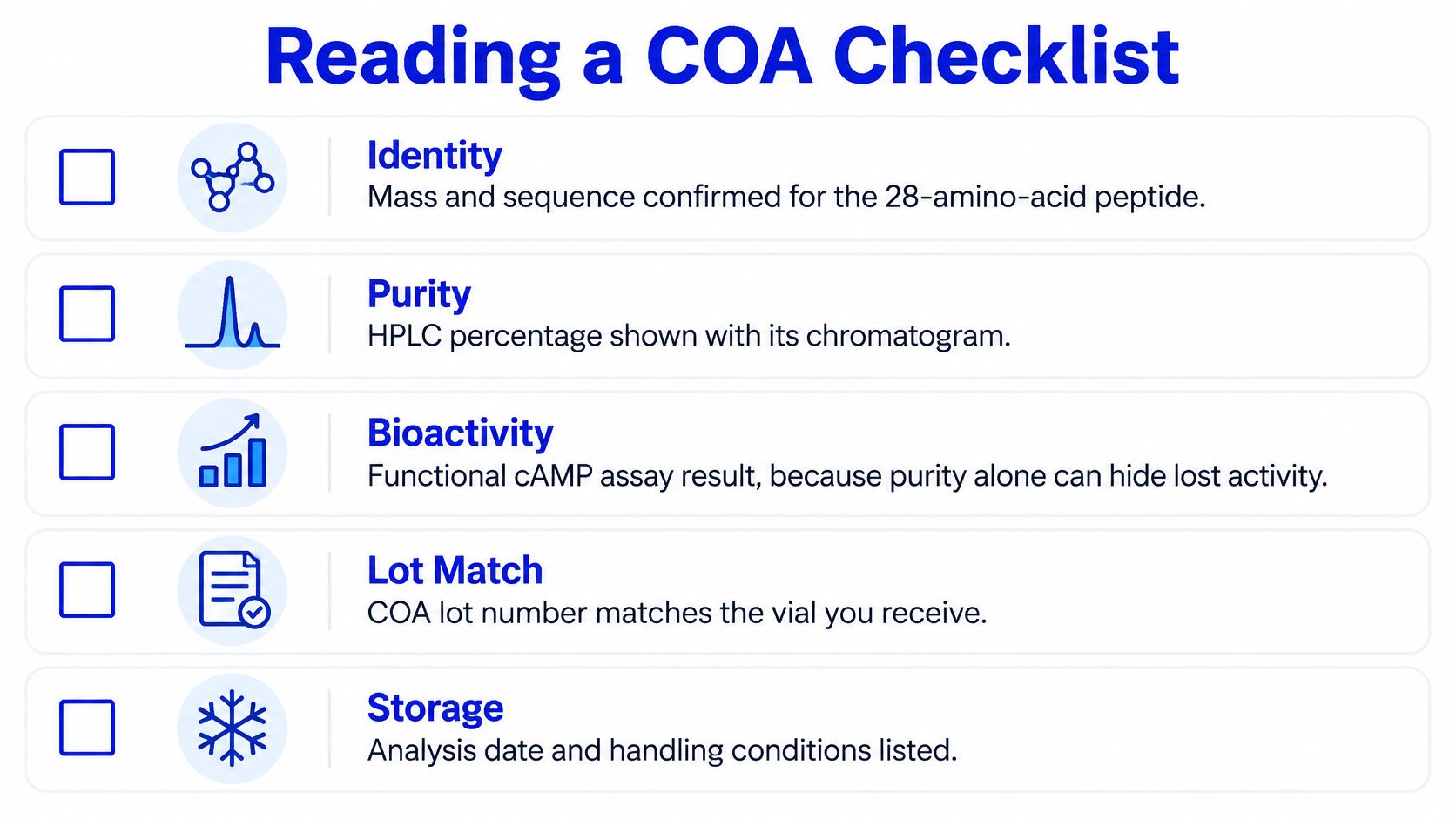
A generic COA, an unnamed method or a purity figure without its supporting chromatogram should leave the order unresolved. Missing endotoxin documentation should also prompt review when the intended cell-culture protocol requires it.
At Peptide Warehouse USA, our products are made in the USA, batch produced and batch tested. We provide high-purity research peptides backed by third-party documentation, including COAs, endotoxin and microbial reports.
Those business-level assurances don't replace lot matching. Confirm that the documents supplied apply to the material you receive and contain the attributes your protocol requires.
Procurement rule: Treat an unreported attribute as unverified, not as an implied pass.
Temperature alone isn't a complete VIP quality specification. The documented behavior depends on solution conditions, concentration, matrix and formulation.
| Condition | Documented Behavior | What to Request or Plan |
|---|---|---|
| Acidic to neutral solution | Largely stable under the tested conditions | Confirm the permitted buffer pH range |
| Strongly alkaline solution | Pronounced degradation | Obtain validated reconstitution guidance; avoid unvalidated alkaline buffers |
| Low-concentration solution in cold storage | Degradation observed | Request concentration-specific stability information |
| Simulated gastric and intestinal fluid | Rapid destruction | Don't assume unprotected oral delivery is suitable |
| Free VIP in the colonic model | Decline during the reported short solution window | Validate preparation-to-measurement timing |
| Capsule-encapsulated VIP | Reproducible release under appropriate storage | Obtain formulation-specific storage and release data |
The HPLC stability study found VIP largely stable at pH ≤7, but reported complete loss within 30 minutes at pH 13; ionic strength didn't materially change stability, and dilute samples degraded during cold storage, according to the VIP solution-stability study. These findings aren't a universal shelf-life specification for every buffer or concentration.
Before ordering, resolve the following with product documentation:
For our products, we assist with non-medical documentation questions so researchers can establish what information is available before purchase. If a required stability attribute isn't documented, the laboratory should decide whether it needs validation before using the material.
Schedule preparation and measurement around the short free-peptide window identified in the delivery research, while recognizing that the reported model doesn't establish a universal assay deadline. Record elapsed time after dilution so an unexpected result can be investigated.
Keep reconstitution instructions, shipping information and handling records beside the COA. A historical purity result cannot establish the condition of material after an undocumented storage excursion or incompatible dilution.
An orphan designation or clinical trial doesn't mean a research product is approved. Approved medicine, orphan-drug designation, Fast Track designation and investigational use are distinct categories.
The FDA's VIP orphan-drug record explicitly states “Not FDA Approved for Orphan Indication”, making the FDA orphan-designation database entry a useful checkpoint against misleading supplier language. The designation doesn't authorize a catalog research material for diagnosis, treatment, prevention or human consumption.
Aviptadil received Fast Track designation for investigation in critically ill COVID-19 patients with respiratory failure, as discussed in this review of VIP clinical development. That development milestone isn't a general authorization to purchase or administer research-grade VIP.
Nor should a buyer interpret the phrase clinical research as a quality bridge between unrelated products. The relevant clinical formulation, manufacturing documentation and protocol belong to the investigational program.
At Peptide Warehouse USA, our products aren't intended for human or veterinary consumption. We're not a compounding pharmacy or compounding facility under Section 503A, nor an outsourcing facility under Section 503B, of the Federal Food, Drug, and Cosmetic Act.
Our website statements haven't been evaluated by the FDA. Our products and information aren't intended to diagnose, treat, cure or prevent disease.
A research listing should clearly identify its scope:
Regulatory terminology should explain a product's limits, not create an impression of therapeutic authorization.
Purchasing and import requirements can depend on jurisdiction and institutional policy. Have the institution's compliance office review the order where required, particularly when the material, destination or planned application raises an unresolved question.
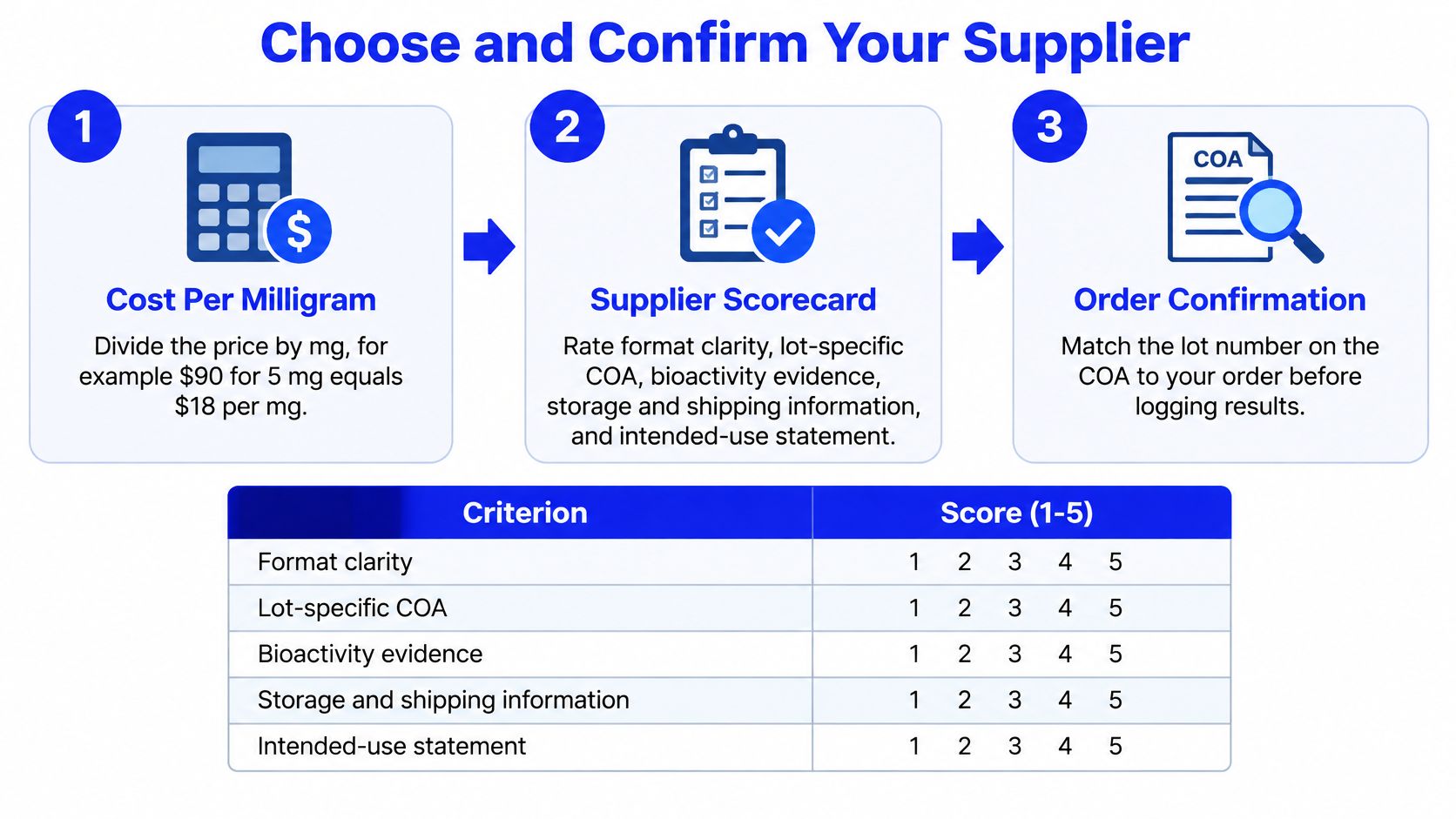
The lowest price per milligram can be a poor comparison if suppliers report different measures of content or provide different levels of documentation. Compare a usable, documented research input, not just vial prices.
| Criterion | What Good Looks Like | Red Flag |
|---|---|---|
| Format clarity | Named form with sequence information | Only VIP listed, without format or sequence |
| Lot-specific COA | Matching lot number, named method and analysis date | Generic COA unrelated to the vial |
| Functional bioactivity | Receptor cAMP evidence or a stated test plan | Purity presented as proof of activity |
| Purity chromatogram | HPLC chromatogram and peptide-content reporting | Unsupported headline percentage |
| Endotoxin and microbial results | Documentation appropriate to the cell-culture protocol | Required results absent |
| Storage and shipping | Powder and solution instructions, shipping terms | No handling information |
| Intended-use wording | Research-only scope and appropriate disclaimer | Treatment or personal-use language |
Use the scorecard to identify unresolved requirements, not to average away a critical failure. Strong shipping information doesn't compensate for uncertain identity.
Divide the vial price by stated peptide content in milligrams, not gross label weight. Then include applicable reconstitution materials and shipping charges.
For a hypothetical comparison, Vendor A charges $150 for 5.0 mg, or $30 per mg. Vendor B charges $110 for 4.0 mg, initially $27.50 per mg, but $30 shipping brings its delivered cost to $35 per mg.
These are illustrative arithmetic examples, not supplier prices. Neither calculation establishes value until the format and documentation meet the experiment's requirements.
The supplied purchasing visual can serve as a reminder to compare documentation before confirming an order.
Our support team answers non-medical, non-clinical questions about availability, documentation and order status. We don't provide medical advice, dosing instructions or treatment guidance.
We ship to all 50 U.S. states and offer multiple delivery options at checkout. Check the current catalog and confirm VIP availability rather than assuming a particular form is stocked; catalog availability isn't established by the research literature.
An order is ready when the laboratory can explain both why the material fits the experiment and how it will verify that fit after receipt.
A clinical development name doesn't establish the status of an individual listing. The TESICO trial discussed earlier used protocol-specific material, so examine any aviptadil listing's identity, formulation, intended use and documentation rather than assuming clinical equivalence.
Quarantine the vial and don't begin assays. Request documentation matching the received lot, record the discrepancy in the purchase file and resolve it before releasing the material for use.
Check the experimental record before concluding that purity explains performance:
These checks distinguish handling or assay questions from unresolved product-quality questions without assuming the cause.
Provide the lot number, required format and a concise description of the laboratory application. Request available cAMP evidence, storage instructions and shipping information, while keeping the inquiry separate from dosing or treatment questions.
Use the supplier scorecard to turn the reply into a documented purchasing decision.
Peptide Warehouse USA offers US-made, batch-tested research peptides supported by third-party COAs, endotoxin and microbial reports. Visit Peptide Warehouse USA to explore the current catalog and contact our team about VIP availability, lot documentation and order status before selecting material for your research.