No products in the cart.

You're comparing two peptide listings for your next experiment. Both say 99% pure, both look like clean white powder, and the price gap makes no obvious sense. That confusion is normal when you're shopping for purity ingredients, because the headline number rarely tells you what's in the vial.
A 99% label can be accurate and still leave the vial underfilled for your assay. The percentage usually reports one chromatographic result, while the experimental signal depends on the correct sequence, the amount of actual peptide in the powder, and the contaminants that never appear in that trace.
Purity ingredients are the materials and test results that show a peptide is the correct molecule, is present in the stated amount, and is free of unwanted substances. Treat purity as a bundle of separate measurements: identity, chromatographic purity, net content, and named contaminants. A single headline cannot compress those into one answer.
Modern quality standards developed as testing shifted from appearance and supplier trust toward predefined analytical criteria, the principle behind today's certificates of analysis.
A purity percentage is useful only when you know which question the test answered.
Read the certificate in this order: identity first, then the chromatographic purity method and result, then net content and named contaminants. If the main peak is high but water, counter-ions, solvents, endotoxins, or microbial results are absent or unstated, the 99% figure describes less than the label suggests. Other ingredient fields use the same logic. Resources on understanding terpene quality standards make a similar point, that documented testing beats label claims.
This guide covers laboratory and preclinical research materials only. It doesn't cover human use, dosing, or medical effects.
Four questions sit behind every purity claim: is the molecule correct, how clean is the chromatogram, how much of the powder is peptide, and which contaminants are absent. A strong dossier answers each one with its own test, because no single method can cover all four.
| Attribute | Question it answers | Common method | What a good entry shows |
|---|---|---|---|
| Identity | Is the molecule the expected sequence and mass? | LC-MS or LC-MS/MS | Observed mass matches calculated mass within a stated tolerance |
| Chromatographic purity | What share of the detected signal is the main peak? | RP-HPLC or UHPLC with UV detection | Area percentage, column, gradient and wavelength stated |
| Peptide content (assay) | How much of the weighed powder is actual peptide? | Amino acid analysis, nitrogen analysis, quantitative NMR | Net peptide content reported, often below 100% |
| Counter-ions and residual TFA | Which salt form is present, and how much? | Ion-specific chromatography | TFA or acetate level reported |
| Water content | How much moisture is in the powder? | Karl Fischer titration | Percentage by weight |
| Residual solvents | Were synthesis solvents removed? | Headspace gas chromatography | Named solvents below stated limits |
| Endotoxins | Are bacterial endotoxins present? | LAL (Limulus amebocyte lysate) assay | Endotoxin units per milligram |
| Microbial purity | Is there a viable microbial load? | Plate counts and specified organism tests | Colony counts within stated limits |
| Elemental impurities | Are heavy metals present? | ICP-MS | Results per element against limits |
A bag of rice shows the difference between two of these rows. HPLC purity tells you how clean the rice looks under one light. Content tells you how much of the bag is rice at all, rather than packaging, moisture, and dust.
In reversed-phase HPLC, the sample passes through a column and separates by hydrophobicity. Compounds that interact less with the column exit earlier. Compounds that interact more exit later.
A UV detector draws each exiting compound as a peak. Area percentage is the main peak's area divided by the total area of all peaks. That is a share of detected signal, and it says nothing directly about powder weight.
Practical rule: If a contaminant doesn't absorb UV light at the chosen wavelength, it draws no peak, so it can't lower the area percentage.
That's the trap. Salts, water, and many non-UV-absorbing contaminants stay invisible to that detector. ICH Q6B states that measured purity is method-dependent and should be estimated using a combination of complementary analytical procedures, and it notes that a nominal result such as "99.5% HPLC purity" does not by itself characterize residual solvents, counterions, water, inorganic residue, or unidentified impurities.
LC-MS/MS is primarily the identity check. It confirms molecular mass and can support sequence confirmation. It also reveals species that hide under the main HPLC peak, including:
Mass spectrometry doesn't prove sterility, endotoxin status, or exact net content. A correct mass tells you the right molecule is present. It says nothing about how much of the powder is that molecule.
Mass balance takes a stricter route. The lab measures peptide-related impurities, counter-ions, water, residual solvents, and non-combustible residue, then subtracts them from 100%. The remainder is assigned as overall purity.
Say, as a hypothetical worked example, a lot reports 99.4% HPLC area purity alongside 4.5% water, 12% TFA, 0.3% residual solvents, and 0.2% residue. Subtracting those four items from 100% leaves about 83% before peptide-related impurities are even counted. The HPLC number wasn't false. It just never measured those components.
That gap matters when you weigh powder for a quantitative assay. If you assume the powder is 99% peptide but it's closer to 83%, every concentration you calculate runs high. Your dose response curve then shifts for a reason that has nothing to do with biology.
This separation of attributes is standard practice. Analytical guidelines keep identity, chromatographic purity, and content as distinct measurements, calling for orthogonal content methods such as liquid chromatography, amino-acid analysis, nitrogen analysis, and quantitative NMR, with separate tests for residual solvents, endotoxins, and microbial purity.
So the question to ask of any 99% claim is which test produced it. Does the figure mean 99% active peptide by mass, or 99% chromatographic peak area under one HPLC method? A slightly lower headline backed by identity, content, solvent, endotoxin, and microbial data is often more decision-useful than a higher number with nothing behind it.
Contaminants fall into families based on where they come from. Knowing the origin tells you which test should catch them.
| Contaminant | Where it comes from | Why it matters |
|---|---|---|
| Deletion and truncated sequences | Incomplete coupling steps during synthesis | Shorter chains can behave differently and are hard to separate from the target |
| Oxidized residues (methionine, tryptophan) | Exposure to air, light or oxidizing conditions | Adds 16 daltons per oxygen and can alter activity |
| Deamidation products (asparagine, glutamine) | Storage at warm or alkaline conditions | Small mass change that can co-elute with the main peak |
| Residual TFA | Cleavage and purification with trifluoroacetic acid | Adds mass to the powder and can affect cell-based work |
| Residual solvents (for example DMF, acetonitrile) | Synthesis and purification steps | Remain in the powder unless removed and tested |
| Endotoxins | Bacterial cell wall fragments from water, equipment or handling | Can trigger immune-type responses in cell and animal models |
| Heavy metals | Catalysts, equipment and raw materials | Can interfere with assays and must be limited |
The laboratory work behind these checks looks like this:
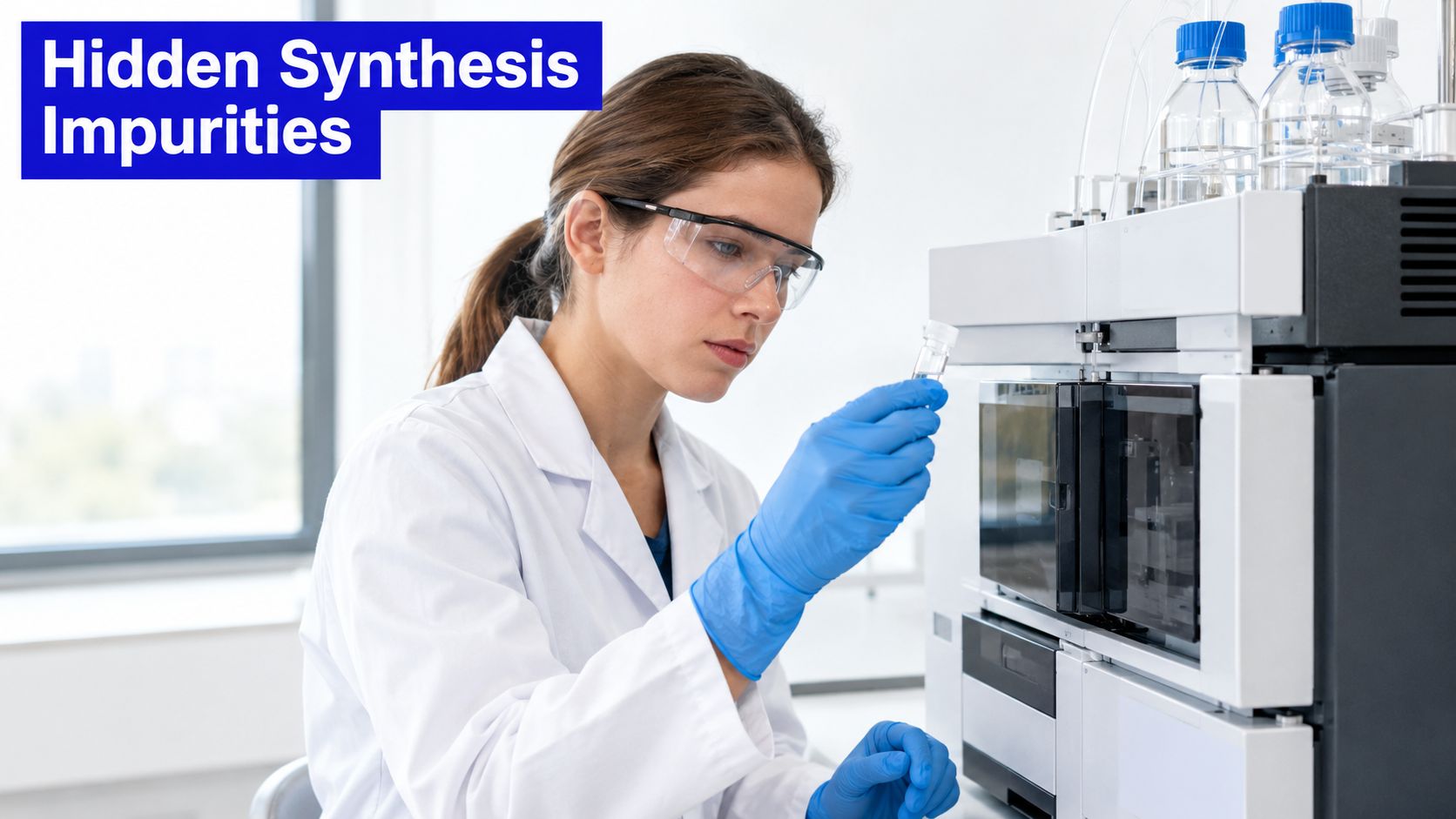
Deletion sequences form when a coupling step doesn't finish, so the chain continues without that amino acid. The result is nearly identical to the target, which makes purification difficult. Contaminants like these are like a few wrong letters in a long sentence. The sentence still looks right at a glance.
Oxidation and deamidation happen after synthesis, during purification, storage, and handling. Racemization, where a residue flips its spatial configuration, belongs in the same family. Each change can shift activity, solubility, or stability without changing the powder's appearance.
TFA is a counter-ion left from cleavage and HPLC purification. It adds real mass, so it directly lowers net peptide content, and it can affect cell-based work. Residual solvents and heavy metals are simpler. They're process leftovers that should be removed, then tested to confirm removal.
Endotoxins and microbial load come from water, equipment, and handling rather than chemistry. They matter most in cell and animal models, where endotoxin can produce a response you'd mistakenly attribute to your peptide.
Storage keeps changing the picture after a lot ships. Heat, light, and moisture drive oxidation and deamidation. Cold, dry, dark storage slows that drift.
This overview shows the reading order at a glance:
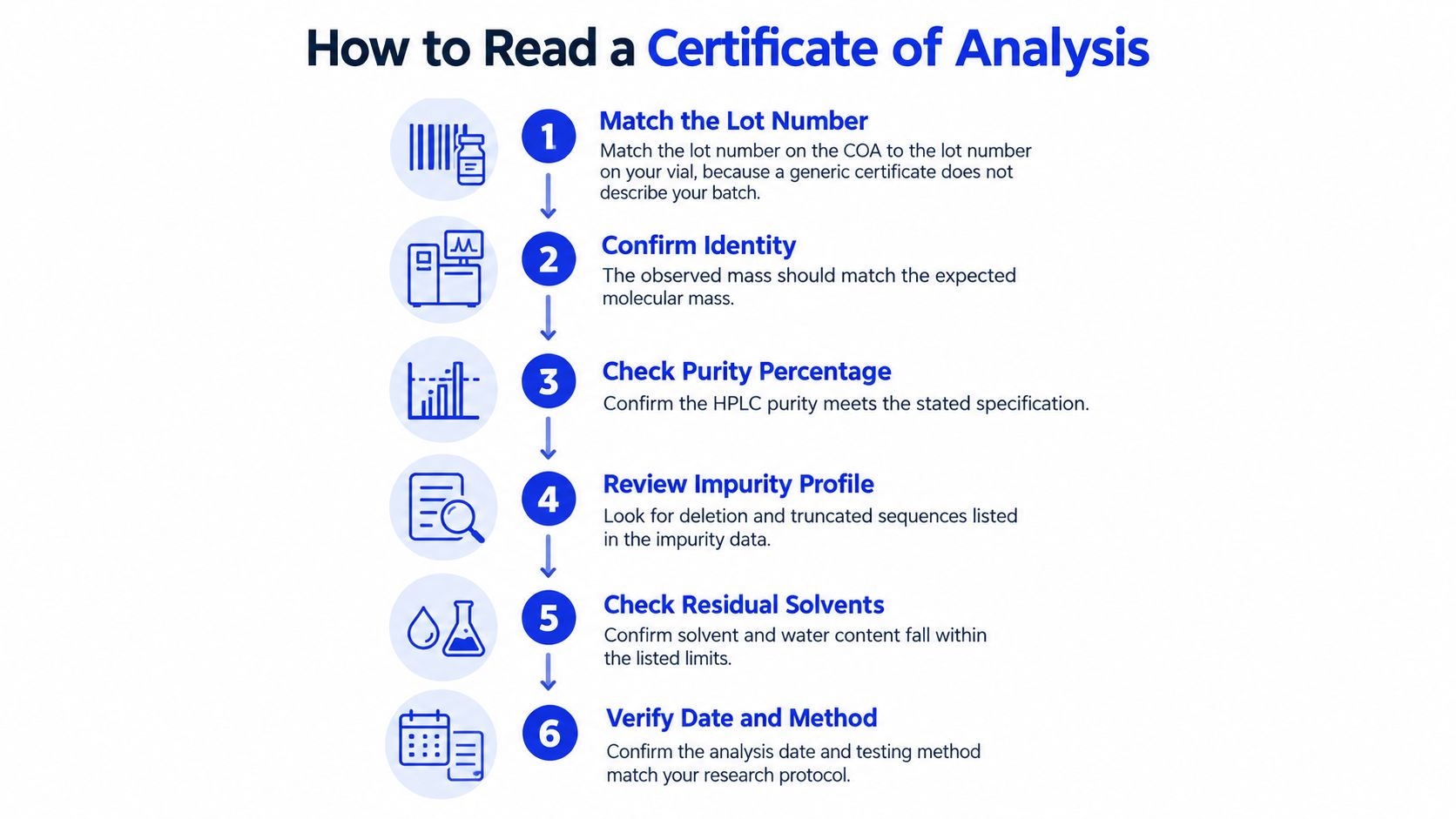
Work through the document in a fixed order so you don't stop at the first big number. The same habit helps in other categories, such as checking CBD potency against label claims, where you also match the report to your specific batch.
This short video walks through the same checks visually:
A label isn't verification. A certificate becomes useful evidence when it is tied to your lot, issued by a named laboratory, and detailed enough to show what was measured and how. It works like a shipping manifest: it needs the contents, shipment identifier, and inspector before it can support a claim.
The broader quality record explains why that standard makes sense. In 2017, the World Health Organization fact sheet on substandard and falsified medical products estimated a 10.5% failure rate for medical products in low- and middle-income countries, based on more than 100 published medicine-quality studies covering approximately 48,000 samples across 88 countries. WHO treated that figure as indicative rather than universally representative, and it concerns finished medical products rather than research ingredients. Still, roughly one in ten sampled products failed expected standards, so labels alone are weak evidence.
That result matters because purity is a bundle of separate answers. One lot can have confirmed identity, good chromatographic purity, low net peptide content, and no endotoxin result. Each missing line leaves a different question unanswered.
| Red flag | What it may signal | Question to ask |
|---|---|---|
| A single purity percentage with no method | The figure may describe only one part of purity and cannot be compared | Which HPLC method and detection wavelength produced it? |
| A generic certificate not tied to a lot number | The test may represent a different batch | Can you provide the certificate for this batch number? |
| No identity data | The sequence or observed mass is unconfirmed | Is mass spectrometry data included, and does the mass match the sequence? |
| No net peptide content or salt form | The weighed powder may overstate the actual peptide | Is net peptide content reported with the TFA or acetate level? |
| No endotoxin or microbial results | Contamination control is not documented | Which laboratory ran these tests, and on what date? |
| Vague manufacturing or sourcing details | You cannot tell who made or verified the batch | Who manufactures and who tests each batch? |
| Claims such as pharmaceutical grade with no documents | A marketing term without evidence | Which specification and documents support this term? |
Ask who manufactures each batch and who tests it. Those are separate questions. A supplier may manufacture the material in-house and use an outside laboratory, or test it at the manufacturing site. Independent testing gives you clearer separation between the maker and the verifier.
Traceability matters across product categories. A supply-chain guide about choosing safer treats for backyard chickens sits in a different market, but the underlying principle transfers: you should be able to trace a research peptide back to a maker, a batch, and a lot-specific test.
Terms such as pharmaceutical grade mean little for research material unless documents define and support them.
Treat those phrases as claims awaiting evidence. If a supplier cannot point to the specification behind the term, the phrase adds no usable information.
Keep your standard simple. A slightly lower headline number backed by full, lot-specific data is usually more useful than a higher number with nothing behind it. You can work with a known impurity profile. You can't correct for one you've never seen.
Decide what your application needs before you compare offers. Screening work can tolerate a chromatographic profile that quantitative work can't.
For dose response or other quantitative assays, net peptide content and salt form matter most. They determine the effective amount of peptide in each vial you weigh out. A high area percentage doesn't rescue a calculation built on the wrong content figure.
For early screening, identity and a reasonable impurity profile may be enough. You'll still want lot-specific documents, because you can't interpret a negative result if you don't know what you tested. Write your acceptance range down first, then shop against it.
Then check the lot-specific certificate line by line instead of accepting the headline figure. If a field is missing, ask for it before ordering rather than after the material arrives.
Research materials and compounded human drugs aren't interchangeable categories. The FDA document on Section 503B outsourcing facilities states that a Section 503B outsourcing facility must operate at one geographic location or address, compound sterile drugs, elect to register as an outsourcing facility, and comply with all Section 503B requirements, and that its products remain subject to CGMP requirements despite certain exemptions from FDA approval and adequate-directions-for-use labeling.
Section 503A pharmacies sit in a separate category again. A certificate of analysis doesn't make a product FDA-approved or suitable for human use. It documents test results for a research material, and that's how it should be labeled and discussed.
We state that our research peptides are made in the USA, batch produced and batch tested, with third-party endotoxin and microbial reports, certificates of analysis available, and a stated purity of 99.5%. Confirm that figure against the document for your own batch number rather than taking the listing at face value. All products are sold for research, laboratory, or analytical purposes only and are not for human consumption.
Use the documents to explore options before you commit. Learn more by reviewing the certificate for the exact lot you'd receive, and check that every value falls inside the specification you set.
Peptide Warehouse USA supplies high-purity research peptides backed by third-party testing, including COAs, endotoxin, and microbial reports you can review lot by lot. If you're ready to compare documented purity evidence instead of headline percentages, visit Peptide Warehouse USA to explore the catalog and supporting documents.