No products in the cart.


Cu 50 peptide usually means a 50 mg research vial of GHK-Cu, the copper(II) complex of glycyl-L-histidyl-L-lysine, sold for laboratory use only and not as an approved injectable drug. The popular shortcut is to treat that one label as a single proof class, as if a face cream, a cell dish, and a syringe all sit on the same human record.
They don't. The number on the vial is a mass of dry solid. It isn't a tissue concentration, a clinical strength, or permission to inject or swallow the powder. A lab-minded read starts with the label, then checks the chemistry, the route that was studied, and the batch file that belongs to this lot.
What follows is a buyer's map for that paperwork. It separates topical cosmetic findings from cell data and from injectable use, and it stops short of dosing or treatment advice.
Cu 50 peptide is shopper shorthand for GHK-Cu. On most research listings that phrase points to a lyophilized vial of the copper(II) complex of the tripeptide glycyl-L-histidyl-L-lysine, also written Gly-His-Lys. The "50" is the nominal mass of solid in the container, about 50 mg. It doesn't tell you how much belongs in a well, a cream, or a person.
Think of a labeled reagent bottle on a bench. The number says how much powder the chemist put in the glass. The experiment, written later, decides the vehicle, the dilution, and the time. Price shopping before you match sequence, copper form, and lot size is how two unlike vials get treated as the same reagent.
Finished creams live in a different category. If you're comparing leave-on products rather than dry research powder, guides on finding effective peptide moisturizers show how cosmetic formulas are judged. That reading doesn't transfer to a lyophilized research vial.
| Field | Typical meaning | What it is not |
|---|---|---|
| Common name | Cu 50 peptide or GHK-Cu | A generic copper supplement |
| Sequence | Glycyl-L-histidyl-L-lysine | A large protein or collagen itself |
| Metal | Copper(II) bound to the tripeptide | Free copper salts alone |
| Nominal size | About 50 mg lyophilized solid | A human dose or serum level |
| Form | Dry research powder | A finished cosmetic or sterile drug |
| Use category | Laboratory or analytical research | Diagnosis, treatment, or consumption |
Practical rule: Match the sequence, the copper(II) form, and the lot size on the supplier page before you compare prices or papers.
Three checks stop most mix-ups.
Cell-culture papers sometimes report activity at very low concentrations. Those figures describe dishes, not instructions printed for a 50 mg container. Read them only after the identity row above is settled.
Picture a courier with a small package. GHK-Cu can travel as an intact peptide-copper complex, and it can also split into a peptide part and a copper part. The tripeptide is the courier. Copper is the cargo. Lysyl-oxidase-family enzymes use that copper when they cross-link collagen and elastin. Reviews also tie GHK to matrix-remodeling pathways that include collagen, glycosaminoglycans, metalloproteinases, and the inhibitors of those enzymes.
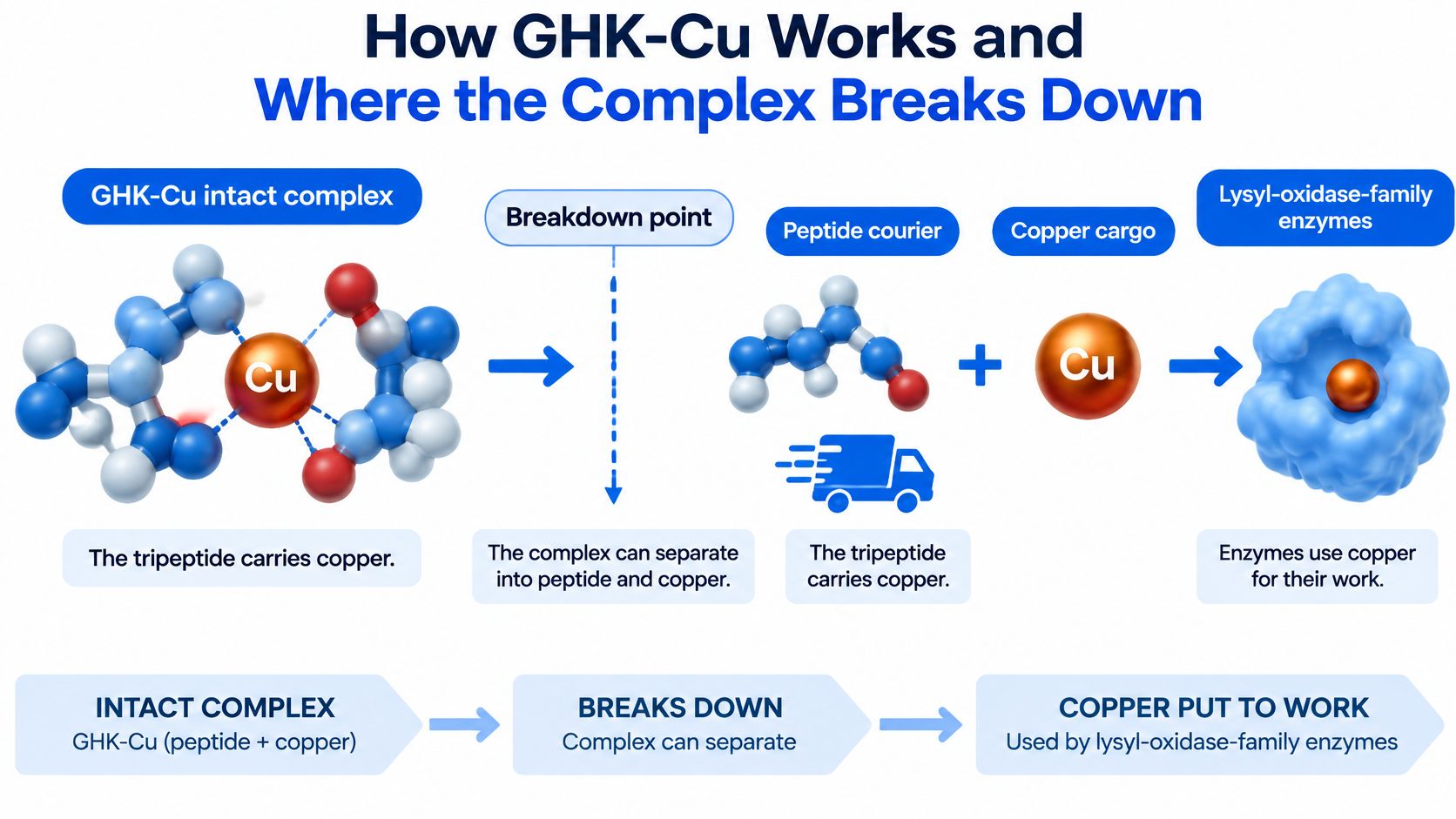
The split is the point people skip. If the complex separates, you no longer have one species with one fate. You have a peptide and a metal that can go different ways. A blue or blue-green tint can reflect copper complexation. It isn't a purity assay. Clumping after humid air hits the powder is a handling failure, not a new grade of peptide. Free copper and bound copper are different analytical results, even when both came from the same vial.
In human dermal-fibroblast experiments, GHK-Cu at 0.01, 1, and 100 nM increased collagen and elastin production, so activity showed up across a broad nanomolar range rather than only at one high concentration, according to a review of the copper-binding tripeptide. That window is a cell-culture observation. It isn't a recipe for dissolving a 50 mg vial.
The same literature is clear about the gap. Formulation, copper speciation, peptide integrity, skin penetration, and exposure time can change what you measure. Cell activity isn't validated clinical performance, and review literature of this kind doesn't establish that research-grade material is safe or effective for human administration.
Say a lab weighs powder on a humid afternoon, leaves the cap off, then prepares a solution the next morning and calls it "the same sample." The solid and the liquid are no longer interchangeable. Biological fluids can degrade the tripeptide quickly, so a time-course in the actual vehicle matters more than a single purity percentage taken on day one.
A review of GHK-Cu and skin remodeling describes a 12-week facial-cream study of 71 women with photoaged skin, with reports of improved density and thickness, less laxity, better clarity, and reduced fine lines and wrinkle depth, plus a thigh-skin summary in which collagen production improved in 70% of women on GHK-Cu, 50% with a vitamin C cream, and 40% with retinoic acid. Those comparisons are study-specific, not universal rankings, because formulation, randomization, endpoints, and statistics decide whether they can be lined up. The same review's practical constraint is stability. Track the material as an intact peptide-copper species and as parts that may separate, and run degradation testing in the relevant vehicle or biological matrix, with microbial and endotoxin controls where they apply. That record supports research into topical repair and matrix biology. It doesn't justify weight-loss, muscle-growth, disease-treatment, or consumption claims.
For lyophilized powder, keep the vial cool and dry, protect it from light, and limit warm humid air while you weigh. Don't assume a prepared solution still matches the powder you documented yesterday. If the vehicle changes, the degradation clock changes with it.
A short walk-through of how people talk about the complex, without turning it into a protocol, sits here:
Use this checklist when you compare lots or reopen a stored vial.
Peptide purity and stability under the intended storage conditions belong in the same packet. Together these controls describe a research material. They don't convert it into a medicine.
Most popular summaries blend cell findings, animal work, and cosmetic creams into one claim that copper peptides "work." That blend hides the only question a careful buyer can answer from the published record: which route, which endpoint, and what sample size.
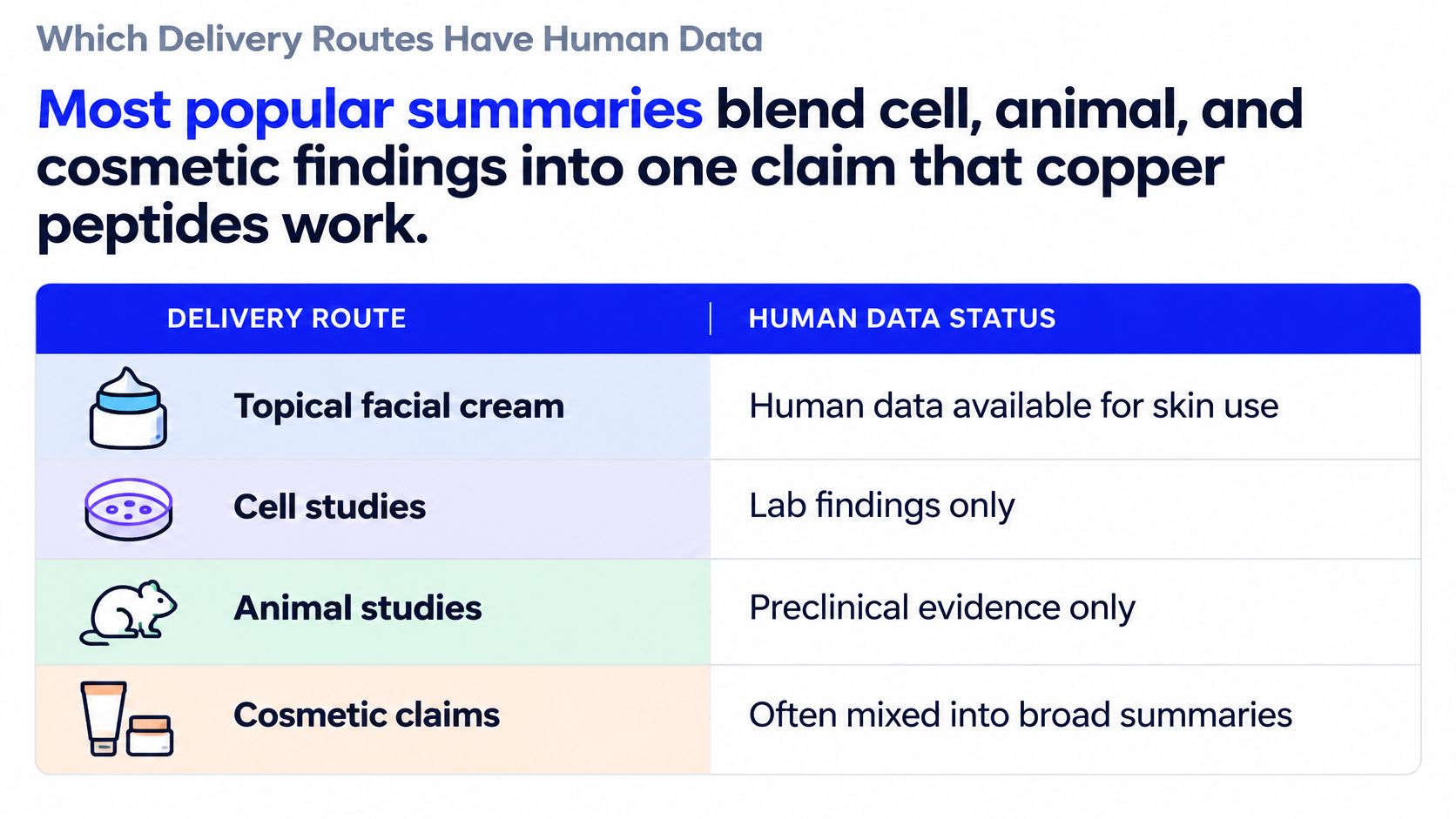
| Route | Human record cited | Scale | Reader takeaway |
|---|---|---|---|
| Topical facial cream | 12-week photoaging study | 71 women | Stronger cosmetic skin data than injection data |
| Topical thigh skin | Collagen improvement vs vitamin C and retinoic acid | 70 percent vs 50 percent vs 40 percent | Study-specific, not a universal ranking |
| Microneedle-assisted | Systematic review of delivery | No adequately powered human RCT cited | Preclinical rationale is not a clinical trial |
| Injectable | Safety and effectiveness of injection | Not established in published controlled studies | Research material is not an approved injectable drug |
Read the first two rows as cosmetic skin observations, not as a ranking you can carry into a new formula. The percentages and the 71-woman study live in that table because they are study-specific. They aren't a dose, and they aren't instructions for how to apply anything.
A review of how much GHK-Cu evidence is human evidence separates the routes that marketing pages tend to fuse. Published controlled studies have focused mainly on topical cosmetic use, and samples are generally small. That review describes a 2026 randomized split-face eyebrow study of only 18 healthy participants. Treat that as a split-face cosmetic trial, not as evidence about injection. An acute-wound phase 2 study was still recruiting, without posted efficacy results.
The same review notes that NPR's reporting concentrates controlled human research on skin aesthetics, with less evidence for wound healing and hair growth, and that published studies don't establish the safety or effectiveness of injecting copper peptides. A systematic review finds extensive preclinical work on microneedle delivery and no adequately powered human randomized trial of that route.
A stronger lab rationale can sit next to a weak translational file. Mechanism isn't a clinically meaningful dose, route, or outcome.
None of these rows converts into administration steps. If a seller points at "GHK-Cu research" as one pile, ask which route was tested in people, for which endpoint, and in how many participants. If the answer is a fibroblast paper or an animal wound model, you don't yet have a human result for injection, microneedles, or hair.
A single purity percentage is often waved around as if it proved a sterile injectable. It doesn't. Purity answers how much of the main signal matches the peptide you ordered. Sterility, endotoxin, aggregates, residual solvents, and immune-reactive impurities are different questions.
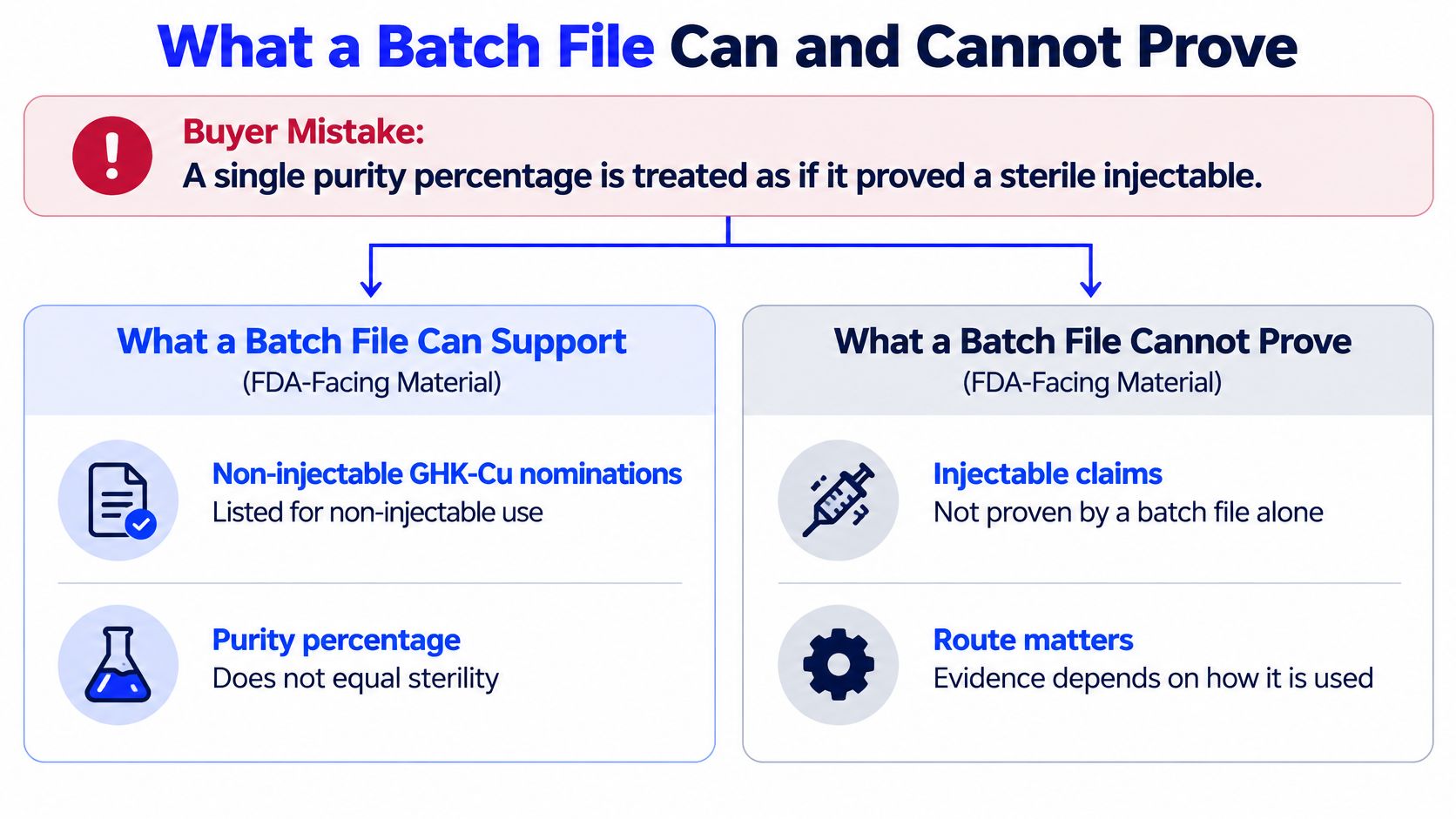
FDA discussion of GHK-Cu nominations treats route as part of the filing, not as a footnote. Non-injectable GHK-Cu has been handled separately from injectable use. Injectable nominations have been tied to safety concerns and sit outside the evidence base of an FDA-approved injectable drug. Independent reporting on compounded injectable GHK-Cu flags impurities, peptide aggregation, immune reactions, and limited human safety data.
So the direct safety point is this. Published human safety data for injectable GHK-Cu is limited. The concerns people raise are impurities, aggregation, and immune reactions. Route plus documentation set the risk, not the word "peptide" on a shop page. A topical research material and an injectable preparation don't share one documentation bar. The injectable bar is higher because the route-specific risk is higher.
| Document | Question it answers | What it does not prove |
|---|---|---|
| Batch-specific certificate of analysis | Identity and purity method for this lot | Aggregates, sterility, or injectable safety |
| HPLC purity report | Share of main peptide signal | Endotoxin, sterility, or residual solvents |
| Endotoxin report | Bacterial endotoxin level in the tested lot | Sterility or identity |
| Microbial report | Microbial load at test time | Stability after handling |
| Copper and stoichiometry data | Copper-to-peptide ratio and free copper | Activity in tissue |
| Stability time course | Degradation in the stated vehicle | Performance in other matrices |
A certificate of analysis should name the batch and show identity plus the purity method. A recycled marketing number isn't that document. Even a high advertised figure, such as 99.5% purity, doesn't by itself identify aggregates, endotoxin, sterility, residual solvents, or biologically active contaminants. Endotoxin and microbial reports answer a different question from an HPLC peak. If a sterility statement exists, it applies to the tested lot and the presentation that was tested, not to later handling in your lab.
A high purity claim can't establish sterility or injectable safety.
Peptide Warehouse USA provides high-purity research peptides backed by third-party testing, including COAs, endotoxin reports, and microbial reports. Products are made in the USA and are batch produced and batch tested. We work with manufacturing partners and outside laboratories against defined purity and identity specifications. That stack is what you compare. It still doesn't turn research-use material into a clinically validated medicine.
Five lines before you trust a file:
The useful move is to design work the literature can support, and to set aside the shopping claims it can't. Three example programs show the difference. None of them is a dose or an administration plan.
A matrix-biology assay can track collagen, elastin, glycosaminoglycans, and the balance of metalloproteinases with their inhibitors. The published nanomolar activity window is a hypothesis range inside cell culture only. The comparison breaks if you switch media or serum halfway through and still call every well the same exposure. Animal wound results don't stand in for that human-cell endpoint either.
Formulation work can follow skin-density or wrinkle-style endpoints already used in cosmetic studies, while logging vehicle, pH, and whether the copper complex stays intact. The edge case is a vehicle change mid-study. If the cream base changes, you aren't comparing GHK-Cu anymore. You're comparing two products. Record the intact complex or you won't know which species the endpoint belongs to.
Take the same nominal 50 mg GHK-Cu lot and test identity, copper-to-peptide stoichiometry, free copper, and degradation over time. The edge case is treating a fresh powder chromatogram as if it described a week-old solution in a different buffer. Same label, different sample.
Claims that don't belong on this record:
Read primary methods beside the lot documents. Treat benefits of peptides discussed online as research hypotheses until a fit-for-purpose study says otherwise.
The purchase decision is a documentation decision. Four checks cover it.
Peptide Warehouse USA is one U.S. research-chemical supplier on that paperwork path, not a clinic and not a pharmacy. We aren't a compounding pharmacy or compounding facility under Section 503A, and we aren't an outsourcing facility under Section 503B. Products aren't sold for human or veterinary consumption. Statements on the site haven't been evaluated by the FDA and aren't intended to diagnose, treat, cure, or prevent any disease.
We ship to all 50 U.S. states, and non-medical help is limited to availability, documentation, and order status. The public catalog includes GHK-Cu among other research peptides. Clinic pages, including Yoyime Clinic's GHK-Cu therapy, describe a care setting. That isn't the same decision as buying a research lot, and it doesn't replace a COA.
Explore options and learn more, then set the certificate next to the checklist in this article before you purchase. No section here is dosing, medical, or treatment guidance.
Peptide Warehouse USA supplies USA-made research peptides, including GHK-Cu, with batch-level COAs plus endotoxin and microbial reports for laboratory and analytical work. If you're comparing a Cu 50 peptide vial, match the lot file to identity, copper data, and research-use limits before you buy. Visit Peptide Warehouse USA to review documentation and current research listings.