No products in the cart.



A search for ARA-290 peptide buy can bring up purity badges beside claims about recovery, fat loss, or antiaging. Those claims deserve more scrutiny than a product-page headline: ARA-290, also called cibinetide, is an investigational research peptide, not an approved consumer therapy.
A useful buying decision starts with the intended laboratory assay and the identity of the specific lot, not the lowest price or the largest purity number. The checks below cover paperwork, the proposed mechanism, human trial limits, and the U.S. regulatory line between laboratory supply and drug claims. A short-lived nerve-study signal isn't a reason to expect weight loss, muscle growth, or general healing from a catalog vial.
Consider a researcher who searches for ARA-290 and finds a listing with a prominent purity badge and language about nerve repair. The badge may look decisive, but it doesn't show whether the certificate of analysis (COA) belongs to the vial being considered, whether the stated peptide identity is confirmed, or whether the material suits the planned assay. A marketing claim about neuropathy doesn't answer those questions either.
ARA-290's human research has focused chiefly on specific neurological and metabolic research questions, not on consumer weight loss, bodybuilding, antiaging, or general healing. A registered study in sarcoidosis-associated small-fiber loss, for example, measured a biological marker of nerve health. That kind of result can be relevant to researchers studying that population, but it doesn't establish that a commercial lot will reproduce a clinical result, or that the result applies to unrelated uses.
The practical question is therefore not, “What's the listed purity?” It's whether a traceable, identified lot is scientifically usable for a defined research purpose. Before ordering, a buyer should be able to connect the vial to its documentation and decide whether the documents cover the quality attributes the assay needs.
A Herbilabs Labware lot traceability guide is a useful resource for understanding why lot identifiers matter: documentation only helps when a researcher can connect it to the material in hand. That same principle applies to peptide sourcing. A polished, generic COA isn't a substitute for evidence tied to the specific batch.
The checks ahead offer a pass-or-pause routine for reviewing a lot. The trial table later puts the human evidence in context so buyers can separate what was studied from what a sales page might imply.
Run these checks before checkout. A COA can support a procurement decision, but only when it's specific, readable, and relevant to the work.
Match the lot numbers. Compare the COA sample or lot number with the vial label. A generic purity sheet may describe a different batch, even if the product name is the same.
Confirm identity by mass spectrometry. Compare the observed molecular mass with the theoretical mass for the stated peptide sequence. The laboratory guidance on peptide analysis explains that mass spectrometry checks molecular identity, while HPLC separates sample components and estimates purity from the target peak's share of total peak area.
Read the HPLC evidence, not just the headline. Inspect the chromatogram and confirm that the COA reports how the target peak compares with total peak area. A percentage alone can't establish identity, correct folding, biological activity, or assay fitness.
Check microbial and endotoxin documentation when the assay requires it. Purity isn't a measure of microbial status or endotoxin. Define the requirements for your model before ordering, then verify that the lot-specific reports address them.
Assess storage and shipping. Record the conditions the material needs, including cool, dry, light-protected storage, and determine whether transit conditions fit the lab's stability plan. Heat exposure or freeze-thaw handling may affect usability after testing.
Write down the model and quantity first. Decide what the experiment needs before selecting a vial size. A review of nerve-injury research says the optimal dose, route, timing, and duration for that application remain unknown, so a purchase decision shouldn't be built around an assumed clinical protocol (Frontiers in Dental Medicine review).
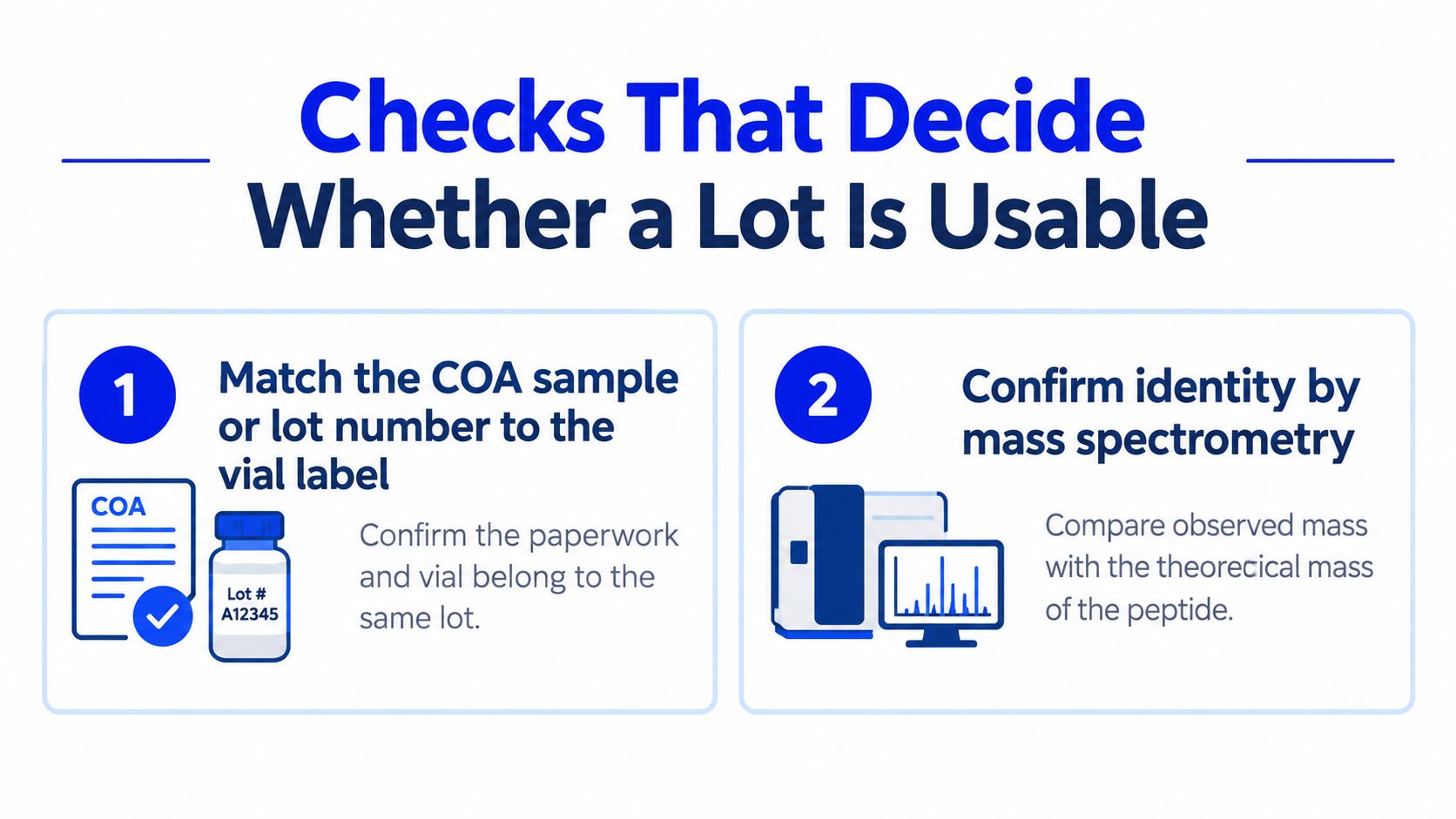
| Check | What must match | Why it matters |
|---|---|---|
| Lot traceability | COA sample or lot number equals the vial label | A generic purity sheet may not belong to this vial |
| Identity | Mass spectrometry observed mass agrees with theoretical mass | A different peptide can still show a high purity number |
| HPLC purity | Target peak as a percentage of total peak area, plus the chromatogram | The trace shows what contributes to the reported purity estimate |
| Endotoxin and microbes | Lot-specific reports when the assay requires them | Purity doesn't show bioburden or endotoxin |
| Storage and shipping | Cool, dry, light-protected handling and known transit conditions | Heat or freeze-thaw exposure can change usability after the COA date |
Peptide Warehouse USA advertises 99.5% purity and says its high-purity research peptides are backed by third-party testing, including COAs, endotoxin reports, and microbial reports. Its products are made in the USA and are batch produced and batch tested. Those statements are useful starting points, but the buyer still needs to connect the documentation to the vial and confirm that each report suits the planned experiment.
For U.S. buyers, paperwork isn't the only boundary. The FDA explains in its warning-letter material on research peptides that products promoted as drugs without an approved application can be considered unapproved new drugs under section 505(a) of the Federal Food, Drug, and Cosmetic Act, codified at 21 U.S.C. 355(a). A research-use disclaimer doesn't, by itself, make a product approved for diagnosis, treatment, prevention, or human consumption.
Pause the order if the lot match, mass agreement, or chromatogram is missing. A purity badge can't fill those gaps.
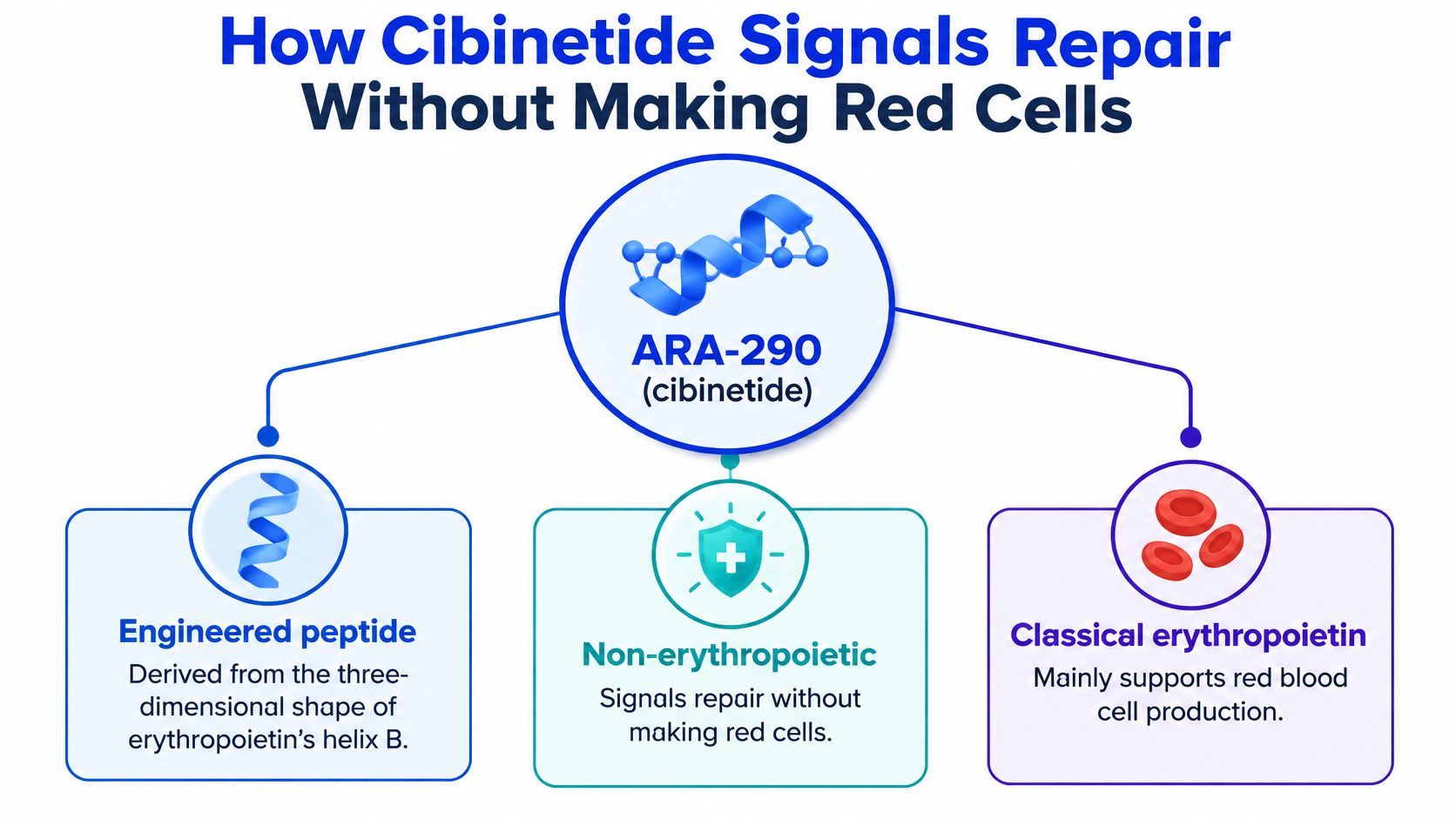
ARA-290 is an engineered, non-erythropoietic peptide derived from the three-dimensional structure of erythropoietin's helix B. It's also known as cibinetide. Researchers have proposed that it selectively activates the innate repair receptor, rather than following erythropoietin's classical red-blood-cell production pathway (PubMed study on ARA-290's proposed mechanism and clinical research).
One way to understand the proposed distinction is to think of classical erythropoietin as a factory order for red blood cells. ARA-290 is discussed as a molecule intended to knock on a different door, the innate repair receptor, so tissue-protective and anti-inflammatory signaling can be investigated apart from red-cell production. That's a description of a proposed mechanism, not proof that a vial from any supplier will produce a particular biological effect.
A phase 2 study involving people with type 2 diabetes provides one example of a published research context. Participants self-administered 4 mg subcutaneously once daily for 28 days, then had 28 days without treatment. Investigators reported no potential safety issues during that observation period and described changes in HbA1c, lipid profiles, and neuropathic symptoms measured with the PainDetect questionnaire. These findings describe a particular study, not a regimen or product specification to transfer to another supplier's vial.
The distinction matters for procurement. A clinical formulation and study protocol don't establish another lot's identity, concentration, sterility, endotoxin status, or shipping stability. Nor do the reported changes approve ARA-290 for diabetes, neuropathy, pain, weight loss, or tissue repair.
Selective receptor signaling is a hypothesis to test, not a product benefit to assume.
| Feature | Erythropoietin | ARA-290 |
|---|---|---|
| Origin | Native hormone | Engineered peptide based on the helix B structure |
| Proposed main action | Red-blood-cell production | Selective innate repair receptor activation, non-erythropoietic |
| Route in studies | Not specified in the cited ARA-290 studies | Subcutaneous in the diabetes study; intravenous in the sarcoidosis study |
| Regulatory status for ARA-290 | Not applicable | Investigational only, with no approved indication |
A trial result is a narrow answer to a narrow question. To interpret ARA-290 research, separate the population studied, the route and duration tested, and the outcome measured. Those details set the limits of what a result can support.
| Record | Who and what was tested | Main signal reported | What it does not prove |
|---|---|---|---|
| NCT02039687 | 64 people with sarcoidosis-associated small-fiber loss; daily subcutaneous 1 mg, 4 mg, or 8 mg versus placebo for 28 days | Corneal nerve-fiber density or area; independent summaries identify the 4 mg arm as the clearest signal | Long-term pain relief, functional recovery, or non-neuropathy uses |
| Exploratory IV sarcoidosis study | 22 patients; 12 received 2 mg IV three times weekly for 4 weeks, 10 received placebo | Small Fiber Neuropathy Screening List score changed about -11.5 versus -2.9, p < 0.05; no safety concerns in the short study | Equivalence of other routes or self-directed products |
| Type 2 diabetes phase 2, NTR3858 | 4 mg subcutaneous once daily for 28 days, followed by 28 days off treatment | Reported HbA1c, lipid, and neuropathic symptom changes; no potential safety issues in the observation window | Approval to treat diabetes, neuropathy, or metabolic disease |
| Healthy adult study, NCT02070783 | 36 healthy adults; 2 mg versus placebo, assessed one week later | No clear antidepressant-like effect on mood | A mood, antiaging, or wellness indication |
| NCT01933529 | People with prediabetes or early diet-treated type 2 diabetes; randomized, double-blind glucose study | The registry describes a study examining glucose homeostasis; the listed record does not establish a treatment benefit | An approved metabolic therapy |
| NCT06626971 | Diabetic macular edema; 9 enrolled; drug expired and recruitment stopped | Study didn't finish as a treatment evaluation | An eye-disease product claim |
The clearest registered efficacy study in this group was NCT02039687, a randomized, double-blind, placebo-controlled phase 2 trial in people with sarcoidosis-associated small-fiber loss and neuropathic symptoms. It assessed daily subcutaneous doses and focused on corneal nerve-fiber density or area, a surrogate measure of peripheral nerve health. Its 28-day treatment period, sample size, and surrogate endpoint cannot establish long-term pain relief or functional recovery.
A separate exploratory study measured symptoms rather than the same nerve-fiber endpoint. Among 22 people with sarcoidosis-associated small-fiber neuropathy, the screening-list score changed by -11.5 ± 3.04 in the ARA-290 group and -2.9 ± 3.34 with placebo at week four. The between-group comparison was reported as statistically significant at p < 0.05. This is a result from a small, condition-specific trial, not evidence that other routes or products are equivalent (published exploratory sarcoidosis trial).
Other records answer different questions. A healthy-volunteer study assessed mood and affective symptoms and found no effect supporting an antidepressant-like profile (healthy adult study). The prediabetes or early type 2 diabetes registry study examined glucose homeostasis, while the diabetic macular edema record reports that recruitment stopped after the study drug expired and no replacement was available (ClinicalTrials.gov record for NCT06626971).
Across the human studies, short treatment periods, small samples, and surrogate endpoints limit what can be concluded. The findings do not support claims about fat loss, muscle growth, or general healing.
A research-use disclaimer doesn't erase the regulatory line. In the United States, products promoted as drugs without an approved application can be considered unapproved new drugs under section 505(a) of the Federal Food, Drug, and Cosmetic Act. FDA warning-letter material describes research peptides as unapproved new drugs when they're promoted in drug-like contexts.
That's why buyers should read the whole product page, not just the label. Trial registration or experimental use in a study doesn't approve a catalog product for consumer treatment, and a disclaimer doesn't authorize human or veterinary consumption.

Peptide Warehouse USA is a research chemical supplier, not a compounding pharmacy or compounding facility under Section 503A, nor an outsourcing facility under Section 503B, of the Federal Food, Drug, and Cosmetic Act. It doesn't provide medical advice, dosing instructions, or treatment guidance, and its products aren't intended for human or veterinary consumption.
If a sales page reads like a therapy, the paperwork problem is regulatory, not just analytical.
Place an order only when the vial and its documentation match, the identity and chromatogram support the stated material, and any endotoxin or microbial reports required for the assay are available. The six checks are meaningful only when they're applied to a defined laboratory or analytical use, not to a self-directed treatment plan.
Avoid pages that sell ARA-290 as a treatment, a stack, or a self-use protocol. A research lot isn't clinically interchangeable with material used in a trial, and the published studies don't establish a product's dose, route, sterility, or efficacy.
Peptide Warehouse USA is a U.S. research chemical supplier. It ships to all 50 U.S. states using trusted carriers, with multiple delivery options at checkout. Customers can ask non-medical questions about availability, documentation, and order status.
You can learn more about Peptide Warehouse USA and compare documentation rather than slogans. Website statements aren't a substitute for reviewing the COA for the lot being considered, and this article isn't medical advice.
These products aren't intended to diagnose, treat, cure, or prevent any disease.
For laboratory and analytical buyers, Peptide Warehouse USA offers research chemicals supported by batch testing and third-party documentation, including COAs and endotoxin and microbial reports. Review the paperwork against your assay requirements, then visit Peptide Warehouse USA to explore options and ask non-medical questions about availability or documentation.