No products in the cart.



A nasal format describes how a product is presented, not whether it is approved or safer. Cleveland Clinic reports that nasal tanning sprays containing Melanotan II are not FDA-regulated and that their sale is illegal in all 50 U.S. states, the United Kingdom, and Australia.
A listing, a purity badge, or laboratory paperwork may describe a product or its testing. None establishes that it is suitable for human use or has marketing authorization. Chemical purity also cannot answer questions about skin surveillance or substitute for drug approval.
For those looking for MT2 nasal spray for sale, the key distinction is among a commercial listing, a research material, and an approved medicine. These are different categories, and each document supports only specific conclusions.
A for-sale listing can establish that a seller offers a product. It cannot establish that the product is authorized as a medicine. Cleveland Clinic reports that nasal tanning sprays containing Melanotan II are not FDA-regulated and that their sale is illegal across all 50 U.S. states, the United Kingdom, and Australia.
An FDA statement says Melanotan II was not an ingredient in an approved human drug, was not on the applicable 503A bulk-drug list, and lacked an applicable USP or NF monograph. Separately, the FDA warning-letter record includes a letter dated February 27, 2024, categorizing products containing Melanotan I and II as unapproved new drugs and adulterated finished pharmaceuticals.
What a for-sale listing does and does not establish
| Buyer question | Documented status | What it does not prove |
|---|---|---|
| Is it an approved medicine? | The FDA statement says Melanotan II was not an ingredient in an approved human drug | A product page is not approval |
| Is compounding or a monograph established? | The statement says it was not on the applicable bulk-drug list and lacked an applicable USP or NF monograph | A research catalog is not a drug monograph |
| Is sale for tanning lawful? | Cleveland Clinic reports that the sprays are not FDA-regulated and their sale is illegal throughout the jurisdictions identified above | Checkout availability is not legality |
| Has FDA enforced against marketers? | The warning letter treated Melanotan I and II products as unapproved new drugs and adulterated finished pharmaceuticals | One letter is an example, not the full enforcement record |
Professional photography, customer reviews, and detailed shipping information describe a seller's commercial operation. They do not show that a regulator has assessed the product.
Research-only wording also needs to fit the rest of a listing. A disclaimer at the bottom does not turn tanning claims elsewhere on the page into approved uses.
A certificate of analysis, often abbreviated COA, reports particular test results for particular material. It is not a license to sell a tanning medicine, and it does not establish a favorable balance between human benefits and risks.
The same distinction applies to packaging. A nasal bottle does not become a validated metered medicine because a listing states an amount per spray.
Buyer boundary: Read a catalog as a commercial description and a laboratory report as evidence about the tests performed. Neither is human-use authorization.
Laboratory documentation can support legitimate analytical and preclinical procurement. A research catalog does not establish human tanning, weight loss, healing, or antiaging uses.
Melanotan II is a synthetic cyclic analogue of alpha-melanocyte-stimulating hormone. In plain language, it's a manufactured compound modeled on a biological signaling molecule, with a structure that allows it to interact with melanocortin receptors.
Think of a receptor as a lock and a signaling compound as a key. A selective compound would fit mainly one target, such as the pigment-associated MC1 receptor. MT2 isn't a selective pigment switch: its activity extends across melanocortin targets associated with functions beyond skin color.
The concept map separates pigment-related activity from the broader biological questions.
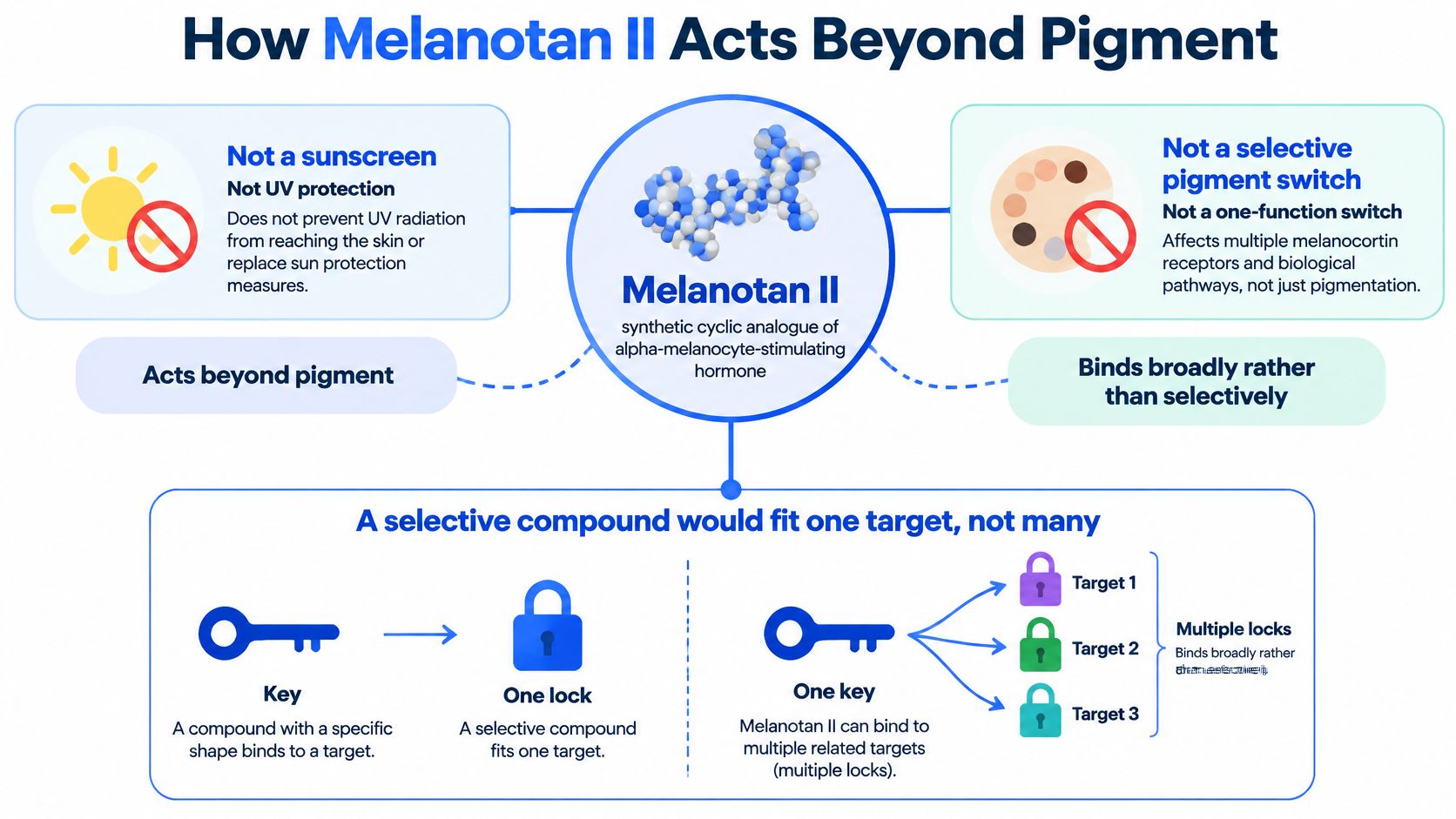
MT2 is described as a non-selective agonist at MC1R, MC3R, MC4R, and MC5R. That broader activity is why discussions of the compound include appetite, blood pressure, sexual function, and smooth-muscle pathways alongside melanogenesis, the process of pigment production.
The foundational human evidence is much narrower than many product descriptions imply. The Melanotan II evidence overview describes a 1996 single-blind, placebo-controlled pilot involving 3 men over approximately 2 weeks, with increased pigmentation observed in 2 of the 3 participants.
That observation supports a limited conclusion: pigmentation-related effects occurred in some participants under the study conditions. Such a small, short study can't reliably estimate uncommon adverse events, establish long-term safety, or predict results across different populations.
Pigmentation in a handful of volunteers is a signal, not a dosing standard.
No large Phase II or Phase III development program subsequently established a clinically validated tanning indication. The pilot also doesn't validate commercially advertised nasal formulations.
FDA enforcement records state that introducing or delivering MT2 into U.S. interstate commerce for drug uses without an approved application violates the Federal Food, Drug, and Cosmetic Act. Those records distinguish marketed drug claims from the evidence needed for approved products.
For a laboratory buyer, identifying a peptide answers a chemical question. It doesn't establish how a finished nasal formulation behaves, how much reaches the circulation, or whether a displayed microgram amount is equivalent to an injectable preparation or a validated intranasal medicine.
MT2 is also not sunscreen. Pigment-related activity shouldn't be confused with demonstrated protection against ultraviolet injury.
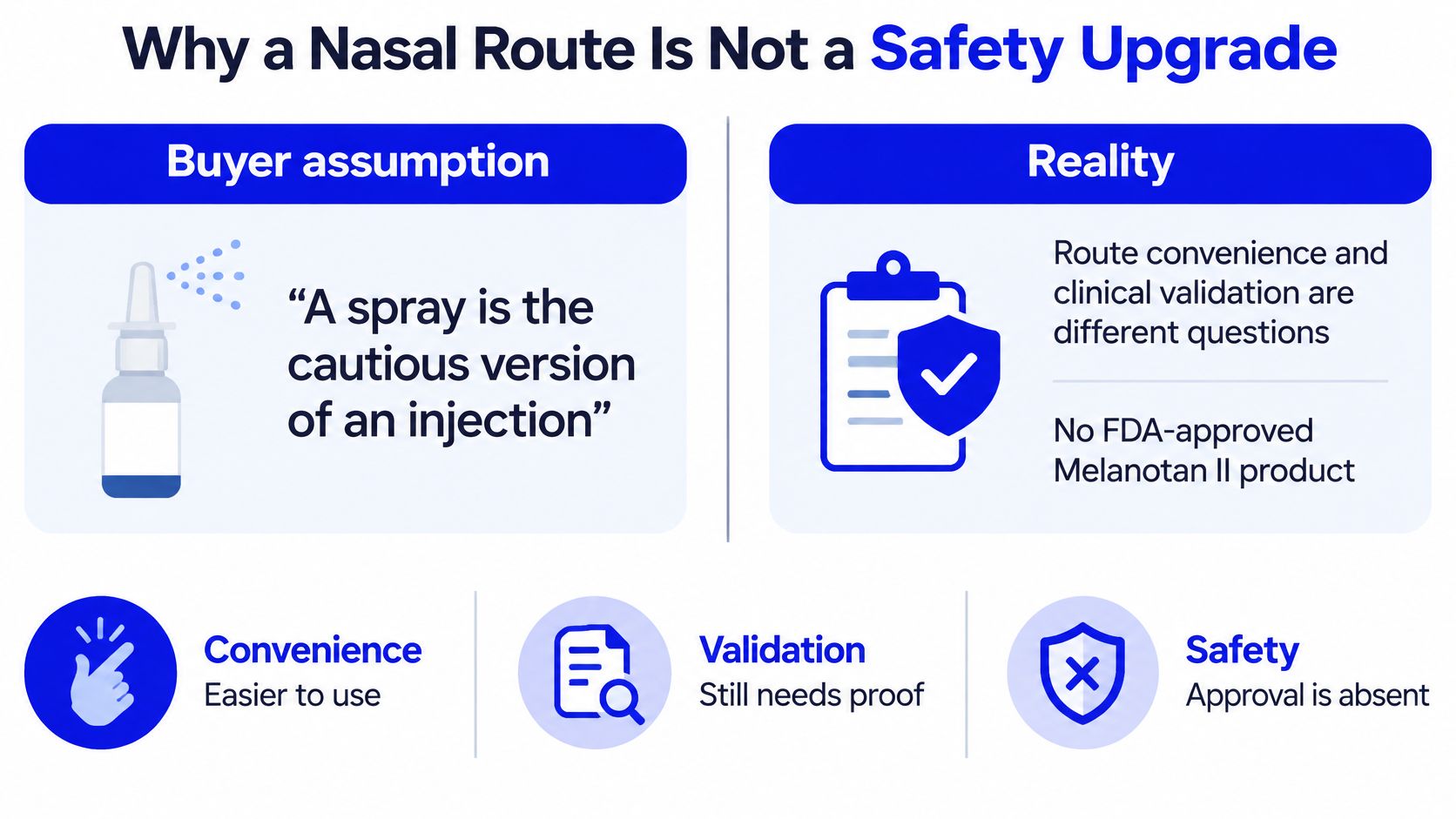
A spray can seem like the cautious alternative to an injection because it avoids needles. That is a statement about route convenience, not evidence of clinical safety.
Healthline's medical overview notes that melanotan products aren't FDA-approved, unregulated products may be mislabeled or contaminated, and adequate long-term safety evidence is lacking. There is no FDA-approved Melanotan II product establishing a validated intranasal dose.
The comparison below highlights the difference between a familiar format and a clinically evaluated product.
A research buyer evaluating a nasal formulation needs answers about the whole product:
The FDA chemistry, manufacturing, and controls guidance for nasal products addresses components, manufacturing processes, controls, and labeling. FDA also maintains separate guidance on bioavailability and bioequivalence for nasal aerosols and metered-dose pumps because device behavior and absorption require formal evaluation.
Say separate listings advertise the same bottle size and nominal concentration. Different pumps, excipients, or storage histories can still leave important performance questions unanswered. Matching label descriptions don't demonstrate equivalent delivery.
This video provides additional context for evaluating nasal tanning claims.
Reported concerns include nausea, flushing, uncertain dose content, and sudden darkening or multiplication of moles and freckles. Independent safety reporting also describes associations with hypertension and muscle injury, although such reports don't establish how frequently these events occur.
Severe nausea, persistent nasal symptoms, unexpected pigment changes, or priapism require medical evaluation, not advice from a seller about adjusting a research chemical. Priapism, a prolonged erection, can require urgent care.
Laboratory paperwork can help characterize material and identify missing tests. It can't turn an unevaluated spray into an approved drug.
A prominent purity percentage often attracts more attention than the rest of a laboratory file. Yet purity is only one result, measured using a particular method on particular samples.
The practical question is whether the file allows a qualified reviewer to understand what was tested, how it was tested, and what remains unknown.
COA lines and the limits of each line
| File item | What it can show | What it cannot show |
|---|---|---|
| Identity and stated purity | The tested lot matched the named peptide at the reported purity | Human safety, nasal tolerability, or clinical benefit |
| Related impurities at the reporting threshold | Specified impurities and degradation products under the applicable testing framework | That a single purity percentage without impurity information is enough |
| Sample plan and replicates | Number of samples, individual or composite sampling, and replicate analyses | That a COA-verified badge replaces the method |
| Microbial and endotoxin results | Results of the lot's microbial-burden and endotoxin testing | Sterile approved-drug status |
| Concentration and volume per actuation | Stated concentration and nominal spray volume for that device | Dose uniformity or human bioavailability without supporting studies |
| Residual solvents and synthesis impurities | Solvent and synthesis-impurity results for the lot | That peptide purity alone covers these |
| Stability and container closure | Whether tested specifications hold for the stated storage period and package | Suitability for human or animal use |
The FDA nasal-spray quality guidance describes acceptance criteria and analytical procedures for identity, strength, quality, purity, and performance, and states that related impurities and degradation products appearing at 0.1% or greater should be specified. It also recommends testing plans that identify sample counts, whether samples are individual or composite, and the number of replicate analyses.
Those details matter because a result without its sampling and analytical context is difficult to interpret. A composite sample can answer a different question from individual samples, while a method aimed at peptide identity doesn't automatically characterize every possible contaminant.
For example, a report might identify the named peptide and state a purity result while saying nothing about the finished spray's microbial burden. That isn't evidence of acceptable microbial quality. It's an unanswered question.
Likewise, nominal concentration multiplied by nominal spray volume describes an intended amount. It doesn't independently demonstrate consistent delivery throughout the container's use or establish human absorption.
A blank field is missing evidence, not a passing result.
A certificate for bulk peptide doesn't necessarily characterize the liquid placed in the bottle. Formulation, filling, packaging, and storage introduce additional variables that deserve their own documentation.
Ask which material each report describes: the synthesized peptide, the formulated liquid, or the packaged product. Then check whether the batch identifiers connect those stages without ambiguity.
Residual solvents and synthesis impurities deserve explicit attention rather than an assumption that a purity badge covers them. Microbial results, endotoxin results, and container-closure information address different questions and shouldn't be collapsed into a general quality claim.
Stability also needs a defined scope. A storage statement is more useful when supporting evidence concerns the actual formulation and container, not merely the peptide's name.
Use the file as a procurement record, not as a substitute for scientific review.
Confirm the intended use. The label should state research, laboratory, or analytical use only, not for human or veterinary consumption. A cosmetic-style presentation shouldn't obscure that restriction.
Reject human-outcome marketing. Promises involving tanning, weight loss, healing, antiaging, or other human outcomes conflict with a strictly research-only procurement purpose.
Require traceable analytical results. Look for the batch ID, analytical methods, and named impurity results. A certificate image without a clear connection to the offered lot doesn't establish traceability.
Check contamination and stability records. Require microbial, endotoxin, and storage-period stability statements supported by relevant testing. Note whether the records describe the finished formulation.
Review the device and formulation together. Require stated concentration and nominal volume per actuation. Treat the pump, excipients, packaging, and storage conditions as variables that bottle size doesn't standardize.
Match the paperwork to delivery. Compare the certificate's lot identifier with the material received. Retain the relevant reports with the receiving record rather than relying on a generic online image.
Separate procurement from participant oversight. Any work involving human participants requires appropriate institutional, medical, and regulatory oversight. A supplier file isn't that oversight.
If a report lacks an identifiable lot, readable methods, or relevant results, pause evaluation rather than filling the gaps with assumptions. Record the missing items explicitly so the decision can be reviewed by the person responsible for the laboratory's procurement standards.
For non-medical questions about availability, documentation, and order status, our support role at Peptide Warehouse USA is administrative and research-focused. We don't provide medical advice, dosing instructions, or treatment guidance.
Identity is not proof of sterility, and a sterility-related result isn't marketing authorization. A certificate doesn't confer human approval or establish clinical benefit, while price, shipping speed, and purity badges aren't substitutes for a complete, interpretable file.
A darker appearance is the result many shoppers want. It's also where a separate concern begins: changes in pigmentation can make skin surveillance more difficult.
DermNet's Melanotan II guidance describes darkening of existing moles, new pigmented lesions, and case reports of melanoma after use. The careful interpretation matters.
Case reports don't prove that Melanotan II caused melanoma, and they don't clear the concern.
If existing spots darken or additional lesions appear, a person may struggle to distinguish an expected cosmetic change from an evolving lesion. A clinician may also need a clearer history of what changed and when.
Some users add ultraviolet exposure to deepen their color. That adds another concern rather than supplying evidence that the compound protects skin.
The Skin Cancer Foundation states that MT2 isn't FDA-approved and that its safety hasn't been established, and warns about changes in pigmented lesions and melanoma reports. Chemical purity can't establish the absence of cancer risk or resolve the lack of adequate long-term human evidence.
MT2 doesn't replace sunscreen or protect against ultraviolet injury. A darker appearance shouldn't be interpreted as permission to increase sun exposure.
A simple photo record can help communicate changes, but it isn't clearance to use an unapproved compound:
For readers trying to distinguish cosmetic pigmentation concerns from questions requiring medical assessment, Chernoff Cosmetic Surgery's patient guide to aesthetic pigmentation treatments provides context about appearance-focused care. It isn't a substitute for assessment of a suspicious lesion or evidence supporting MT2 use.
The purchasing question therefore extends beyond whether a compound can alter color. It includes whether uncertain pigment changes could make a clinically important change harder to recognize.
Before evaluating a seller, decide whether the intended work belongs in a research procurement process at all. A polished file can't correct a mismatch between the buyer's actual purpose and the product's restricted use.
Use these decision questions to separate a consumer search from a legitimate laboratory inquiry.
Is the goal tanning, appearance, appetite change, or another human outcome? If yes, stop treating research documentation as a route to that goal. No certificate changes the intended-use boundary.
Does the listing market human outcomes? If yes, stop even if the page also carries a research disclaimer. Evaluate the whole presentation rather than treating the least prominent statement as the only one that counts.
Is the work analytical or preclinical, with a complete lot file and the necessary oversight? Only then does supplier evaluation become the relevant next step. Where participants are involved, institutional, medical, and regulatory review must remain separate from purchasing.
Peptide Warehouse USA is a U.S. research chemical supplier. Our products are sold for research, laboratory, or analytical purposes only and aren't intended for human or veterinary consumption; we don't provide medical advice, dosing instructions, or treatment guidance of any kind.
That is a contrast in labeling practice, not an MT2 offer. This isn't an MT2 product page, and no MT2 availability is represented here.
The useful next action depends on purpose: legitimate researchers can examine labeling and lot documentation, while people seeking appearance changes need an appropriate clinical conversation. Keeping those paths separate is more important than finding a convenient bottle.
Peptide Warehouse USA offers research peptides and related compounds for laboratory, analytical, and preclinical applications, not human or veterinary consumption. Visit Peptide Warehouse USA to learn more about research-only labeling and available lot documentation, and use those records to assess research suitability rather than infer approval for a nasal tanning product.