No products in the cart.


You're looking at a kisspeptin product page, but the description reads more like a wellness ad than a reagent sheet. Before making a kisspeptin peptide buy, you need a pass-fail document checklist, a clear distinction between kisspeptin-10 and kisspeptin-54, the luteinizing-hormone readouts published studies measured, and the FDA record separating catalog availability from approval.
The useful question isn't where to buy a vial. It's whether the material, its lot documentation, and your experimental question belong together.
A research purchase starts with a defined laboratory application, not a promised personal outcome. A vial advertised alongside weight-loss or hormone-optimization language still needs to be evaluated as a research chemical, not as a prescription or supplement.
Kisspeptin is a peptide ligand for KISS1R, a receptor involved in signaling upstream of gonadotropin-releasing hormone. That position in reproductive hormone signaling explains its relevance to endocrine investigations, receptor studies, and analytical work. It doesn't make every catalog product interchangeable with the material used in a published experiment.
Say a lab manager is comparing a product listing with a paper reporting a luteinizing-hormone response. The listing says kisspeptin, but the paper names a particular isoform, route, and study population. Before comparing prices, the manager needs to establish whether the listing identifies the same material.
A useful purchase note should identify:
The practical benefits of peptides as research tools come from their fit with a defined experimental system. A compelling product description can't substitute for that fit.
Procurement rule: Keep the vial label, the certificate of analysis, and the study question on the same desk before comparing prices.
This approach also clarifies what a supplier should help you resolve. Availability, identity documentation, and order details are procurement questions. Whether a research chemical should be used as a treatment is not.
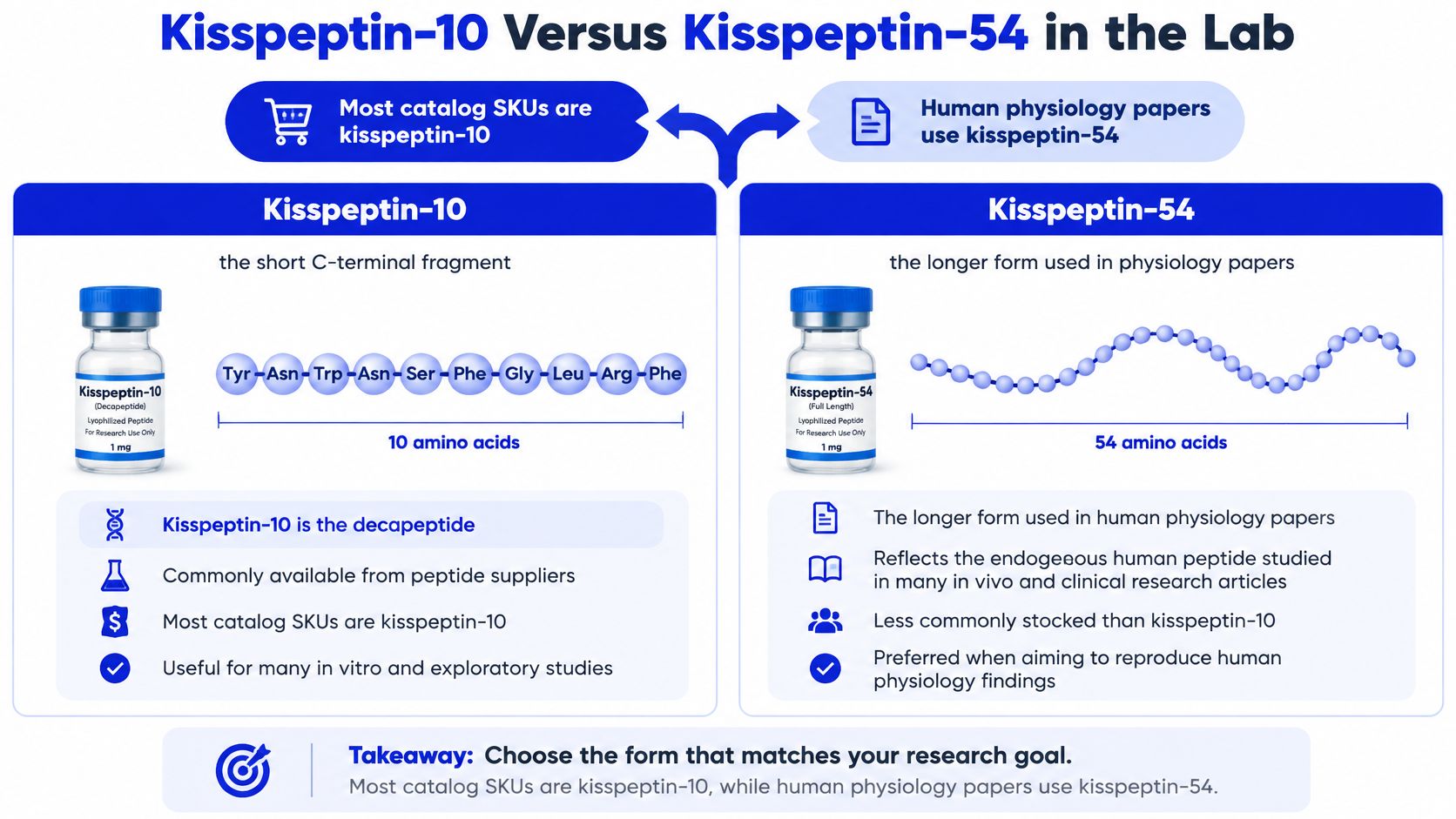
The first buying fork is kisspeptin-10 versus kisspeptin-54. Kisspeptin-10 is the short C-terminal fragment commonly encountered in research catalogs, while the human physiology studies discussed below used the longer kisspeptin-54 form. A matching family name isn't enough to establish a matching reagent.
Kisspeptin-10 is the decapeptide. Kisspeptin-54 is the longer form, and a lab shouldn't assume that a vial of the shorter fragment reproduces a paper using the longer peptide.
Use this comparison to identify the material before evaluating the rest of the listing.
For analytical or preclinical work, the protocol should specify which form is required. For a literature comparison, preserve the paper's material designation rather than shortening it to kisspeptin in the purchasing record.
The distinction matters even when both forms are relevant to the same receptor pathway. Receptor relevance doesn't establish equivalence across exposure conditions, experimental models, or physiological readouts.
Kisspeptin forms researchers compare
| Form | Where it shows up | Published reference point | Buyer caution |
|---|---|---|---|
| Kisspeptin-10 | Short C-terminal fragment and common research SKU | Limited human data; FDA proposed against adding it to the 503A Bulks List | Confirm sequence and impurity data; don't treat it as an approved drug |
| Kisspeptin-54 | Longer isoform in human physiology papers | Intranasal and intravenous crossover investigations measuring hormone responses | A kisspeptin-10 vial isn't the same material |
| Sustained administration designs | Dose-ranging reproductive hormone trials | Planned enrollment and treatment-rate comparisons in a clinical-trial listing | Route, exposure duration, and infusion rate affect interpretation |
A CenterWatch clinical-trial listing updated in 2024 reported 76 planned participants, with doses of 0.1, 0.3, and 1.0 nmol/kg/hour across four treatment groups. That's a study-design reference, not evidence that a particular retail vial is suitable for the trial or that planned enrollment represents completed results.
A vial's labeled mass describes packaged material. A weight-adjusted infusion rate describes exposure over time within an investigation. Those aren't interchangeable purchasing specifications.
Before ordering, reconcile these fields:
If your protocol specifies kisspeptin-54, don't substitute kisspeptin-10 because it's easier to find. Resolve the material requirement with the study lead first. Published administration rates are records of controlled investigations, not instructions for preparing or administering a purchased research vial.
The cheapest vial fails the procurement test if its paperwork doesn't match the lot. A polished certificate is no more useful than a product photograph if you can't connect it to the material you'll receive.
At Peptide Warehouse USA, we provide high-purity research peptides backed by third-party testing, including certificates of analysis, endotoxin reports, and microbial reports. Our products are advertised with 99.5% purity, but a purchasing team should still evaluate the actual lot file against its protocol requirements.
Start with identity. The certificate should name the peptide sequence and an analytical method, such as mass spectrometry, that supports the stated identity. A marketing nickname or an unexplained pass designation isn't an adequate substitute.
Then inspect purity. High-performance liquid chromatography, or HPLC, provides a chromatographic assessment that should be accompanied by a stated result and method context. Request the raw HPLC chromatogram, the mass-spectrometry trace, and the name of the testing laboratory for the specific lot.
Kisspeptin lot checks before purchase
| Check | Pass standard | Red flag |
|---|---|---|
| Sequence identity | Mass spectrometry or an equivalent method matching kisspeptin-10 or the stated isoform | Method or sequence missing |
| HPLC purity | Lot-specific numeric HPLC result meeting the protocol's acceptance criterion, with chromatogram and method | Vague pure claim with no chromatogram |
| Lot-matched COA | Certificate lot number equals the vial lot number | One generic COA reused across lots |
| Endotoxin | Numeric result, units, and a stated acceptance limit | No endotoxin report |
| Microbial screen | Bioburden or equivalent microbial result with method and acceptance criterion | No microbial data |
| Storage | Lyophilized powder, cool, dry, protected from light, with product-specific requirements | No handling instructions |
| Label status | Research use only, not for human consumption | Dosing or disease-treatment claims |
| Price context | Kisspeptin-10 listed at $59.99, evaluated alongside its documentation | Low price and no lot file |
Our KISSPEPTIN-10 costs $59.99. That's a concrete comparison point, not a reason to waive a missing report or accept a certificate for another batch.
A purity figure doesn't answer every question about a reagent. Identity testing addresses what the material is, while endotoxin and microbial testing address different potential sources of experimental interference. None of these reports, alone or together, establishes suitability for human administration.
Say your laboratory is running a sensitive cell-based experiment. A strong HPLC result won't resolve a missing endotoxin report, because the reports address different acceptance criteria. The purchasing decision should follow the experiment's requirements rather than the most prominent percentage on the page.
A purity claim is something to verify against a lot-specific analytical record, not something to accept because it appears in large type.
Use a final accept test before payment:
If a required result is missing, hold the order for clarification. Don't convert incomplete paperwork into an assumption of quality.
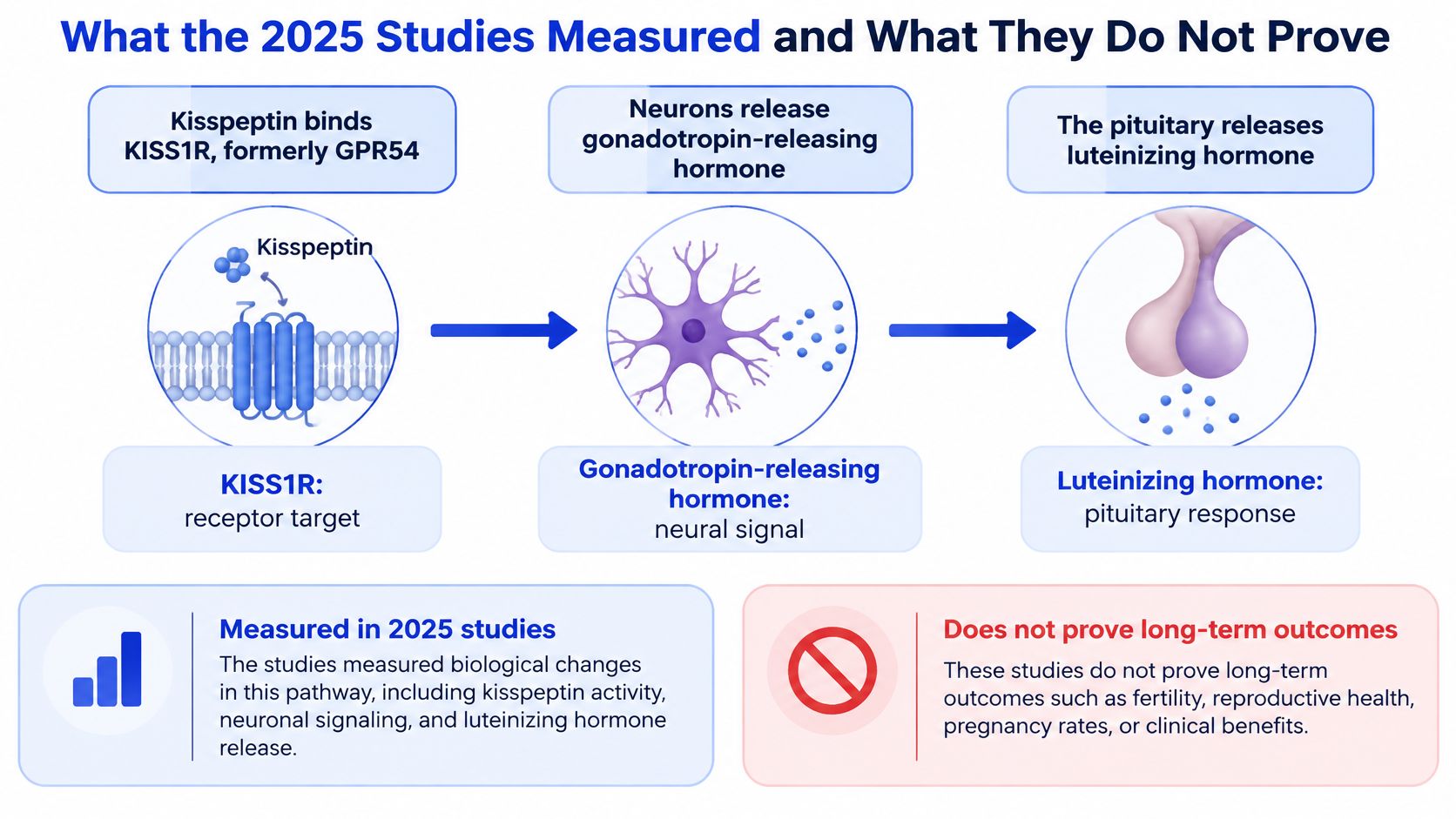
The biological relay starts when kisspeptin binds KISS1R, formerly called GPR54, on neurons involved in gonadotropin-releasing hormone release. That neural signal then prompts the pituitary to release luteinizing hormone, or LH. The receptor-ligand identification in 2001 helped establish this pathway's relevance to reproductive maturation and fertility biology, as described in the background to the intranasal kisspeptin-54 study indexed by PubMed.
The pathway diagram shows why LH is a relevant downstream measurement.
The intranasal investigation was a randomized, double-blind, placebo-controlled crossover study. It evaluated kisspeptin-54 at 12.8 nmol/kg, with the following mean maximal LH increases above baseline and comparisons against placebo.
LH response in the 2025 intranasal kisspeptin-54 crossover
| Group | Mean maximal LH rise (IU/L) | P versus placebo |
|---|---|---|
| Healthy men | 4.4 ± 0.6 | P = 0.002 |
| Healthy women | 1.4 ± 0.3 | P = 0.004 |
| Hypothalamic amenorrhea | 4.4 ± 0.2 | P < 0.001 |
These are group-specific hormone responses, not a universal expected effect for any kisspeptin product. The difference between the healthy women and the other groups is a practical reminder to preserve the study population when summarizing a result.
A statistically significant comparison also doesn't establish the size, durability, or practical importance of an effect outside the experiment. For help distinguishing a P value from a broader claim, PlotStudio AI's guide to statistical evidence for research decisions provides useful context.
A separate randomized crossover study indexed by PubMed enrolled 95 participants, including 63 men and 32 women, with an average age of 30.9 years and average BMI of 24.0. Participants received a 75-minute intravenous infusion of kisspeptin-54 at 1 nanomole per kilogram per hour or a rate-matched placebo, in randomized order.
The study reported a significant increase in serum LH. It found no statistically significant effects versus placebo on state anxiety, cortisol, systolic blood pressure, diastolic blood pressure, or heart rate.
Those findings belong together. The positive hormone result doesn't justify adding unrelated benefits, and the null comparisons don't establish overall or long-term safety.
The accompanying video offers another format for exploring the topic; the study records remain the basis for evaluating measured outcomes.
Claim boundary: An LH response supports a discussion about reproductive hormone signaling under controlled conditions. It doesn't establish weight-loss, fat-loss, muscle-growth, healing, or anti-aging benefits.
For procurement, translate that boundary into a defensible rationale. A literature-based endocrine experiment can cite the measured LH endpoint, while an analytical identity check needs a separate analytical justification. Neither should be sold internally as evidence of guaranteed clinical outcomes.
A response in a human study also doesn't predict the result in another species, an isolated receptor assay, or a different disease model. Purchase the reagent for the question your experiment can answer, not for an outcome the paper never measured.
Kisspeptin is not an FDA-approved drug for a therapeutic indication. The FDA briefing document on kisspeptin-10 assessed potential inclusion on the 503A Bulks List and identified only one clinical study involving a single subcutaneous bolus in approximately 35 healthy women.
The agency proposed not adding kisspeptin-10 to that list. Its concerns included limited safety information, peptide-related impurities and characterization, and uncertainty about proposed administration routes.
That assessment isn't a review of every kisspeptin experiment, and it shouldn't be presented as one. It concerns a particular substance and a particular compounding framework. Its purchasing relevance is straightforward: a catalog listing doesn't establish that the material has been evaluated as an approved medicine.
The impurity concerns are especially relevant to procurement. A reagent's name doesn't describe its full impurity profile, and an advertised purity figure doesn't resolve every characterization question. Documentation supports a laboratory assessment, not a claim of therapeutic authorization.
For a research page, examine the language as carefully as the certificate:
The statements on our website haven't been evaluated by the U.S. Food and Drug Administration. We're a research chemical supplier, not a compounding pharmacy or compounding facility under Section 503A, and not an outsourcing facility under Section 503B of the Federal Food, Drug, and Cosmetic Act.
That distinction should remain beside the purchasing checklist, not buried beneath product benefits. Neither a complete certificate nor a successful checkout changes the intended-use category.
A research-use label also isn't a way to make contradictory treatment advertising acceptable. Evaluate the entire page, including its descriptions and support language. Supplier availability doesn't create FDA approval, proven clinical effectiveness, or permission for self-administration.
A defensible research order leaves a record another team member can follow. It identifies why the material was selected, which documents were reviewed, and what the laboratory accepted before payment.
Healthline's overview of research chemicals and FDA-approved peptides distinguishes research-use-only products intended for laboratory experiments, in-vitro assays, or animal research from approved treatments. It also explains that marketing research peptides for human use, as supplements, or as unapproved drugs can create problems under the Federal Food, Drug, and Cosmetic Act.
Write the experimental endpoint. Use a specific description, such as receptor-binding activity, an analytical identity check, or an LH readout in an approved experimental model. An LH immunoassay measures LH; don't assume kisspeptin itself is the assay's calibration standard.
Select the required isoform. Choose kisspeptin-10 when that's what the protocol requires. If the protocol specifies kisspeptin-54, preserve that requirement rather than substituting a more convenient catalog item.
Apply the document gate. Review the lot file against the acceptance criteria before paying. A failed required check should pause the purchase until the discrepancy is resolved.
Record receipt and storage. Enter the lot number in the laboratory notebook or inventory system. Keep the lyophilized material cool, dry, and protected from light, and follow the documented product-specific storage requirements.
Our U.S.-made products are batch produced and batch tested, with third-party documentation supporting research procurement. We assist with non-medical, non-clinical questions about availability, documentation, and order status, and we ship to all 50 U.S. states. Shipping information and delivery options belong in the order review, alongside the laboratory's receiving arrangements.
Our products are not intended for human or veterinary consumption. We don't provide medical advice, dosing instructions, or treatment guidance of any kind, and our products and information aren't intended to diagnose, treat, cure, or prevent any disease.
Before checkout, learn more on our Kisspeptin-10 research page and compare the available lot file with your laboratory's acceptance criteria. Explore options for laboratory, analytical, or preclinical work only when the material and documentation fit the planned application.
The strongest purchase decision is modest and specific: this identified lot meets this protocol's documented requirements. That's more useful to a research team than a broad promise about what peptides might do.
Peptide Warehouse USA offers U.S.-made, batch-tested research peptides supported by third-party COAs, endotoxin reports, and microbial reports. Visit Peptide Warehouse USA to explore Kisspeptin-10 for research and review the documentation before placing a laboratory order.