No products in the cart.



A calculator that displays 0.0500 mL can look more trustworthy than one that displays 0.05 mL. But extra decimal places don't make the result more accurate. A glow peptide calculator can do the arithmetic correctly and still be working from the wrong label, an uncertain concentration, or a syringe scale that doesn't match its assumptions.
Used carefully, it's an educational unit-conversion and documentation aid: divide the labeled peptide mass by the diluent volume to find concentration, then divide a planned sample mass by that concentration to estimate a volume. That output is not a recommendation about what amount belongs in a study or how anyone should use a product.
Suppose a researcher enters a vial labeled with a total peptide mass, adds a stated solvent volume, and asks the calculator to convert a planned sample mass into a liquid volume. The calculator can divide the first two inputs, divide the planned mass by the resulting concentration, and display a neat answer. It can't tell whether the label, solvent, sample amount, or study plan is appropriate.
People searching for a glow peptide calculator are often trying to understand a research blend discussed as BPC-157, GHK-Cu, and TB-500 together. Those names appear in different research contexts, including tissue-repair models, skin-structure research, and recovery studies. Their presence in one preparation doesn't make them interchangeable or establish a shared effect.
This page starts with a concentration and U-100 syringe reference table, then explains the input categories and walks through worked examples. It also covers checks for unit mistakes, documentation fields to save beside a result, and how related blend names can be cross-referenced without implying equal potency.
The boundary matters: These calculations are for laboratory, analytical, or preclinical planning only. They aren't a prescription, clinical protocol, or human-consumption guide.
A calculator's result is only as useful as the values entered. That's why reliable recordkeeping and an understanding of the label matter as much as the division itself. For readers exploring how measurement tools fit into broader wellness conversations, personalized health beyond wearable tracking offers another perspective on interpreting personal health information without confusing a measurement with a treatment decision.
Start with the reference table below. Find the row that matches the vial's labeled mass and the solvent volume used in the calculation, then confirm the intermediate concentration before looking at any syringe units.
The arithmetic has two parts:
For example, 5 mg in 2 mL equals 2.5 mg/mL. A planned sample mass of 0.25 mg divided by 2.5 mg/mL gives a draw volume of 0.1 mL.
The last step converts that volume into syringe units, and only if the syringe scale is known. Every row below uses a U-100 syringe, where 100 units equal 1 mL. So, for this scale, units equal milliliters multiplied by 100. Units are not milligrams. The American Diabetes Association's discussion of compounded GLP-1 products describes confusion between milliliters, milligrams, and units, and emphasizes the importance of product labels that identify dosage and contents.
| Labeled mass | Diluent | Concentration | Planned sample mass | U-100 units |
|---|---|---|---|---|
| 5 mg | 2 mL | 2.5 mg/mL | 0.25 mg | 10 units |
| 10 mg | 2 mL | 5 mg/mL | 0.25 mg | 5 units |
| 10 mg | 1 mL | 10 mg/mL | 0.5 mg | 5 units |
| 50 mg | 2 mL | 25 mg/mL | 1 mg | 4 units |
These are lookup calculations, not recommendations. The mass in each row is the total labeled peptide mass entered into the calculator. It isn't a component-by-component breakdown of BPC-157, GHK-Cu, and TB-500.
Match the vial label before copying any row. A different solvent volume changes the concentration and every later value, even when the labeled mass stays the same. A clear calculator should always show the intermediate result in mg/mL, so the user can inspect the conversion instead of seeing an unexplained number of units.
The table applies only when its inputs match the vial and the named syringe scale. To find the right row, identify the labeled mass, the solvent volume used in the calculation, the planned sample mass, and the syringe's units-per-milliliter scale.
A calculator is easier to check when each box has one job. Group the inputs by what they change, and don't treat milligrams, milliliters, and syringe units as interchangeable labels.
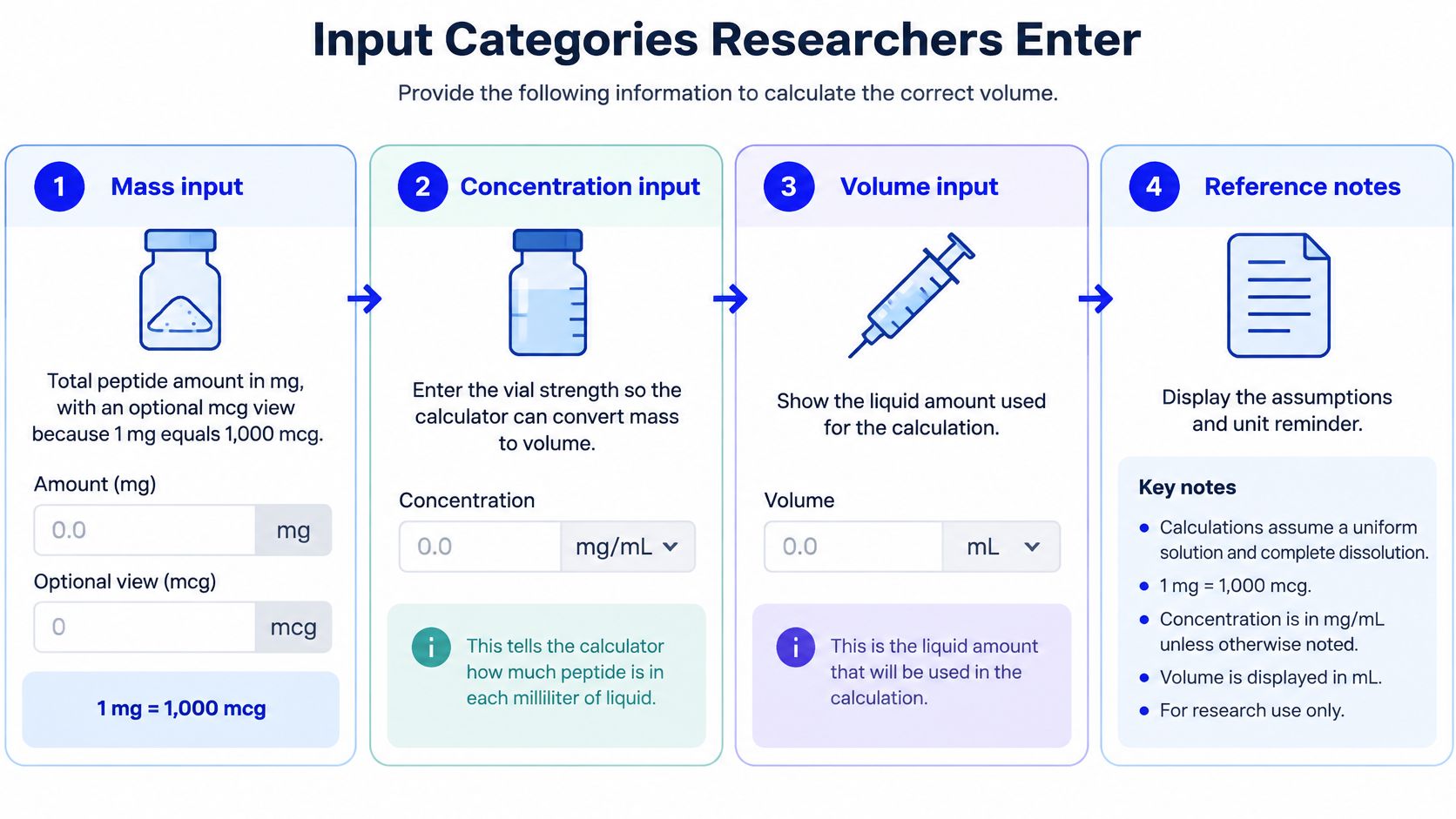
Mass input is the total peptide amount printed on the vial label, entered in milligrams. An optional microgram view can help with unit checking because 1 mg equals 1,000 mcg. If a label states 0.25 mg, entering 250 in a box expecting milligrams would create a thousand-fold mismatch.
The concentration field should show the vial strength in mg/mL, calculated from the mass and solvent-volume inputs. Some calculators derive this value rather than ask for it directly. Either way, the user should be able to see and verify the intermediate concentration.
Volume input includes the solvent volume used in the calculation and the resulting draw volume. The mass and solvent volume set the concentration. The planned sample mass then determines the calculated draw volume.
Scale input identifies the syringe graduation. For a U-100 scale, 100 units correspond to 1 mL. Another syringe scale must use its own printed units-per-milliliter value, not the U-100 multiplier. The scale changes only how a volume is represented in units. It doesn't change the volume or turn units into milligrams.
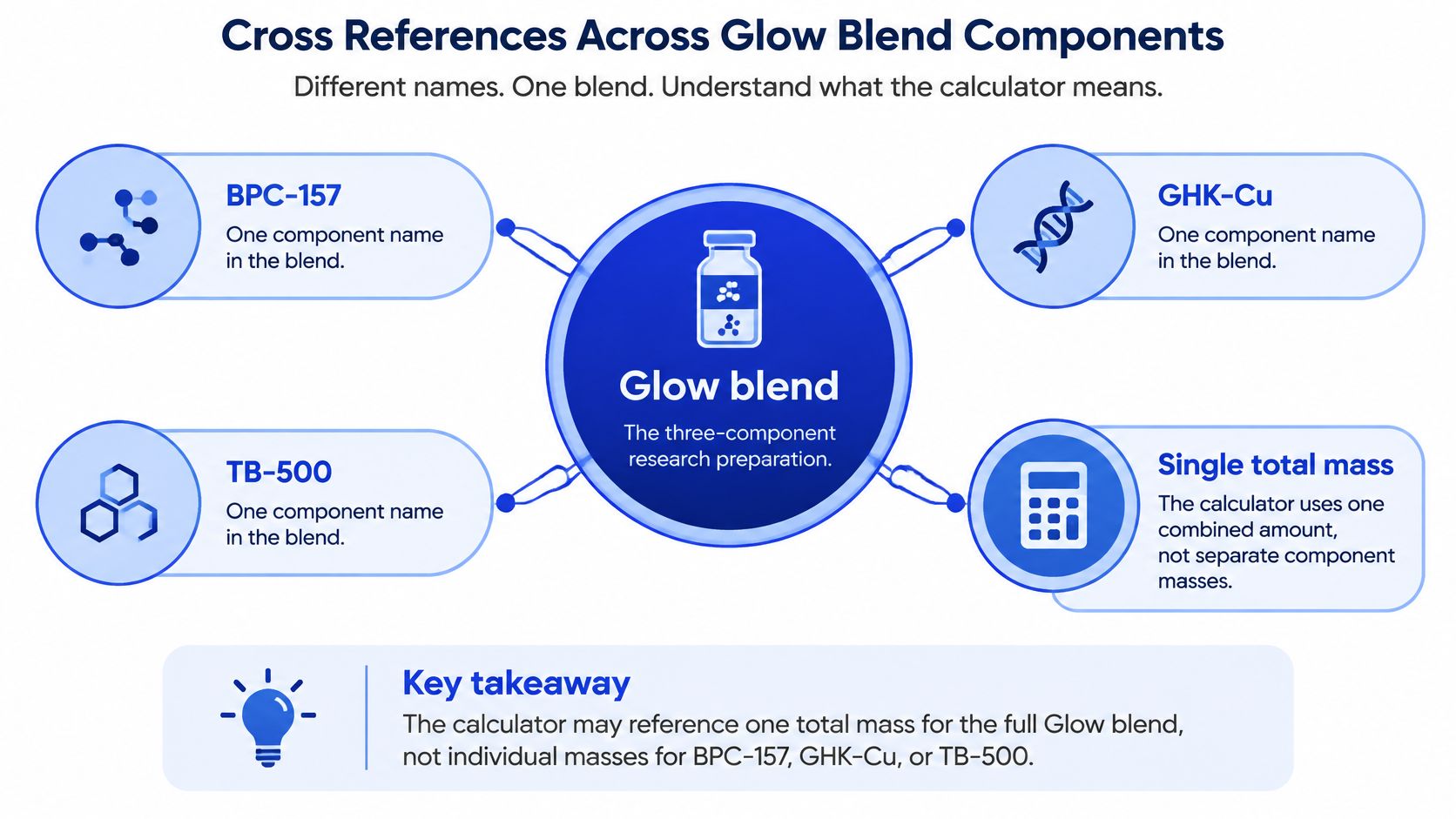
For a glow blend, add a component note that the vial is a preparation containing BPC-157, GHK-Cu, and TB-500. Unless the label lists separate component masses, the calculator's mass input is the single total labeled mass, not an invented split among ingredients.
The saved record belongs beside the calculation, not in place of an input. Recordkeeping details appear later; the calculator's immediate job is to show how the entered mass and volume produce concentration, and how concentration and planned mass produce draw volume.
Stop if a required field is empty or inconsistent. A blank syringe scale means no syringe-unit result should appear. A mass entered in the wrong unit, or a solvent volume that doesn't match the preparation record, also means the displayed output shouldn't be used. The worked examples show how each input affects the result.
Use a label and a documented laboratory plan to supply the inputs. The following examples show how the arithmetic works, but they don't validate any protocol or recommend a sample amount.
Each result follows from the entered values. It doesn't establish that the plan is suitable or that the material behaves as assumed.
Variant A changes only the solvent volume. Keep the labeled mass at 10 mg and the planned sample mass at 0.25 mg, but use 1 mL of solvent. Concentration becomes 10 mg/mL. The calculated volume is 0.025 mL, or 2.5 U-100 units. A syringe may not mark that amount cleanly, which makes the displayed conversion less useful as a measurement.
Variant B confuses mass and volume. Keep the 10 mg in 2 mL setup, so concentration remains 5 mg/mL. If someone treats 0.25 mg as though it meant 0.25 mL, the result represents 1.25 mg, five times the planned mass. The error comes from substituting a volume for a mass, not from difficult arithmetic.
The FDA has described dosing errors involving compounded injectable semaglutide when people converted between milligrams, milliliters, and syringe units. In one example, an intended amount of 0.25 mg, or 5 units, was prescribed as 25 units, and the patient experienced severe vomiting. The FDA alert on compounded semaglutide dosing errors supports keeping mass, volume, concentration, and syringe scale distinct. The FDA also notes that compounded drugs don't undergo the same premarket review for safety, quality, and effectiveness as FDA-approved medicines.
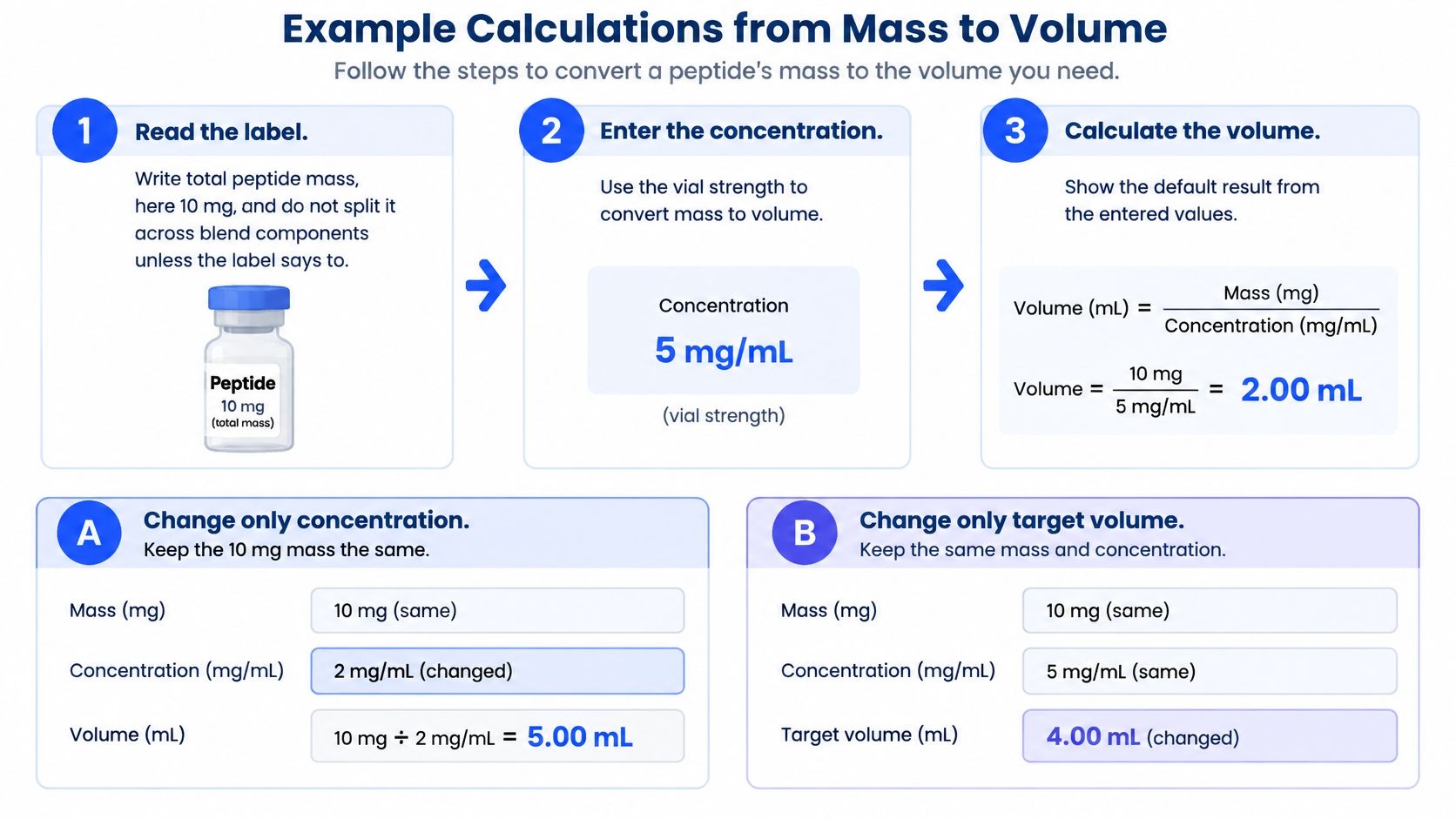
These figures illustrate unit conversion only. They don't validate a protocol, a product, or a human dose. Before treating any calculated draw as meaningful, check whether the volume can be measured clearly and whether the inputs agree with the label and the approved laboratory plan.
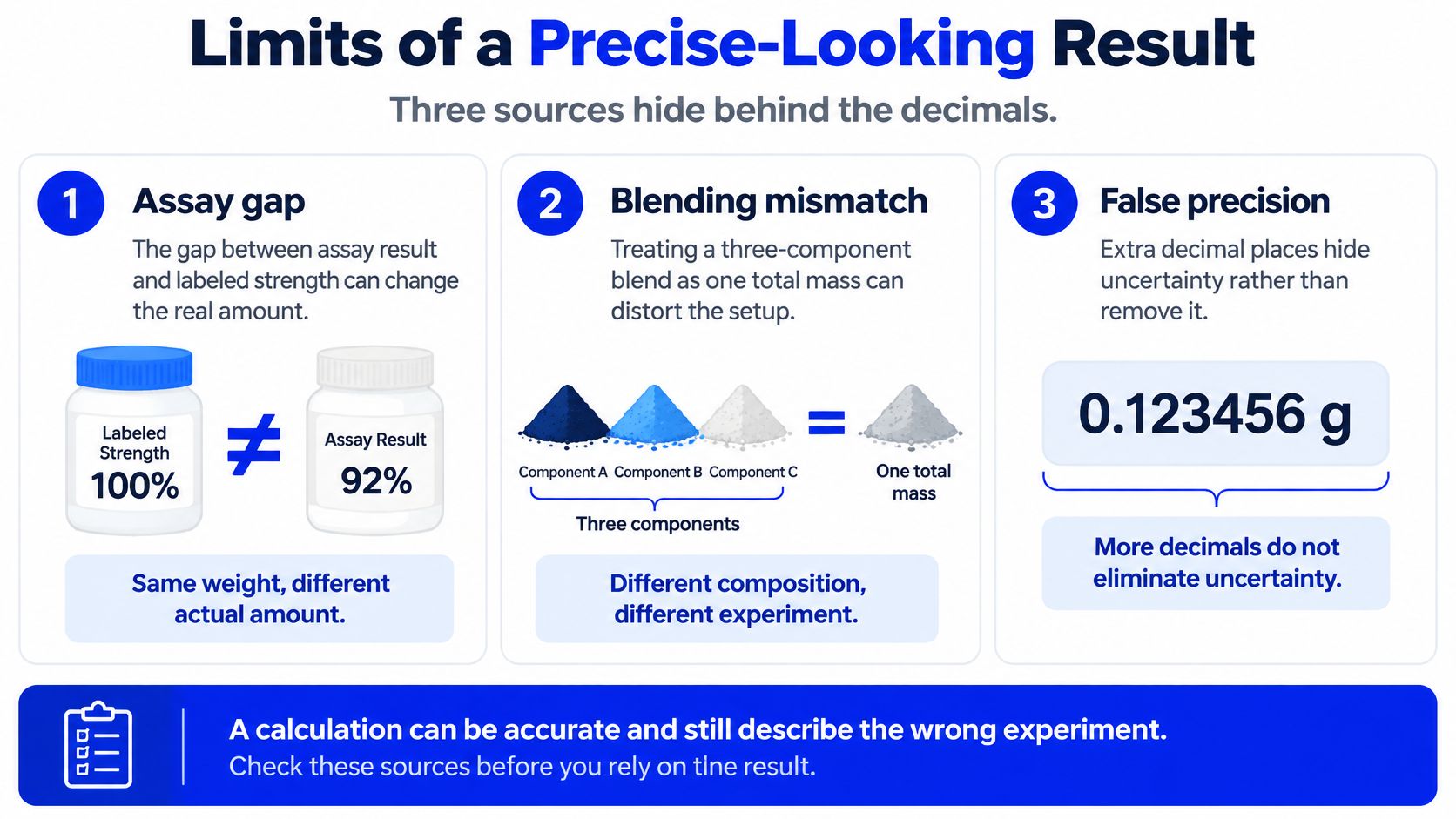
More decimal places don't mean more accuracy. A calculator can return a precise-looking answer even when the assay result differs from the nominal label mass, some material is lost during mixing or transfer, or the syringe graduations are too coarse to measure the displayed volume reliably.
A draw of 0.05 mL may fall between marks on a syringe. A 2.5-unit draw on a 1 mL U-100 syringe can also be difficult to read precisely. These are measurement limitations, not problems that can be fixed by adding digits to the calculator's display.
| Check | What it catches | What it does not prove |
|---|---|---|
| mg versus mcg | A thousand-fold unit swap, since 1 mg = 1,000 mcg | That the planned mass belongs in the protocol |
| Draw volume versus syringe | Draws under about 2 units or over 100 units on a 1 mL U-100 syringe | That the syringe is sterile or the right device |
| Syringe scale named | A missing U-100 or other graduation before units are shown | That units equal milligrams |
| Label match | Vial mass, blend name, or diluent left blank or inconsistent | Identity, purity, or stability of the lot |
| Single total mass for a blend | Treating BPC-157, GHK-Cu, and TB-500 as separate doses when only one vial mass is labeled | Equivalence among those components or with any other peptide |
Those checks can catch arithmetic or entry problems, but they can't settle whether a planned mass belongs in a protocol, whether the solvent suits the material, whether storage remained within the required conditions, or whether three components in one vial behave like any single peptide.
The broader history of peptide therapeutics offers no universal formula to fill those gaps. FDA-authorized peptide therapeutics differ in sequence, target, half-life, formulation, route, and clinical indication. A conversion tool can't rank cosmetic, metabolic, repair, or performance outcomes from a weight-based calculation.
The peptide-calculator guidance on arithmetic limits likewise distinguishes a precise calculation from validation of the inputs, protocol, syringe, or handling. Treat the displayed number as a mathematical result, not scientific guidance and not a human dose.
A glow blend is a three-component research preparation containing BPC-157, GHK-Cu, and TB-500. The names can help identify what a label describes, but they don't tell a calculator how much of each component is present unless the label provides those individual masses.
| Name | Research context or distinction |
|---|---|
| BPC-157 | Commonly discussed in tissue-repair models |
| GHK-Cu | Discussed in skin-structure and connective-tissue research |
| TB-500 | Discussed in recovery and mobility models |
Those themes describe research contexts, not dosing amounts. They also don't become additive just because the components share a vial. If only one total mass appears on the label, a calculator can use that total for the arithmetic, but it can't recover the component ratio or infer equivalent amounts.
KLOW is a different four-component blend that adds KPV. A calculation based on a glow label shouldn't be copied onto a KLOW label. Likewise, a GHK-Cu-only vial, a BPC-157 and TB-500 blend, and a topical cream such as GHK-Cu and KPV are different materials, routes, and mass bases.
Package-size filters may show options such as 10 mg, 15 mg, and 30 mg, but the calculator must use the printed mass of the vial in hand. A product name or size filter doesn't replace the actual label, and neither tells the calculator to divide a total among ingredients.
Research-use wording is another label detail that needs careful interpretation. It doesn't transform a calculated quantity into an approved human use. In a warning letter dated December 10, 2024, the FDA said certain products marketed as semaglutide, retatrutide, cagrilintide, tirzepatide, and mazdutide were unapproved new drugs when introduced into interstate commerce, despite “research only” or “research chemical only” statements. The FDA warning letter to Summit Research Peptides shows why research-use labeling shouldn't be treated as authorization for human consumption.
The practical rule is straightforward: new label, new mass, new solvent volume, new saved record. Cross-referencing names can prevent mix-ups, but each material needs its own inputs and documentation.
Convert to milligrams first, then enter that value once. For example, 250 mcg is 0.25 mg. Don't enter the microgram number into a field expecting milligrams.
Use the units-per-milliliter scale printed on that syringe. Units equal milliliters multiplied by that scale, so check the barrel before reading any unit result.
No. It assumes the stated volume is the volume used in the calculation. Any preparation loss is a laboratory and protocol question, not something the arithmetic can measure.
Run each label separately. Different component lists or total masses don't share a calculation just because both products use the word “glow.”
No. The calculator converts units; it doesn't evaluate safety, purity, or suitability for any use. A precise number isn't a clinical assessment.
A concentration without a record is difficult to reproduce or audit. Save the material details beside the calculation so another qualified researcher can tell which label, lot, and assumptions produced the displayed result.
A useful record includes:
A certificate of analysis should identify the testing method, testing limits, and actual test results. The FDA's current good manufacturing practice guidance for dietary-ingredient manufacturing also says a supplier's testing information must be qualified before relying on its certificate to verify component specifications. That guidance applies to dietary-ingredient manufacturing; it isn't blanket approval of research peptides. Its documentation principles are still useful for distinguishing a nominal label amount from recorded analytical results.
A filled example could read: Lot [recorded lot], 10 mg nominal, purity as printed, 2 mL [solvent name], [preparation date], COA [identifier], 5 mg/mL, 0.25 mg planned, 0.05 mL draw, U-100, 5 units.
The bracketed details must come from the actual vial, certificate, and preparation record. Don't invent a lot number, purity figure, solvent name, date, or COA identifier just to make the record look complete.
Before treating the result as a planning record, confirm three things:
Those steps make calculations easier to trace and repeat. They don't establish sterility, human safety, therapeutic effectiveness, or suitability for a particular purpose. A certificate and a calculator each answer limited questions, and neither replaces the laboratory's documented procedures.
Peptide Warehouse USA offers GLOW BLEND, a research preparation of BPC-157, GHK-Cu, and TB-500, for $169.99. The company describes its research peptides as supported by third-party testing, including COAs, endotoxin reports, and microbial reports, and advertises purity up to 99.5 percent. Those documents can support traceability, but they don't establish human safety or approval.
Peptide Warehouse USA is a research chemical supplier, not a compounding pharmacy or a 503B outsourcing facility. It doesn't provide medical advice, dosing instructions, or treatment guidance, and its website statements haven't been evaluated by the FDA. Keep any calculator output within laboratory, analytical, or preclinical planning, and don't use it to select a human amount or direct self-injection.
For research planning, Peptide Warehouse USA offers GLOW BLEND and batch documentation that can help researchers identify and track the material entered into a calculation. Review the label and lot records first, then visit Peptide Warehouse USA to learn more about the glow blend documentation or explore research-use options.