No products in the cart.



The most popular advice for judging DSIP for sale is also the weakest. Buyers are told to look for 99% purity and move on, as if one number proved identity, safety, stability, and legal status. It doesn't.
A purity percentage answers one narrow analytical question. It doesn't tell you whether the sequence is correct, which administration route the evidence covers, or what kind of seller you're buying from. Learning how to read the documents, the route evidence, and the listing itself will tell you far more than the headline number.
DSIP, or delta-sleep-inducing peptide, is a short peptide first identified during research into sleep related brain activity. Its name reflects an early observation in animals, an increase in delta, or slow wave, activity during sleep. That name describes a research finding, not a promise about any product sold today.
Historical accounts summarized in a ScienceDirect review of DSIP research place its isolation in rabbit cerebral venous blood between 1974 and 1977, after researchers electrically stimulated the intralaminar thalamic area to induce sleep related brain activity. Chemists later identified DSIP as a nonapeptide with a molecular weight of approximately 849 daltons. Early experiments reported mainly delta sleep effects in rabbits, rats, mice, and humans, while cats showed a stronger effect on rapid eye movement sleep.

Think of a peptide as a string of beads, where each bead is an amino acid. DSIP has nine beads, and their exact sequence defines the material. Swap one bead, shorten the chain, or damage a link, and you no longer have the same compound, even if a vial label still says DSIP.
That example shows why a name alone can't verify a lot. A laboratory still needs analytical evidence that the material in the container matches the expected sequence and mass. It also needs records that connect that evidence to a specific production batch.
A listing describes material offered for laboratory work. It doesn't turn DSIP into a validated sleep product.
Four terms will keep the rest of your evaluation organized. Route means how material was administered in a study, endpoint means what researchers measured, COA means Certificate of Analysis, and batch or lot means the specific production run being tested. When you see DSIP for sale, judge each listing against those four terms before you judge its price or presentation.
Say a listing advertises 99.5% purity in large type but shows no mass spectrum. That figure may describe one chromatogram, yet it leaves the peptide sequence unconfirmed. You've learned something about the main peak, not enough about the material itself.
Quality review works better when you separate four questions. Identity asks whether it's DSIP, purity asks how much of the signal belongs to the main peak, content asks how much peptide is present, and microbiological testing asks about bacterial or endotoxin burden. A clean answer to one question doesn't answer the others.

Start with a lot-specific Certificate of Analysis that names the test dates and analytical methods. A generic certificate without a lot number can't prove that the vial you're considering was the material tested. Dates matter too, because they show when the result was generated and help you spot recycled paperwork.
Next, read the HPLC result for what it is. It shows the share of the main peak and can reveal related impurities, but matching retention behavior isn't the same as proving the amino acid sequence. A contaminant that moves similarly through the system, or one the method doesn't detect well, may not stand out in the headline percentage.
Then look for mass spectrometry. The USP guidance on synthetic peptide reference standards identifies mass spectrometry and nuclear magnetic resonance for confirming structural features, while HPLC can assess content, impurities, and residues such as acetic acid or trifluoroacetic acid. USP also supports using at least two orthogonal identification methods, such as molecular mass determination combined with LC-MS/MS, peptide mapping, amino acid analysis, or NMR.
Orthogonal means the methods test the material in different ways. If two independent approaches point to the same identity, your confidence is stronger than if one technique is repeated under a different label. That's the difference between verification and decoration.
| Document or test | What it establishes | What it does not establish |
|---|---|---|
| Lot-specific Certificate of Analysis | Record of the tested lot with test dates and named methods | Human safety or efficacy |
| HPLC purity | Share of the main peak in the chromatogram | Sequence identity or the absence of every contaminant |
| Mass spectrometry | Observed molecular mass compared with the expected value of about 849 daltons | Purity or batch consistency on its own |
| Second identity method (LC-MS/MS, peptide mapping, amino-acid analysis or NMR) | Confirmation of structural features and sequence | Sterility or endotoxin status |
| Counterion and residual solvent data (acetic acid, trifluoroacetic acid) | Leftover synthesis residues and salt form | Biological activity in any species |
| Microbial and endotoxin reports | Bacterial and endotoxin burden of the tested lot | Identity or purity of the peptide |
Counterion and residual data tell you about the salt form and synthesis leftovers, which can affect the actual peptide content in a weighed amount. Microbial and endotoxin reports answer a separate contamination question. Neither document replaces identity testing, and neither demonstrates biological activity.
Third-party testing can improve traceability, especially when reports identify the lot, laboratory, methods, and dates. It doesn't establish human safety, clinical efficacy, or suitability for consumption. A seller who blurs that distinction is asking analytical paperwork to do work it can't do.
Request these items in writing before buying:
If a supplier can't connect those documents to the exact lot, treat the purity claim as unproven. The percentage is the last thing to evaluate, not the first.
Route is where many DSIP listings become misleading without making an outright false statement. A page may cite an older intravenous experiment beside a product presented for intranasal or subcutaneous research. Those are materially different exposures, so the evidence cannot travel from one format to another.
The early intravenous record is small and mixed. A Springer report on synthetic DSIP in chronic insomnia describes 25 nmol/kg given intravenously to six middle-aged people with chronic insomnia, with longer, better quality sleep, fewer interruptions, and no reported daytime sedation. The apparent effect began mainly during the second hour and persisted for up to six hours, but later work didn't consistently reproduce increases in slow wave sleep, REM sleep, or EEG delta power.
A different result came from a four-night double-blind crossover study summarized in a PubMed record for intravenous DSIP research. At 25 nmol/kg, total sleep and NREM sleep increased mainly through stage 2 sleep, while slow wave sleep, REM sleep, and stage 1 sleep were not significantly modified. The authors concluded that the clinical improvement was of little significance because relevant differences were already present at baseline.
That distinction is easy to miss. More total sleep isn't automatically more restorative slow wave sleep, and a change in one endpoint doesn't validate every claim attached to DSIP. For people comparing non-drug approaches to nightly routines, practical resources on breathing routines for better sleep address habits directly, without borrowing authority from small peptide experiments. Keeping those categories separate helps buyers avoid treating a research compound as a consumer sleep aid.
A double-blind study involving 16 people with chronic insomnia adds another caution. A clinical evidence review of DSIP describes weak objective signals, no clear subjective improvement in sleep quality, and a conclusion that short-term DSIP was unlikely to provide major therapeutic benefit. The same review characterizes the human literature as small, old, conflicting, and limited to intravenous administration.
Endpoint specificity also appears outside sleep staging. In 11 healthy men, the same intravenous dose reduced ACTH-like immunoreactivity for at least three hours without corresponding changes in cortisol or urinary monoamine metabolites. That pattern supports a narrow neuroendocrine observation, not a broad claim that DSIP resets hormones or improves sleep through every pathway.
Animal findings require the same discipline. Rabbit intracerebroventricular experiments delivered material directly into the brain's ventricular system, a route with no human counterpart in the cited product literature. Using that result to imply an effect from a nasal or subcutaneous format skips species, route, formulation, and exposure differences all at once.
The schizophrenia correlation is another example of a finding that shouldn't be stretched. Researchers observed a relationship in 15 drug-free men diagnosed with schizophrenia and stated that it required further study in nonpsychiatric populations. A correlation in cerebrospinal fluid isn't evidence that supplying DSIP causes the same sleep pattern.
| Route | What has been studied | Human evidence | Gap for buyers |
|---|---|---|---|
| Intravenous | Synthetic DSIP at 25 nmol/kg in chronic insomnia and healthy-volunteer studies | Small, older and inconsistent studies, including one with 16 people | The only route with a clinical record; does not transfer to other forms |
| Intracerebroventricular | Rabbit experiments at 6 nmol/kg with a 35% rise in EEG delta activity | No human data in the cited literature | Animal data, not a human route |
| Intranasal | Products marketed for research use | No established clinical benefit or safety in the cited literature | No direct clinical equivalence to intravenous evidence |
| Subcutaneous | Products marketed for research use | No established benefit or safety in the cited literature | No direct clinical equivalence to intravenous evidence |
Before you rely on any cited result, watch how route and endpoint are being used in the explanation below.
Write a one-line evidence note for every DSIP product you compare. Name the route, study type, population, endpoint, and participant count, then state whether the offered format matches that record. If it doesn't match, record the gap plainly instead of converting intravenous history into consumer dosing advice.
A product page can't reveal its legal category through a disclaimer alone. The words research only describe the seller's stated purpose, but category depends on who is selling, how the product is made or distributed, and what the overall presentation encourages. You need to test those signals separately.
The FDA summary of human drug compounding provisions separates section 503A pharmacies from section 503B outsourcing facilities. A 503A product must generally be compounded by a licensed pharmacist or physician in a state-licensed pharmacy or federal facility from a valid patient-specific prescription. A research chemical supplier isn't automatically a 503A pharmacy merely because it sells a peptide.
A 503B outsourcing facility operates under a different structure. It may distribute compounded drugs for a specific patient or as office stock ordered by a healthcare provider, but it must comply with current good manufacturing practice, FDA inspection, reporting, and information submission requirements. Catalog availability proves none of that.

Peptide Warehouse USA is not a compounding pharmacy or compounding facility under Section 503A, nor an outsourcing facility under Section 503B, of the Federal Food, Drug, and Cosmetic Act. All our products are sold for research, laboratory, or analytical purposes only and are not for human consumption. That clear category statement is useful because it tells you what we are and what we aren't.
| Category | Who it covers | Key requirement | What it means for a listing |
|---|---|---|---|
| 503A pharmacy | Licensed pharmacist or physician compounding | Generally a valid patient-specific prescription | A research supplier is not automatically one |
| 503B outsourcing facility | Compounding for specific patients or office stock | Current good manufacturing practice, FDA inspection and reporting | Catalog availability does not show this status |
| Research-chemical supplier | Sells for laboratory or analytical use | Research-use wording, which does not itself create an exemption from drug law | The disclaimer alone does not set a legal category |
| Bulk substance on the 503B list | Ingredient listed on FDA's bulks list, or a shortage condition applies | Must be checked separately from the finished product | Availability does not show approval or legal compounding |
The ingredient pathway creates another checkpoint. An FDA statement on compounding policy explains that a 503B facility generally may compound from a bulk substance only when that substance appears on FDA's 503B bulks list or the finished drug is on FDA's drug shortage list at the relevant time. Finding DSIP for sale therefore doesn't demonstrate FDA approval, legal compounding status, or authorization for human use.
Regulators also look beyond the disclaimer. A Sheppard Mullin analysis of FDA peptide enforcement notes that objective conduct under 21 CFR 201.128 can include marketing claims, bacteriostatic water or reconstitution supplies, peptide calculators, and dosing guides. In plain language, a seller can't print research only at the bottom while building the rest of the page for personal human use.
Watch for these red flags:
Stronger signals point the other way. Look for lot documentation, laboratory or analytical language, no treatment claims, no administration guidance, and a stated legal category you can compare with the table. Documentation should be specific enough that you don't need to infer status from branding.
Decision rule: Stop when the seller's stated category conflicts with its claims, tools, or supplies. Several red flags together matter more than one reassuring disclaimer.
Don't try to rescue a questionable listing by assuming the seller must have an exemption. Ask for the category in writing, compare the whole presentation, and walk away when the signals don't align. That's a procurement control, not legal advice, and it's the point where caution protects both the laboratory and the buyer.
Poor handling can undo good paperwork. Peptides can degrade when they're exposed to unsuitable conditions, and degradation products may change what later testing detects. A COA describes the tested lot at the time of testing, not every vial forever after shipping, storage, and repeated handling.
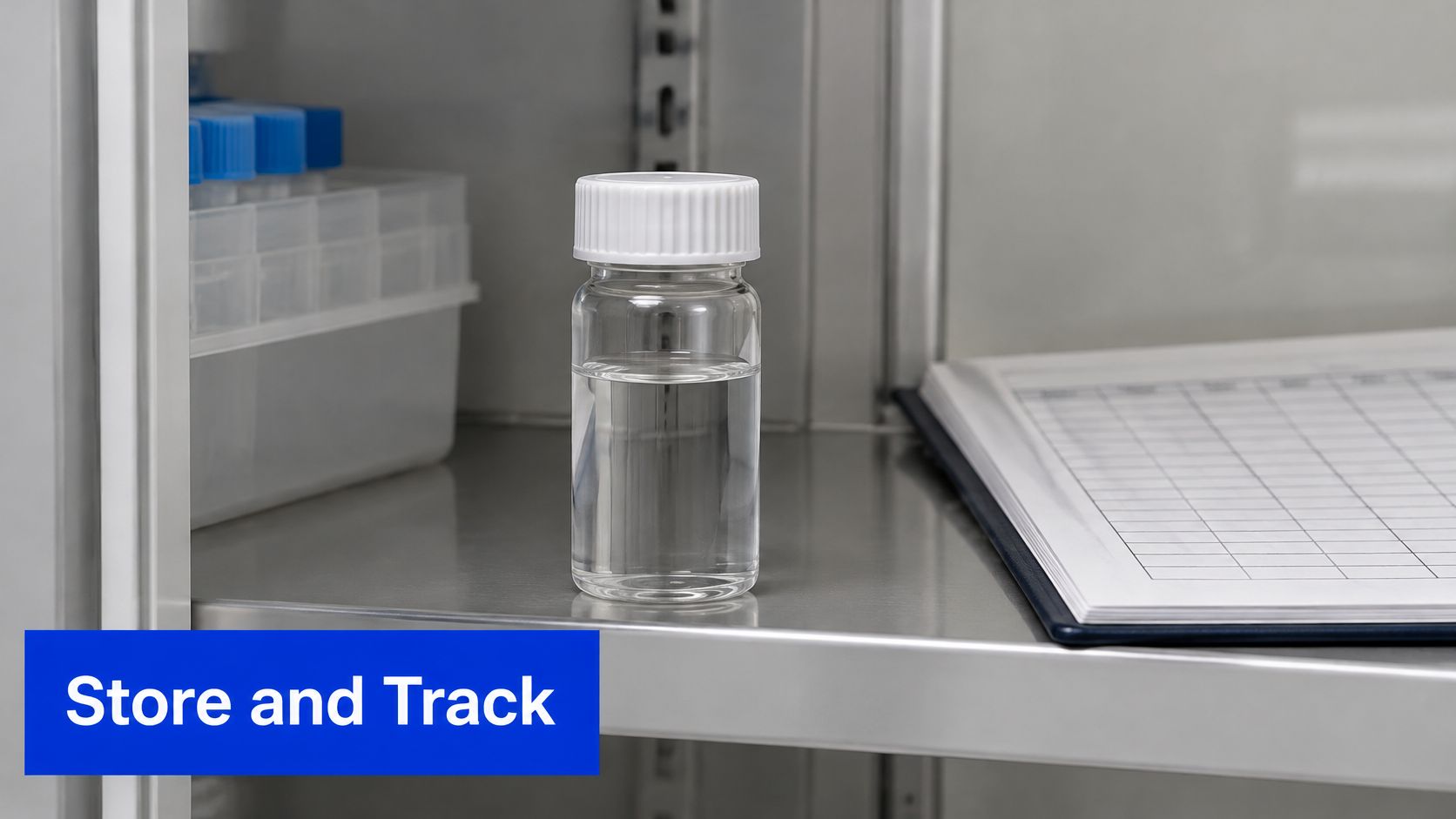
Use the same routine for every order:
A stated storage condition is useful only when the lot documents support it and your log shows that you followed it. If a shipment arrives damaged, unusually warm, or with paperwork for a different lot, quarantine it in your records and ask the supplier to resolve the mismatch. Don't merge that material into an approved inventory record just because the label looks familiar.
Reconstitution, dilution, and administration sit outside what a research supplier can advise on for personal use. A listing that offers those instructions is signaling a different intended purpose and should be treated as a red flag. Keep a simple log for each order so the vial, COA, and storage history still match when questions arise months later.
Order only after the documents answer the questions that matter. Use this short decision path with DSIP for sale listings and with any supplier whose category or paperwork is unclear. A low price can't compensate for an unverified lot or a mismatch between the listing and its documents.
Labels can make unrelated wellness products sound similarly scientific, so the same habit of checking primary documentation is useful even when readers are finding nootropic pouches with Optimal Native or comparing other catalog claims. The format changes, but the discipline doesn't. What is it, who sells it, which lot was tested, and what does each test prove?
Peptide Warehouse USA is a research chemical supplier, and we assist with non-medical, non-clinical questions about product availability, documentation, and order status. That's where we can help you compare catalog information and lot paperwork. Questions about human use, dosing, administration, or clinical outcomes fall outside what a research supplier can answer.
If the documents don't match the listing, don't order. If they do match, explore options with the records in hand and learn more about the exact material before you commit. Buy only when identity, lot traceability, category, contamination reporting, and storage guidance are all answered clearly.
If you're evaluating DSIP for a legitimate laboratory, analytical, or preclinical project, bring your documentation checklist to Peptide Warehouse USA and ask us about availability, lot records, and order status. We'll help you review the non-medical details that a research supplier can confirm, so you can decide from evidence in the paperwork rather than a purity headline.