No products in the cart.



The most popular advice on CJC 1295 Tesamorelin comparisons is also the most misleading. It treats both compounds as interchangeable fat loss peptides and asks which one is stronger. That's the wrong starting question, because the human research behind each one measured a different outcome. One body of work tracked hormone responses. The other tracked visceral fat in a specific disease population. Once you separate those endpoints, the comparison gets clearer, narrower, and much more useful for research decisions.
Grouping CJC-1295 and tesamorelin as general fat loss products hides the main difference between them. Both are growth-hormone-releasing hormone analogues, often shortened to GHRH analogues. They act through the same broad pathway, but they don't carry the same evidence, approval status, or documented outcome.
Tesamorelin's clinical role was defined first by regulation, not by marketing. The U.S. Food and Drug Administration labeling for Egrifta records approval on November 10, 2010, for reducing excess abdominal fat in HIV-infected adults with lipodystrophy. That label summarizes two multicenter, randomized, double-blind, placebo-controlled studies, each with a 26-week main phase and a 26-week extension, and reports placebo-adjusted mean visceral adipose tissue changes of -19.6% in one study and -11.7% in the other.
CJC-1295 has no equivalent approved indication. Its early human work followed healthy adults and measured growth hormone and IGF-1, not CT-scanned fat compartments. That distinction sounds technical, but it determines what a research team can reasonably cite as a precedent endpoint.
| Attribute | CJC-1295 | Tesamorelin |
|---|---|---|
| Drug class | GHRH analogue | GHRH analogue |
| Approved indication | None established | Reduction of excess abdominal fat in HIV-infected adults with lipodystrophy |
| Pivotal human evidence | Two randomized, placebo-controlled ascending-dose trials in healthy adults lasting 28 and 49 days | Two randomized, double-blind, placebo-controlled trials with 26-week main phases and 26-week extensions |
| Primary measured outcome | Growth hormone and IGF-1 response | Visceral adipose tissue measured by CT |
| Route of administration | Subcutaneous injection | Subcutaneous injection |
| Absolute bioavailability | Unknown | Unknown in the pivotal evidence summarized in this comparison |
Read the approved indication row first. It sets the reference point for every other row, because tesamorelin's visceral fat results came from adults with HIV-associated lipodystrophy who met trial criteria. They don't automatically describe total body weight change, generalized fat loss, or muscle gain in a different population.
The evidence row shows a second mismatch. A short ascending-dose study can characterize how long a hormone signal lasts, yet it can't substitute for a longer trial built around an imaging endpoint. Even the shared route of administration doesn't make the research questions interchangeable.
Analyst verdict: CJC-1295 is best described as a hormone-response research model, tesamorelin as a disease-specific visceral fat reference, and neither as a general fat loss product.
That verdict isn't a ranking of quality. It's a statement about fit. A laboratory that needs an endocrine time course and a laboratory that needs a visceral adiposity precedent are solving different problems, even though both compounds enter the growth hormone axis at the GHRH receptor.
The shared pathway explains why these compounds get compared. It also explains why duration drives most of the practical differences in the research, well ahead of receptor target.
CJC-1295 and tesamorelin both enter at step two, at the GHRH receptor. Neither compound is growth hormone itself, and neither one is IGF-1. A reported rise in either hormone describes the axis responding to receptor stimulation. It says nothing on its own about fat, muscle, or tissue repair, which is why a hormone time course and a tissue imaging endpoint cannot be graded on the same scale.
The diagram below maps that sequence before the duration differences are added.
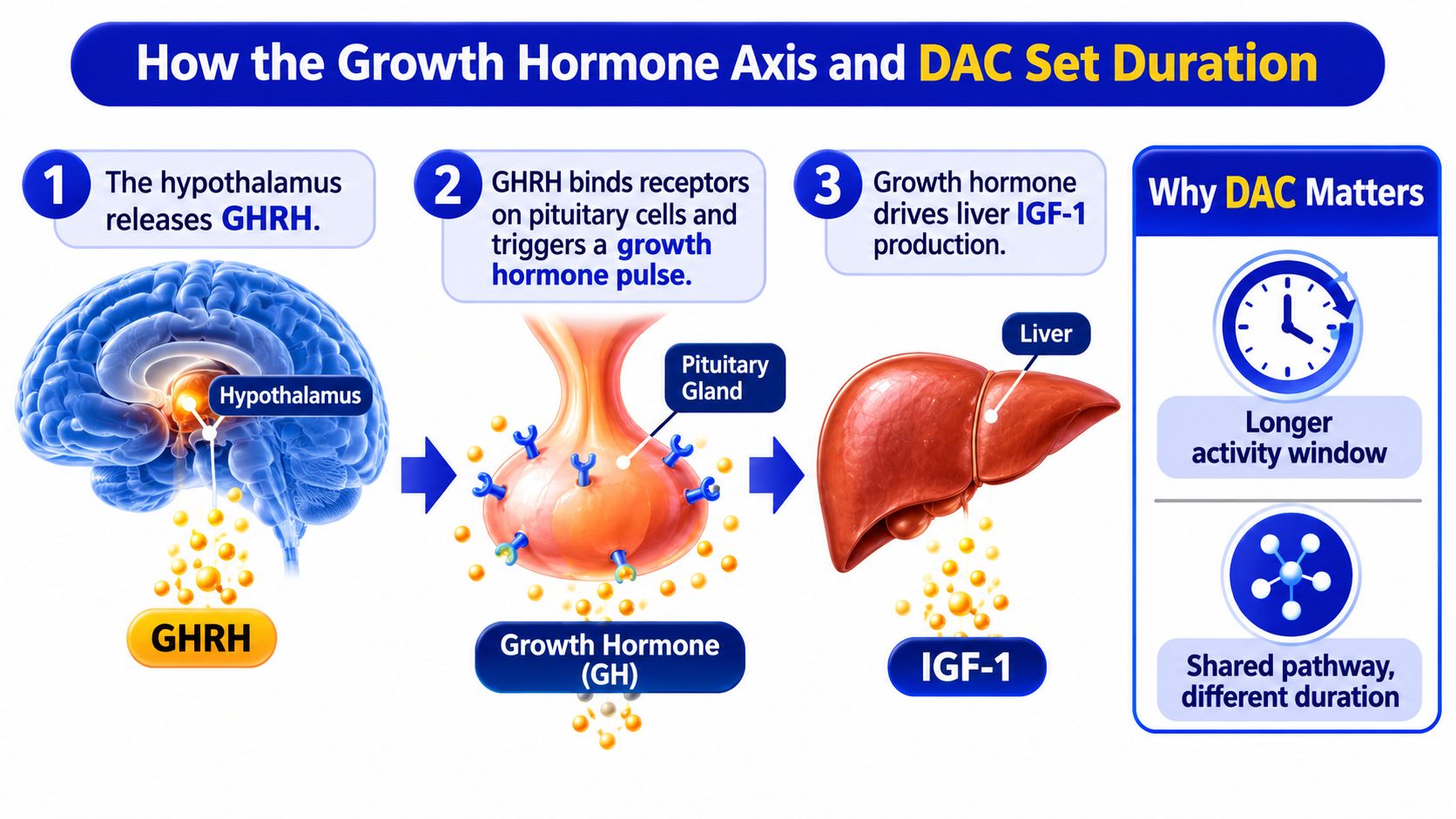
DAC refers to the drug affinity complex used in one form of CJC-1295. That form binds circulating albumin after subcutaneous injection, which slows clearance and extends exposure. The form without DAC lacks that albumin-binding feature and clears faster, so the shared CJC-1295 name can conceal two materially different activity profiles.
A regulatory submission summarizing the 2006 CJC-1295 clinical research describes two randomized, placebo-controlled, double-blind ascending-dose trials lasting 28 and 49 days in adults aged 21 to 61 years. After a single subcutaneous injection, mean plasma growth hormone rose approximately 2-fold to 10-fold for at least 6 days, mean plasma IGF-1 rose approximately 1.5-fold to 3-fold for 9 to 11 days, and the estimated half-life was 5.8 to 8.1 days.
Those figures support prolonged pharmacodynamic activity for the DAC form. They say nothing about the duration of the non-DAC form, and they do not convert a hormone marker into a body composition outcome. A careful reader should not borrow the DAC half-life to describe a product whose molecular form is different.
| Form | Estimated half-life | Duration of response | Human data basis |
|---|---|---|---|
| CJC-1295 with DAC | 5.8 to 8.1 days | Growth hormone elevated at least 6 days; IGF-1 elevated 9 to 11 days | Two small healthy-adult studies of 28 and 49 days |
| CJC-1295 without DAC | Not established | Not established | Not established in human studies |
| Tesamorelin (labeled product) | Not stated | Not stated | Two pivotal trials with 26-week main phases and 26-week extensions |
An effect that persists between injections changes study design. Sampling schedules, washout assumptions, and interpretation of later measurements all depend on whether the signal from an earlier exposure has cleared. In the same ascending-dose research, repeated dosing kept mean IGF-1 above baseline across the dosing periods, which points to possible accumulation rather than a clean return to baseline between exposures.
That matters because IGF-1 sits downstream. It confirms that the GH axis responded, and it lets researchers compare the timing and magnitude of that response under controlled conditions. It is not proof of fat loss, muscle gain, healing, or any other clinical endpoint, because the studies that tracked it were not designed to measure those outcomes. Tesamorelin's key trials were built around a measured tissue outcome instead, so the two compounds produce different categories of evidence rather than stronger and weaker versions of the same one.
Check three things before accepting any duration claim: which node in the axis was measured, over what time window, and in which population.
Do not infer the non-DAC duration from the DAC numbers. If a supplier lists CJC-1295, the form should be named explicitly and supported with batch-specific documentation, so the molecule in hand matches the pharmacokinetic description used to design the work.
The common comparison error is grading both compounds on fat loss. Tesamorelin has quantifiable adiposity outcomes, bounded by the population that produced them. CJC-1295 has a clearer endocrine exposure model, without a validated body composition endpoint. Those are different kinds of evidence.
The New England Journal of Medicine randomized trial of tesamorelin in adults with HIV and excess abdominal fat enrolled 412 participants and tested 2 mg of tesamorelin subcutaneously once daily for 26 weeks. Visceral adipose tissue fell by 15.2% with tesamorelin while it rose by 5.0% with placebo, and triglycerides fell by 50 mg/dL compared with a 9 mg/dL rise on placebo.
Later randomized-trial syntheses point in the same direction qualitatively: reductions were reported across visceral, trunk and hepatic fat, along with waist circumference. The headline is compartmental. Abdominal and visceral depots move more clearly than whole-body weight.
That makes the measurement method part of the result. CT can isolate visceral adipose tissue, while DEXA partitions regional fat and lean mass; services such as DEXA body composition testing in Liverpool show how those compartment reports are typically separated. A change in one compartment still does not describe every compartment.
The Journal of Clinical Endocrinology and Metabolism study of CJC-1295 in healthy adults reported particularly favorable tolerability at 30 to 60 μg/kg in two randomized, placebo-controlled, dose-escalation studies. Its documented endpoints were growth hormone and IGF-1 responses after subcutaneous administration, which support CJC-1295 primarily as a long-acting GH and IGF-1 stimulation model rather than as a validated fat loss or body composition intervention.
That evidence base remains small and was built in healthy adults, not broad clinical populations. It can justify measuring endocrine exposure over time. It cannot support a claim that visceral fat, trunk fat or body weight changed by a particular amount, because those were not the established endpoints.
Reading rule: For CJC-1295, ask whether the study measured a hormone or an outcome. For tesamorelin, ask whether the study population matches the one being modeled.
When people discuss the benefits of peptides in this category, that rule keeps the language honest. A hormone rise can be a real pharmacodynamic finding without becoming a clinical benefit, and a visceral fat reduction can be a real trial outcome without becoming a general weight loss claim. Endpoint and population travel together.
A clean short-term tolerability report tells a laboratory very little about repeated or prolonged exposure. The harder question is what a brief trial cannot detect, especially when compounds acting on the same axis are combined.
CJC-1295's human safety database is limited by design. A review of peptides for muscle growth summarizing the CJC-1295 and tesamorelin safety records notes that CJC-1295 human trials lasted only about 28 to 49 days and were primarily pharmacokinetic and pharmacodynamic studies. FDA briefing materials on that early work described transient injection-site reactions as common. Injection-site findings matter for protocol feasibility, but a study built to measure hormone curves over several weeks is neither powered nor prolonged enough to rule out slower endocrine or metabolic effects.
The same review notes a phase 2 study in 192 people with HIV-associated lipodystrophy in which one myocardial infarction death occurred, without establishing causation. That single event should not be turned into a causal claim. It also cannot clear the compound, because an unresolved event in a limited database is a reason for caution in interpretation, not certainty in either direction.
Tesamorelin's prescribing information raises monitoring issues that consumer comparisons often omit: high IGF-1, fluid-retention effects, glucose intolerance or worsening glycemic control, and contraindication concerns involving active malignancy and certain pituitary disorders. Those items reflect a labeled drug's regulatory framework, where monitoring expectations are written down rather than left to informal practice.
No cited randomized evidence shows that CJC-1295 plus tesamorelin is safer or more effective than either agent alone, and no long-term trial establishes an appropriate combined or alternating regimen for healthy adults. Because both compounds act on the same axis, combined exposure raises questions that separate short studies cannot answer.
Before any protocol is finalized, a research team should be able to answer three design questions. Which baseline measures were recorded? How were IGF-1 and glucose tracked over time? What predefined endpoint would trigger a stop? These are research governance questions, not individualized dosing guidance, and they belong in the protocol before exposure begins rather than after a signal appears.
The images researchers work from often look simple, such as a hormone curve rising and falling on a screen.

Say a lab is modeling growth hormone and IGF-1 time courses in a healthy-subject design, and the team needs a long activity window so it can sample the response across several days. CJC-1295 with DAC is the documented fit for that job, because its human research characterized sustained endocrine measurement. The deliverable is a time course, not a claim about adiposity.
Now say a metabolic team is studying visceral adipose tissue in an HIV-associated lipodystrophy model, and it needs a precedent with CT-measured endpoints and a rigorous trial design. Tesamorelin provides the stronger reference there. Its value to that team lies in the imaging outcome and the defined population, not in a general statement about body weight.
A third lab might want to compare two GHRH analogues at the same receptor. Using both compounds as research tools could help separate receptor-level stimulation from downstream markers such as IGF-1, provided the protocol defines which signal counts as the primary readout. Without that discipline, the team risks collecting overlapping hormone data and calling it an outcome comparison.
A fourth group might start with body weight, muscle growth, or healing as the desired endpoint. That's where the honest answer is uncomfortable. The research summarized here doesn't support either compound for those endpoints, so the study question should change before the compound does. Choosing a different vial won't repair a mismatch between the endpoint and the precedent literature.
The video below is useful as general background on how researchers discuss growth hormone axis compounds, but it doesn't replace endpoint-specific documentation.
Choose the compound that matches an endpoint you can measure. That's a narrower rule than most product pages use, but it's the one that keeps a protocol defensible.
No. Both are GHRH analogues, but tesamorelin carries an FDA approval for reducing excess abdominal fat in HIV-infected adults with lipodystrophy. CJC-1295 has no established approved indication.
The DAC form showed prolonged activity in small healthy-adult studies, consistent with albumin binding and slower clearance. The duration of the non-DAC form is not established, so it should not be estimated from the DAC profile.
No randomized evidence in the available material shows that combining CJC-1295 and tesamorelin is safer or more effective than either compound alone. A shared receptor pathway isn't, by itself, a safety rationale.
No. IGF-1 is a downstream hormone marker that confirms the growth hormone axis responded. It doesn't establish a change in visceral fat, total body fat, or body weight.
Tesamorelin's approval covers its labeled indication only, and CJC-1295 has no approved use. Questions about any human use belong with qualified clinicians and applicable regulators, not with a product comparison page.
Match the compound to the endpoint and to its documentation, not to a marketing label. That decision comes before price, package size, or product naming, because a well-documented material for the wrong endpoint still produces an indefensible protocol.
Fix the study question first. Then choose the compound whose precedent research measured something your team can also measure, whether that's an endocrine time course, a CT-based visceral fat endpoint, or a receptor-level comparison. If the endpoint can't be named in one sentence, the order isn't ready yet.
The FDA materials summarizing CJC-1295 phase 1 work and tesamorelin's regulatory context describe transient injection-site reactions, including pain, swelling, induration, and occasional local urticaria, as the most frequently reported events in the early CJC-1295 trials and report no serious adverse reactions in those phase 1 studies. They also reinforce that tesamorelin's evidence comes from defined clinical trials and a prescription-drug labeling framework, not from broad consumer supplementation research.
That regulatory separation should shape product language. Descriptions shouldn't imply that research peptides are approved for human consumption, routine fat loss, muscle gain, healing, or antiaging. We work with established manufacturing partners and third-party laboratories to ensure our products meet defined purity and identity specifications, and we provide high-purity research peptides backed by third-party testing, including COAs, endotoxin, and microbial reports.
For reference, our TESAMORELIN research material is priced at $74.99, but price only becomes relevant after identity and documentation check out. Learn more by reviewing the research catalog against the checklist above, then explore options that match your endpoint and your paperwork requirements. These compounds are for laboratory research only and not for human use, and human-use questions belong with qualified clinicians and regulators.
If your protocol calls for a GHRH analogue with batch-level documentation behind it, Peptide Warehouse USA offers research peptides supported by certificates of analysis and third-party endotoxin and microbial testing. Visit the catalog, compare the documentation for CJC-1295 and tesamorelin materials against the checklist in this article, and order only the compound whose identity and paperwork match the endpoint you've defined.