No products in the cart.


The familiar advice to combine growth-hormone peptides for a stronger response skips the question that matters most: has the exact combination been tested? CJC 1295 DAC with ipamorelin pairs compounds with very different exposure timelines. Human findings for either ingredient don't establish how a blended product behaves, whether it improves a meaningful outcome, or what risks emerge when both are administered together.
CJC-1295 DAC and ipamorelin compared on the criteria that matter
| Attribute | CJC-1295 DAC | Ipamorelin | The Pairing |
|---|---|---|---|
| Role on the growth hormone axis | GHRH analogue with a long-acting DAC modification | Growth hormone secretagogue acting as a short pulse | Two signals acting on the same axis |
| Human half-life | Estimated 5.8 to 8.1 days | Measured in hours, not days | Not established |
| Growth-hormone response | 2 to 10-fold rise lasting at least 6 days | A single brief burst | Not established |
| Human evidence base | Two randomized, placebo-controlled studies lasting 28 and 49 days, in adults aged 21 to 61 | A small early-phase dose-escalation study | No controlled combination study identified |
| US regulatory status | FDA Category 2, September 2023 | FDA Category 2, September 2023 | No FDA-approved finished drug identified |
The pairing is often sold as complementary: one compound extends the signal, the other adds a pulse. The table shows where that framing ends. Each ingredient has human data behind it. The combination does not.
The CJC-1295 timing and study details above come from the human-study report included in FDA briefing materials, which describes the individual compound rather than the pairing. Ipamorelin's human data describe a much shorter exposure window and a concentration-related growth-hormone response, the basis for the short-pulse characterization in the table.
The regulatory classifications in the table are documented in the US regulatory history of CJC-1295 and ipamorelin. Those classifications flag potential safety issues in compounding; they do not confer approval.
The shorthand for the pairing is a sustained signal plus a short pulse. CJC-1295 DAC remains available over a prolonged period, while ipamorelin produces a comparatively brief release pattern.
That contrast explains the research interest. It does not predict the combined response. Researchers cannot add the individual half-lives, hormone increases, or response durations and treat the arithmetic as a measured property of a blend. A combination has its own absorption, distribution, and elimination profile, and no published study has characterized one for these two compounds together.
Evidence rule: A study of an ingredient supports conclusions about that ingredient under the tested conditions. It does not automatically validate a product containing that ingredient alongside another active compound.
The same logic applies when comparing product listings. A shared product name does not confirm the same chemical form, concentration, route, or analytical quality as a published experiment.
Before interpreting any claim about the benefits of peptides, identify what investigators administered. A combined product needs evidence that matches both components and their formulation, not references to studies that happen to contain familiar names.
The DAC modification is designed to extend exposure through albumin binding. Albumin acts as a circulating carrier, allowing CJC-1295 DAC to remain available much longer than a short-acting peptide.
Think of a delivery vehicle that stays on a slow circulating route instead of making one immediate stop and leaving. The analogy explains persistence, not a controlled-release schedule: albumin binding doesn't mean researchers can assume a fixed amount of hormone stimulation at every moment.
The laboratory context is prolonged exposure and its downstream measurements.
The randomized, placebo-controlled, double-blind ascending-dose studies measured growth hormone and IGF-1, not a validated package of body-composition or anti-aging benefits. Their growth-hormone findings are summarized in the comparison table.
In those studies, a single subcutaneous administration increased mean IGF-1 approximately 1.5 to 3-fold for 9 to 11 days; after repeated administration, IGF-1 remained above baseline for as long as 28 days, according to the human-study report cited with the table. These findings describe CJC-1295 DAC alone, not its combination with ipamorelin.
The distinction between a compound's half-life and its downstream effects is important. Half-life describes the decline in compound concentration, while a hormone measurement describes a biological response. Neither establishes how long a person would experience a claimed benefit.
A prolonged laboratory response can be useful for studying endocrine regulation. It doesn't establish that longer stimulation produces better fat loss, muscle growth, healing, sleep, or aging-related outcomes.
To answer a muscle-growth question, investigators need relevant body-composition or functional measurements. To answer a healing question, they need a defined injury or repair outcome. A hormone increase alone answers neither.
These categories shouldn't be substituted for one another. A pronounced biomarker response may justify further investigation without establishing a useful treatment.
The practical consequence is methodological: redosing intervals and washout windows can't be borrowed from short-acting products. Researchers need an interval justified by the long-acting preparation and the intended measurement, rather than by the convenience of a commonly circulated peptide schedule.
The rationale starts at the pituitary. CJC-1295 DAC acts through the growth-hormone-releasing hormone receptor pathway, while ipamorelin acts through the ghrelin receptor pathway. Researchers are interested in whether stimulating these different receiving systems changes the magnitude or timing of downstream growth-hormone release.
That is a reasonable hypothesis. It isn't the same as demonstrating synergy, improved clinical outcomes, or an acceptable safety profile for a particular blend.
The pathway relationship and the evidence gap are separate parts of the question.
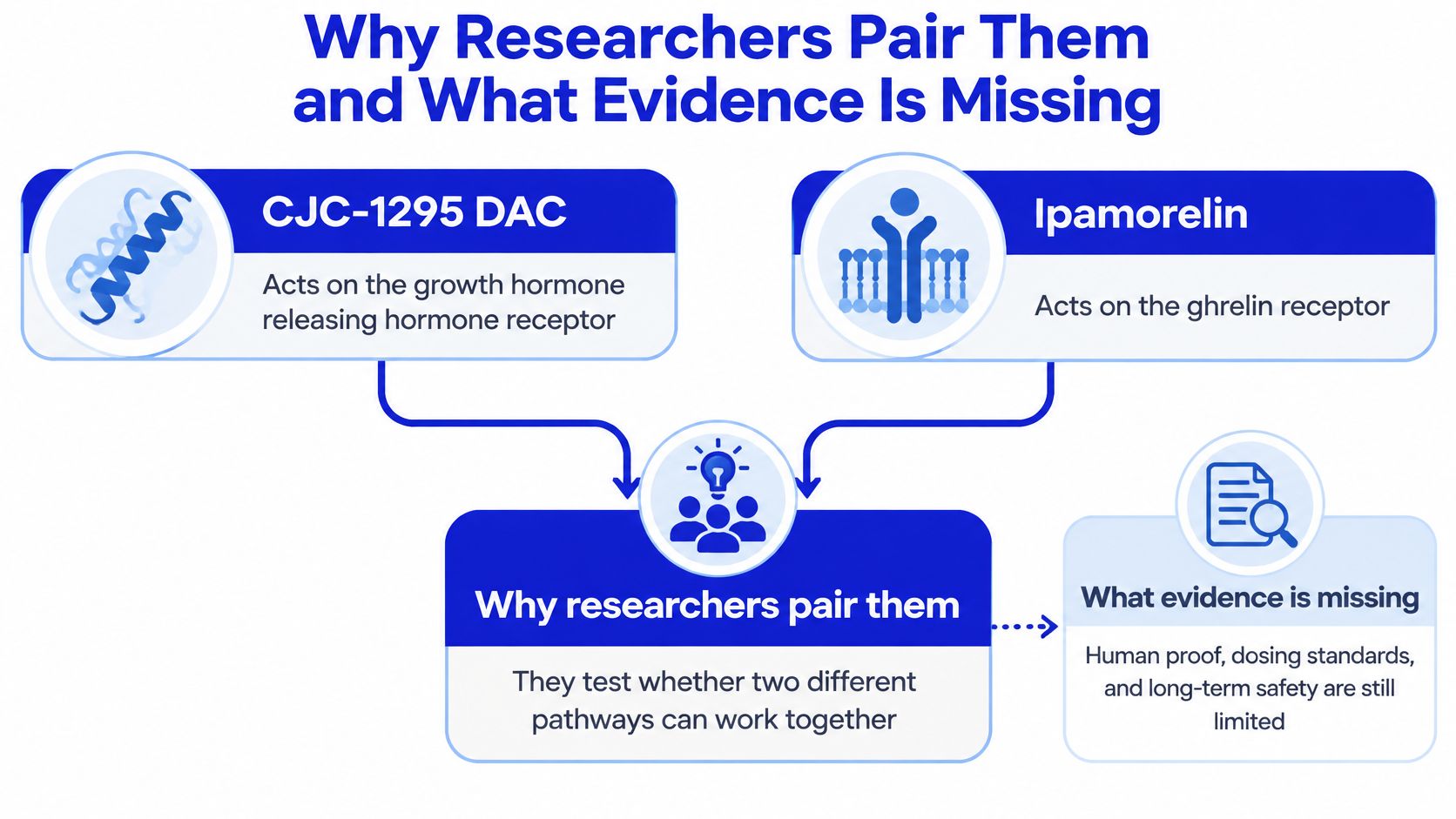
The foundational controlled human evidence concerns CJC-1295 DAC administered alone. The clinical record also includes a terminated CJC-1295 trial in people with HIV-associated visceral obesity, rather than an established therapeutic indication, as discussed in ABC's coverage of unapproved peptide prescribing and regulatory concerns.
Ipamorelin's Phase 1 findings concern a short-term hormone response in healthy men. The dose-group design summarized in the comparison table doesn't establish the safety or effectiveness of adding it to sustained DAC exposure.
The word synergy needs particular care. It describes an interaction exceeding an explicitly defined expectation, not the presence of different receptor pathways. Without an appropriate comparison, a larger response could reflect ordinary addition, a different exposure pattern, or another influence.
Two active ingredients on the same label don't create a new clinical evidence base.
A meaningful investigation would separate component effects from interaction effects. Its protocol should include:
If the intended claim concerns fat loss or repair, the study must measure that outcome directly. A study designed only around growth-hormone release can't support a different claim merely because the proposed mechanism sounds relevant.
For an accompanying discussion, keep the same distinction between pathway explanations and clinical proof in mind.
The defensible conclusion is narrow: the pairing has a pharmacological rationale, but its clinical performance remains unestablished. It belongs in investigational research, not in confident claims about superior physique, recovery, or anti-aging results.
A research-use-only label isn't evidence of human approval, validated dosing, or proven benefit. It identifies a use boundary; it doesn't replace the evidence and regulatory review required for an approved medicine.
The dated sequence below records the relevant US review history. The Category 2 classifications were associated with potential safety concerns, while the committee actions addressed proposed inclusion in a compounding framework.
Dated FDA actions affecting CJC-1295 and ipamorelin
| Date | FDA action or review | Reported outcome |
|---|---|---|
| September 2023 | Interim Category 2 compounding framework | Both compounds listed; classification associated with potential safety concerns, not approval |
| October 29, 2024 | Pharmacy Compounding Advisory Committee review of ipamorelin | Vote of 0 in favor, 12 opposed, 1 abstention on inclusion on the Section 503A bulk-drug list |
| December 4, 2024 | Committee review of five CJC-1295 forms | Adverse recommendations for free base, acetate, DAC free base, DAC acetate, and DAC trifluoroacetate |
| Current status in the cited record | Research-use-only sales | No FDA-approved finished drug containing CJC-1295 DAC, ipamorelin, or their combination identified |
The actions and outcomes are recorded in the regulatory history linked with the comparison table. The FDA's CJC-1295 briefing materials also describe limited evidence and concerns relevant to possible compounding.
An advisory recommendation isn't equivalent to a finished-drug approval decision. Likewise, discussion of a substance for compounding doesn't establish that every preparation containing it has a validated formulation or therapeutic use.
The reasons for concern matter more than a reassuring label. FDA materials identify limited clinical safety information, possible immune reactions, peptide-related impurities, and challenges in characterizing the active material.
These are distinct questions. Investigators must consider both the biological effects of the intended peptide and the characteristics of the actual preparation supplied.
A useful assessment separates:
Documentation in one category doesn't settle the others. A certificate of analysis doesn't establish clinical efficacy, and a human study of a different preparation doesn't establish the quality of a supplier's current lot.
Readers evaluating weight-loss, body-composition, repair, or anti-aging claims should therefore ask what supports the specific statement. The combination remains an investigational research subject, not an FDA-approved treatment for those purposes.
Redosing before earlier DAC exposure has declined can produce accumulation. A research design therefore needs explicit washout windows and a documented rationale for each interval, rather than a schedule copied from a short-acting or No DAC product.
Adding ipamorelin introduces another active influence on the same endocrine axis. Without direct combination data, researchers shouldn't assume that the resulting exposure or safety profile follows predictably from either component alone.
Short-term healthy-volunteer studies reported generally favorable tolerability, but that finding doesn't resolve broader safety questions. FDA briefing materials on CJC-1295 identify increased heart rate and systemic vasodilatory reactions, and describe a 12-week trial in 192 people with HIV in which one participant died from myocardial infarction.
Those observations do not prove causation. They do make an unqualified description such as safe peptide inadequate, particularly when the proposed product is an untested combination.
Monitoring should be specified before enrollment, including who reviews abnormal results and what triggers reassessment. The table describes research-design considerations, not a validated clinical protocol or permission for self-administration.
Monitoring items for a research protocol involving CJC-1295 DAC
| Item | Timing | Reason tracked |
|---|---|---|
| IGF-1 | Baseline and follow-up | Tracks sustained endocrine stimulation associated with DAC exposure |
| Fasting glucose or HbA1c | Baseline and follow-up | Captures glycemic change; clinician oversight required for people with diabetes |
| Blood pressure and heart rate | Each visit | Heart-rate increase is flagged in FDA materials |
| Edema, headaches, injection-site reactions, sleep symptoms | Ongoing symptom log | Records effects against the administration timeline |
| Clinician oversight | Before enrollment | Necessary for protocols involving diabetes, cardiovascular disease, cancer risk, or pituitary disorders |
A qualified clinical team must determine assessment intervals and oversight triggers within an appropriately authorized human-study protocol. Laboratory research materials aren't made suitable for human use by adding a monitoring checklist.
For laboratory handling, use a traceable sequence:
These are documentation controls, not evidence of a particular shelf life. Don't assign a storage duration or reconstituted-use window unless material-specific stability evidence supports it.
Quality boundary: A purity percentage alone doesn't establish identity, stability, absence of relevant contaminants, or safety for a proposed route.
Compare the material to the study requirements before comparing prices. A listing can contain familiar peptide names while differing in chemical form, formulation, analytical support, or intended use.
The first procurement decision is whether the paperwork identifies the exact material the experiment requires. The checklist below separates that question from broader claims about product quality.
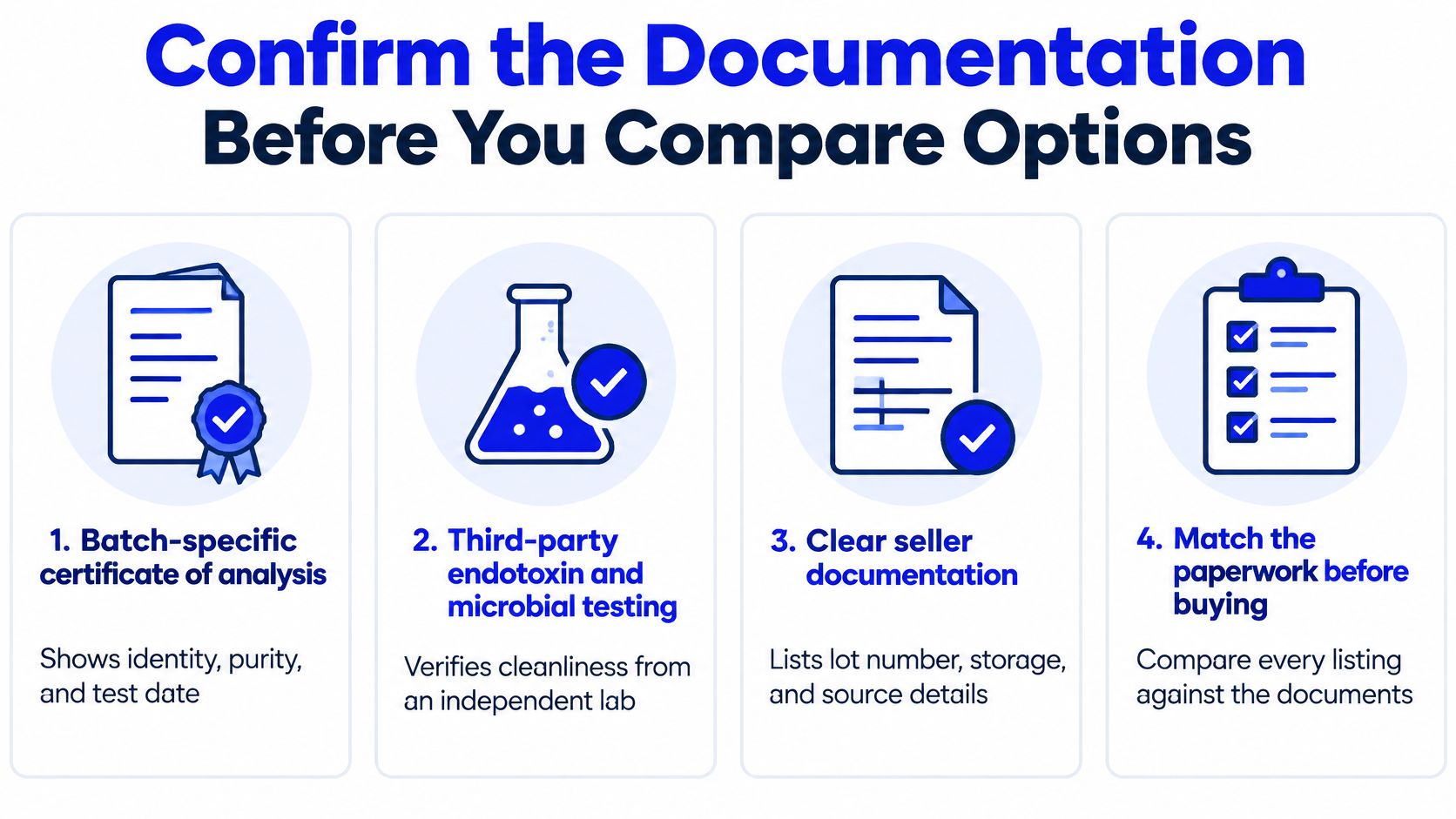
Authenticity checks are also product-specific. Dream Body Clinic's resource on checking Genotropin HGH authenticity concerns a different product category; it isn't a validation method for a CJC-1295 peptide blend.
At Peptide Warehouse USA, we provide high-purity research peptides backed by third-party testing, including COAs, endotoxin, and microbial reports. We're a research chemical supplier, not a compounding pharmacy or compounding facility under Section 503A, nor an outsourcing facility under Section 503B of the Federal Food, Drug, and Cosmetic Act.
Our listed CJC 1295 (No Dac) + IPAMORELIN is $69.99. This is the No DAC version, a different molecule, not the DAC product discussed in the long-acting human studies; DAC-specific documentation and evidence don't transfer to it.
Our support team assists with non-medical, non-clinical questions about documentation, availability, and order status. Learn more about the lot-specific documentation before ordering.
No controlled combination study has established a validated dose, dosing interval, or washout period. The experimental-design considerations explain why this article doesn't provide a dosing schedule.
No. The label doesn't establish FDA approval, validated dosing, or clinical benefit; the regulatory discussion distinguishes those questions from research-use sales.
No. A different molecule needs its own evidence and matching documentation, so the procurement checklist starts with exact chemical identity rather than a shortened product name.
Human studies of CJC-1295 DAC found hormone changes lasting days, but compound persistence and downstream activity aren't identical measurements. The timing explanation distinguishes those findings, which don't establish a combination redosing interval.
Confirm the exact chemical form required by the experiment, then match its lot number to the analytical documents. Use the documentation checklist to assess identity, testing methods, handling information, and supplier status before making a purchasing decision.
Peptide Warehouse USA offers research peptides with third-party COAs, endotoxin reports, and microbial reports for documentation-focused procurement. Visit Peptide Warehouse USA to review the No DAC CJC 1295 with ipamorelin offer and confirm that its identity and lot documentation match your laboratory requirements before ordering.