No products in the cart.



An amino acid is an individual molecular building block, while a peptide is a chain of 2 to 50 amino acids linked together. That difference determines how a compound behaves in synthesis, analysis, purification, and biological research.
Why does a small change in an amino-acid sequence sometimes produce a completely different peptide? The answer starts with structure, but it ends with practical decisions: which reagent to order, which synthesis method to expect, what quality documents to request, and how confidently you can interpret an experimental result.
Researchers often encounter terms such as dipeptide, tripeptide, oligopeptide, and polypeptide in the same catalog or paper. These labels aren't interchangeable. A clear understanding of the amino acid and peptide relationship helps prevent mistakes in sequence interpretation, specification review, and reagent selection.
What should a researcher check first when a catalog lists a dipeptide beside a longer peptide? Start with the molecular units and how they are connected. An amino acid is one unit. A peptide is an ordered chain of amino acids joined through peptide bonds. That distinction affects how you interpret a specification and what you should expect from synthesis, purification, and analysis.
Each amino acid has a central carbon attached to an amino group, a carboxyl group, a hydrogen atom, and a variable side chain. The side chain supplies much of the molecule's chemical character. It can affect charge, polarity, hydrophobicity, steric bulk, solvent behavior, and interactions with a target molecule. For reagent selection, those differences can influence which building blocks, protection strategies, and purification conditions are appropriate.
Twenty common proteinogenic amino acids provide the standard vocabulary for ribosomal protein synthesis. Their identification was gradual. Asparagine was identified in 1806, cystine in 1810, glycine and leucine in 1820, and threonine in 1935, the last of the 20 common amino acids to be discovered. The term “amino acid” entered English in 1898. In 1902, Emil Fischer and Franz Hofmeister independently proposed that proteins consist of amino acids joined by peptide bonds. These milestones appear in the historical overview of amino acids.
Names such as dipeptide, tripeptide, oligopeptide, and polypeptide describe chain length, but they should not replace review of the full product specification. A dipeptide contains two amino acids, and a tripeptide contains three. Britannica applies the same count-based logic to an octapeptide, which contains eight amino acids. The National Human Genome Research Institute definition of a peptide describes peptides as short amino-acid chains typically containing 2 to 50 amino acids.
Longer chains are commonly called polypeptides. The NCBI Bookshelf explanation of peptide structure presents this as a practical convention rather than a strict rule for biological function. In a laboratory, the convention helps organize catalog entries and compare materials, while the exact sequence and specification determine what compound you are ordering.
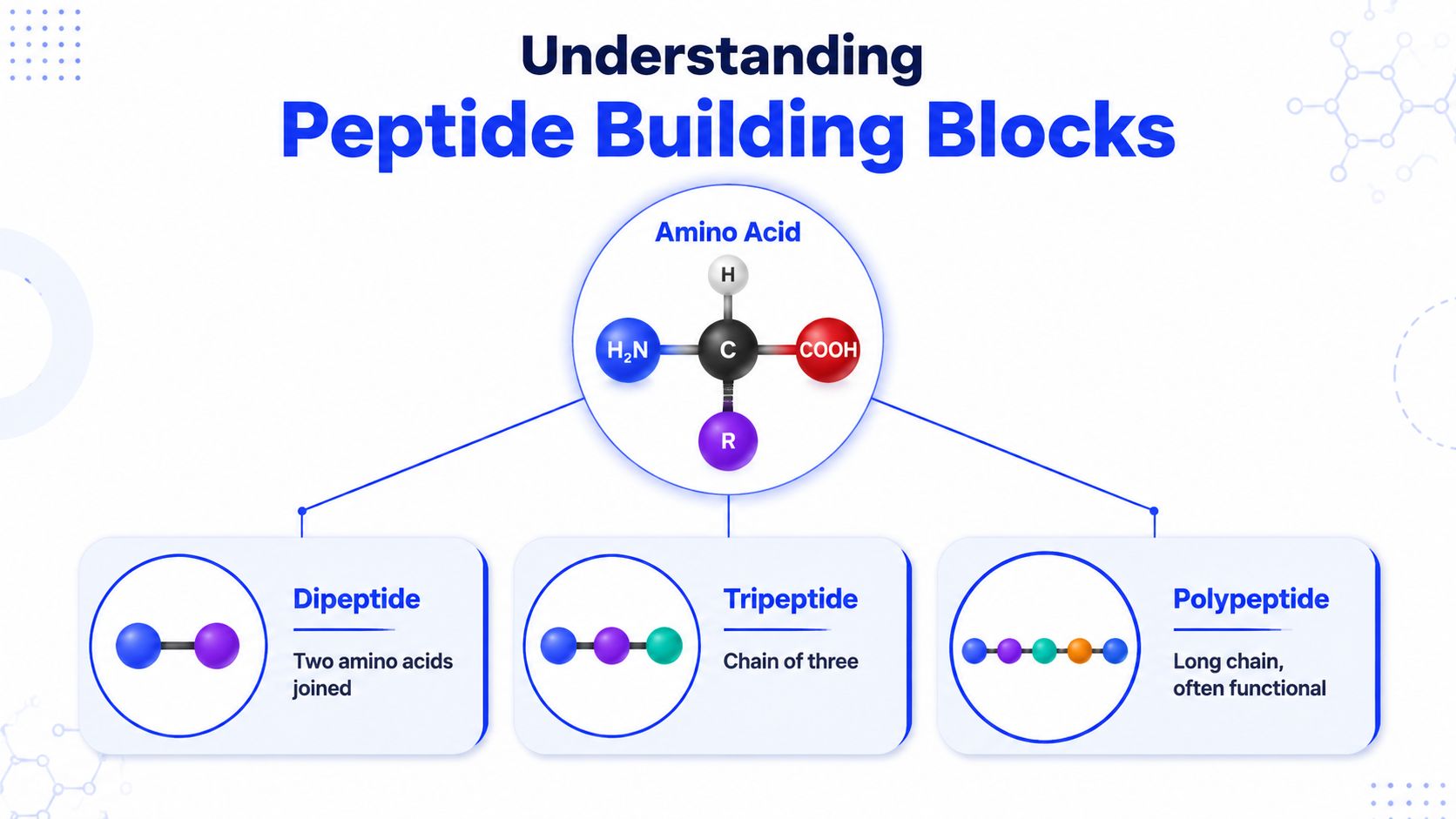
A peptide is identified by more than its ingredient list. Sequence order changes the molecular surface, charge distribution, and preferred three-dimensional arrangements. The same amino acids in a different order can therefore require a different synthesis plan and produce different experimental behavior.
Sequence diversity grows quickly, even for short chains. A cited industry educational source states that 3.2 million different pentapeptides can be formed from the 20 proteinogenic amino acids, as summarized in the NHGRI definition. For reagent selection, record the exact sequence, stereochemistry, terminal groups, modifications, and purity requirement. A general product name cannot provide those details.
Practical rule: Treat the sequence, not just the product name, as the identity of a research peptide.
A peptide bond forms when the carboxyl group of one amino acid reacts with the amino group of another. The reaction is a condensation process, meaning the linkage forms as part of a reaction that removes the elements of water. The resulting chain has directionality, with an amino terminus and a carboxyl terminus.
That direction is important. A sequence written from the amino terminus to the carboxyl terminus isn't equivalent to the same residues written in reverse order. In a synthesis record, an apparently minor transcription error can therefore describe a different compound rather than a slightly different version of the intended one.
The peptide bond isn't a freely rotating single bond. The NCBI Bookshelf discussion of peptide structure explains that the bond formed in the ribosome has partial double-bond character, which makes it relatively rigid and planar and restricts rotation between the carbonyl carbon and nitrogen.
Think of the peptide bond as a stiff hinge rather than a loose connector. The bonds around the alpha carbon still allow conformational movement, but the peptide bond itself limits how the backbone can bend. That constraint influences secondary structure, local folding, receptor presentation, and the way a sequence exposes or shields side chains.
A researcher doesn't need to calculate every backbone angle to use this concept. The important point is that amino-acid identity and position work together. Replacing a residue can alter charge, hydrophobic contacts, steric fit, conformational preference, or susceptibility to enzymatic cleavage.
A dipeptide has only two residues, but it already has an ordered backbone and two termini. Adding another residue creates a tripeptide with new sequence possibilities and a different balance of chemical groups. As chains become longer, the number of possible arrangements increases while purification and characterization become more demanding.
The distinction between peptide and polypeptide is therefore useful in both literature and procurement. Short chains may be selected for binding studies, standards, labels, or method development. Longer constructs may require closer attention to aggregation, incomplete coupling products, folding behavior, and analytical confirmation.
| Structural feature | Laboratory implication |
|---|---|
| Individual amino acid | A building block, standard, or synthesis input |
| Dipeptide or tripeptide | Short defined sequence with two or three residues |
| Peptide of 2 to 50 residues | A widely used working category for short chains |
| Longer polypeptide | Greater sequence length and more complex characterization needs |
The chemistry also explains why a product's biological behavior can't be inferred from a single residue or a general category such as “amino-acid based.” The complete sequence, configuration, termini, and modifications determine what the molecule presents to its environment.
How does a peptide move from a biological sequence to a usable laboratory reagent? Cells and synthesis instruments answer that question differently. Ribosomes read messenger RNA, connect amino acids in a defined order, and produce a chain that may then fold or undergo further processing.
For many research peptides, laboratories instead use solid-phase peptide synthesis, or SPPS. The growing chain stays attached to an insoluble resin while amino acids are added one at a time. Each cycle protects the incoming building block, removes the relevant protecting group, forms the next peptide bond, and prepares the chain for another cycle.
Keeping the intermediate on the resin changes the practical workflow. After each coupling, the resin can be washed, removing excess reagents and soluble byproducts without isolating the growing peptide. SPPS also permits molecular designs that a straightforward biological expression system may not produce efficiently.
The Royal Society of Chemistry review of peptide synthesis describes SPPS as a central platform for established and emerging peptide-manufacturing workflows. The method can accommodate post-translational modifications, fluorescent labels, and linkers, and it can be combined with solution-phase, liquid-phase, or catalytic approaches when a sequence creates particular difficulties.
A practical synthesis plan must account for:
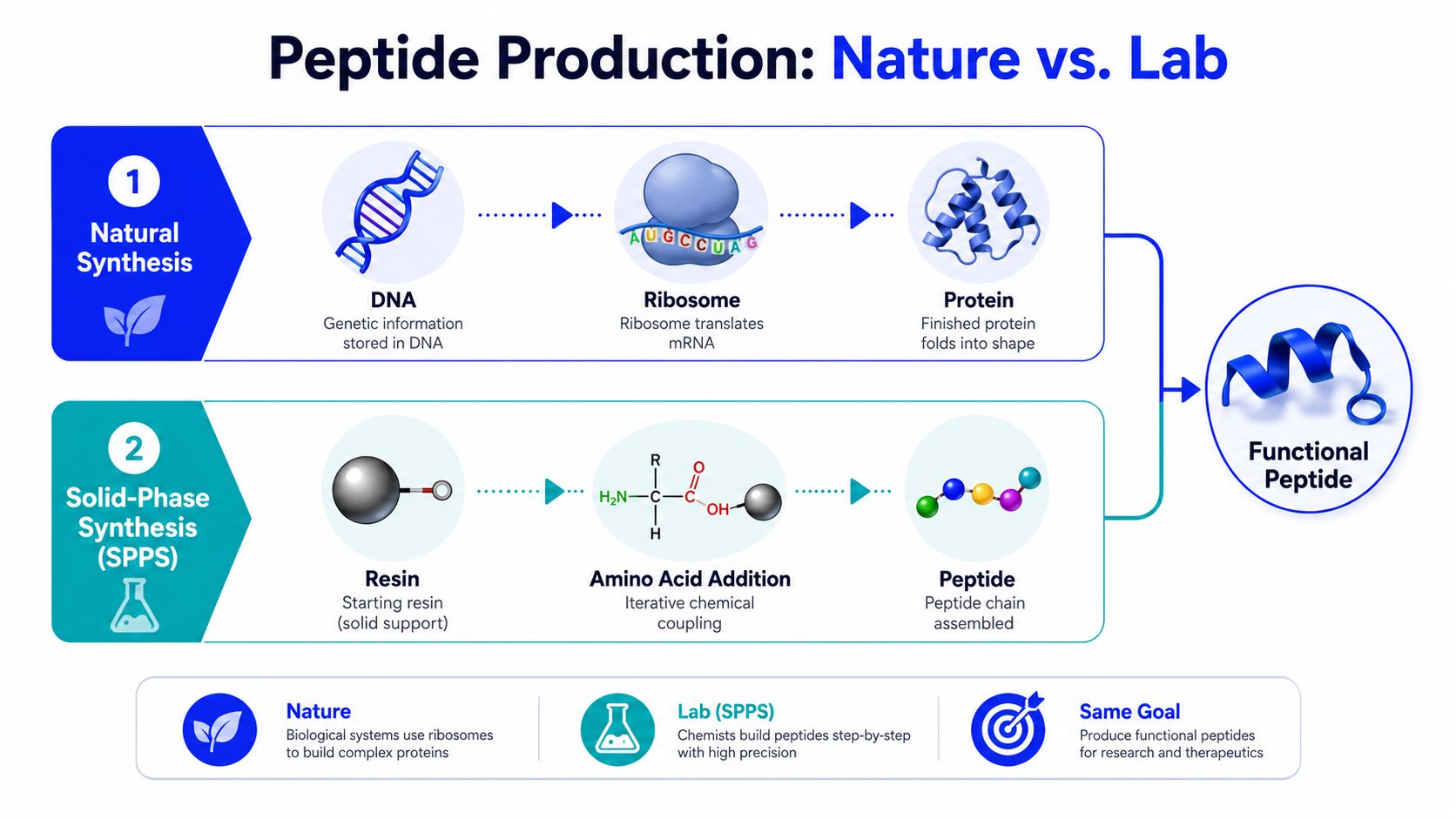
A supplier's stated synthesis method provides useful context, yet analytical data remains necessary. A difficult sequence may call for adjusted coupling conditions, alternative protecting groups, another resin, or extra purification. The review notes that high-purity production depends on sequence-specific choices rather than one universal recipe.
Before selecting a reagent, check for unusual residues, terminal modifications, fluorescent groups, linkers, or a sequence likely to aggregate. These features can affect yield, purification, storage, and how chromatographic results should be interpreted.
A clean synthesis record begins with a precise molecular specification. “Same family” isn't the same as “same sequence.”
Why can two peptides with nearly identical sequences produce different stability results? A small change in stereochemistry, topology, or terminal chemistry can alter protease recognition, conformation, solubility, target binding, and analytical behavior. The practical question is which modification addresses the observed failure mode, rather than whether a sequence is native or modified.
D-amino-acid substitution changes the three-dimensional arrangement of the peptide backbone and can reduce susceptibility to several proteolytic pathways. Comparative work found that placing D-amino acids at the C terminus increased serum stability stepwise. In that assay, two C-terminal D-amino acids rendered a peptide completely stable in 50% human serum for the duration of the assay, as reported in this peer-reviewed study of D-amino-acid substitutions.
| Design approach | What it changes | When it may be relevant |
|---|---|---|
| D-amino-acid substitution | Backbone stereochemistry and enzyme recognition | Proteolytic degradation, especially near vulnerable termini |
| Hydrocarbon stapling | Local conformational constraint | Maintaining a preferred helical presentation |
| Cyclization | Distance between termini and overall topology | Restricting flexibility and reducing accessible degradation sites |
| Retro-inverso design | Sequence direction and residue configuration | Preserving selected side-chain presentation while changing backbone susceptibility |
| N- or C-terminal modification | Terminal charge and exopeptidase accessibility | Degradation dominated by terminal cleavage |
The position of a change can matter as much as the residue itself. Terminal protection may affect exopeptidase susceptibility more strongly than an internal substitution. For that reason, identify the likely degradation pathway before choosing a design. A reagent intended to test stability may require a different modification from one intended to preserve receptor binding.
Improved stability can come with lower binding or altered solubility. Sequence fidelity therefore matters during both design and procurement. The Nature Reviews Drug Discovery perspective on peptide design describes receptor-specific design, computational methods, and deliberate amino-acid positioning as routes toward better bioavailability, stability, and selectivity.
A modified peptide should not automatically replace the native sequence. Record the exact stereochemistry, terminal chemistry, salt form, and intended use in the protocol. These details connect an assay result to the reagent tested and help determine whether a synthesis or specification change is justified.
A peptide can be chemically plausible and still be a poor reagent for a specific experiment. The correct choice depends on the sequence, modification profile, purity requirement, documentation, storage conditions, and assay sensitivity.
A product described as high purity should come with evidence that lets you evaluate what “purity” means. A Certificate of Analysis, chromatographic result, mass confirmation, microbial testing, and endotoxin documentation each answer a different question. None should be treated as a substitute for the others.
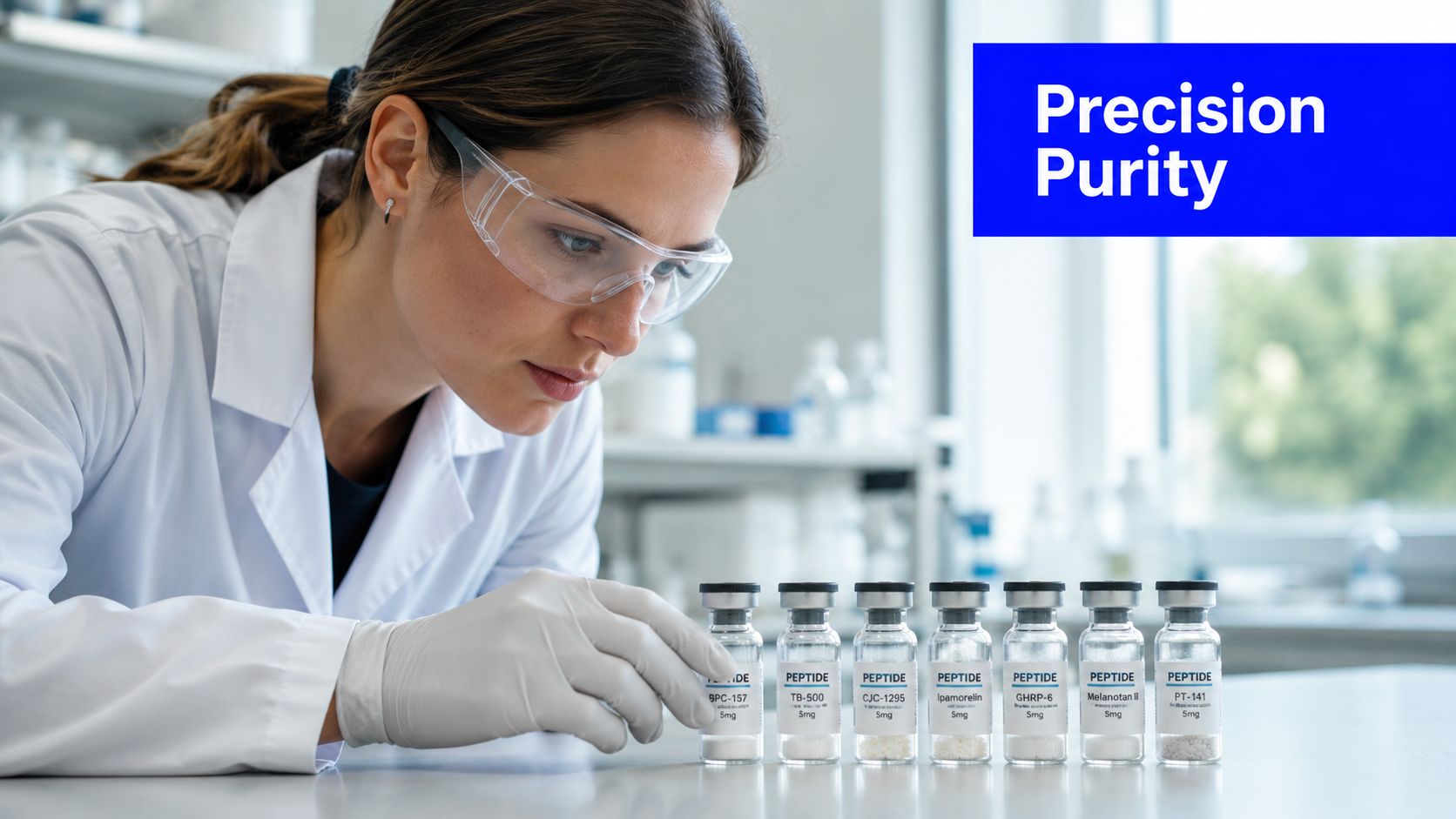
Start with the molecular identity. Write down the sequence from N terminus to C terminus, any D-amino-acid substitutions, unusual residues, terminal caps, conjugates, labels, and requested salt or solvent form.
Then match the quality package to the experiment:
Peptide Warehouse USA describes its catalog as containing research peptides, liquids, aminos, and related compounds for laboratory, analytical, and preclinical applications. Its published supplier information states that lots can include third-party documentation such as Certificates of Analysis, microbial reports, endotoxin reports, and stated purity levels up to 99.5%. Treat those documents as part of the purchasing decision, not as optional paperwork.
An incompletely characterized peptide can create ambiguous assay results. A contaminant may affect solubility, a degraded lot may reduce apparent activity, and a different terminal form may change behavior even when the sequence appears correct.
Use the same lot for a longitudinal comparison when practical, retain the documentation with the experimental record, and define acceptance criteria before testing. If a result changes, you should be able to distinguish biological variation from a change in reagent identity or quality.
The media below offers additional visual context for researchers reviewing peptide handling and laboratory workflows.
Peptide Warehouse USA operates as a research chemical supplier rather than a compounding pharmacy or outsourcing facility, and its products are designated for research, laboratory, or analytical use only. That distinction matters. Research reagents must be evaluated within the scope of the experiment and applicable laboratory procedures, not treated as products for human consumption or as substitutes for approved medical products.
Understanding the amino acid and peptide relationship gives you a better way to read every product page, paper, and analytical report. You can distinguish a building block from a defined chain, recognize why sequence order matters, and identify when a modification changes the research question rather than just improving the original compound.
A reliable workflow follows a simple logic:
“Research-grade” isn't a magic label. It should mean that the material has a defined intended use and documentation appropriate for evaluating its identity and quality. Your lab still needs to decide whether the evidence is sufficient for the assay, model, and risk profile.
Peptide language can also become confusing outside laboratory settings. For readers interested in how peptide terminology appears in topical product discussions, the resource hyaluronic acid peptides explained provides consumer-facing context. It shouldn't replace a chemical specification, but it can help separate marketing language from the structural meaning of “peptide.”
The most dependable purchasing decision is transparent and specific. Choose a supplier that states the intended research use, provides lot-level evidence, explains sourcing and storage, and can answer technical questions before the material enters your experiment.
Peptide Warehouse USA offers USA-manufactured research peptides and related compounds for laboratory, analytical, and preclinical work, with published lot documentation that can include COAs, microbial testing, endotoxin reports, and purity information up to 99.5%. Visit Peptide Warehouse USA to review available peptide, amino, liquid, and nasal spray research options and select materials that match your sequence and documentation requirements.