No products in the cart.


Published human and preclinical studies report AOD-9604 dosing from 25 µg to 400 µg per kg bodyweight by injection and 0.25 mg/day to 54 mg/day orally, so the research envelope is far wider than most protocol sheets suggest. That's the starting point for understanding AOD 9604 peptide dosage in a way that matches the evidence, not just the simplified numbers that circulate online.
AOD-9604 dosing looks simple on the surface, then gets complicated fast once you separate published study ranges from protocol conventions. In the literature, the peptide has been examined at a far broader span than the familiar 250 mcg to 500 mcg daily talking point, and that difference matters for anyone trying to read the data accurately. The question isn't just what number appears on a protocol sheet, it's where that number came from and what kind of evidence supports it.
A useful way to see the issue is to compare animal work, early safety studies, and later human trials. The field moved from high, weight-based experimental dosing in animals to much smaller fixed daily doses in people, and that shift reflects both translational scaling and safety-driven selection. It also explains why so many summaries sound consistent while still leaving out the messy parts of the evidence base.
AOD-9604 sits in that gap between science and simplified dosing advice. It's a useful peptide for studying fat metabolism, but the dosing story is more nuanced than most buyers or researchers expect. The sections below break down what's been tested, what seemed to work, and where the evidence stops.
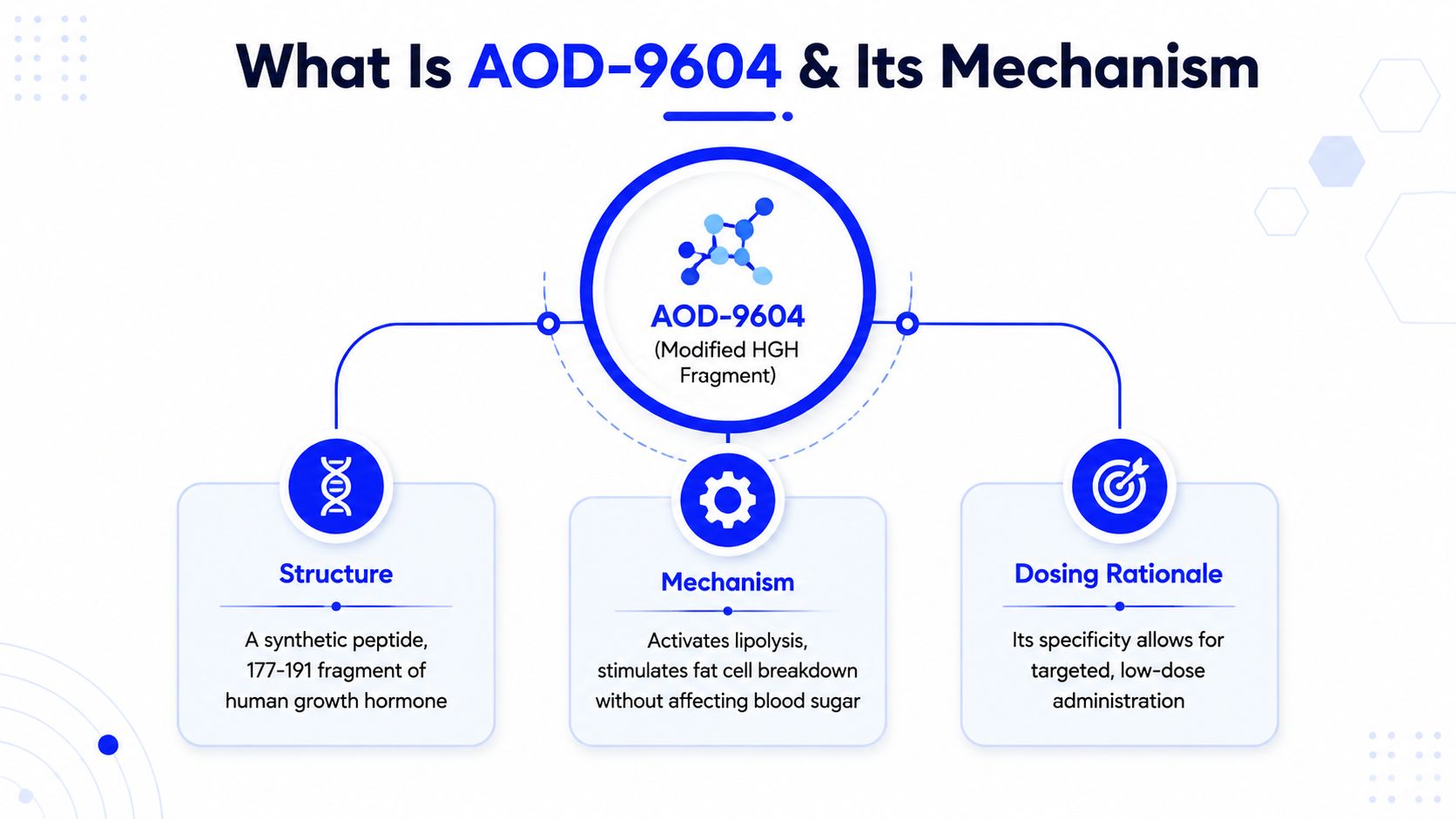
AOD-9604 is a modified fragment of human growth hormone, designed to keep the lipolytic, fat-breaking activity while minimizing endocrine effects. That basic design is why the peptide shows up in metabolic research rather than as a general growth hormone substitute. It's not built to replicate the full hormonal profile of GH, it's built to isolate one metabolic slice of it.
The early signal came from metabolic research published in 2001, where daily oral administration of 500 µg/kg body weight for 19 days reduced animal body-weight gain by more than 50% compared with controls, with values of 15.8 ± 0.6 g vs. 35.6 ± 0.8 g (PubMed 11146367). That study helped define AOD-9604 as a lipolytic GH fragment. It also created the first recognizable benchmark for later human work, which then moved toward much smaller absolute daily doses.
Mechanism and dose are linked here because the peptide's purpose is selective. Published summaries describe AOD-9604 as acting on fat metabolism while avoiding the broader growth-hormone effects that people often worry about, including the endocrine disruptions you'd expect from full GH signaling. In practical terms, that's why later human studies explored lower fixed daily doses instead of carrying over the animal-style weight-based approach.
For readers trying to place AOD-9604 in a broader peptide framework, the article on peptide therapy explained for patients gives a useful overview of how peptide-based interventions are usually discussed in clinical settings. That kind of context helps explain why AOD-9604 is usually framed as a research compound rather than a routine therapy.
Practical rule: if a dosing discussion ignores the peptide's selective mechanism, it's usually oversimplifying the science.
Controlled human studies typically evaluated AOD-9604 at subcutaneous doses of 0.25 mg, 0.5 mg, and 1.0 mg daily (PMC 3584306). The strongest published efficacy signal appeared at 1 mg/day, where one 12-week randomized trial reported mean weight loss of 2.6 kg vs 0.8 kg on placebo (PMC 3584306). That result is important, but it shouldn't be overread as proof that more peptide always means more effect.
A later 24-week trial in 536 subjects did not show significant weight-loss efficacy overall (PMC 3584306). So the literature doesn't support a neat upward dose-response story. If anything, it suggests that dose selection, endpoint choice, and study design matter as much as the nominal microgram amount.
| Route | Dose Range | Study Type | Key Outcome |
|---|---|---|---|
| Injectable | 25 µg to 400 µg per kg bodyweight | Early safety work | Generally well tolerated, no treatment-related withdrawals or serious adverse events (JOFEM) |
| Subcutaneous | 0.25 mg to 1.0 mg daily | Controlled human trials | Strongest efficacy signal at 1 mg/day, but later efficacy was mixed (PMC 3584306) |
| Oral | 0.25 mg/day to 54 mg/day | Human and clinical safety work | Generally well tolerated, with more gastrointestinal adverse events at 54 mg (JOFEM) |
Early summaries also report that oral programs showed no meaningful IGF-1 or glucose disruption at studied levels, which matters because it reinforces the compound's selective profile (JOFEM 213/278). That doesn't mean the peptide is universally effective, it means the pharmacology stayed relatively narrow across the doses that were tested.
For researchers comparing peptide dosing frameworks, a useful parallel is the way GLP-1 maintenance schedules are usually discussed. A dosing concept can be operationally clear without proving that higher intensity is automatically better, which is why full Wegovy maintenance dose details can be a helpful contrast when you're thinking about stepwise titration versus endpoint outcomes.
The practical research benchmark is 1 mg/day as the upper studied reference dose, not a guaranteed more effective target. That's a different conclusion from the way many protocol pages talk about the peptide, and it's the more defensible reading of the data. AOD-9604 dosing is best treated as an evidence-limited range with a narrow efficacy signal, not as a simple escalation ladder.
Interpretation matters more than the headline number. The same dose can look promising in one design and unconvincing in another if the trial duration or endpoints change.
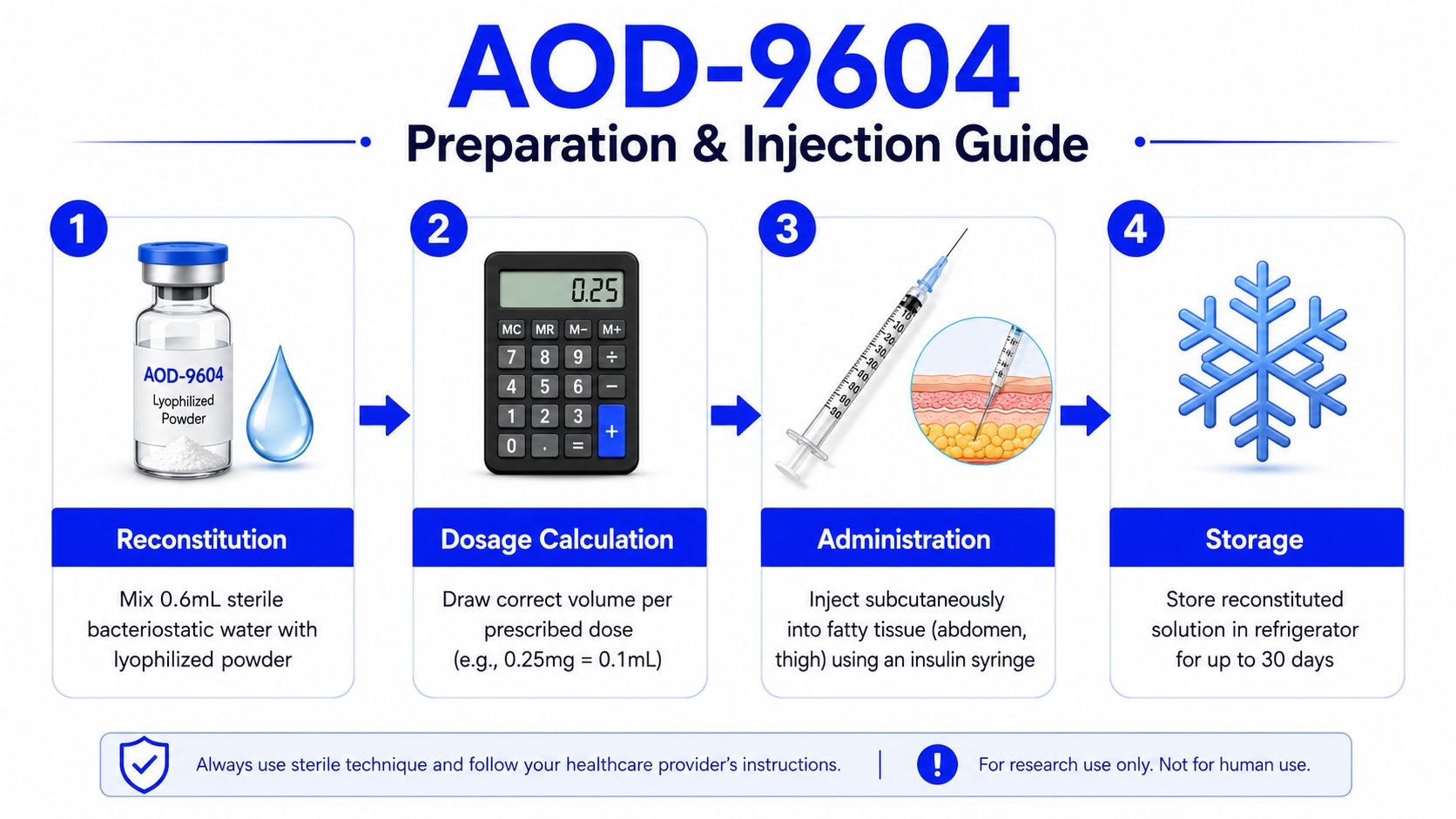
Most research protocols use subcutaneous administration, usually once daily in the morning on an empty stomach. That timing shows up because researchers want consistent absorption and a repeatable schedule, not because the peptide has a magical hour attached to it. In practice, the dosing mechanic needs to be simple enough that it can be replicated without confusion.
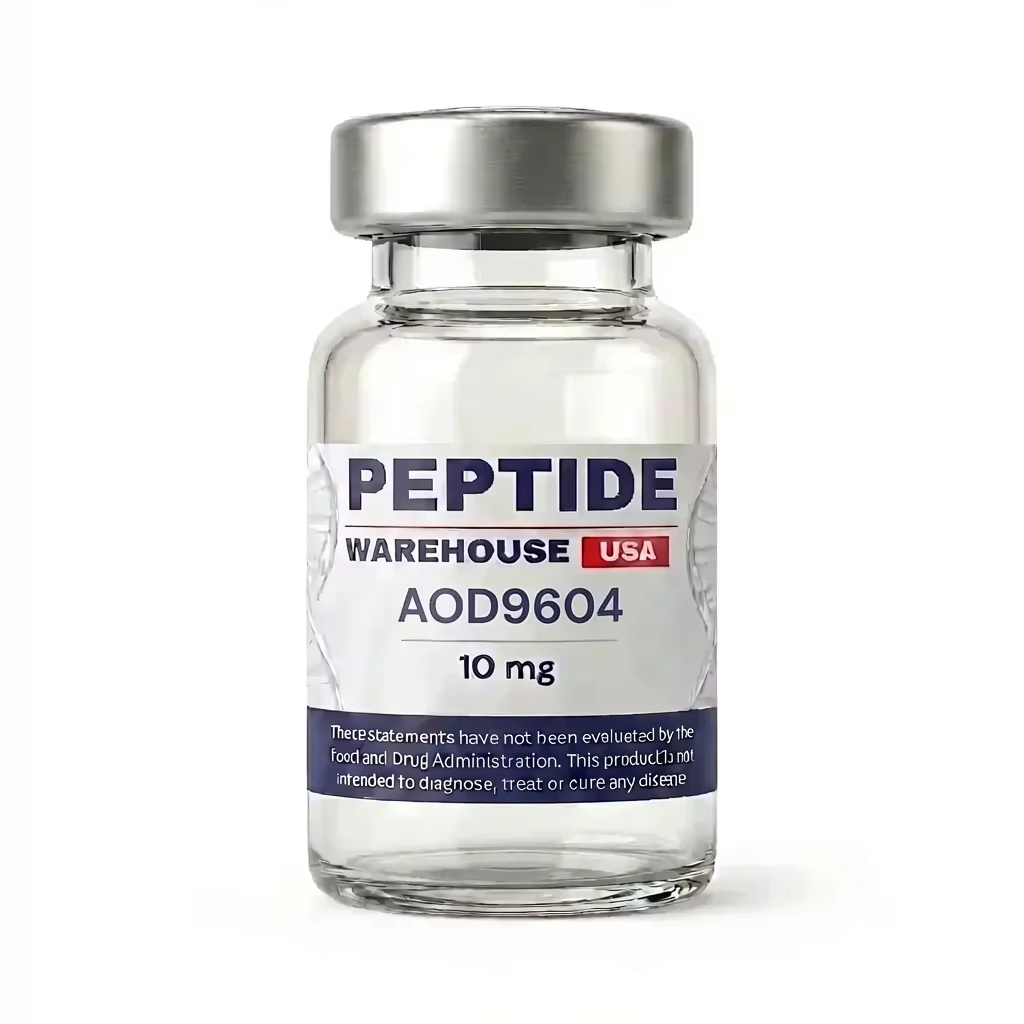
The preparation math is where many people get lost, so the example matters. One guide gives a concrete reconstitution model, where a 10 mg AOD-9604 vial diluted with 1 mL of bacteriostatic water yields a solution in which each 500 mcg injection equals 0.05 mL (PeptideMind). The calculation is straightforward, divide total peptide content by liquid volume to get concentration in mcg/mL, then divide the target dose by that concentration to determine draw volume.
The practical dosing range in protocol writeups often begins at 250 mcg once daily, with some guidance titrating to 375 mcg and a listed maximum of 500 mcg per day (Peptide Research Institute). That's a convention built around reproducibility, not proof that the top end is superior.
For a supplier-facing researcher, consistency is the core issue. If you're comparing lots, concentrations, or documentation standards, you want a product page that clearly labels the material as research grade and provides lot-level traceability. Peptide Warehouse USA lists an AOD-9604 research-grade peptide with a COA verified label, which makes it relevant to this kind of protocol work.
Safety data around AOD-9604 is one reason the peptide became a serious research subject in the first place. In the clinical program, investigators reported that dosing regimens were generally well tolerated, with no treatment-related withdrawals, serious adverse events, or clinically significant changes in vital signs, laboratory tests, or ECGs (JOFEM). The same review states that 1 mg/day over 24 weeks could be considered safe and well tolerated, while the 54 mg oral dose was associated with more gastrointestinal adverse events (JOFEM).
That tolerability profile doesn't convert the peptide into a general-use product. It does explain why researchers keep returning to it as a selective metabolic tool. The emphasis remains on research use only, with proper oversight, documentation, and handling standards.
A separate safety summary reports that obese subjects treated for 24 weeks with daily doses of 0.25 mg to 1 mg had a safety and tolerability profile “indistinguishable from placebo” (Seek Peptides). That language is useful because it shows the direction of the safety signal without overstating efficacy.
For researchers comparing metabolic tools, it's also helpful to look at how other compounds are discussed alongside muscle retention and body composition goals. The piece on Wegovy muscle retention strategies gives useful context for why selective body-composition support is a recurring concern in this space.
The biggest misconception is that higher doses must work better. The published evidence doesn't support that assumption, because escalating above 1 mg/day did not clearly produce better outcomes in the human trials already discussed (PMC 3584306). That matters more than most dosing pages admit, since it shifts the discussion from “how much can I use?” to “what was shown to matter?”
A second misconception is that 8 to 12 week cycles are a validated optimization rule. They're common in protocol writeups, but that doesn't make them an evidence-based law. In practice, cycle length is still a convention layered on top of incomplete data, not a firmly settled standard.
Some protocol sources recommend starting around 300 mcg and titrating toward 500 mcg if no response appears after several weeks (BHR Center dosage guide). That's a reasonable operational tactic, but it's still a protocol convention rather than a proven optimization rule. The mixed trial record means non-response is a real outcome, and the honest response is to measure endpoints carefully instead of assuming the peptide failed because the number was too low.
The most useful questions aren't “what's the biggest dose?” and “how fast should it work?” They're “what endpoint am I measuring, how long am I measuring it, and what would count as a meaningful signal in this protocol?” Those are the questions that separate a dose sheet from a study design.
AOD-9604 dosage in the published literature spans a wide range, from 250 mcg to 1 mg per day in human subcutaneous trials and much higher weight-based doses in early animal and IV safety studies (PMC 3584306, JOFEM). The cleanest takeaway is that the 300 to 500 mcg/day protocol range is a convention, not a law, and 1 mg/day is better viewed as the upper studied reference dose than a guaranteed optimization point. Endpoint choice, cycle duration, and response assessment matter just as much as the nominal microgram amount.
Researchers who want to work carefully with the peptide should prioritize documentation, lot traceability, and realistic expectations about efficacy. The evidence supports cautious interpretation, not hype. If you're comparing suppliers or building a protocol file, the quality of the material and the clarity of the paperwork are part of the experiment.
Peptide Warehouse USA offers research-grade peptides with batch documentation, COAs, and a U.S.-based supply chain for laboratory and preclinical work. If you're evaluating AOD-9604 dosage protocols and need a documented research source, visit Peptide Warehouse USA to review available options and product details.